https://www.mining.com/web/hedge-funds-bullish-copper-bets-run-into-chinas-slowdown/
As copper surged to record highs last
month, several senior Chinese traders started trying to contact western
hedge fund managers whose names they’d only read in the press. For
years, the veteran traders’ privileged insight into their own economy
had given them an edge in the copper market, where China accounts for
more than half of global demand.
But now they were bewildered. Everything in China pointed to a market
that should be slumping, and yet prices were soaring on a wave of
speculative money. What were they missing?
Sign Up for the Copper Digest
The approaches – direct and through intermediaries, to fund managers
like Pierre Andurand and Luke Sadrian who had made a splash as some of
the market’s biggest bulls – highlight the tug of war that has gripped
the copper market in the past few months.
On one side are bullish fund managers in London and New York, who
have plowed tens of billions of dollars into copper with an eye to
future shortages. On the other are Chinese purchasers, more focused on
the here and now, who have rarely if ever been so gloomy.
For the Chinese traders, it has been a humbling experience. The
downbeat mood at home had persuaded them to bet against international
copper prices. Then a wave of investor buying pushed prices to a record,
and traders who fancied themselves the smartest players in the market
were wiped out.
“This year has been tough for Chinese traders,” Tiger Shi, managing
director at broker Bands Financial Ltd., said in an interview last week.
“Their vaunted information advantage over the Chinese physical market
didn’t bring them the rewards they imagined.”
But now, as the dust settles on last month’s frenzy, the importance
of the Chinese market has reasserted itself. Prices have dropped about
13% from the peak above $11,100 a ton, as speculators sharply reduced
their bullish bets in the wake of the surge — with much of that
reduction driven by trend-following funds, according to traders.
Without western investors buying, all eyes are back on China, and a
copper market that several industry insiders say is still the weakest
they’ve ever seen it.
The tug of war between the two is likely to determine where copper
prices go next: If tentative signs of a recovery in Chinese buying are
sustained, some copper bulls believe the market could be gearing up for
fresh record highs in the second half of the year.
But if weak Chinese orders persist, it would suggest that the soft
patch is not just a result of delayed buying, but an indicator of poor
underlying demand. Prices could fall even further — back to $9,000 or
even $8,000 a ton, according to the most bearish traders.
It’s a dynamic that’s likely to dominate conversations as more than
1,000 smelter executives, traders, bankers and analysts are set to
gather in Hong Kong this week for the London Metal Exchange’s annual
Asia party. It’s traditionally an occasion for western investors to
glean insight into Chinese fundamentals, but this year Chinese traders
are likely to be just as interested in better understanding their
counterparts.
It’s also a sign that, after more than two decades in which China’s
industrialization and urbanization has been the major driver of the
copper market, the situation is evolving as the electrification of
everything gobbles up greater volumes of copper the world over.
Among Chinese copper traders and the fabricators who shape raw metal
into pipes, wires and other parts used in everything from air
conditioners to power transmission cables, the mood remains
overwhelmingly gloomy.
“Business is shrinking significantly. The physical sales business is very bleak”
Even though some of the people Bloomberg spoke to in the
past two weeks said they had seen a recent uptick in demand, they were
reluctant to suggest that the market is turning around.
“This could be the most difficult year during my over-a-decade
industry history,” said Ni Hongyan, vice general manager at trading firm
Eagle Metal International Pte. “Business is shrinking significantly.
The physical sales business is very bleak,” she said.
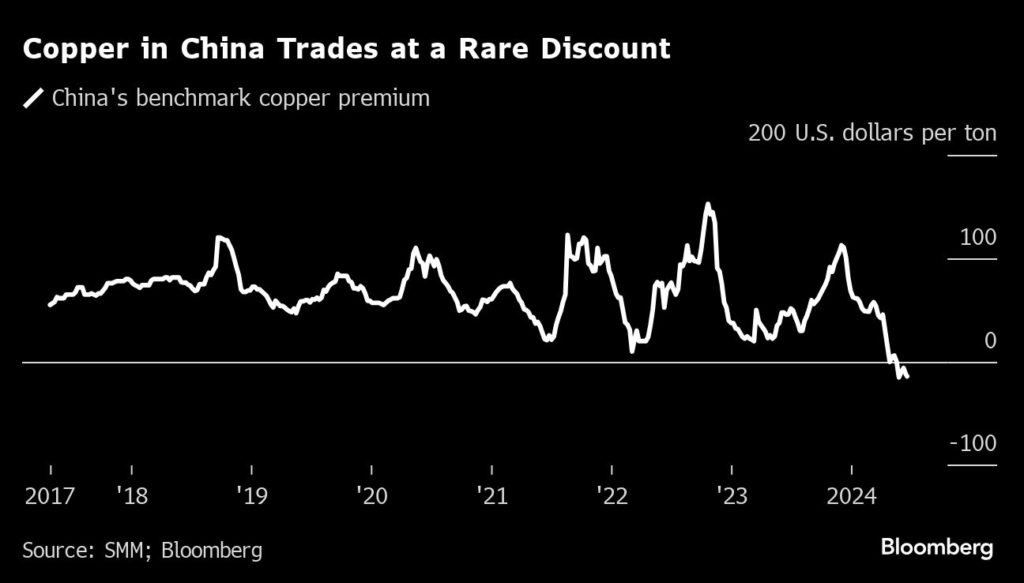
The data paints a similar picture. Copper in Shanghai’s tax-free
bonded zone has been selling at a highly-unusual discount to London
Metal Exchange prices for more than a month. That was painful for many
Chinese merchants, who consider the second quarter the peak season for
fabricators to purchase and prepare raw material stocks after the annual
political meetings of the country. Instead, copper inventories on the
Shanghai Futures Exchange have risen by 78% since the end of Chinese New
Year to a record high for this time of the year.
A senior executive at one of the world’s top metals traders said the
market for refined copper in China was weaker than he had ever seen it –
“by a distance.”
Short squeeze
The disconnect between the Chinese market and western investors had
been building for several months. Investors and analysts fell over one
another to make the most bullish prediction for copper prices amid
forecasts of soaring demand from the energy transition, and challenges
boosting mine production. A series of reports estimating massive amounts
of copper needed for artificial-intelligence data centers added to the
frenzy.
Goldman Sachs Group Inc. said copper was in “the foothills of what
will be its Everest,” predicting prices would average $15,000 a ton next
year, while Andurand called for copper to hit $40,000.
The situation came to a head in May. As copper prices in China lagged
international prices, many domestic traders had been placing bets that
the gap would narrow, going short the international copper contracts and
long the Shanghai market. After their brokers refused to put on new
short positions in London to avoid being exposed to volatility during a
week-long Chinese holiday, some traders placed bearish bets on the Comex
in New York instead.
But as investor money kept piling in to the market, particularly US
copper futures in New York, the Chinese traders were caught in a short
squeeze. Faced with rising copper prices, their cash flow was running
out and they had no choice but to give up, causing an unprecedented
blowout in New York futures that saw them trade far above other price
benchmarks.
Since then, however the Chinese market has reasserted itself.
Chinese copper exports hit a record 149,000 tons in May. LME stocks
in South Korea and Taiwan — the locations closest to China — have been
rising. And traders have been rushing to ship copper to the US to
arbitrage the difference in prices – though none of it has yet appeared
in Comex-registered inventories.
‘Not there yet’
In compiling this account, Bloomberg spoke to more than a
dozen senior figures in China’s copper trading industry, most of whom
who asked not to be identified discussing private information.
Many of the traders gathering in Hong Kong this week will still be
nursing their wounds. The past six months could be among the worst
performing period in their copper trading careers, several said.
For the wider market, the key question is what happens next.
In China, some traders say there have been tentative signs of a
pick-up in buying in the past couple of weeks, a move which, if
sustained, could put a floor on prices. Inventories of copper on SHFE
have fallen for the past two weeks, albeit by a modest 14,000 tons.
Beijing is also set to announce more long-term policy support for the
economy at a key Communist Party meeting next month, which is seen
boosting demand for raw materials like copper.
Wang Wei, general manager at major copper trader Shanghai Wooray
Metals Group Co., which sells refined copper to hundreds of Chinese
fabricators, said that demand was “rebounding a bit,” although only to
return to similar levels as a year ago.
But there are still reasons to worry about China’s underlying copper
consumption. Property is a key driver of copper demand, and the weakness
in the Chinese sector is likely to continue as a drag, according to
Eugene Chan, trading manager at Zhejiang Hailiang Co. There are also
some indications that high prices are spurring a greater push for
substitution of copper for aluminum.
“The financial market flood of net new length has become a trickle.
Without that incremental macro-driven buyer, it comes down to whether
the underlying physical market can support the current price,” said
Colin Hamilton, managing director for commodities research at BMO
Capital Markets. “We have to reset to a level to bring these buyers
back, and we’re not there yet.”