Now I must leave the treasures of the past and turn to the future.
Famous have been the reigns of our queens. Some of the greatest periods
in our history have unfolded under their sceptre. Now that we have the
second Queen Elizabeth, also ascending the Throne in her twenty-sixth
year, our thoughts are carried back nearly four hundred years to the
magnificent figure who presided over and, in many ways, embodied and
inspired the grandeur and genius of the Elizabethan age.
Queen Elizabeth II, like her predecessor, did not pass her childhood
in any certain expectation of the Crown. But already we know her well,
and we understand why her gifts, and those of her husband, the Duke of
Edinburgh, have stirred the only part of the Commonwealth she has yet
been able to visit. She has already been acclaimed as Queen of Canada.
We make our claim too, and others will come forward also, and
tomorrow the proclamation of her sovereignty will command the loyalty of
her native land and of all other parts of the British Commonwealth and
Empire. I, whose youth was passed in the august, unchallenged and
tranquil glories of the Victorian era, may well feel a thrill in
invoking once more the prayer and the anthem, “God save the Queen!”
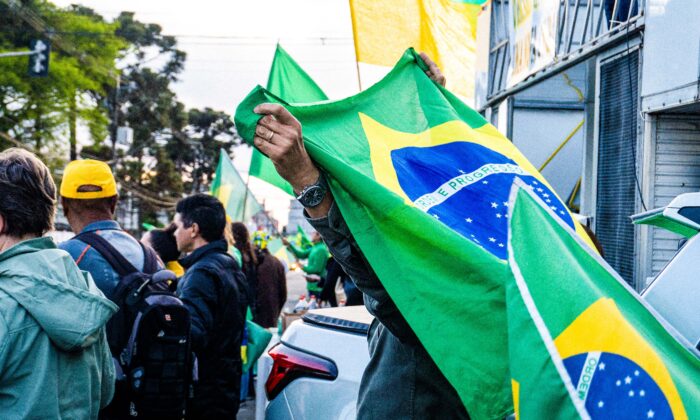
A Brazilian protester holds a flag in Curitiba, Brazil, on November 4,
2022. The country, Latin America’s largest economy, has many taking to
the streets, after historical elections spark controversy. (Frederico
Vidovix/The Epoch Times)
CURITIBA, Brazil—A
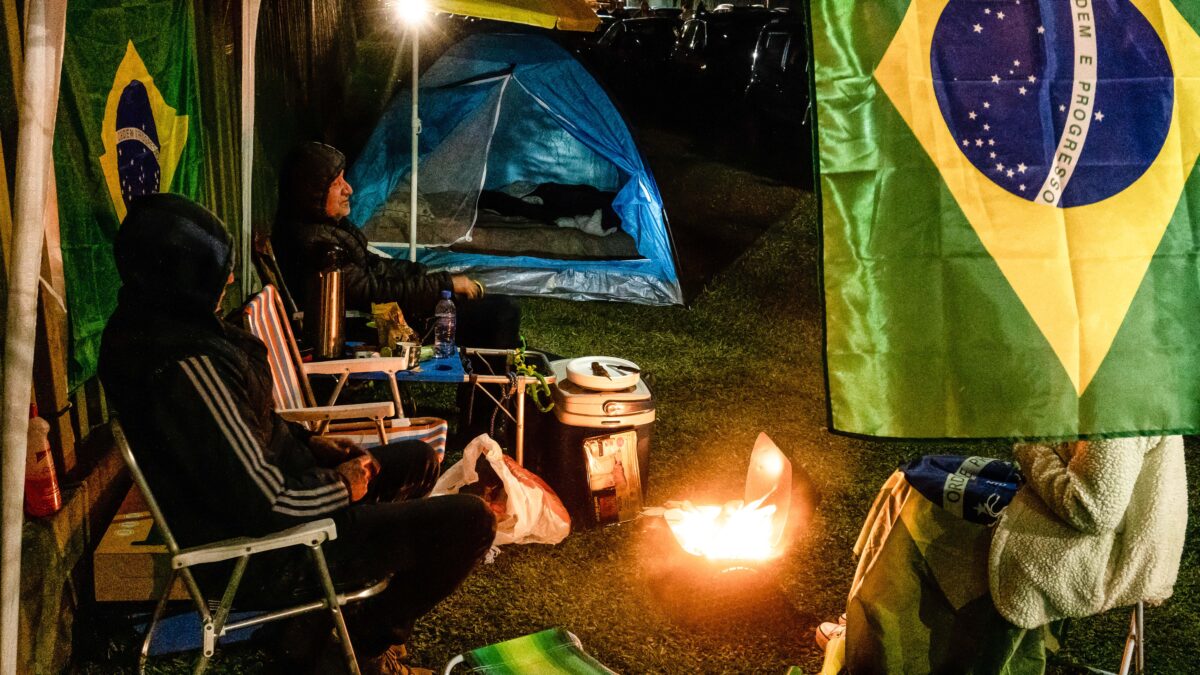
family sits around a small makeshift fireplace. They have been camping
there on shifts for days, nearly a week. That was the scene for Luiz
Henrique and his relatives on Friday, as they, in their own words,
reject the prospect of the country going back to what it was under the
Workers Party, which now has led Lula da Silva to a new term. The
left-wing candidate was Brazil’s president from 2003 to 2010, and won a
run-off vote by a razor-thin margin on Oct. 30, over a decade after
leaving office. His inauguration is scheduled for January.
Henrique’s family is not an isolated case. Hundreds of families have
set up tents around the Pinheirinho fortress, in the city of Curitiba.
More are protesting around army headquarters throughout the country.
Most there call for aid, or intervention, from the military, many cast
doubt on whether the elections were free and fair, and some just say
they’re hoping for a last chance not to have Brazil go the way of
neighboring socialist governments in Venezuela, Argentina, and beyond.
Henrique and his family drink “maté,” also known as “chimarrão,” a traditional drink of Latin America’s southern cone.
Mr. Luiz Henrique and his family drink “mate”, also known as
“chimarrão”, a traditional drink of Latin America’s southern cone, in
Curitiba, Brazil, on November 4, 2022. (Frederico Vidovix/The Epoch
Times)
“What we want… I have children. I have grandchildren. We don’t want
them to suffer what countries around us are suffering, and what we’re
seeing every single day. We don’t want Brazil to go through that as
well,” Henrique said.
He explained: “We’re here 24 hours, every day, since this movement
started on Monday. We have been taking turns, me and my relatives. Some
of us have businesses to run, some have day jobs. Some stay in the
morning, some in the afternoon. We [right now] are on the night shift.
We coordinate among our family. … At least our family… we’re playing our
part, like most Brazilians are.”
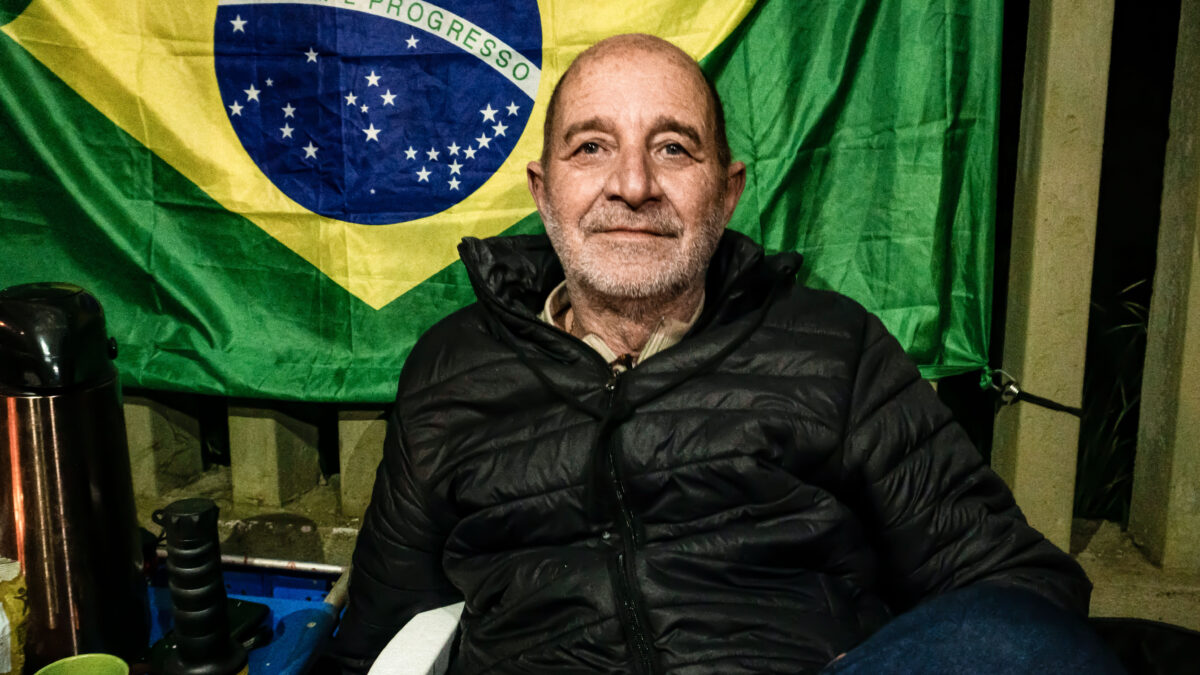
Luiz Henrique poses for a photograph in front of a Brazilian flag he
hung next to his family’s tent in Curitiba, Brazil, on Nov. 4, 2022.
(Frederico Vidovix/The Epoch Times)
Da Silva has befriended, and eventually supported, a number of Latin
American socialist dictators. Among them are Venezuela’s Nicolás Maduro,
and Nicaragua’s Daniel Ortega, whose persecution of Christianity and
the press was a talking point of the presidential debates in the run-up
to the October elections. Da Silva was elected in an alliance with the
Communist Party of Brazil, and the possibility of him leaning into
authoritarianism or stifling free enterprise has been a cause for
concern.
“We’re in a situation where you either do [something now], or you
won’t do it ever again,” another protester told The Epoch Times. “The
hard part is: what if you don’t do [something] and then our country
becomes like Venezuela? Not to say anything bad about Venezuela, but
they are now facing poverty due to letting [the hard-left] take over.”
On Nov. 2, during the “Finados” national holiday, hundreds of
thousands of people came out to protest throughout Brazil. Interviewees
quoted police data saying up to 170,000 more joined them in the city of
Curitiba alone. More were there during the weekend—a trend unlikely to
end soon, with strikes starting on Nov. 7.
Some called it a struggle for freedom.
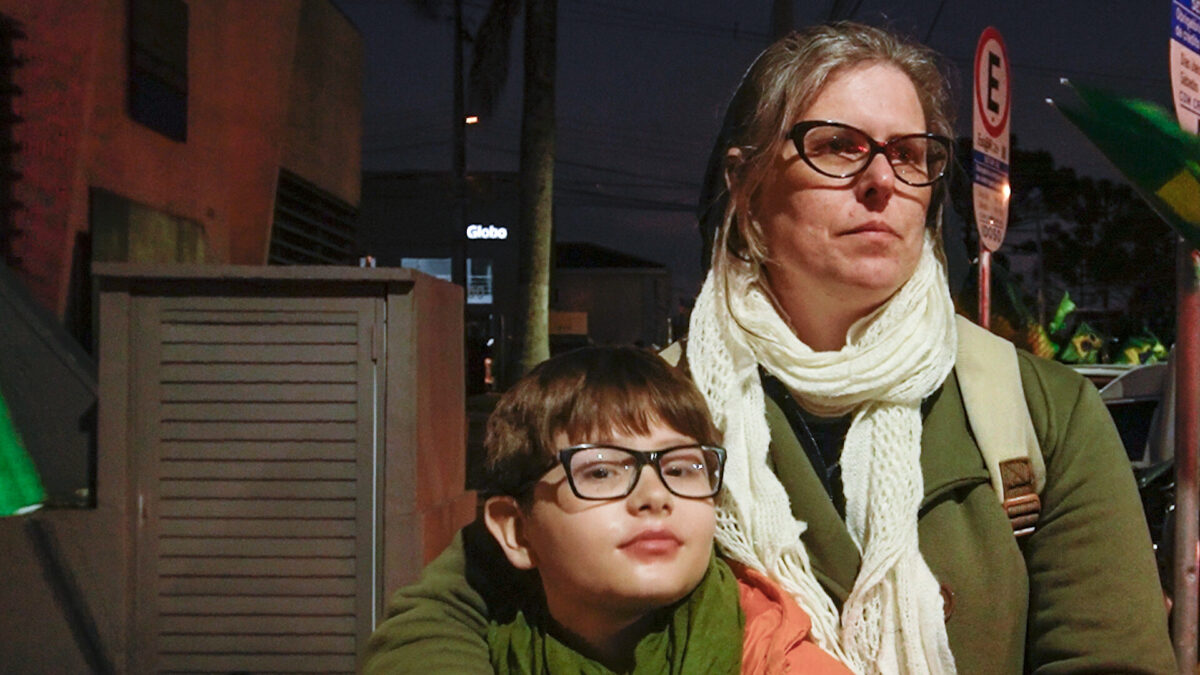
“My son will not live in a communist country. My son was born to be
free,” said Fernanda, as she hugged her son, school-aged Joaquim. “Our
country was born to be free! And that’s why I brought him here. That’s
why I’m here. My country will not have a red flag. It is not possible to
live in that type of country. That’s why I’m here fighting for my
homeland, and for his freedom.”
The boy accompanied his mother to the protests, calmly observing the concerned adults around him.
Mother and son: Fernanda and Joaquim are an example of the myriad
people attending the rallies spontaneously with their relatives. They
stand next to the Bacacheri military infrastructure in Curitiba Brazil,
on November 4, 2022. (Frederico Vidovix/The Epoch Times)
‘Not a Single Case of Vandalism’
Protesters say they are lawfully exercising their constitutional
right to protest and are financially supporting themselves and are also
receiving donations from others who support their cause.
“We haven’t had a single case of theft, not a single case of
vandalism, not even in a single car, no fights on record here. Nothing,”
said Ivo, one of the early organizers of the 24/7 protests in Curitiba.
“This is a pretty democratic action. Children, the elderly, and
families are here. And nothing goes on. Businessmen are helping us, …
and ordinary people are as well.”
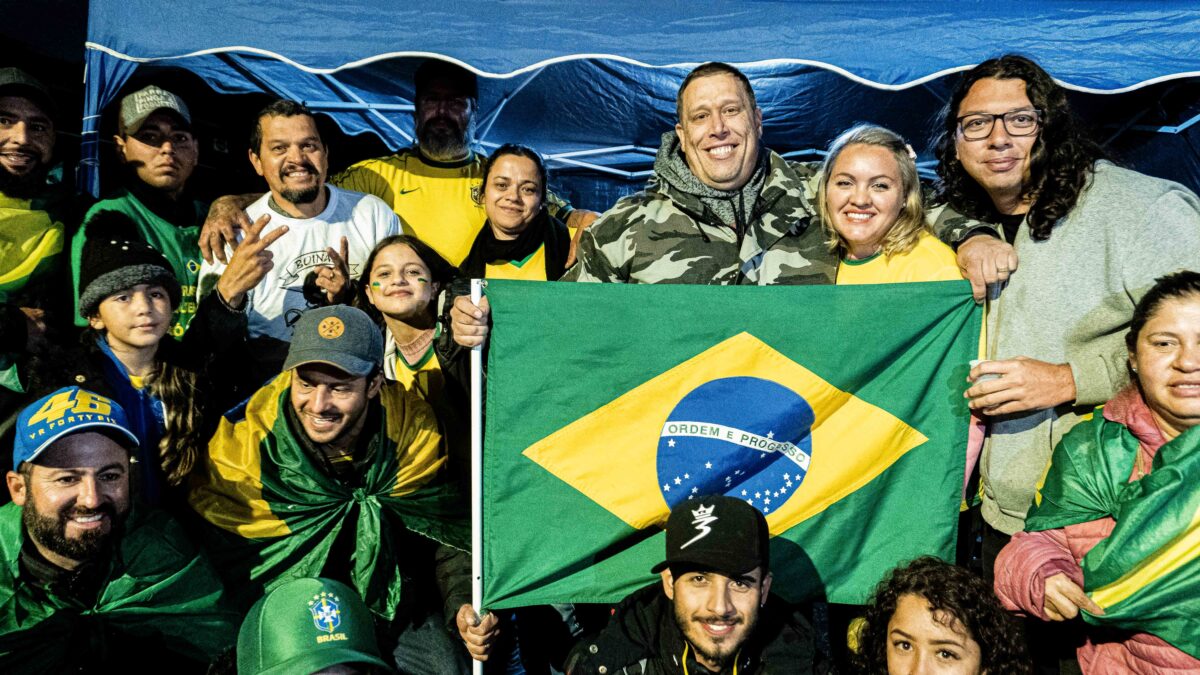
Ivo, third from right to left on the top row, holds a Brazilian flag
surrounded by protesters near the Pinheirinho Fortress in Curitiba,
Brazil, on Nov. 4, 2022. A former member of the military, he was one of
the early starters of the 24/7 protests in southern Brazil,
spontaneously setting a tent on Oct. 30, just as the votes were counted.
(Frederico Vidovix/The Epoch Times)
Legal experts, local left-wing politicians, activists, and others
have called the protests “illegal” and “anti-democratic,” and said that
an intervention by the armed forces that could overturn election results
would violate Brazil’s Constitution and institutions. The claims were
denied and dismissed by the protesters, who said they were orderly and
peaceful and hadn’t committed any crime.
Claims of Illegitimacy on the Electoral Dispute
Protesters told The Epoch Times they feel this was not a fair
electoral process. A shared concern was da Silva’s past. After being
convicted on corruption and money laundering charges, penalties against
him were voided by Supreme Court Justice Edson Fachin—not by proof of
his innocence, but on procedural grounds. Fachin was nominated by Lula’s
presidential successor, former communist guerrilla Dilma Rousseff, and
campaigned for the Workers Party before taking on his duties.
“We want to show to the powers of the republic we’re not in agreement
with the way this electoral process was run, and with the way the
winner achieved victory,” said Eiko, one of the protesters, as he held a
Brazilian flag along with his wife in front of a military building.
“At many points we noticed one of the candidates had more access to
free speech than the other did, this is what we are questioning,” he
added. “It’s not about the result. There’s always a loser and a winner.
But the point is the way this played out.”
After Lula’s release, conservatives claim a level playing field is
hardly what was seen in Brazil. Leading news outlets faced pressure—at
best—and, as the targeted media companies themselves put it, censorship,
to specifically not report on da Silva as a convicted criminal or on
his historical and well-documented ties with Latin American
dictatorships.
This pressure from Brazil’s Electoral Court contributed to a feeling
of distrust in the local justice system among the crowds gathered. The
country’s Electoral Court oversees elections and shares many of its
members with the Supreme Court that got da Silva back to politics.
Contributing to the tension in Brazil, on Friday a press conference
was broadcast from Argentina explaining an independent audit showed
there were statistical anomalies that could point to fraud in the
October vote. Electoral Court president and Supreme Court Justice
Alexandre de Moraes has threatened to consider challenges to the
election results as criminal. Those broadcasting the press conference
said this was part of the reason for broadcasting from Argentina.
Protesters told The Epoch Times they are concerned about voter fraud.
Reports about the audit sparked controversy in Brazil, with experts
and supporters of da Silva dismissing them as baseless or misleading.
Suppression and censorship, along with unwillingness among Brazilian
institutions to broach the topic have increased dissent, according to
the protesters.
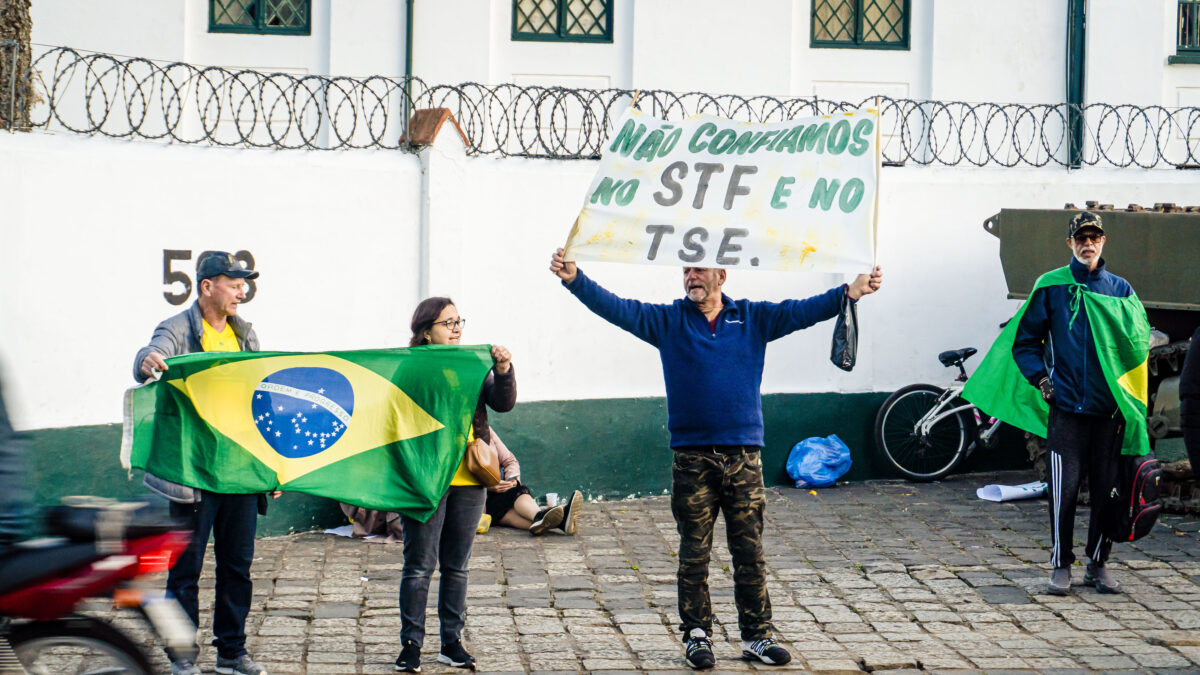
A protester, away from the crowds, holds a banner that reads, “We do
not trust the Supreme Court, neither the Electoral Court” in front of
the Bacacheri military infrastructure in Curitiba, Brazil, on Nov. 4,
2022. (Frederico Vidovix/The Epoch Times)
Concerns About Press Coverage
As The Epoch Times reporters moved through the crowds they were asked
by locals to have the “truth be told” about the protests. Distrust in
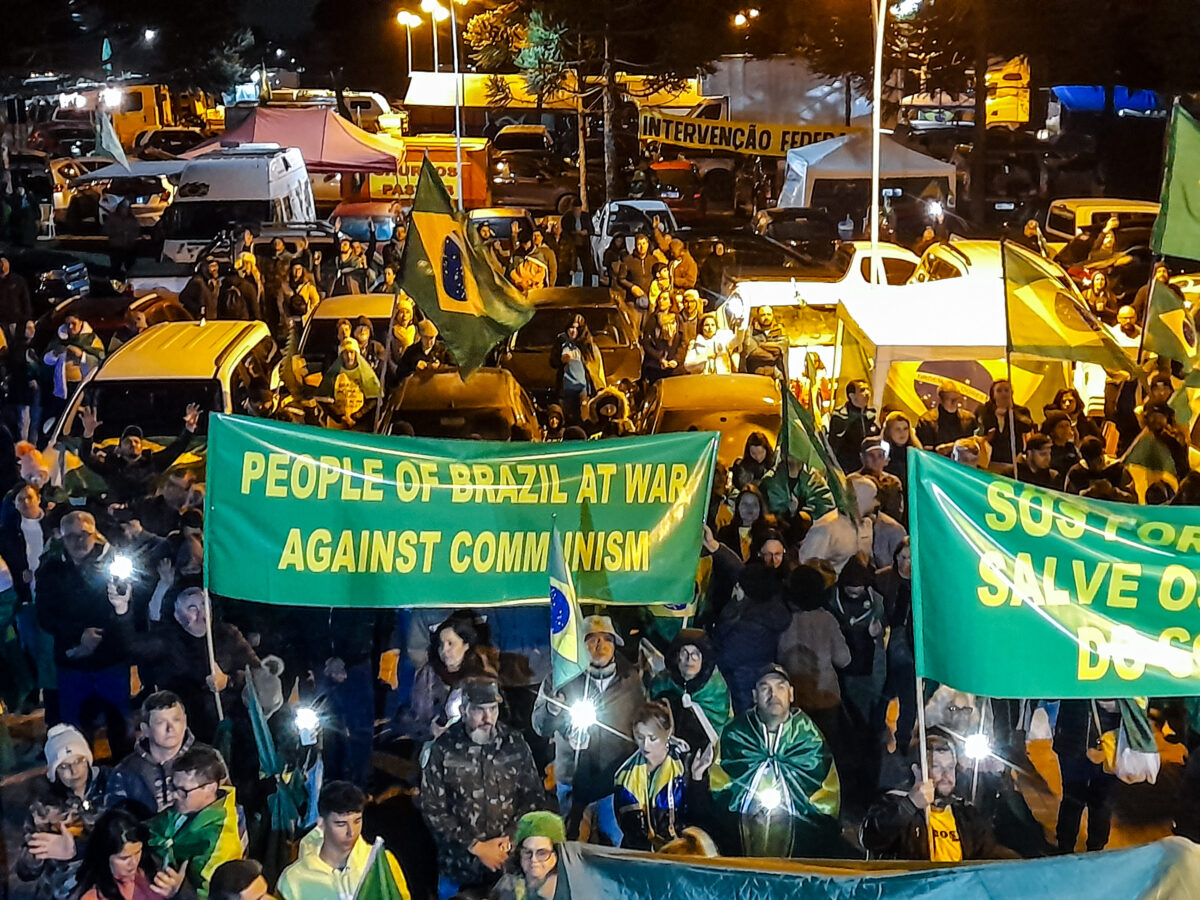
the press, local and foreign, was widespread. Slogans were displayed in
English for the international press.
Protesters show a banner in English, reading, “People of Brazil at war
against communism” near the Pinheirinho fortress in Curitiba Brazil, on
Nov. 4, 2022. (Frederico Vidovix/The Epoch Times)
“Where are we heading, if this becomes a communist [country]?” said
one protester. “Where are my grandchildren headed? What is gonna happen
to everyone? We’re already under communism, actually. We’re being
silenced. We can’t say anything. We depend on foreigners to be able to
express what is happening here.”