Tuesday, January 24, 2023

Column: Iron ore price rally justified as China’s January imports surge

Iron ore price retreats as China seeks to cool rally

https://www.mining.com/web/column-iron-ore-price-rally-justified-as-chinas-january-imports-surge/ 

The price of spot iron ore has been one of the major beneficiaries of expectations of strong demand as China re-opens its economy after abandoning its strict zero-covid policy.

While other commodities, such as crude oil and copper, have also enjoyed recent gains on the back of the China recovery narrative, iron ore’s rally seems grounded in actual gains in demand.

The spot price of benchmark 62% iron ore, as assessed by commodity price reporting agency Argus, ended at $126 a tonne on Jan. 20.

This is up 7.1% from the beginning of the year and the steel raw material has now surged 59.5% since its low last year of $79 a tonne, reached on Oct. 31.

At first glance, the rise in prices doesn’t appear to tally with imports by China, which dominates the global seaborne trade, buying about 70% of the total shipped volumes.

China’s iron ore imports were 90.86 million tonnes in December, down from 98.85 million in November and also weaker than October’s 94.98 million.
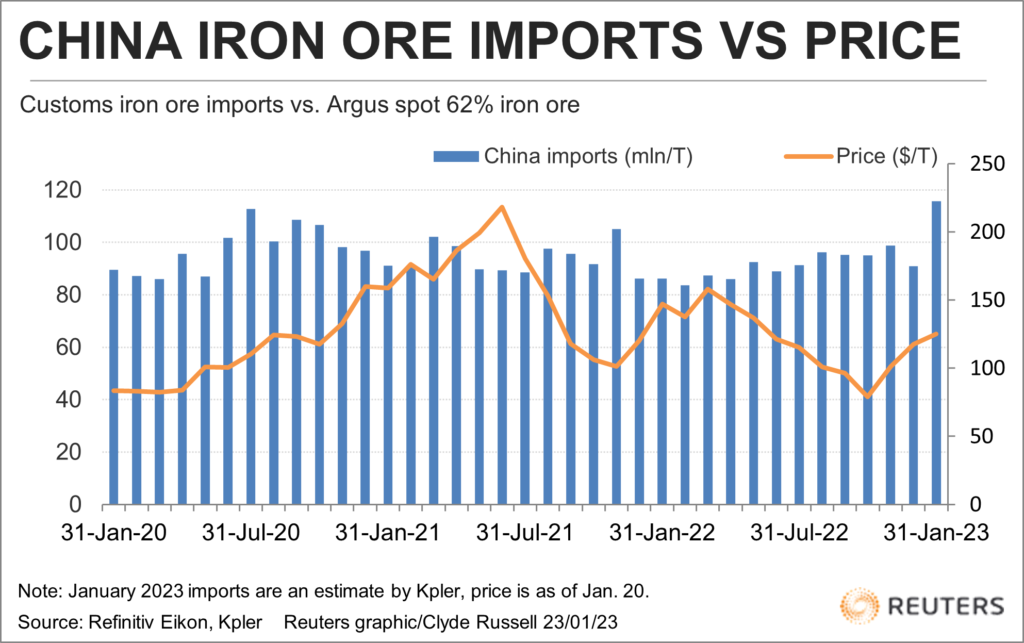
However, December is historically a soft month for China’s imports, and the outcome last month was actually 5.6% above the level of imports for December 2021.

What is more important for spot iron ore prices is that January’s imports appear to be considerably stronger, according to vessel-tracking and port data compiled by commodity analysts Kpler and Refinitiv.

China is on track to import 115.6 million tonnes in January, according to Kpler data, while Refinitiv is estimating 116.8 million tonnes.

The figures from the commodity analysts don’t exactly align with official customs numbers, given differences as to when cargoes are assessed as having been cleared.

Also, the seaborne figures don’t take into account the small volumes of overland iron ore from China’s neighbors Russia and Mongolia.

Nonetheless, the January estimates point to an extremely strong month for China, possibly even exceeding the record high of 112.65 million tonnes in July 2020.

An official reading on imports may not be available until March, as in recent years China customs has not reported January and February numbers separately, rather combining the first two months to filter out volatility caused by the shifting timing of the Lunar New Year holidays.

Official unhappiness

The rising spot price of iron ore is causing some consternation in Beijing, with the state planner last week issuing a third warning against excessive speculation.

The National Development and Reform Commission has stuck to verbal warnings but the risk of higher margins for futures contracts and other actions is increasing, especially if the main domestic contract on the Dalian Commodity Exchange keeps rising.

The front-month contract hit a 17-month high of 896.50 yuan ($132.23) a tonne on Jan. 13, although it has retreated a touch since then to close at 856.60 yuan on Jan. 20.

While there are more steps the authorities can take to try to rein in prices, history suggests that if the underlying market demand is strong, efforts at controlling prices are liable to only bring short-term relief.

There is unlikely to be relief on the supply front, with shipments from top exporter Australia likely to rise only modestly, while those from number two Brazil are expected to remain largely steady in 2023.

Ultimately, for the bullish view on iron ore prices to be sustained, evidence of rising steel output and demand in China will have to be forthcoming.

Its steel production rose 4.5% to 77.89 million tonnes in December from November, although annual output was 1.10 billion tonnes, down 2.1% from the record high achieved in 2021.

There are expectations of rising housing construction and infrastructure development this year in China but it seems that iron ore pricing and imports are front-running the actual demand for steel.

(The opinions expressed here are those of the author, Clyde Russell, a columnist for Reuters.)

(Editing by Robert Birsel)

Saudi Aramco Acquires Motiva, Announces Launch of Aramco Trading Americas

https://www.middleeasteye.net/sites/default/files/styles/article_page/public/main-images/MBS2.AFP_.jpg?itok=Fk9yMJ-E

https://tankterminals.com/news/saudi-aramco-acquires-motiva-announces-launch-of-aramco-trading-americas/?vgo_ee=peYRwyI2Ab3FcNxZ0pnEDgA3SuMkJhmkGexv49sZvNU%3D 

January 23, 2022 [Gulf Business] – The move strengthens Aramco Trading Company’s global operations and extensive portfolio, giving it incremental access to the largest oil refinery in North America.

Aramco has acquired Motiva Trading through its commodity trading company, Aramco Trading Company (ATC).

It also announced the launch of Aramco Trading Americas (ATA), a wholly-owned subsidiary of ATC based in Houston, Texas.

Aramco Trading Americas will be ATC’s regional office, expanding its trading business in North and South America to tap new opportunities and increase its existing customer base.

Strengthening its value chain globally

Under the purchase agreement, ATA will be the sole supplier and ‘offtaker’ of Motiva Enterprises, which owns North America’s largest refinery with a crude refining capacity of 630,000 barrels a day, producing consumer and commercial grade fuels and base oils.

Mohammed K Al-Mulhim, president and CEO of ATC, said: “The acquisition of Motiva Trading and the establishment of Aramco Trading Americas are a giant step towards executing our ambitious global growth strategy, which aims to expand our geographical reach and scale of operations, while further strengthening our product flexibility and optionality.”

With the launch of ATA, ATC brings its business closer to customers and provides them significant access to the world’s robust hydrocarbon system, which will significantly strengthen its value chain globally.

Other developments

In December 2022, Saudi Aramco and French oil and petroleum company TotalEnergies took a final investment decision on an $11bn petrochemical project in Saudi Arabia, betting that demand for materials to make plastics will continue to climb, reported Bloomberg. The world’s largest oil-exporting nation is seeking alternative outlets for its vast supply of crude as countries gradually shift to cleaner energy.

In the same month, Saudi Aramco Base Oil Co, a refining unit of the state-owned oil producer, slumped in its trading debut following an initial public offering that raised $1.32bn, bucking the trend for strong debuts in the Gulf region amid the gloomy outlook for the global economy.

Luberef, as the refiner is known, dropped as much as 6.6 per cent in Riyadh to SAR92.5 ($24.61), valuing the company at SAR15.9bn.

Saudi private equity firm Jadwa Investment sold 50 million shares — a 30 per cent stake — in the offering, for SAR99 per share, the top of the pricing range. Oil giant Saudi Aramco is holding onto its 70 per cent share.

Chevron Expands Venezuelan Crude Sales To Other Oil Refiners

 https://cdni.rt.com/files/2016.10/article/580d1dcdc461885c368b46ae.jpg

https://tankterminals.com/news/chevron-expands-venezuelan-crude-sales-to-other-oil-refiners/?vgo_ee=peYRwyI2Ab3FcNxZ0pnEDgA3SuMkJhmkGexv49sZvNU%3D 

January 18, 2022 [gCaptain] – Chevron Corp. sold a cargo of Venezuelan oil to another US refiner in the first such transaction since sanctions against the Latin American nation were eased less than two months ago.

Phillips 66 bought half-a-million barrels of a type of sludgy oil known as Hamaca from Chevron, according to a person with knowledge of the situation who asked not to be identified. The crude will be processed at the refiner’s Sweeny, Texas, complex about 65 miles (105 kilometers) south of Houston, the person said.

Chevron is expanding Venezuelan crude sales beyond its own refining network just weeks after US sanctions relief allowed the oil giant to return key managers to the country and resume drilling. The transactions appear to advance President Joe Biden’s dual objectives of re-engagement with the Nicolas Maduro regime and increasing crude supplies available to American fuel makers. 

The cargo of Hamaca will be loaded onto the tanker Carina Voyager in Venezuela this month, according to another person who requested anonymity while discussing non-public information. Phillips 66 was one of the largest buyers of Venezuelan oil prior to the imposition of sanctions about four years ago. 

Chevron followed the Phillips 66 deal with an agreement to sell Venezuelan Boscan oil to another US Gulf Coast refiner, according to the first person. The oil giant declined to comment for this story, citing a policy of not commenting on commercial matters. Phillips 66 didn’t return an email seeking comment.

Chevron, which first struck oil in Venezuela more than a century ago, is set to export at least 1.5 million barrels this month. About half of those barrels will go to Chevron’s Pascagoula refinery in Mississippi. 

Production of oil in Venezuela, once the largest supplier of crude to Gulf Coast refiners, dwindled amid US efforts to oust Maduro. Daily output slumped to 656,000 barrels in November from 1.8 million barrels in 2018. 

Here is a list of tankers sailing between the US and Venezuela this month:

    Sealeo, laden with 500,000 barrels of Hamaca crude, is expected to arrive in Pascagoula next week
    Kerala, carrying 250,000 barrels of Boscan oil, also is scheduled to arrive in Pascagoula next week
    UACC Eagle discharged about 600,000 barrels of US heavy naphtha in Venezuela last week
    ICE Fighter arrived in Lake Maracaibo where the Bajo Grande terminal is located
    Carina Voyager arrived in Venezuela to load 500,000 barrels of Hamaca oil, bound for Phillips 66 refinery

Exxon Prepares to Start Up $2b Texas Oil Refinery Expansion

 http://www.energyglobalnews.com/wp-content/uploads/2019/01/Beaumont-Enterprise_3.jpg

https://tankterminals.com/news/exxon-prepares-to-start-up-2b-texas-oil-refinery-expansion/?vgo_ee=peYRwyI2Ab3FcNxZ0pnEDgA3SuMkJhmkGexv49sZvNU%3D 

January 18, 2022 [bdnews24.com] – Initial startup of a 250,000 bpd crude distillation unit (CDU) at the 369,000 bpd refinery is expected by Jan 31, making the Beaumont refinery the second largest in the US

Exxon Mobil Corp in coming days will sharply boost gasoline and diesel production at its Beaumont, Texas, refinery, people familiar with the matter said, completing a $2 billion expansion first considered nine years ago.

Initial startup of a 250,000 barrels per day (bpd) crude distillation unit (CDU) at the 369,000 bpd refinery is expected by Jan 31, the sources said, making the Beaumont refinery the second largest in the United States.

It is the first major expansion to US oil processing in nearly a decade, adding the equivalent of a mid-sized refinery, and coming online as scheduled at a time when US President Joe Biden has been urging refiners to produce more fuels, or face penalties.

An Exxon spokesperson declined to discuss the date of the unit’s initial startup. Exxon has previously said the unit will start production in the first quarter of this year.

“Construction of the new crude unit is completed. We have initiated startup procedures and commissioning is underway,” said Exxon spokesperson Chevalier Gray in an emailed statement. “The unit will add 250,000 barrels per day of all new supply for the refined products market.”

US stockpiles of diesel and gasoline are near five-year lows, and profit margins for producing motor fuels in the US Gulf Coast region are near record levels.

Refiners are earning about $35.40 per barrel using the industry’s crack spread , a profit measure which compares the cost of crude oil to sale prices for gasoline and diesel, according to Refinitiv.

“Right now, margins are sensational,” said Garfield Miller, president of refining investment banker Aegis Energy Advisers Corp. “These margins tell you that as far as the US Gulf Coast is concerned, there is plenty of demand relative to supply.”

SHALE OIL TO DIESEL

The new CDU, called BLADE for the Beaumont Light Atmospheric Distillation Expansion project, was under consideration as early as 2014 and formally approved in 2019. It is planned to process Exxon’s crude oil pumped from the Permian shale field in West Texas and New Mexico.

Exxon said on Friday the total cost of BLADE is $2 billion. In a filing posted on Sept 28 with the Texas Comptroller’s office in support of property tax reductions, the company said its total cumulative investment was $1.2 billion.

Turning on the new equipment will not immediately generate big new volumes of gasoline and diesel. Exxon plans to bring the new CDU up slowly to deal with potential startup problems, the people said.

The new CDU, which will be the third at Beaumont, will increase the refinery’s capacity by 68%. CDUs do the initial work of turning crude into feedstocks for all other units at the refinery.

BLADE was constructed from modular sections over four years, a period that included the COVID-19 pandemic and 2020’s massive decline in motor fuel demand that led to a record annual loss for the No. 1 US oil firm.

Operators at the Beaumont refinery this week were purging the new CDU of air in preparation to introduce its first crude, the people familiar with the matter said.

The new CDU will make up for the refining capacity to be lost at the end of this year when Lyondell Basell Industries shutters its 263,776 bpd Houston refinery, said analysts.

“Up until COVID, the US added the equivalent of a world scale refining facility to existing capacity every year through expansions, de-bottlenecking, and tweaks,” Aegis Energy Advisers’ Miller said.

Since the COVID-19 pandemic began, six US crude oil refineries have closed dropping US capacity from 18.98 million bpd to 17.9 million bpd, according to a US Energy Information Administration report issued in June.

POST-PANDEMIC MILESTONE

Exxon’s Beaumont expansion marks a return to an era of steady refining capacity gains through processing tweaks and adding new equipment to existing plants.

There are several major oil companies adding refineries outside the United States, said Matthew Blair, managing director of refiners, chemicals and renewable fuels research at energy banking firm Tudor, Pickering, Holt & Co.

“Overall, there are quite a number of new refineries on the docket this year,” Blair said, citing projects in Kuwait, Mexico, Nigeria and China.

“This will help rebalance global markets and bring down product cracks,” he added, using the industry term for processing margins.

Glencore halts operations in Peru due to violent protests

Attack Antapaccay - Glencore Jan. 20, 2023

Attack to Antapaccay’s worker housing area on Jan. 20, 2023. (Image by Antapaccay, Facebook.)

https://www.mining.com/glencore-halts-operations-in-peru-due-to-violent-protests/ 

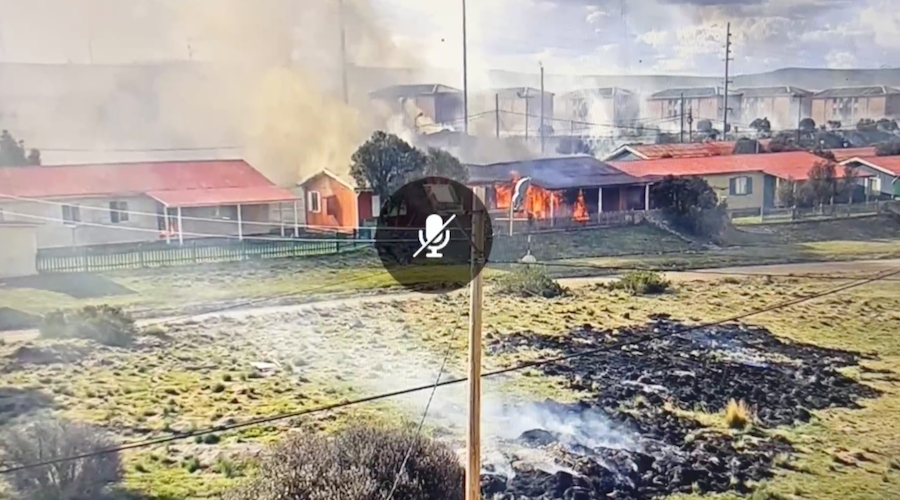
Following Friday’s attack that set on fire a worker housing area, Glencore announced that it has halted operations at the Antapaccay copper mine in southern Peru.

In a media statement, the company said that yesterday’s incidents endangered the safety of its employees and, therefore, authorities should start taking action to safeguard people’s integrity and private property rights. 

According to the Swiss miner, a group of citizens from the Espinar province, where Antapaccay is located, arrived at the site Friday noon and demanded that operations be stopped and that the firm issue a communiqué asking for the resignation of Peruvian President Dina Boluarte.

Next, some of the people forced their entry into different mine facilities, stole workers’ belongings, and set the housing area on fire. Two and a half hours later, the protesters left the site.

“The emergency and security teams are working to guarantee the safety of the employees that remain in the operation, as well as to extinguish the fires. So far no injuries have been reported,” the press release states.

Prior to this incident, Glencore’s mine, one of the country’s largest, was operating only with 38% of its workforce due to protests. Less than a week ago, ​​activists broke into Antapaccay’s water plant and set the facility on fire. The plant provides drinking water to over 6,000 people in nearby communities.

Given the number of attacks that have taken place in the first half of January, which also include roadblocks, the mine halted the shipping of copper concentrate. MMG’s Las Bambas, which shares with Antapaccay the same highway access to ports, followed suit. 

Unrest has rattled Peru since the ouster and arrest of former President Pedro Castillo late last year. Protest leaders are demanding a general election.

According to Bloomberg, the disruption is threatening to choke off access to almost $4 billion worth of red metal. 

This comes at a particularly precarious moment for copper markets as inventories stand at historically low levels while miners warn demand is poised to skyrocket with the growing electrification of vehicles.