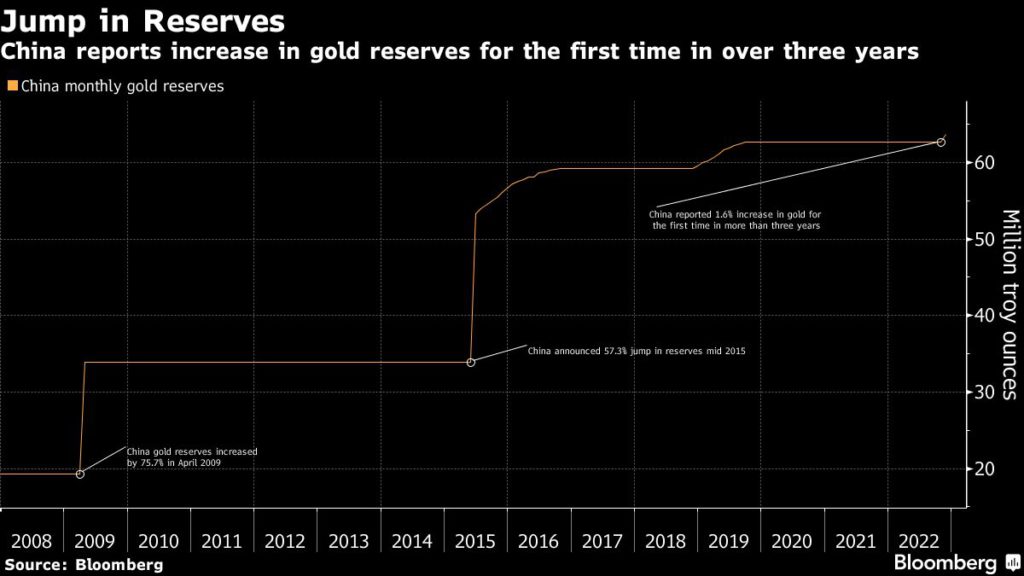
China reported an increase in its gold reserves for the first time in
more than three years, shedding some light on the identity of the
mystery buyers in the bullion market.
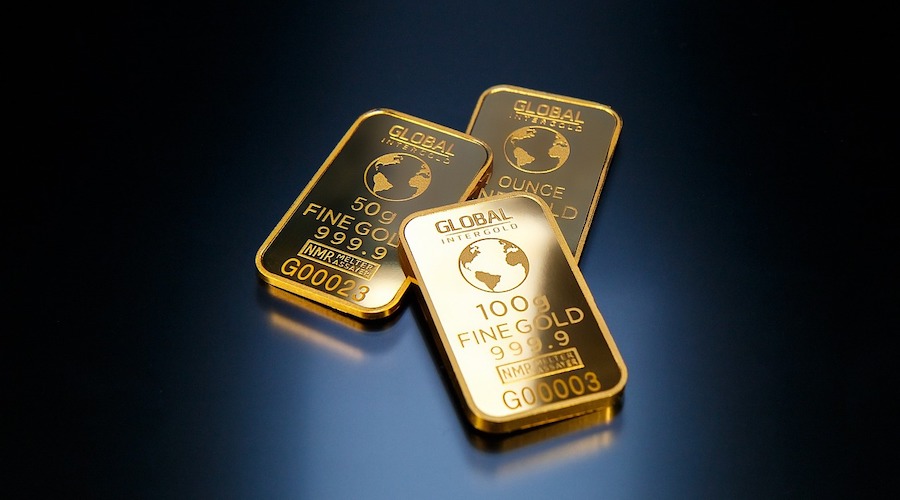
The People’s Bank of China raised its holdings by 32 tons in November
from the month before, according to data on its website on Wednesday.
That brought its total to 1,980 tons, the sixth-biggest central bank
bullion hoard in the world.
The gold industry has been rife with speculation over the central
banks behind nearly 400 tons of sovereign purchases during the third
quarter. Only about a quarter of the buying was publicly reported at the
time, causing market watchers to tout both China and Russia as
potential culprits.
For China, the need to find an alternative to dollars, which dominate
its reserves, has rarely been greater. Tensions with the US have been
high since measures taken against its semiconductor firms, while
Russia’s invasion of Ukraine has demonstrated Washington’s willingness
to sanction central bank reserves.
The PBOC’s purchases may be part of a plan to diversify its reserves
away from the dollar, said Giovanni Staunovo, an analyst at UBS Group
AG. “Gold holdings in China as part of the total reserves are still very
low, so there is probably room for further purchases down the road,” he
said.
China has previously gone long periods without disclosing changes in
its gold holdings. When the central bank announced a 57% jump in
reserves to 53.3 million ounces in mid-2015, it was the first update in
six years. It took another breather from the end of October 2016, before
resuming reporting purchases in December 2018.
While central bank buying rarely drives sustainable gold rallies, it
can provide an important pillar of support when prices fall. The
precious metal has been under pressure this year from the Federal
Reserve’s aggressive monetary tightening, though it has held up
relatively well against moves in the dollar and Treasury yields.
“As deglobalisation accelerates, the non-G-10 nations are expected to
‘re-commoditize’ and ramp up gold holdings,” said Nicky Shiels, head of
strategy at MKS PAMP SA.
Gold edged higher to $1,772.81 an ounce by 10:41 a.m. in London.
Bullion had a shortlived rally back above $1,800 on Friday, and is down
about 3% this year. The Bloomberg Dollar Spot Index was little changed.
Silver gained, platinum fell and palladium was steady.
(With assistance from Jason Rogers and Eddie Spence)
Bold Types
Christophe Chantre of Tender Foods is making a meatier plant-based meat
Developed
in a Harvard laboratory, Tender Foods is hoping to fight climate change
by creating a version of plant-based meat that tastes, well, meatier,
mimicking the striated muscle tissue in a sirloin steak or chicken
breast.
Working out of Greentown Labs in Somerville, its scientists use a
technology that’s similar to a cotton candy machine, spinning plant
proteins into strings that can be designed to replicate different cuts
of meat. Co-founder Christophe Chantre says the company’s goal is to
create a product that is “just better” — for the planet, for our diets,
and that tastes better than other plant-based meats on grocery store
shelves.
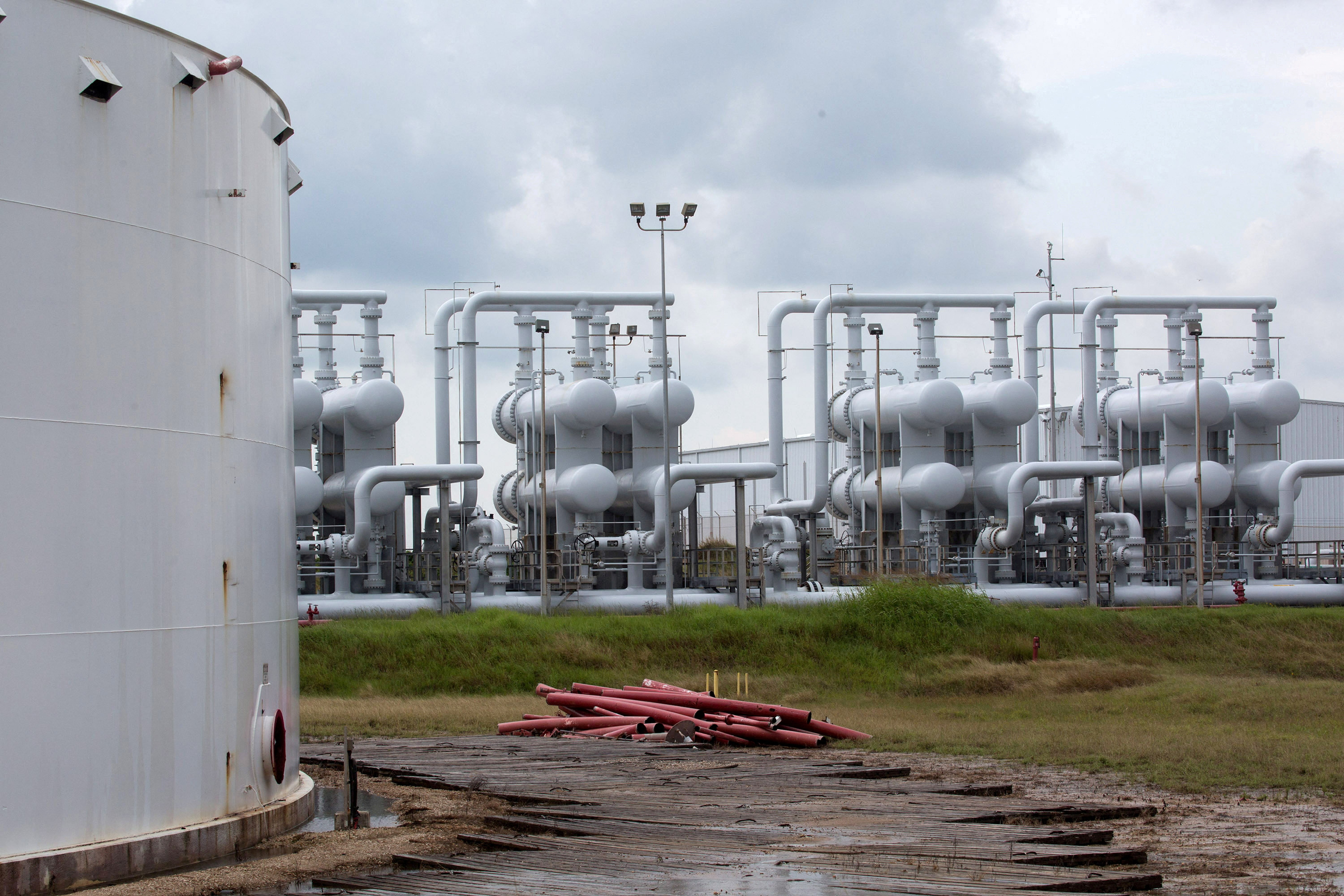
An oil storage tank and crude oil pipeline equipment is seen during a
tour by the Department of Energy at the Strategic Petroleum Reserve in
Freeport, Texas, U.S. June 9, 2016. REUTERS/Richard Carson/File Photo
WASHINGTON,
Nov 17 (Reuters) - The Biden administration has asked Congress for $500
million to modernize the U.S. strategic petroleum reserve (SPR), a
document outlining the request shows.
If approved by Congress, the request,
issued by the White House on Tuesday, provides the Department of Energy
(DOE) with funding to improve the four SPR sites along the Texas and
Louisiana coasts.
President
Joe Biden announced the biggest withdrawal ever from the reserve
earlier this year of 180 million barrels in an effort to push down oil
prices that jumped after Russia's Feb. 24 invasion of Ukraine. The
historic release of oil has pushed supplies in the SPR to the lowest
level since March of 1984.
The
SPR oil is stored in hollowed-out, underground salt caverns that can
shift and potentially require maintenance when petroleum is removed and
replaced. The facility's steel pumps and equipment are also subject to
constant lashing of moist, salty air, which can be corrosive.
The
proposed funding "would allow the SPR to both maintain operational
readiness levels and also alleviate anticipated shortfalls due to supply
chain issues, the COVID-19 pandemic, and related schedule delays," the
White House said in the request.
The
SPR funding was included in the White House's proposal for nearly $38
billion in aid to Ukraine as part of a supplemental funding request. The
funding for Ukraine for the duration of the fiscal year would go to
defense equipment, humanitarian assistance, and nuclear security
support, the White House said.
The
request also includes $126.3 million for the National Nuclear Security
Administration, part of the DOE, to guard against potential nuclear and
radiological incidents in Ukraine, the White House said. It would also
help Ukraine with security of nuclear and radiological materials, and
prevent illicit smuggling of nuclear, radiological, and dual-use
materials.
Advertisement · Scroll to continue
Russia
has claimed ownership of the Zaporizhzhia Nuclear Power Plant in
Ukraine, Europe's largest. Repeated shelling has damaged buildings and
cut power lines essential to cooling reactor fuel and avoiding a nuclear
meltdown. Russia and Ukraine blame each other for the shelling. read more
DOE
spokesperson Charisma Troiano said the money was needed to perform
necessary infrastructure repairs and keep the SPR ready for future
scheduled sales and to "address global energy supply chain disruptions"
such as those caused by Russia's invasion of Ukraine.
The White House did not immediately respond to a request for details about why the SPR needs to be modernized.
The head of the largest oil and natural gas trade association warned
that failure to replenish the U.S. Strategic Petroleum Reserve (SPR)
could trigger another oil crisis in the coming weeks.
“The Strategic Petroleum Reserve, unfortunately, has become the
strategic political reserve. And we have grave concerns about how it has
been so politicized. This is for emergency purposes, not to lower
gasoline prices during a time during a political season,” American
Petroleum Institute CEO Mike Sommers said in a Friday interview on Fox News.
Sommers added that “I think doing this willy-nilly and doing it in a
way that that doesn’t make sense for the market we’re in, we could be
dealing with another major oil crisis here in the next few weeks.”
Sommers did not elaborate.
Starting earlier this year, the Biden administration has been
releasing oil from the SPR in the midst of historically high gas prices.
After tens of millions of barrels of oil were released, as of Nov. 25,
it’s down to 389.1 million barrels—the lowest amount in decades.
“We’re also real concerned, Maria, about how low it has gone. Lowest
level since 1984, not necessarily because of market conditions, but
because of political concerns,” Sommers told the news outlet Friday,
adding that the federal government needs to start replenishing the SPR
in the near future.
“The best plan, in my view, is for us not to continue to use it in a
way that is for political purposes and rather do it in a market-based
way. And if there is an emergency, that’s what this is for. And the real
concern is that 1984, when it was at the levels that we’re in
currently, we were using 20 percent less oil,” Sommers said.
President Joe Biden
and other White House officials have denied the SPR is being used for
political purposes, instead blaming the release and relatively high gas
prices on the Ukraine–Russia conflict. Earlier this week, White House
spokesman John Kirby told reporters that the federal government has
issued about 9,000 permits for drilling on federal lands.
Sommers disputed Kirby’s recent statement by saying that “they make
it seem like as soon as you get a lease that you can start drilling on
that property,” adding that companies “have to do a lot of prep work
before you actually produce on those federal leases, including getting
multiple permits.”
In October, after Biden released another 180 million barrels, the
White House indicated it would start refilling the SPR once the price of
crude oil drops to around $70 per barrel. Earlier this week,
U.S. energy security advisor Amos Hochstein told Bloomberg News the
White House would consider replenishing the SPR once oil prices are “consistently” around $70, although he didn’t say for how long.
Other than Sommers, Chevron CEO Mike Wirth said Thursday during a New
York event that the plan to refill at $70 per barrel is “not
necessarily a wise move.” He added that “durable and meaningful
permitting reform” would be a “huge step forward.”
More Activity
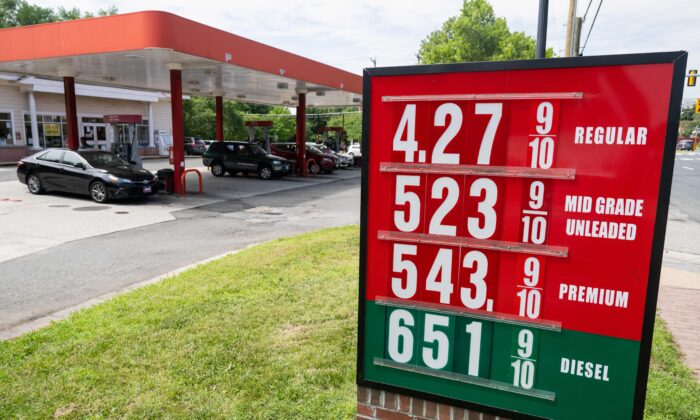
As of Friday, automotive group AAA says the average price
for a gallon of regular gasoline stands at $3.44. That’s down about 30
cents from one month ago, and it’s slightly higher than the average
price exactly one year ago.
Republicans and oil industry officials have said
that Biden’s move to release oil from the SPR was designed to keep gas
prices artificially low ahead of the Nov. 8 midterm elections. But they
have argued that the long-term effects of the order may be devastating.
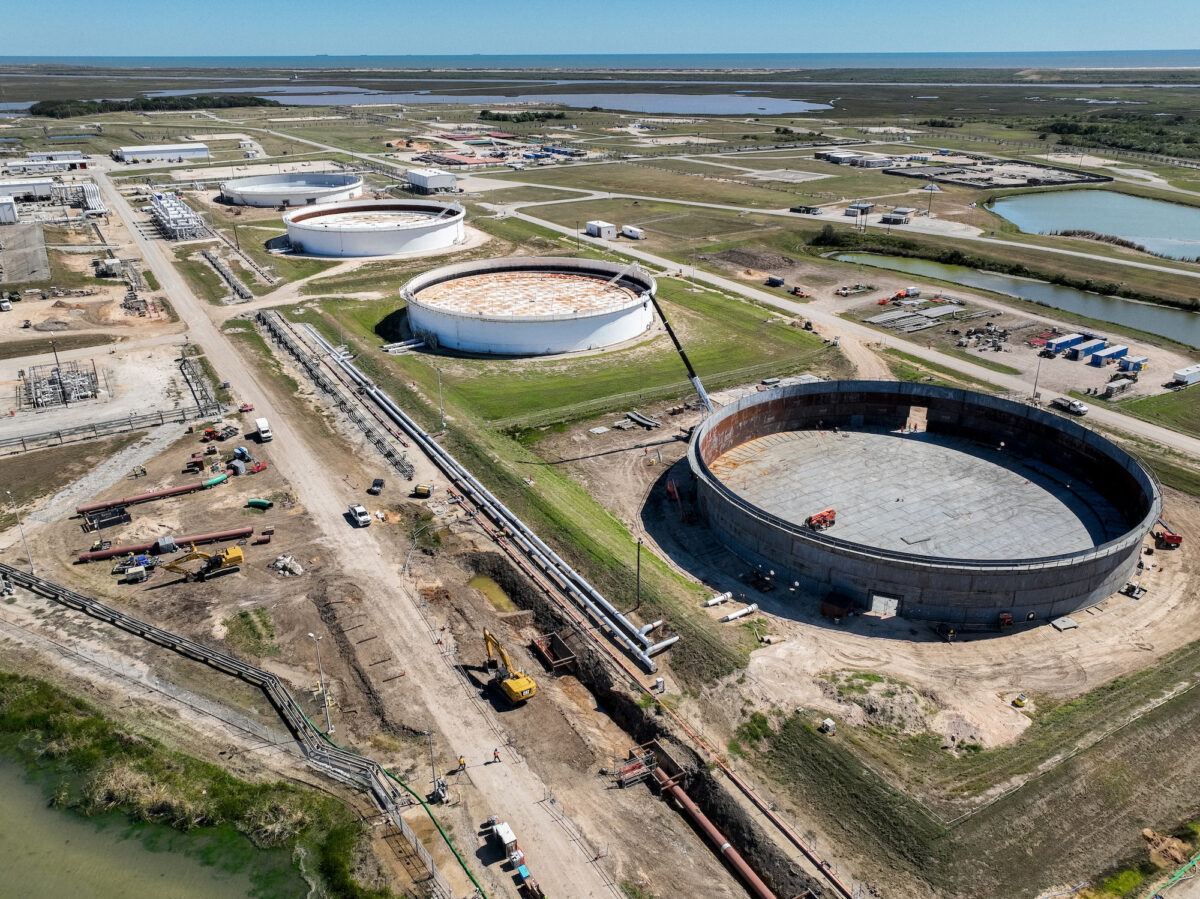
In an aerial view, the Strategic Petroleum Reserve storage at the Bryan
Mound site is seen in Freeport, Texas, on Oct. 19, 2022. (Brandon
Bell/Getty Images)
Earlier this month, the White House asked Congress for $500 million
to modernize the SPR, according to a document. If approved by Congress,
the request, issued by the White House on Nov. 15, provides the
Department of Energy with funding to improve the four SPR sites along
the Texas and Louisiana coasts.
The SPR oil is stored in hollowed-out, underground salt caverns that
can shift and potentially require maintenance when petroleum is removed
and replaced. The facility’s steel pumps and equipment are also subject
to constant lashing of moist, salty air, which can be corrosive.
The proposed funding “would allow the SPR to both maintain
operational readiness levels and also alleviate anticipated shortfalls
due to supply chain issues, the COVID-19 pandemic, and related schedule
delays,” the White House said in the request.