Wednesday, January 25, 2023

Top Ukrainian officials quit in anti-corruption drive

https://www.bbc.com/news/world-europe-64383388
Several senior Ukrainian officials have resigned as President Volodymyr Zelensky begins a shake-up of personnel across his government.
A top adviser, four deputy ministers and five regional governors left their posts on Tuesday.
Their departures come as Ukraine launches a broad anti-corruption drive.
Recently, authorities have seen bribery claims, reports of officials buying food at inflated prices and one figure accused of living a lavish lifestyle.
Senior aide Mykhailo Podolyak said Mr Zelensky was responding to a "key public demand" that justice should apply to everyone.
The president has already banned state officials from leaving the country unless on authorised business.
The first to resign on Tuesday was Kyrylo Tymoshenko, the president's deputy head of office, who oversaw regional policy and had earlier worked on Mr Zelensky's election campaign.
After Russia launched its invasion of Ukraine last February he became a frequent spokesperson for the government.
He was accused by Ukrainian investigative journalists of using several expensive sports cars throughout the war - though denies any wrongdoing.
In a Telegram post, he thanked Mr Zelensky for "the opportunity to do good deeds every day and every minute".
Deputy Defence Minister Vyacheslav Shapovalov also resigned, following reports he oversaw the purchase of military food supplies at inflated prices from a relatively unknown firm. The department called this a "technical mistake" and claimed no money had changed hands.
The defence minister himself - Oleksii Reznikov - has been under scrutiny for the same reason.
A host of other top officials were dismissed on Tuesday, including:
- Deputy Prosecutor General Oleskiy Symonenko
- Deputy Minister for Development of Communities and Territories Ivan Lukerya
- Deputy Minister for Development of Communities and Territories Vyacheslav Negoda
- Deputy Minister for Social Policy Vitaliy Muzychenko
- And the regional governors of Dnipropetrovsk, Zaporizhzhia, Kyiv, Sumy and Kherson
Ukraine has a history of corruption and in 2021 Transparency International ranked the country at 122 out of 180 countries in its ranking of corrupt states.
A crackdown is one of the EU's key demands if the country is to advance its application to join the bloc.
In an address on Sunday, Mr Zelensky promised there would be "no return to what used to be in the past, to the way various people close to state institutions" used to live.
His comments followed the arrest of Ukraine's Deputy Infrastructure Minister Vasyl Lozinskyi on Saturday on suspicion of accepting a bribe worth over $350,000 (£285,000) over the supply of electricity generators. He has denied the charges.
David Arakhamia, the head of Mr Zelensky's Servant of the People party, has said that corrupt officials could face jail.
"Officials at all levels have been constantly warned through official and unofficial channels: focus on the war, help the victims, reduce bureaucracy and stop doing dubious business.
"Many of them have actually listened, but some, unfortunately, did not," he said in a Telegram statement.
"If it doesn't work in a civilised way, it will be done according to the laws of wartime. This applies both to recent purchases of generators and to fresh scandals in the ministry of defence."
While there have been anti-corruption reforms in recent years, the stakes are high for Kyiv - which is receiving billions of dollars worth of financial aid from Western allies.
Sen. Markwayne Mullin Highlights New GOP Energy Reforms
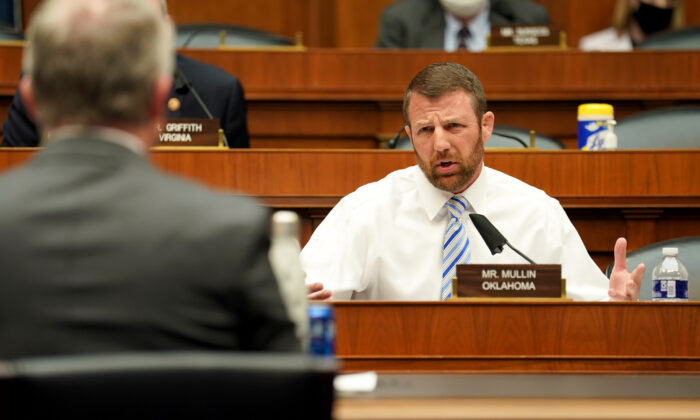
Rep. Markwayne Mullin (R-Okla.) asks questions to Dr. Richard Bright,
former director of the Biomedical Advanced Research and Development
Authority, during a House Energy and Commerce Subcommittee on Health
hearing to discuss protecting scientific integrity in response to the
coronavirus outbreak, in Washington on May 14, 2020. (Greg
Nash-Pool/Getty Images)
Newly sworn-in Sen. Markwayne Mullin (R-Okla.) has been in the U.S. Senate for three weeks and he’s moving forward with his first legislative package, which is focused on expanding U.S. energy production and cross-border energy permits.
On Tuesday, Mullin introduced three new Senate bills focused on the energy sector. The first bill he introduced seeks to clarify that a state has the sole authority to regulate hydraulic fracturing—also known as fracking—on federal land within the boundaries of the state. Mullin’s second bill would give states further control over energy production on federal lands available to those states. His third bill would reform the process for permitting the construction and operation of cross-border oil and natural gas lines, with a goal to make the process more uniform and transparent.
“It is not Washington, D.C., that creates jobs,” Mullin told NTD. “Washington, D.C., is to create an environment for entrepreneurs and job creators to create jobs. It’s also not Washington, D.C.’s position—and it shouldn’t be their position—to choose the products, choose the industry. That is a consumer that makes those decisions.”
While he expressed his view that consumers should be able to choose the products and industries that succeed, Mullin said “D.C. elites, bureaucrats” have been controlling those decisions. “So if they’re going to play this game, and it looks like they’re going to, then we need to take it out of their hands.”
US Doesn’t Need to Tap Strategic Oil Reserves: Mullin
President Joe Biden repeatedly withdrew oil from the Strategic Petroleum Reserve (SPR) throughout 2022 as gas prices rose throughout the year.
Mullin said the Biden administration timed withdrawals from the SPR as a ploy to lower gas prices before the 2022 midterms.
“They used the Strategic Petroleum Reserve, SPR, which is supposed to be for national security emergency purposes, for a political ploy,” Mullin said.
According to the U.S. Energy Information Administration (EIA), the United States had 588 million barrels of oil in the strategic reserve at the start of 2022. By October, the supply of oil in the SPR had fallen to 398 million barrels, placing the SPR at its lowest level since April 1984.
“We’re at the lowest level we’ve been since 1984, yet we’re at a very volatile time around the world,” Mullin said. “We see the aggressiveness of [Russian President Vladimir] Putin and we see the aggressiveness of China, and we’re at the lowest level we’ve been. And what we’re saying is, ‘Listen, you’re playing games using the SPR for something that it wasn’t supposed to be used for, you’re using it to bring down gas prices.'”
Mullin noted Rep. Cathy McMorris Rodgers (R-Wash.) recently introduced a bill that would restrict the executive branch from making withdrawals from the SPR without developing a plan to boost domestic oil and gas production to match the amount being taken out of the SPR. The bill stipulates emergency situations where the executive branch may make withdrawals from the SPR without having to develop plans to refill the reserve.
Mullin said withdrawing oil from the SPR wouldn’t be necessary with higher domestic oil production.
“Underneath the Trump administration, we became a net [oil] exporter. We were exporting nearly a million barrels per day underneath Trump. Today, we’re importing that same amount,” Mullin said. “So we don’t have to tap our strategic oil or strategic petroleum reserves.”
“All we had to do is let the [oil] industry go,” he added.
The Biden administration has indicated the president would veto McMorris Rodgers’ bill if it does pass in the House and the Senate.
In a Monday press conference, Energy Secretary Jennifer Granholm said the bill “would not offer any tangible benefits to the American people” and would instead “interfere with our ability to be responsive to release oil during an international emergency, helping Putin’s war aims.”
During the press conference alongside Granholm, White House Press Secretary Karine Jean-Pierre repeatedly described McMorris Rodgers’ bill as a Republican plan to “raise” prices on Americans at the pump.
Keystone XL Cancellation Was ‘Political’
As one of his bills would reform how cross-border oil and natural gas lines are built, Mullin spoke out on the Biden administration’s decision to cancel the Keystone XL pipeline project.
The Keystone XL line was a proposed new route for the existing Keystone Pipeline, which carries gas from Canada to the United States. Former President Donald Trump had permitted the Keystone XL pipeline construction to proceed, but Biden revoked the pipeline permits through an executive order on his first day in office.
Mullin said Biden revoked the Keystone XL pipeline permits “for nothing more than political reasons, not national security interests.”
Mullin said the current authority that the president has to approve cross-border energy pipelines can create complications for the companies working to build the pipelines.
“If you’re an investor and you’re looking at the Keystone pipeline, and say a next administration comes in—say Trump comes back in and he approves the Keystone pipeline—well, you’re going to get four years for it to be approved. So you’re going to invest billions of dollars knowing that the next president that comes in can reject that permit just like Biden did? And all of sudden you have all this material that was already on the ground and in the ground … and then some of it already dug, that you’re just going to stop the project?” Mullin said.
Mullin said if the United States wants to attract energy investors who could create thousands of jobs with new energy construction projects, it will need to change the permitting process so that years of work to gather permits and prepare for construction aren’t canceled as they were under Biden’s order.
Tuesday, January 24, 2023
California Democrats consider wealth tax — including for people who moved out of state

California Democrats consider wealth tax — including for people who moved out of state
https://www.yahoo.com/news/california-democrats-consider-wealth-tax-010948671.html
California lawmakers are pushing legislation that would impose a new tax on the state's wealthiest residents — even if they've already moved to another part of the country.
Assemblyman Alex Lee, a progressive Democrat, last week introduced a bill in the California State Legislature that would impose an extra annual 1.5% tax on those with a "worldwide net worth" above $1 billion, starting as early as January 2024.
As early as 2026, the threshold for being taxed would drop: those with a worldwide net worth exceeding $50 million would be hit with a 1% annual tax on wealth, while billionaires would still be taxed 1.5%.
Worldwide wealth extends beyond annual income to include diverse holdings such as farm assets, arts and other collectibles, and stocks and hedge fund interest.
The legislation is a modified version of a wealth tax approved in the
California Assembly in 2020, which the Democrat-led state Senate
declined to pass
The current version just introduced includes measures to allow California to impose wealth taxes on residents even years after they left the state and moved elsewhere.
Exit taxes aren't new in California. But this bill also includes provisions to create contractual claims tied to the assets of a wealthy taxpayer who doesn't have the cash to pay their annual wealth tax bill because most of their assets aren't easily turned into cash. This claim would require the taxpayer to make annual filings with California's Franchise Tax Board and eventually pay the wealth taxes owed, even if they've moved to another state.
California was one of several blue states last week to unveil bills to impose new wealth taxes. The other states were Connecticut, Hawaii, Illinois, Maryland, Minnesota, New York and Washington. Each state's proposal contained a difference tax approach, but they all centered around the same basic idea: the rich must pay more.
Lee's office didn't respond to a request for comment for this story. However, he's made public statements echoing the message that wealthier residents should pay higher taxes.
"The working class has shouldered the tax burden for too long," Lee wrote in a tweet. "The ultra-rich are paying little to nothing by hoarding their wealth through assets. Time to end that."
According to Lee, the tax would affect 0.1% of California households and generate an additional $21.6 billion in state revenue, which would go to the state general fund. California has among the highest taxes of any state in the country.
Advocates argue that the money could boost funding for schools, housing and other social programs. Perhaps more importantly, however, Lee hopes it could help address California's massive $22.5 billion budget deficit.
LIST OF COMPANIES LEAVING CA GROWS AS BLUE STATE'S EXODUS TREND CONTINUES
"This is how we can keep addressing our budgetary issues," he told the Los Angeles Times. "Basically, we could plug the entire hole."
However, experts counter that the bill will have the exact opposite effect through high administrative costs and by causing an exodus of people to flee the state.
"It brings significant administrative challenges with respect to asset and liability valuation, high and distortionary effective rates, among other problems that make it an inefficient revenue source," Gordon Gray, director of fiscal policy at the American Action Forum, told Fox New Digital.
Others echoed this point, also arguing a new wealth tax would likely lead many wealthy residents to leave California.
"The proposed California wealth tax would be economically destructive, challenging to administer and would drive many wealthy residents — and all their current tax payments — out of state," Jared Walczak, vice president of state projects at Tax Foundation, told Fox News Digital. "The bill sets aside as much as $660 million per year just for administrative costs, more than $40,000 per prospective taxpayer, giving an idea of how difficult such a tax would be to administer."
People are already moving from high-tax states into low-tax ones, according to a recent analysis by James Doti, president emeritus and economics professor at Chapman University. He found that the 10 highest tax states lost nearly 1 in 100 residents in net domestic migration between July 2021 and July 2022, while the 10 lowest tax states gained almost 1 in 100.
California lawmakers pushing the wealth tax think they can "get around" the problem of residents leaving "by trying to tax people even after they leave the state," said Patrick Gleason, vice president of state affairs at Americans for Tax Reform. However, he, Gray and Walczak all questioned the legality of such an approach or labeled it outright unconstitutional.
CALIFORNIA VOTERS REJECT TAX THAT WOULD HAVE FUNDED ELECTRIC VEHICLES
Past studies have shown that the top 1% of taxpayers pay about 50% of state income taxes in New York, California and elsewhere, raising the question of how damaging a mass exodus of wealthy residents could be to tax revenue.
Walczak noted that a wealth tax would be especially problematic for California, joking that the people most excited about such a law should be people in Texas, where some high-profile Californians have relocated in recent years.
"A wealth tax could be particularly destructive in California, home to so many tech startups, because the owners of promising businesses could be taxed on hundreds of millions of dollars' worth of estimated business value that never actually materializes," said Walczak. "Very few taxpayers would remit wealth taxes, but many taxpayers would pay the price. The only people who should genuinely love a California wealth tax are the ones who work in Texas' economic development office."
However, some proponents of wealth taxes argue they're necessary to combat economic inequality.
Maryland Democrat Delegate Jheanelle K. Wilkins, for example, has proposed a bill so that families would owe taxes on inheritances over $1 million rather than $5 million, as is the case today. She said such ideas will now gain more support after the COVID-19 pandemic exposed inequality between the rich and poor.
"That's quite a bit of funds that we're leaving on the table," she told the Washington Post.
Other supporters say wealth taxes are small and the rich can afford them. But experts note that because the rates are on net worth, not on income, they have an outsized effect.
CLICK HERE TO GET THE FOX NEWS APP
Walczak illustrated the point in a recent blog post, using as an example a $50 million investment, held for 10 years and earning a 10% nominal annual rate of return in an environment of 3% annual inflation. Without a wealth tax, that investment would yield $46.5 million in investment returns, in current dollars, after 10 years. With a 1% wealth tax, however, it would yield $37.3 million, wiping out nearly 20% of the gains.
Wealth taxes "cut deeply into investment returns, to the detriment of the broader economy," wrote Walczak. "Average taxpayers may not care if the ultra-wealthy have lower net worths. But they will certainly care if innovation slows and investments decline."
Timeline: 150 Years of U.S. National Debt
https://www.visualcapitalist.com/timeline-150-years-of-u-s-national-debt/


This interactive visualization uses debt held by the public for its calculations, which excludes intragovernmental holdings.
Looking Back at 150 Years of U.S. Debt
The total U.S. national debt reached an all-time high of $28 trillion* in March 2021, the largest amount ever recorded.
Recent increases to the debt have been fueled by massive fiscal stimulus bills like the CARES Act ($2.2 trillion in March 2020), the Consolidated Appropriations Act ($2.3 trillion in December 2020), and most recently, the American Rescue Plan ($1.9 trillion in March 2021).
To see how America’s debt has gotten to its current point, we’ve created an interactive timeline using data from the Congressional Budget Office (CBO). It’s crucial to note that the data set uses U.S. national debt held by the public, which excludes intergovernmental holdings.
*Editor’s note: This top level figure includes intragovernmental holdings, or the roughly $6 trillion of debt owed within the government to itself.
What Influences U.S. Debt?
It’s worth pointing out that the national debt hasn’t always been this large.
Looking back 150 years, we can see that its size relative to GDP has fluctuated greatly, hitting multiple peaks and troughs. These movements generally correspond with events such as wars and recessions.
| Decade | Gross debt at start of decade (USD billions) | Avg. Debt Held By Public Throughout Decade (% of GDP) | Major Events |
|---|---|---|---|
| 1900 | - | 4.8% | - |
| 1910 | - | 10.0% | World War I |
| 1920 | - | 22.9% | The Great Depression |
| 1930 | $16 | 36.4% | President Roosevelt's New Deal |
| 1940 | $40 | 75.1% | World War II |
| 1950 | $257 | 56.8% | Korean War |
| 1960 | $286 | 37.3% | Vietnam War |
| 1970 | $371 | 26.1% | Stagflation (inflation + high unemployment) |
| 1980 | $908 | 33.7% | President Reagan's tax cuts |
| 1990 | $3,233 | 44.7% | Gulf War |
| 2000 | $5,674 | 36.6% | 9/11 attacks & Global Financial Crisis |
| 2010 | $13,562 | 72.4% | Debt ceiling is raised by Congress |
| 2020 | $27,748 | 105.6% | COVID-19 pandemic |
| 2030P | - | 121.8% | - |
| 2040P | - | 164.7% | - |
| 2050P | - | 195.2% | - |
Source: CBO, The Balance
To gain further insight into the history of the U.S. national debt, let’s review some key economic events in America’s history.
The Great Depression
After its WWI victory, the U.S. enjoyed a period of post-war prosperity commonly referred to as the Roaring Twenties.
This led to the creation of a stock market bubble which would eventually burst in 1929, causing massive damage to the U.S. economy. The country’s GDP was cut in half (partially due to deflation), while the unemployment rate rose to 25%.
Government revenues dipped as a result, pushing debt held by the public as a % of GDP from its low of 15% in 1929, to a high of 44% in 1934.
World War II
WWII quickly brought the U.S. back to full employment, but it was an incredibly expensive endeavor. The total cost of the war is estimated to be over $4 trillion in today’s dollars.
To finance its efforts, the U.S. relied heavily on war bonds, a type of bond that is marketed to citizens during armed conflicts. These bonds were sold in various denominations ranging from $25-$10,000 and had a 2.9% interest rate compounded semiannually.
Over 85 million Americans purchased these bonds, helping the U.S. government to raise $186 billion (not adjusted for inflation). This pushed debt above 100% of GDP for the first time ever, but was also enough to cover 63% of the war’s total cost.
The Postwar Period
Following World War II, the U.S. experienced robust economic growth.
Despite involvement in the Korea and Vietnam wars, debt-to-GDP declined to a low of 23% in 1974—largely because these wars were financed by raising taxes rather than borrowing.
The economy eventually slowed in the early 1980s, prompting President Reagan to slash taxes on corporations and high earning individuals. Income taxes on the top bracket, for example, fell from 70% to 50%.
2008 Global Financial Crisis
The Global Financial Crisis served as a precursor for today’s debt landscape.
Interest rates were reduced to near-zero levels to speed up the economic recovery, enabling the government to borrow with relative ease. Rates remained at these suppressed levels from 2008 to 2015, and debt-to-GDP grew from 39% to 73%.
It’s important to note that even before 2008, the U.S. government had been consistently running annual budget deficits. This means that the government spends more than it earns each year through taxes.
The National Debt Today
The COVID-19 pandemic damaged many areas of the global economy, forcing governments to drastically increase their spending. At the same time, many central banks once again reduced interest rates to zero.
This has resulted in a growing snowball of government debt that shows little signs of shrinking, even though the worst of the pandemic is already behind us.
In the U.S., federal debt has reached or surpassed WWII levels. When excluding intragovernmental holdings, it now sits at 104% of GDP—and including those holdings, it sits at 128% of GDP. But while the debt is expected to grow even further, the cost of servicing this debt has actually decreased in recent years.
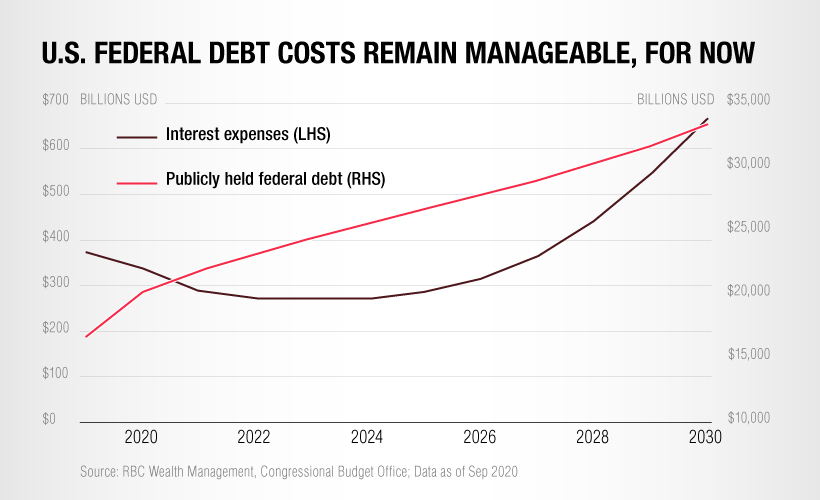
This is because existing government bonds, which were originally issued at higher rates, are now maturing and being refinanced to take advantage of today’s lower borrowing costs.
The key takeaway from this is that the U.S. national debt will remain manageable for the foreseeable future. Longer term, however, interest expenses are expected to grow significantly—especially if interest rates begin to rise again.
Congo president demands more from $6.2 billion China metals deal
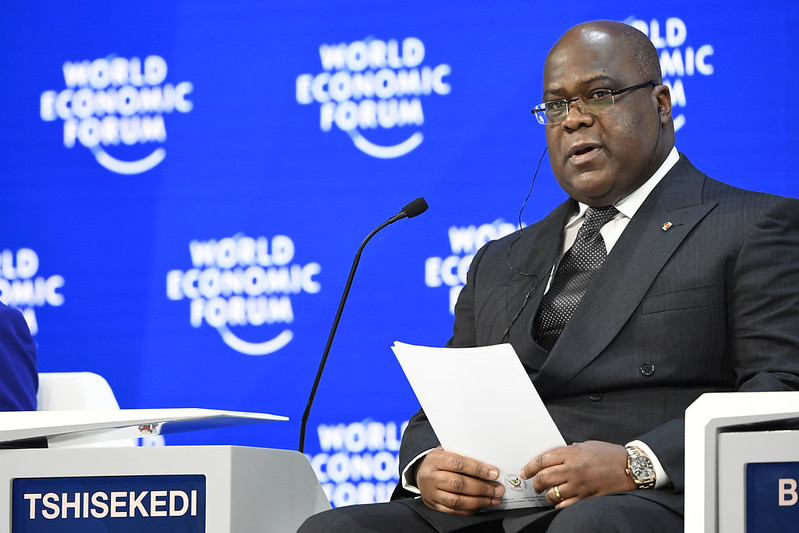
Felix Tshisekedi, President of the Democratic Republic of the Congo. Image courtesy of the World Economic Forum via Flickr.
https://www.mining.com/web/congo-president-demands-more-from-6-2-billion-china-metals-deal/
Democratic Republic of Congo President Felix Tshisekedi criticized a $6.2 billion minerals-for-infrastructure contract with China, saying the world’s largest producer of a key battery metal hasn’t benefited from the deal.
Congo, Africa’s second-largest nation by landmass, is flush with natural resources — including copper and cobalt that are major components in electric vehicles — but remains one of the world’s least-developed countries. Most of its minerals end up in China, which signed a landmark deal with Tshisekedi’s predecessor in 2008 to trade roads and buildings for the two metals.
“The Chinese, they’ve made a lot of money and made a lot of profit from this contract,” Tshisekedi said in an interview at the World Economic Forum in Davos, Switzerland. “Now our need is simply to re-balance things in a way that it becomes win-win.”
The contract renegotiation is part of a campaign by the president to ensure the country gets paid for the full value of its resources, which are increasingly in high demand.
The accord with China was signed at a time when Congo was emerging from decades of dictatorship and war and newly elected President Joseph Kabila was desperate for financing. It mandated that Chinese companies invest $3.2 billion in a copper-cobalt mine and another $3 billion in infrastructure funded by the mine’s revenue.
‘Nothing tangible’
Congo’s government says China has released less than a third of the infrastructure funds.
“We’re happy to be friends with the Chinese, but the contract was badly drawn up, very badly,” Tshisekedi said. “Today, the Democratic Republic of Congo has derived no benefit from it. There’s nothing tangible, no positive impact, I’d say, for our population.”
The Chinese Embassy in Congo and the Chinese ambassador didn’t immediately respond to an email and a text message requesting comment on the negotiations, which have gone on for more than a year.
“You know, the Chinese are the champions of marathon discussions,” Tshisekedi said. “They’re known worldwide for it. We’re undergoing this experience now and so, we’ll see, but we remain optimistic.”
Negotiations are also dragging on over the Grand Inga site with Australia’s Fortescue Metals Group Ltd., which has a memorandum of understanding with Congo to develop what could be the world’s largest hydropower project, Tshisekedi said.
African investors
The president wants Fortescue to allow other investors into the deal, especially from Africa, and possibly scale down its ambitions in order to speed up development, he said.
“We’re not on the same wavelength,” he said, adding that he’d met at Davos with Andrew Forrest, Fortescue’s billionaire chairman.
“We want to make it a kind of opportunity to also unite other interests, particularly African interests,” Tshisekedi said. “We’re open to everything, to all discussions, to all meetings.”
Talks with Fortescue are continuing, Tshisekedi’s director of communications later confirmed. Fortescue Future Industries Ltd. plans to use Inga’s energy, which could eventually be twice as powerful as China’s Three Gorges project, to produce green hydrogen and green ammonia.
The company is in “active discussions” about the project, FFI Chief Executive Officer Mark Hutchinson said in an emailed response to a request for comment. Tshisekedi plans to visit Australia to continue those talks, he said.
“Fortescue has a team in the DRC and are continuing to work closely with the government to take this forward,” Hutchinson said. “Fortescue welcomes other partners to this important project.”
There’s no timetable for the next phase of Inga, the 10-gigawatt project known as Inga 3, Tshisekedi said.
Regional conflict
The president, who’s also dealing with a multitude of violent conflicts at home and a reelection campaign at year’s end, has grown more outspoken against outsiders taking advantage of Congo’s resources for their own gain.
This has been particularly true in the country’s east, where an offensive by the M23 rebel group — allegedly backed by neighboring Rwanda — has displaced more than 450,000 people. Rwanda denies that it’s supporting the militants, who say they’re fighting for the rights of Congolese of Rwandan heritage.
Eastern Congo has been wracked by conflict since the 1990s, when violence from the aftermath of Rwanda’s civil war and genocide spread across the border. More than 100 armed groups remain active in the region, some of whom profit from the illegal trade in natural resources, which often transit through neighboring countries.
“Rwanda has been at the base of instability in Democratic Republic of Congo for twenty years,” Tshisekedi said. “It’s thanks to this instability that it can create mafia networks of illicit exploitation of gold, coltan and other minerals.”
Cobalt monopoly
Rwanda’s government rejected Tshisekedi’s accusation.
“The root cause of instability in eastern Congo is the security and governance failures of the Congolese government and the longtime involvement in the mining sector of the Democratic Forces for the Liberation of Rwanda, the genocidal militia that fled Rwanda in 1994, as well as dozens of Congolese illegal armed groups that are supported by the Congolese military and government, and which exploit Congo’s natural resources with impunity,” spokeswoman Yolande Makolo said by text message.
A plan to impose a monopoly on the sale of all hand-dug cobalt is also part of Tshisekedi’s goal to ensure Congo is paid for its minerals, he said.
Congo’s state-owned Entreprise Generale du Cobalt, or EGC, still needs a full management team and a regulator, according to the president. Talks are ongoing with potential partners, including Trafigura Group, the Singapore-based commodities trader, he said.
Congo is responsible for about 70% of world cobalt production, as much as 30% of which comes from so-called artisanal miners.
Those miners often work in dangerous and unregulated conditions, and EGC “represents one of the brightest hopes for instigating the improvements needed,” Trafigura said in an emailed response to questions Thursday.
“Trafigura remains committed to its commercial agreement with EGC and delivering on the pressing need to kick-start the large-scale formalization” of the artisanal and small-scale mining cobalt industry, it said.
(By Jacqueline Simmons and Michael J. Kavanagh, with assistance from James Fernyhough and Kamlesh Bhuckory)