PARIS—A surge in the cost of most food commodities last year, as the
disruption caused by Ukraine’s conflict raised concerns of shortages,
sent the U.N. food agency’s average price index to the highest level on
record.
The Food and Agriculture Organization’s (FAO)
food price index, which tracks international prices of the most
globally traded food commodities, averaged 143.7 points in 2022, up 14.3
percent from 2021, and the highest since records started in 1990, the
agency said on Friday.
The index had already gained 28 percent in 2021 from the previous year as the world economy recovered from the impact of the pandemic.
Food prices surged after Russia’s invasion of Ukraine in February
last year on fears of disruptions to Black Sea trade. They have pared
some of their gains since, in part because of a U.N.–backed grain export
channel from Ukraine and the prospect of improved supplies in producing
countries.
In December the benchmark index fell for the ninth consecutive month
to 132.4 points, compared with a revised 135.00 points for November. The
November figure was previously given as 135.7 points.
“Calmer food commodity prices are welcome after two very volatile years,” FAO Chief Economist Maximo Torero said.
The decline in the index in December was driven by a drop in the
international price of vegetable oils, together with some declines in
cereal and meat prices, but mitigated by slight increases in those of
sugar and dairy, the FAO said.
Still over the whole of 2022, four of the FAO’s five food
sub-indexes—cereals, meat, dairy, and vegetable oils—had reached record
highs, while the fifth one, sugar, was at a 10-year high.
The FAO Cereal Price Index index rose 17.9 percent in 2022 due to
factors including significant market disruptions, higher energy, and
input costs, adverse weather, and continued strong global food demand, the FAO said.
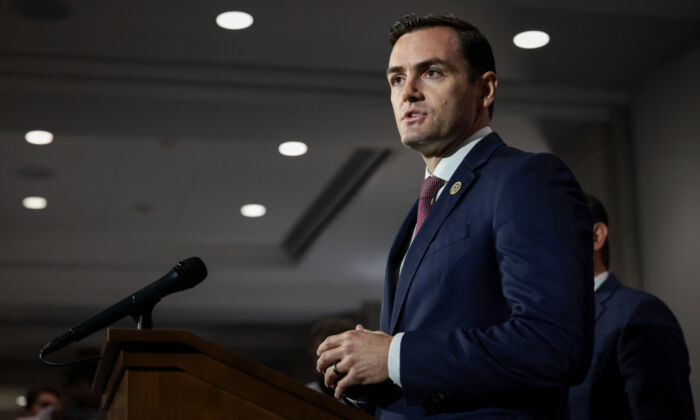
Leadership for the new Republican-led House Select Committee on China is ready to pursue an aggressive agenda aimed at countering the malign influence of China’s communist regime.
Rep. Mike Gallagher (R-Wis.), who is slated to lead the panel, said that he was eager to begin the process, but that the delay in selecting a House speaker would put an extra load on the committee’s first weeks.
“We have a very aggressive plan that we’re ready to launch but we
can’t launch it until the committee is created and we get members on
that committee,” Gallagher said during a brief interview on Thursday
with NTD, a sister media outlet of the Epoch Times.
“We’ll have to work weekends, we’ll have to work nights, you know,
we’ll get no time off. That’s fine. We’ll make it up. I’m just so eager
to get to work and do that.”
Republican lawmakers first announced that they would establish a new Select Committee on China to counter threats from the communist regime back in early December.
At that time, then-House Minority Leader Kevin McCarthy (R-Calif.)
tapped Gallagher to chair the committee based on his experience as a
Marine and dedication to strengthening the nation’s military.
“The Chinese Communist Party is the greatest geopolitical threat of
our lifetime,” McCarthy said in a statement at the time. “We need a
whole-of-government approach that will build on the efforts of the
Republican-led China Task Force and ensure America is prepared to tackle
the economic and security challenges posed by the CCP.”
“As a Member who served in uniform as a Marine Counterintelligence
officer and has dedicated his time in Congress to understanding,
educating, and defending America from the threat the CCP poses, Mike
Gallagher is exceptionally qualified and is the right person to lead and
advance this important agenda at this vital moment.”
Threat From Communist China
The new House Select Committee on China will aim to curb the malign
influence of the Chinese Communist Party (CCP), which rules China as a
single-party state, and which is engaged in a whole-of-society effort to supplant the United States from its position of global leadership.
Defense and security experts say
that the CCP has adopted a strategic doctrine of “unrestricted
warfare,” through which the regime aims to achieve military objectives
through diplomatic, economic, technological, and other means.
Moreover, the Pentagon’s 2022 China Military Power Report found that the CCP was developing
its military to win a war against the United States. That report also
found that the regime sought to seize Taiwan, eject U.S. forces from the
Indo-Pacific, and displace the United States as the world’s preeminent
power.
As such, Gallagher vowed that the new committee, though established
by Republicans, would build out a unified and bipartisan front to combat
Chinese communist aggression and defend American interests from CCP
machinations.
“The CCP continues to commit genocide, obscure the origins of the
coronavirus pandemic, steal hundreds of billions of dollars worth of
American intellectual property, and threaten Taiwan,” Gallagher said in a statement in December.
“The Select Committee on China will push back in bipartisan fashion
before it’s too late. Even in divided government, we have an opportunity
to build a united front against CCP aggression.”
U.S. Virgin Islands Attorney General Denise George
U.S. Virgin Islands Attorney General Denise George was removed from her position on Dec. 31, just days after filing a lawsuit alleging that JPMorgan Chase & Co. aided convicted pedophile Jeffrey Epstein in carrying out his sex trafficking crimes.
George had served under the administration of Democrat Gov. Albert Bryan Jr. for four years.
“I relieved Denise George of her duties as attorney general this
weekend,” Bryan told news outlets in a statement amid reports he was
blindsided by George’s lawsuit.
“I thank her for her service to the people of the territory during
the past four years as attorney general and wish her the best in her
future endeavours.”
Chief Deputy Attorney General Carol Thomas-Jacobs has been appointed acting attorney general in the wake of George’s departure.
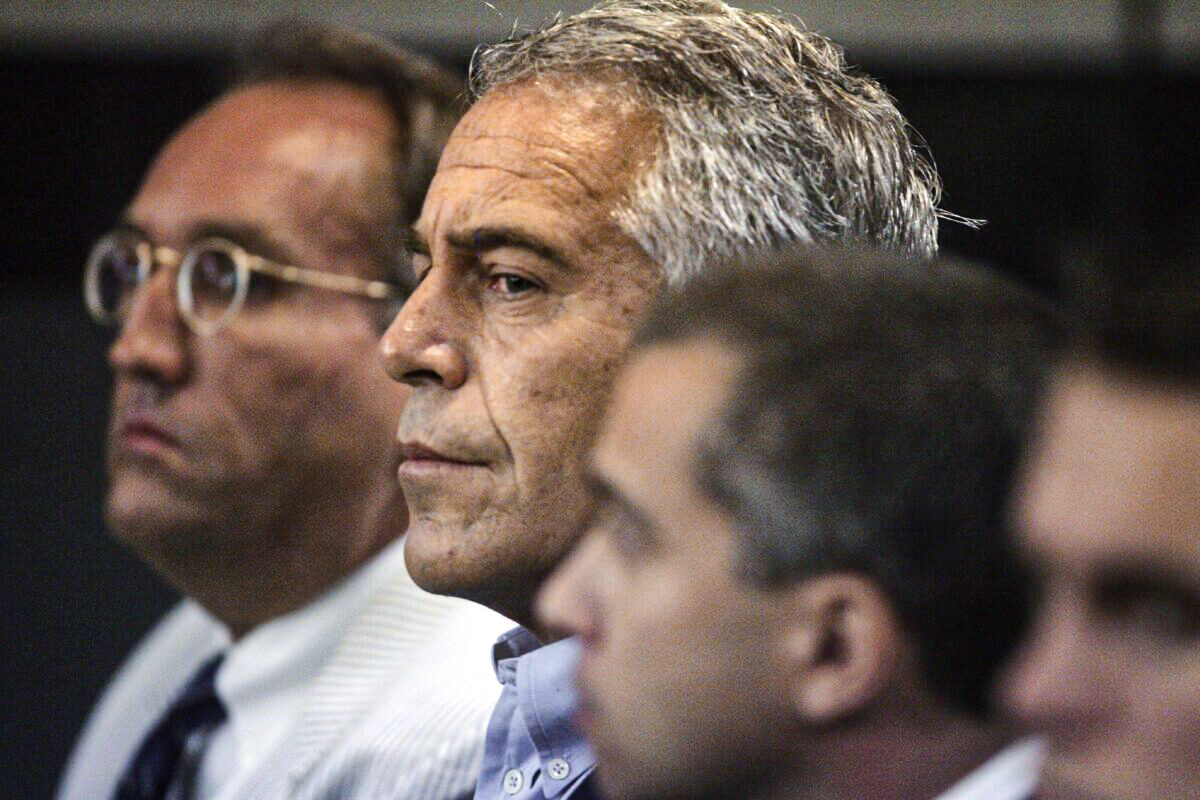
Jeffrey Epstein (C) appears in court in West Palm Beach, Fla., on July 30, 2008. (Uma Sanghvi/Palm Beach Post via AP)
‘A Blind Eye’
Filed on Dec. 27 in a Manhattan District Court, George’s lawsuit
stated that her office had investigated Epstein’s activities and found
that JPMorgan had “knowingly, negligently, and unlawfully provided and
pulled the levers through which recruiters and victims were paid and was
indispensable to the operation and concealment of the Epstein
trafficking enterprise.”
JPMorgan, she held, was “indispensable to the operation and
concealment” of the financier’s operation—even after his 2008 conviction
of soliciting prostitution from a minor.
“Upon information and belief, JP Morgan turned a blind eye to
evidence of human trafficking over more than a decade because of
Epstein’s own financial footprint, and because of the deals and clients
that Epstein brought and promised to bring to the bank,” the lawsuit
alleged.
“These decisions were advocated and approved at the senior levels of JP Morgan,” the filing added.
Further charging that JPMorgan unfairly profited from its
relationship with Epstein, the lawsuit requested unspecified damages for
alleged violations of sex trafficking, bank secrecy, and consumer laws
and asked that the bank be forced to relinquish any profits from its
dealings with Epstein.
The lawsuit followed two separate lawsuits
filed in New York on Nov. 24 by two unnamed women who accused Epstein
of sexual abuse. Those lawsuits alleged that JPMorgan and Deutsche Bank
AG facilitated Epstein’s sex trafficking operation by continuing their
financial relationships with him after his 2008 conviction.
Prior Settlement
In December, Epstein’s estate agreed to pay the U.S. Virgin Islands $105 million,
settling a previous lawsuit George had filed in 2020 over Epstein’s
fraud, sex trafficking, and child exploitation crimes in the territory
on his private island of Little St. James.
In that lawsuit, Epstein’s attorneys were accused of using a network
of shell companies to fraudulently obtain more than $144 million in tax
benefits, funding the purchase of the island and the financier’s sexual
abuse of women and children.
“The action was based on findings of our investigation that revealed
that Epstein and his co-defendants carried out an expansive criminal
enterprise through which dozens of young women and children were
trafficked to the Virgin Islands, raped, sexually exploited, and held
captive on Epstein’s secluded private island, Little St. James, over a
period of 15 years,” George noted at a press conference.
Epstein’s companies received tax benefits from the U.S. Virgin
Islands Economic Development Commission, an entity of the territory’s
Economic Development Authority (EDA) that grants approved applicants a
90 percent income tax exemption to encourage economic development in the
region.
Bryan, prior to his current role as governor, served as chairman of
the EDA from 2007 to 2014, under former Democratic Gov. John de Jongh.
According to the Virgin Islands Daily News, Bryan signed off on a 10-year package of economic incentives for Epstein’s Southern Trust Co. in 2013.
Meanwhile, De Jongh’s wife, Cecile, began working for Epstein in 1998
and was still listed as the office manager for Southern Trust Co. on
the EDA website several months after his alleged suicide in 2019, the
outlet reported.
Epstein, 66, died in a Manhattan jail in August 2019 while awaiting
trial on sex trafficking charges. His death was ruled a suicide by the
city’s medical examiner.
JP Morgan declined to comment, while Bryan’s office did not return an inquiry from The Epoch Times.
Oil prices swung wildly in 2022, climbing on tight supplies amid the
war in Ukraine, then sliding on weaker demand from top importer China
and worries of an economic contraction, but closed the year on Friday
with a second straight annual gain.
Prices surged in March as Russia’s invasion of Ukraine upended global
crude flows, with international benchmark Brent reaching $139.13 a
barrel, highest since 2008. Prices cooled rapidly in the second half as
central banks hiked interest rates and fanned worries of recession.
“This has been an extraordinary year for commodity markets, with
supply risks leading to increased volatility and elevated prices,” said
ING analyst Ewa Manthey. “Next year is set to be another year of
uncertainty, with plenty of volatility,” she said.
Brent crude on Friday, the last trading day of the year, settled at
$85.91 a barrel, up nearly 3% to $2.45 per barrel. U.S. West Texas
Intermediate crude settled at $80.26 a barrel, up $1.86 or 2.4%.
For the year, Brent gained about 10%, after jumping 50% in 2021. U.S.
crude rose nearly 7% in 2022, following last year’s gain of 55%. Both
benchmarks fell sharply in 2020 as the COVID-19 pandemic slashed fuel
demand.
Investors in 2023 are expected to keep taking a cautious approach, wary of interest rate hikes and possible recessions.
“The demand and demand growth is going to be a real question because
of the heavy-handed actions by the global central banks and the slowdown
that they’re trying to engineer,” said John Kilduff, partner at Again
Capital LLC in New York.
A survey of 30 economists and analysts forecast Brent would average
$89.37 a barrel in 2023, about 4.6% lower than the consensus in a
November survey. U.S. crude is projected to average $84.84 per barrel in
2023, down from the prior view.
While a jump in year-end holiday travel and Russia’s ban on crude and
oil product sales has supported crude, tighter supply will be offset
next year by declining fuel consumption due to a deteriorating economic
environment, said CMC Markets analyst Leon Li.
Oil’s decline in the second half of 2022 as rising interest rates to
fight inflation boosted the U.S. dollar. That made dollar-denominated
commodities like crude more costly for holders of other currencies.
The dollar was on track to post its biggest annual gain since 2015.
China’s zero-COVID restrictions, which were eased only this month,
had squashed demand recovery hopes. The world’s top oil importer and
second-biggest consumer in 2022 posted its first drop in oil demand for
years.
While China’s oil demand is expected to recover in 2023, a recent
surge in COVID-19 cases has dimmed hopes of an immediate boost in barrel
buying.
In an indicator of future supply, the U.S. oil and gas rig count rose
33% for the year, energy services firm Baker Hughes Co (BKR.O) said in
its latest report.