Thursday, August 6, 2015

Ghana Jubilee Field produces more than 37 million barrels of oil in 2014

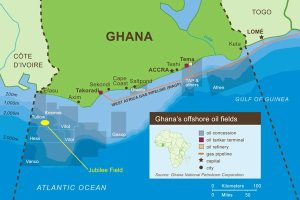
Jubilee field and Ghana offshore oil map


The Jubilee Field in Ghana produced more than 37 million barrels of oil in 2014, more than it did in 2013, according to the Ministry of Finance.

Reporting in accordance to the Petroleum Revenue and Management Act, the Ministry states that the total crude oil produced from the Jubilee Field in 2014 was 37,201,691 barrels, that is 101,976 barrels of oil per day (bopd), compared with a budget estimate of 33,955,644 barrels (93,029 bopd) and the 2013 output of 35,587,558 barrels (99,685 bopd).

The Ghana National Petroleum Company (GNPC), the Ministry noted, lifted eight crude oil cargos of 7,681,120 barrels from the Jubilee Field. This compares with seven crude oil liftings totaling 6,793,449 barrels in 2013.

Ghana discovered oil in commercial quantity in 2007 and production started in December 2010.
By Emmanuel K. Dogbevi

A Primer on Nigeria’s Oil Bunkering

Smoke rises as an illegal oil refinary burns after a military chase in a windy creek near river Nun in Nigeria's oil state of Bayelsa December 6, 2012. Despite billions of dollars worth of oil flowing out of Nigeria South East, life for the majority of Niger Delta's inhabitants remains unchanged. Most people live in modest iron-roofed shacks, and rely on farming or fishing, their only interaction with the oil industry being when they step over pipelines in the swamps – or when a spill blights their landscape. (Courtesy Reuters/Akintunde Akinleye)Smoke rises as an illegal oil refinary burns after a military chase in a windy creek near river Nun in Nigeria's oil state of Bayelsa December 6, 2012. Despite billions of dollars worth of oil flowing out of Nigeria South East, life for the majority of Niger Delta's inhabitants remains unchanged. Most people live in modest iron-roofed shacks, and rely on farming or fishing, their only interaction with the oil industry being when they step over pipelines in the swamps – or when a spill blights their landscape. (Courtesy Reuters/Akintunde Akinleye)

This is a guest post by Emily Mangan, an intern for the Council on Foreign Relations Energy and Environment Program. She studies environmental policy at Skidmore College.


After resuming from recess, the Nigerian Senate pledged to increase the country’s oil revenue by reducing oil theft. Doing so would greatly increase Nigeria’s total oil exports and reduce oil spills that cause severe environmental damage in the Niger Delta.

Every day, oil companies in Nigeria lose between 300,000 and 400,000 barrels of oil to illegal theft. Theft accounts for roughly 15 percent of Nigeria’s 2.4 million barrels per day produced. Oil theft, or “bunkering,” occurs throughout the Niger Delta, where pipelines crisscross the region. Oil export revenue accounts for 70 percent of Nigeria’s total government revenue and 95 percent of the country’s export income. A loss of 300,000 barrels a day costs the government roughly $1.7 billion a month. In comparison, only 5,000 to 10,000 barrels are stolen per day in Mexico, which produces a comparable amount of oil. Despite efforts by the Nigerian government to curtail bunkering by increasing security, theft and pipeline vandalism continues.

What is bunkering? 

The term bunkering encompasses all acts involving oil theft, including diversion and smuggling of oil and unauthorized loading of ships. One common process requires tapping into an oil pipeline and transporting the oil elsewhere to be sold internationally or refined locally. In order to access the oil, a small group of welders will puncture a pipeline at night, establishing a tapping point from which the group can operate.

What damage does it cause?

Oil spills and explosions are a regular occurrence in the Niger Delta. Pipeline vandalism from bunkering leaves pipes especially vulnerable to leaks, spills, and major accidents. Royal Dutch Shell PLC claims that 70 percent of all oil spills over the last five years were the result of sabotage to their facilities. In 2011, the United Nations Environment Program found in Ogoniland, located in Rivers State, oil pollution had devastated mangroves, contaminated soil and groundwater, destroyed the fish habitat, and posed a serious threat to public health. The study concludes that it could take up to thirty years to restore Ogoniland. But oil theft in the Niger Delta continues, and restoration is not likely to happen anytime soon. The degradation to the environment has reduced land arable for farming and has devastated fishing communities. Two thirds of the Nigerian population does not have access to clean drinking water and many have reported oil in drinking water sources.

Roughly a quarter of stolen crude oil is sold locally. Illegal artisanal refineries located in the Delta “cook” the crude into separate petroleum products. The end product yields 2 percent petrol, 2 percent kerosene, and 41 percent diesel. The remaining 55 percent of crude goes to waste, most of which is dumped into the nearby water or into a shallow pit.

Why has it persisted? 

Last year, the Nigerian Navy destroyed 260 illegal refineries by burning the site and, in some cases, pouring out the stolen oil into the creeks, exacerbating environmental damage. Despite the military’s efforts, other refineries pop up elsewhere because it is such a lucrative business. Each refining camp costs only about $4,700 to set up and can make $7,800 a month in profit. The cost of construction is typically no more than 7 percent of annual profits.

Until theft is reigned in, the Nigerian economy will suffer the loss of revenue from thousands of barrels of oil every day. Perhaps more importantly and too often overlooked, the Nigerian people will continue to cope with the consequences of their destroyed environment.

Nigeria names new head of state-run oil company

Dr. Emmanuel Ibe Kachikwu newly appointed GMD of NNPC 
Dr. Emmanuel Ibe Kachikwu newly appointed GMD of NNPC
 
http://news.yahoo.com/nigeria-names-head-state-run-oil-company-193133287.html 

Abuja (AFP) - Nigerian President Muhammadu Buhari has appointed a new head of the country's corruption-hit state oil company, weeks after after sacking the entire board, his spokesman said on Tuesday. Buhari took office on May 29 and axed Nigerian National Petroleum Company (NNPC) chief Joseph Thlama Dawha and his directors less than a month later after vowing to tackle what he called "the evil of corruption".

Emmanuel Ibe Kachikwu's appointment as NNPC group managing director was announced in a statement from Buhari's spokesman Femi Adesina, which also listed other changes at the top of the state-run company. 

No reason was given for Dawha's removal after just 10 months in the job, but changes at the much-criticised NNPC have become routine and observers believe the move may have been a prelude to an in-depth probe of its activities.

"This appointment marks the beginning of the reforms which will establish the NNPC as corporation which fights corruption and drives growth in the Nigerian economy," the company said in a statement.

Kachikwu, a former executive vice-chairman of Exxon-Mobil Africa from the coastal Delta State, is a Harvard-trained lawyer with 30 years' experience in the energy sector, according to the NNPC.

"I am excited to be taking up this challenge," Kachikwu was quoted as saying in the NNPC statement.

"Being in a position to manage the most important natural resource in Nigeria is a source of pride and responsibility for the NNPC and I am committed to taking this forward and helping the NNPC achieve its potential as a globally competitive national oil company."

Nigeria is Africa's largest oil producer, churning out roughly two million barrels of crude per day.
Ordinary people have largely not benefited from the nation's oil wealth, however, with much of the revenue lost to graft.

The NNPC is regarded as one of the world's most opaque and corrupt publicly-controlled oil firms and has been linked to the massive theft of vast crude revenues.

Wednesday, August 5, 2015

Oil bulls' hope for quick price dip dimmed by 2020 crude under $70


HOUSTON (Reuters) - As oil prices entered a second steep slide a few weeks ago, bullish traders and analysts had hoped for a repeat of the sharp but short dip that occurred early in the year - a speculative slide below $50 a barrel followed by a quick recovery.

Some are now reconsidering that view, as long-term oil prices take the lead in the market's latest dive, swaying sentiment toward a lengthier slump that would mean prolonged pain for big producers, from Exxon Mobil Corp to Saudi Arabia.

While immediate delivery benchmark global Brent crude oil futures at $50 a barrel are still about $4 higher than they were at their lowest point in January, prices for delivery in December 2020 are nearly $8 lower than the start of this year, trading at a contract low of less than $67 on Tuesday. A year ago the contract hovered at around $100 a barrel.

The reason for the deterioration of the forward curve and decline in "long-dated" futures is a subject of debate.

But even some who disagree with the fundamental logic of lower long-dated prices are coming round to the scenario that prices will be lower for longer.

"The back of the market has led prices lower as speculators are no longer convinced higher oil prices are required to balance future oil supply and demand," consultants PIRA Energy Group, which called last year's price slide but has also predicted a sharp rebound, wrote in a note this week. 

The firm does not make its specific forecasts public.

"PIRA disagrees with this view, but a 'show me' mindset regarding tightening balances will keep prices lower than forecast earlier."

Some believe the recent selloff was fueled by speculators fleeing the market amid collapsing confidence after China's stock market crash, and exacerbated by a lack of liquidity and resumption of hedging by producers including Mexico, which sell futures to guard against lower prices.

"The decline in calendar year 2016 prices has been

overstated, in our view," analysts at Barclays wrote this week. "Fundamental tightening, demand and stock revisions, and current

positioning are likely to raise prices in the months ahead."

Others say it stems from more deeply rooted fundamental factors, such as falling production costs in the U.S. shale patch and expectations of rising exports from Iran next year following a landmark nuclear agreement - and if so, far forward prices may be flashing warning lights for the future.

A NEW EQUILIBRIUM?

The retreat in long-term oil prices commenced in the latter part of last year, when Saudi Arabia made clear it would no longer cut production in order to tighten up sloppy markets.

Absent the kingdom's implicit promise to defend prices, the value of Brent crude oil for five years in the future slid from nearly $90 a barrel in late November to around $72 almost two months later.

Over the past month, however, it has dived anew, reaching nearly $66 a barrel on Tuesday, its lowest since 2009.

Last week, analysts at ABN AMRO cut its 2016 oil price forecasts by $10 a barrel on a mix of factors including falling production costs, disappointing demand, a stronger U.S. dollar and deteriorating market sentiment.

"What we see is that the U-shape recovery which we still expect for oil prices will take longer to materialize," Senior Energy Economist Hans van Cleef told the Reuters Global Oil Forum last week.

The question for oil executives, traders and analysts is whether this represents a new equilibrium for the market - a price high enough to encourage just enough new production in the future to meet demand, which continues to grow.

Standard Chartered's Paul Horsnell, one of the most bullish forecasters in Reuters monthly poll with a projection for $93 Brent in 2017, says no - long-dated prices are too low, although the latest slide may signal a deferred recovery.

"Is this a market transitioning from a view of an inevitable bounce in 2016 to adding another year onto the rebound? We just don't know yet," said Horsnell.

And while some big companies such as BP Plc and Royal Dutch Shell Plc are preparing investors for a more extended downturn, some are still signaling cautious optimism.

U.S.-focused Anadarko Petroleum Corp, for instance, is opting not to pursue an "aggressive" approach to completing shale wells that have been drilled but not yet hydraulically fractured.

Completing wells more quickly is "an option we might choose to pursue if we thought the current environment was going to be protracted and we were somehow in a new normal, $50-esque oil environment," Chief Financial Officer Bob Gwin told analysts last week.

"We don't believe that's true over the intermediate to longer term."

(Reporting by Jonathan Leff; Editing by Lisa Shumaker)
Tuesday, August 4, 2015

Asian VLCC rates tumble but vessel earnings remain robust on cheap bunker fuel


China Shipping Development Orders Four VLCCs


VLCC worldscale rates for voyages on Persian Gulf to East routes have tumbled over the past fortnight and are expected to fall further as the appetite of Asian buyers to import crude wanes, landed storage fills up and refineries undergo maintenance, market participants said Monday.

However the daily earnings of vessel owners remain robust despite the freefall in Worldscale rates due to falling bunker fuel prices, they said.

The key Persian Gulf to Japan Worldscale rate for VLCCs fell each day for eight consecutive trading days to w56 Friday from a year-to-date high of w88.5 on July 21, Platts data showed.

Daily earnings fell to around $53,000 from more than $85,000 over the same period, which market participants said was still quite healthy given earnings fell below $3,000 during a slump in early June 2014.

"Surplus availability of ships is dragging down the rates as tonnage requirement from cargoes isn't large enough," said a chartering source with a Japanese refiner.

Another chartering source with a South Korean refiner said every cargo was receiving 10-11 offers, reflecting the build-up in tonnage.

A VLCC broker in Singapore attributed the slump in rates to lower refinery margins in Asia and weak demand, and in particular to uncertainty over Chinese requirements.

Refinery margins were being hit as oil product prices tumbled in line with crude.

Several refineries that had earlier postponed routine shutdowns now plan to proceed with maintenance, which was already being reflected in the number of VLCC fixtures on Persian Gulf to East routes.

Around 60 VLCC cargoes for Persian Gulf loading in August are covered with tonnage to date, according to broker reports, compared with 90 in the corresponding period of July.

This already translates to a 60-million barrel month-on-month fall in demand, one broker said.

A VLCC typically carries 2 million barrels of crude.

"The huge spike in VLCC rates during the first half of the year was mainly due to the rush for onshore storage, which is now [almost] complete," the broker said.

The sharp fall in crude prices has also prompted refiners to buy only limited volumes in anticipation prices had further to fall.

VLCC DAILY EARNINGS ROBUST

However, VLCC owners are able to get decent returns even at current worldscale rates because lower crude prices have also pulled down the prices of fuel oil and bunker.

380 CST grade bunker delivered in Singapore was assessed at $284.50/mt Friday, down from $608.50/mt a year earlier, according to Platts data.

"Earnings are good due to cheaper bunker, which usually constitute about 50-60% of the total costs of a voyage, though they will vary with the speed of ships and destination of discharge," said a source with a VLCC owner.

At w55 on the Persian Gulf to South Korea route, worldscale rates are off highs but can still fetch almost $53,000/day, brokers said.

If bunker rates were $600-$650/mt, daily earnings would be almost zero, they said.

Market participants said it because fuel prices were down that shipowners were willing to lower rates rather than remain idle amid excess supply.

The four-week supply of ships is just over 90, said a derivatives trader tracking the VLCC markets.

There are still almost 50 ships available for loading until the end of the second decade of August, the broker said.

The ample supply has ensured that Nigeria's purported ban on more than 100 tankers from operating in its waters failed to support rates.

Some ships that opened in Fujairah early last month would be ready to take another long-haul voyage below last done levels to ensure daily earnings of around $50,000 before winter demand sets in, another dirty tanker broker said, adding PG-East worldscale rates were poised to dip below the w50 mark.

--Sameer C. Mohindru, sameer.mohindru@platts.com
--Edited by Wendy Wells, wendy.wells@platts.com

Nigerian Stolen Oil Funds: Nigeria, US Investigating Banks, Countries For Corruption

 Muhammadu Buhari
Nigerian President Muhammadu Buhari speaks at the United States Institutes of Peace, July 22, 2015, in Washington, D.C. Buhari has pledged to recover "mind-boggling" amounts of stolen oil money and hold accountable those responsible. Brendan Smialowski/Agence France-Presse/Getty Images 


With help from the United States, the Nigerian government announced Monday it was investigating which banks and countries were housing billions of dollars in stolen Nigerian state revenues, a local newspaper reported. Much of the looted monies were linked to Nigeria’s corrupt oil sector, in which 250,000 barrels of crude oil were believed to be stolen each day.

Nigerian President Muhammadu Buhari and his administration have enlisted help from the international community, including U.S. President Barack Obama’s administration, to pinpoint and recover the missing funds. In recent weeks, Nigeria’s new president has moved to strengthen bilateral relations with the United States and to keep his campaign promise of tackling corruption.

“We are getting cooperation from the international community, including information on ships that take crude oil from Nigeria and change direction, or pour their contents into other ships midstream,” Buhari said Monday at the presidential villa in Abuja, the Premium Times newspaper reported. “Some monies were paid to individual accounts. We are identifying the financial intuitions and countries that are involved.”

Buhari asked Obama to help trace the stolen funds before meeting with the U.S. president at the White House in Washington last month. In the oil sector alone, $150 billion was believed to have been stolen, Bloomberg reported. The Nigerian leader met Monday with U.S. Rep. Darrell Issa, R-Calif., in Abuja to discuss the steps taken to confront corruption issues in Nigeria, where the bulk of government revenue comes from its oil sales.

“I have been assured that when we get all our documents together, the United States and other countries will treat our case with sympathy,” Buhari said Monday, Premium Times reported.

During his visit to Nigeria, Issa announced that the United States was ready to provide training to the West African country to aid its fight against the radical Islamist group Boko Haram, which has claimed thousands of lives in three African nations, the Associated Press reported.

“We look forward to helping you in many ways to end the Boko Haram insurgency and the theft of crude oil in the Gulf of Guinea,” Issa, the leader of a U.S. congressional delegation, said Monday, Premium Times reported.

Monday, August 3, 2015

Congress looks underground for cash with U.S. Strategic Petroleum Reserve


http://www.bradenton.com/2015/08/03/5924106/congress-looks-underground-for.html

WASHINGTON -- In its quest to spend more money without raising taxes, Congress has found a new piggy bank. It's buried deep underground, protected by armed guards, and filled with a valuable commodity worth billions of dollars. It's the U.S. Strategic Petroleum Reserve, the country's emergency stockpile of crude oil.

Created in 1975 after Arab oil producers cut off exports to the U.S., causing gasoline prices to soar, the reserve was designed to immunize the country against supply shocks. It stores about 695 million barrels of crude oil in salt caverns in Texas and Louisiana.

While it's supposed to help ensure national security, the reserve has begun to look to Congress like a source of cash. In the past month, lawmakers have proposed two bills that call for the sale of 180 million barrels of oil, to raise almost $15 billion.

On July 10, the House passed a health care bill that would speed drug development and boost funding for medical research, paid for in part by $5.4 billion in expected oil revenue. In the Senate, Majority Leader Mitch McConnell of Kentucky and Democrat Barbara Boxer of California have struck a rare bipartisan alliance with a bill that seeks to replenish the depleted U.S. Highway Trust Fund with $47 billion over six years. About $9 billion of that would come from selling 101 million barrels of reserve crude from 2018 to 2025.

Not every lawmaker thinks this is a good idea. On July 21, after the Senate highway bill was introduced, Alaska Republican Lisa Murkowski, who chairs the Senate Energy and National Resources Committee, tore into her colleagues in a speech on the Senate floor. "The Strategic Petroleum Reserve is not an ATM," she said. While Murkowski said she supports

finding a long-term fix for the Highway Trust Fund, she said doing so by selling crude from the SPR is "akin to selling the insurance on your house in order to pave your driveway."

This wouldn't be the first time Congress has used oil to plug a spending gap. The U.S. sold 28 million barrels from the reserve in 1996 and 1997 to cut the federal budget deficit. The Department of Energy has also periodically released oil to avoid supply disruptions, as it did after Hurricane Katrina and during the 2011 Libyan revolution.

The fracking boom has pushed U.S. oil production to 9.7 million barrels a day, almost double what it was a decade ago. Imports have fallen and now make up less than half of all the petroleum the U.S. consumes. While increased energy independence may insulate the U.S. from supply shocks, it's also partly responsible for the recent plunge in prices. As of late July, a barrel of West Texas Intermediate was trading for less than $50, down from $100 last summer.

This is hardly an ideal time for the government to sell oil, especially when the explicit purpose is to raise money. "It's a bad idea regardless of price," said Guy Caruso, a former administrator of the Energy Information Administration, which tracks and analyzes U.S. energy data.

According to the Congressional Budget Office, Congress expects to be able to sell oil for $75 a barrel in 2018, and for as much as $96 a barrel in 2025. While the EIA forecasts that oil prices will recover to about $70 by 2018, the futures market isn't as optimistic. WTI scheduled for delivery in 2020 was priced at $63 a barrel as of last Wednesday.

The initial version of the highway bill laid out a schedule for the Energy Department that detailed the number of barrels to be sold each year. On July 28, Sen. Ron Wyden, D-Ore., and Sen. Bill Cassidy, R-La., inserted an amendment to give the government flexibility to decide when to sell and for how much. It also extends the period in which the government can sell the oil from 8 to 10 years.

Read more here: http://www.bradenton.com/2015/08/03/5924106/congress-looks-underground-for.html#storylink=cpy