Tuesday, August 14, 2018

Saudi Arabia And Iran Reignite The Oil Price War

http://ifpnews.com/wp-content/uploads/2017/08/photo_2017-08-15_11-13-40-696x392.jpg

https://oilprice.com/Energy/Oil-Prices/Saudi-Arabia-And-Iran-Reignite-The-Oil-Price-War.html


The rivalry between Saudi Arabia and Iran is becoming increasingly evident in the oil pricing policies of the two large Middle Eastern producers. The two countries are currently reigniting the market share and pricing war ahead of the returning U.S. sanctions on Iranian oil.

Saudi Arabia, OPEC’s largest producer, has been boosting oil production to offset supply disruptions elsewhere, including the anticipated loss of Iranian oil supply after U.S. sanctions on Tehran return in early November. The Saudis are also cutting their prices to the prized Asian market to lure more customers as they increase supply.

Iran, OPEC’s third-largest producer, is trying to convince its oil customers to continue buying Iranian oil despite stringent U.S. efforts to curb Iranian production.

Iran has slashed its official selling prices (OSPs) for all grades to all markets for September, looking to monetize what could be its last oil sales to some markets in Asia before the U.S. sanctions kick in. Tehran cut the prices for its flagship oil grades to more than a decade low compared to similar varieties of the Saudi crude grades, according to data compiled by Bloomberg.

Last week, the National Iranian Oil Company (NIOC) slashed the OSP for the Iranian Light crude grade to Asia by US$0.80 to US$1.20 a barrel above the Dubai/Oman average, used for pricing oil to Asia. The September prices for Iranian Light to Asia are at a 14-year-low compared to the similar Saudi grade sold to the world’s fastest-growing oil market, Bloomberg has estimated.

Earlier this month, the Saudis also slashed the September prices to Asia for their flagship grade, Arab Light, by US$0.70 to US$1.20 a barrel premium over the Dubai/Oman average. The reduction was slightly deeper than expected and the second consecutive monthly cut in pricing. The Saudis cut the prices for all their grades to all markets except for the United States.

Now Iran is also slashing prices for all grades to all markets, with the prices for Iranian Light, Iranian Heavy, Forozan, and Soroush grades to Asia, Northwest Europe, and the Mediterranean all cut by between US$0.50 and US$1.45, depending on the market and grades.  


The OSPs for Iranian Heavy and Forozan to Asia were slashed against the similar Saudi grades to their lowest levels since at least 2000, the year in which Bloomberg started compiling the data.

Iranian Light and the Saudi Arab Light for Asia for September are now priced at the same level—US$1.20 a barrel above the Dubai/Oman average.

For the Saudis, the cut is aimed at enticing more buyers in order to take advantage of the refiners in Asia that are looking to cut Iranian oil intake for fear of running afoul of the U.S. sanctions. For Tehran, the cut in prices is an attempt to keep refiners buying by offering yet another incentive for them on top of the extended credit periods and nearly free shipping.

It has also been reported that Iran has started to offer India—its second-biggest oil customer after China—cargo insurance and tankers operated by Iranian companies as some Indian insurers have backed out of covering oil cargoes from Iran in the face of the returning U.S. sanctions on Tehran.

India’s imports from Iran could start to slow from August as some big Indian refiners worry that their access to the U.S. financial system could be cut off if they continue to import Iranian oil, prompting them to reduce oil purchases from Tehran. 
 

The U.S. hasn’t been able to persuade Iran’s biggest oil customer China to reduce oil purchases, but Beijing has reportedly agreed not to increase its oil imports from Iran.

Other relatively large Asian buyers of Iranian oil—South Korea and Japan—are looking for U.S. guidance and (possibly) waivers before deciding how to proceed, but they are currently very cautious and on the lookout for alternative supplies.

Analysts, and reportedly the U.S. Administration itself, currently expect the sanctions to remove around 1 million bpd from the oil market.

Considering the intensity of efforts by the U.S. to cut off as much Iranian oil exports as possible, it is unlikely that even Iran’s significant discounts to Asian customers will save the country’s oil exports.
By Tsvetana Paraskova for Oilprice.com


Monday, August 13, 2018

Venezuela's Citgo Refineries At Risk Of Seizure


In 2007, following Venezuela's expropriation of billions of dollars of assets from U.S. companies like ExxonMobil and ConocoPhillips, I suggested a potential remedy.

Since Venezuela's state-owned oil company, PDVSA (Petróleos de Venezuela, S.A.) owns the Citgo refineries in the U.S., the companies that had lost billions of dollars of assets should target these refineries for seizure as compensation.

These refineries have the same vulnerabilities as the U.S. assets in Venezuela that were seized. They represent infrastructure on the ground that can't be removed from the country.

Citgo has three major refining complexes in the U.S. with a total refining capacity of 750,000 barrels per day. Recognizing the vulnerability from asset seizure, PDVSA tried to sell these assets in 2014, and valued them at $10 billion. That value may be grossly overstated, considering that Venezuela subsequently pledged 49.9% of Citgo to Russian oil giant Rosneft as collateral for a $1.5 billion loan.
In recent years, PDVSA has lost a series of arbitration awards related to expropriations, and companies have been looking for opportunities to collect. In May, ConocoPhillips seized some PDVSA assets in the Caribbean to partially enforce a $2 billion arbitration award for Venezuela's 2007 expropriation.

ConocoPhillips had sought up to $22 billion -- the largest claim against PDVSA -- for the broken contracts from its Hamaca and Petrozuata oil projects. The company is pursuing a separate arbitration case against Venezuela before the World Bank’s International Centre for Settlement of Investment Disputes (ICSID). The ICSID has already declared Venezuela's takeover unlawful, opening the way for another multi-billion dollar settlement award that may happen before year-end.
 
Last week, a court ruling has opened the door for Citgo assets to be seized to pay for these judgments.
Defunct Canadian gold miner Crystallex had been awarded a $1.4 billion judgment over Venezuela’s 2008 nationalization of a Crystallex gold mining operation in the country. A U.S. federal judge ruled that a creditor could seize Citgo's assets to enforce this award.

This ruling is sure to set off a feeding frenzy among those that have won arbitration rulings against Venezuela. Until the legal rulings are settled, it's hard to say which companies will end up with Citgo's assets. But it's looking far more likely it won't be PDVSA.

Robert Rapier has over 20 years of experience in the energy industry as an engineer and an investor. Follow him on Twitter @rrapier or at Investing Daily.

Trafigura to Build U.S. Deep-Water Oil Port

Trafigura

Swiss commodities trader Trafigura has applied to build a deep-water port in Corpus Christi, Texas, on the Gulf of Mexico, which will be able to load supertankers, reports FT.

The report said that the plan would see the commodity house build an offshore deepwater port facility with a view to accommodate very large crude carriers (VLCC) capable of carrying more than 2m barrels of crude. It requires approval from the US Department of Transportation’s maritime division.

According to a Reuters report, United States began exporting crude oil in 2016 after the ban on exports was lifted but while its production and therefore exports keep hitting new highs, its infrastructure has not kept up.

The United States exports over 2 million barrels per day of crude while output hit 11 million bpd for the first time last month, making the country the biggest producer in the world after Russia.

According to a press release from the company, VLCCs are the most economical and efficient way of transporting crude around the world, carrying up to 2 million barrels per voyage, however no US inland ports are capable of fully loading a VLCC. Currently, to fully load a VLCC multiple Ship To Ship Transfers (STSs) are performed in lightering zones out at sea.

On July 9, 2018, Texas Gulf Terminals, Inc., owned by Trafigura US Inc., part of privately-held physical trading and logistics company with offices in Houston, Texas, submitted its permit application for a new Project. The Texas Gulf Terminals Project is a new offshore Deep Water Port facility that will allow VLCCs and other tankers to load cargo safely, directly and fully via a single-point mooring buoy system (SPM).

Using SPMs eliminates unnecessary ship traffic in inland ports as well as the “double handling” of the same crude oil, reducing the opportunity for spills and emissions each time the crude oil is transferred. Once constructed, this globally-proven technology, will ease infrastructure barriers to crude oil exports, grow the U.S. economy, and support jobs.

The Texas Gulf Terminals Project is the latest in a series of long-term investments that Trafigura has made in communities across the U.S., including a nearly USD1 billion investment in the premier marine export terminal and condensate splitter in Corpus Christi, Texas (Buckeye) and the construction of the Burnside Bulk Storage Terminal in Darrow, Louisiana, which rebuilt a site from the mid-1950s into a state-of-the-art bulk facility designed to facilitate international exports.

“The Texas Gulf Terminals Project will give U.S. crude oil producers, particularly Texas operators, safer, cleaner and more efficient access to very large crude carriers, ensuring that the economic and employment benefits of increasing domestic crude production can be fully realized right here at home,” said Corey Prologo, Director, Texas Gulf Terminals Inc. and Director of Trafigura, North America.


Friday, August 10, 2018

U.S. Sanctions Threaten India's Importation of Iranian Oil


https://nationalinterest.org/blog/middle-east-watch/us-sanctions-threaten-indias-importation-iranian-oil-28252

Washington has said that to achieve significant reductions in Iranian oil exports it needs India to observe the sanctions.

When the United States pulled out of the Iran nuclear deal in May, it told countries trading with Iran that they would have to stop soon or face American sanctions. 
 
As the first ninety-day wind-down period for ceasing trading with Iran comes to an end, Washington is ratcheting up the pressure on the main importers of Iranian crude oil. 

However, most of the other countries that signed the nuclear deal —including many in Europe—continue to support it. But companies, not governments, import oil—and they are likely to buckle under the U.S. pressure.

A key exception is Chinese companies, which collectively amount to the world’s largest buyer of Iranian oil. They remain defiant against the U.S. sanctions threat, a stance which their government obviously supports. The defiance comes as tension with America already increasing due to a trade war that Washington started. 

The European Union is also embroiled in a trade war with the United States. This is increasing the pressure on European companies to comply with Washington’s no-trade-with-Iran order. Most have said they will comply with it.

Another important player in the Iran sanctions game is India. In fact, the United States has said that to achieve significant reductions in Iranian oil exports it needs India to observe the sanctions.

Iran’s geographical proximity to India, coupled with India’s growing demand for petroleum, made an oil trading partnership between the two almost inevitable. 

In 2017, India imported almost 40 percent of its oil from Iran, making it the second-largest importer of Iranian crude, behind China. India bought $13 billion worth of petroleum products from Iran that year, with crude accounting for the vast majority 

The energy cooperation between Tehran and Delhi has not been limited to oil and gas trading, however. 

After the Iran nuclear deal was signed in the summer of 2015, India began making major investments in Iran’s oil industry, including building petrochemical and fertilizer plants. 

India has also wanted to invest in the Farzad B gas field. An Indian consortium led by the state-owned Oil and Gas Corporation discovered the field in 2012, and it began producing in 2013. A dispute over the terms of India’s participation in the field’s production has prevented a deal from being reached, however. 

Meanwhile, Iran’s plan to build a gas pipeline through Afghanistan and Pakistan to India has been stalled due to disagreements over the terms of the deal. 

Furthermore, after Iranian President Hassan Rouhani visited India in February, the countries expressed optimism that their trade would double. 

Two events undermined that optimism, however. One was the United States increasing its threats to pull out of the Iran nuclear deal —which it ended up making good on in May. The other was Saudi Arabia, Iran’s main political rival in the Middle East, stepping up its energy diplomacy toward India. 

In April, Saudi Aramco signed a deal with a consortium of Indian companies led by the state-owned Indian Oil Corporation to take a 50 percent stake in a $44 billion mega-refinery and petrochemicals complex that will be built in the port city of Ratnagiri. The Saudis calculated that helping India create one of the world’s largest refining and petrochemical complexes would not only help tilt it away from Iran but also guarantee long-term Saudi crude sales to India 

Meanwhile, the United States has been increasing its diplomacy toward India, with the key goal of persuading India to embrace sanctions against Iran. 

In addition, America’s ambassador to the United Nations, Nikki Haley, who is of Indian descent, visited New Delhi last month to ask that India reduce its Iranian oil imports. 

A U.S. Treasury Department delegation followed. It was led by Marshall Billingslea, the department’s assistant secretary for anti-terrorism financing. Given Billingslea’s background, one topic was likely to be a scheme that Iran and India used to avoid previous U.S. sanctions against Iran.
The two visits are already yielding results for Washington. 

Indian refineries have begun canceling oil import contracts with Iran. Hindustan Petroleum, which owns India’s third-largest refinery, canceled an Iranian oil shipment in July when its insurance company refused to cover the sale because of impending U.S. sanctions. 

In addition, news surfaced that Indian conglomerate Reliance Industries , which owns the largest refining complex in the world, also planned to halt Iranian oil imports. 

Fearing aggressive Trump administration policies towards Iran, India is also expected to scrap the rupee-based trade agreement it concluded with Iran three years ago, Iranian sources say. 

India had used the rupee-rial arrangement to buy Iranian oil before U.S. sanctions were lifted against Iran in 2016. The two sides used Turkey’s Halk Bank as an intermediary in their trading. 

In May, a federal judge in New York sentenced a top Halk Bank executive to three years in prison for designing and carrying out the scheme. U.S. prosecutors had contended that the deal was used to evade U.S. sanctions against Iran that the Obama administration imposed before the nuclear deal.

Washington has said that to achieve significant reductions in Iranian oil exports it needs India to observe the sanctions.

Before he became assistant Treasury secretary for anti-terrorism financing, Billingslea was managing director of business intelligence services for Deloitte, where he focused on illicit finance. In the wake of the prison sentence against the Halk Bank executive for the rupee-rial scheme, it was significant that after Billingslea left India, his next destination was Turkey . 

India did obtain one sanctions-related victory from the United States, however. Washington agreed to allow it to invest in the expansion of Iran’s port of Chabahar if it complies with U.S. import sanctions against Iran. 

Chabahar is key to an Indian policy of offsetting Pakistan’s and China’s use of Pakistan’s port of Gwadar to project more power in the region. China has made renovation and expansion of the port of Gwadar an integral part of its $62 billion China-Pakistan Economic Corridor project. The project includes a naval base. 

Chabahar is only 107 miles from Gwadar. Iran has asked India to help it build steel and petrochemical plants in the port to boost its economy and increase development along the Makrān coast. It also plans to create a free trade zone in the port to try to spur economic growth. 
 
With so many countries trying to flex their muscle in the region —the United States, Saudi Arabia, Iran, China and Pakistan—India is likely to find it harder to strike a balance between competing interests in the Middle East and Southwest Asia.

It will continue to accommodate Iran by supporting the nuclear deal and by participating in mutually beneficial projects such as the expansion of the port of Chabahar.

But it will be increasingly difficult and dangerous for Indian refining and petrochemical companies to find wiggle room that allows them to avoid U.S. sanctions, as they once did. 
 
Rauf Mammadov is a resident scholar at Middle East Institute and Senior Advisor at Gulf State Analytics. 
 
Omid Shokri Kalehsar is a Washington-based senior energy security analyst, and Ph.D. Candidate in International Relations at Yalova University, Turkey. 
 
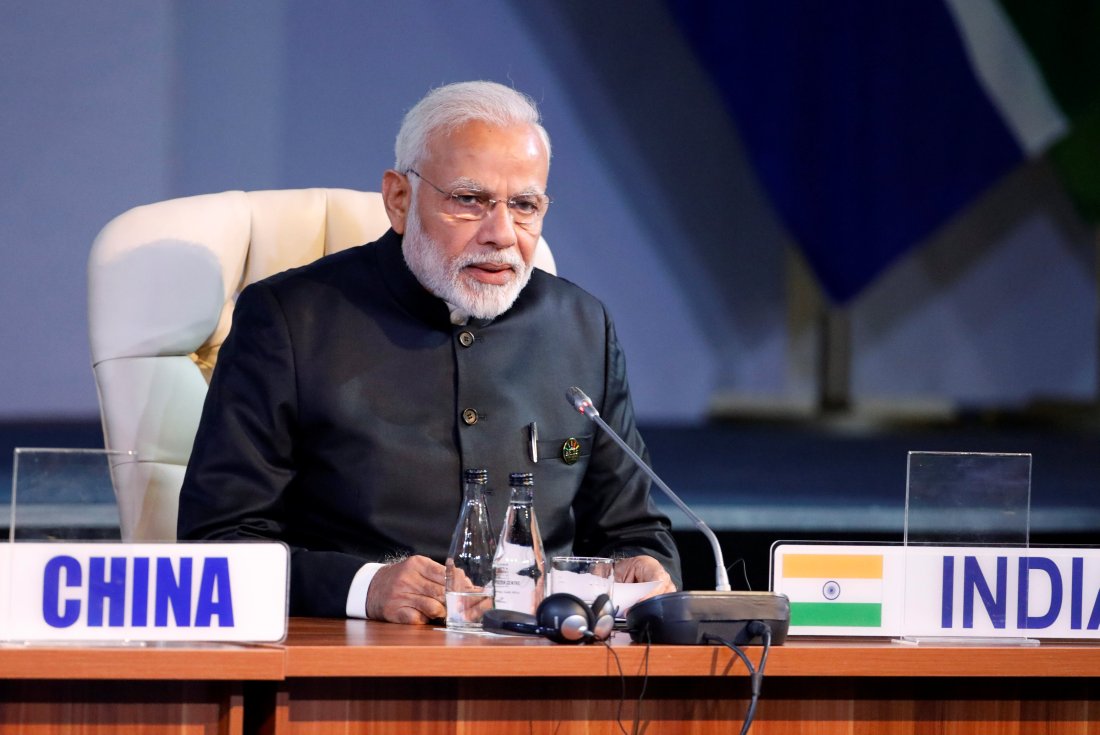
Image: Indian Prime Minister Narendra Modi attends the BRICS summit meeting in Johannesburg, South Africa, July 27, 2018. REUTERS/Mike Hutchings

Thursday, August 9, 2018

Record US refinery product volumes

Oil Refineries In The Us Map Usrefineries 


In a recent weekly petroleum report, the US Energy Information Administration (EIA) noted that US refineries are running at near-record levels. 
 
The four-week average of gross domestic refinery inputs surpassed 18 mill barrels per day for the first time since the EIA started publishing this data in 1990. The last time refinery inputs approached 18 mill barrels per day was in the week of 25th August, 2017 - the week before Hurricane Harvey made landfall, Poten & Partners said in a comment.
 
The US economy is currently running on all cylinders and GDP growth reached an annual rate of 4.1% in the second quarter, which  is driving domestic product demand up, in particular for gasoline and distillate fuel oil, which (combined) count for almost 75% of domestic refinery output.
 
Exports of refined petroleum products are strong as well. Refined product exports (which includes LPGs and Pet Coke) have more than tripled over the last ten years, from an average of less than 1.8 million b/d in 2008 to 5.5 million b/d in 2018 year-to-date and the upward trend shows no sign of slowing down. Do these increases in activity have a noticeable impact on product tanker employment and rates?
 
Refinery inputs are seasonal and typically peak in the summer. Refinery maintenance increases in the spring when refiners are retooling their facilities to make summer gasoline. The same happens in the fall when they switch back to winter grades.
 
For many years, US refining capacity expansions were limited to capacity creep, ie, small increases in distillation capacity due to minor de-bottlenecking within existing facilities (often during maintenance turnarounds).
 
However, since 2011, US refinery capacity has increased by 862,000 barrels per day, partly due to the commissioning of four small new facilities (mostly condensate splitters) in Texas and one in North Dakota.
 
Motiva significantly expanded its refinery at Port Arthur and Valero did the same with its Corpus Christi facility. Some idled capacity has been brought back on line as well. In short, US refineries are in good shape, especially those on the Gulf Coast. They have access to surging light tight oil production, as well as abundant Canadian barrels. Due to the ample availability of shale gas, they also enjoy low energy costs.
 
So, have these positive dynamics for refinery runs and product exports translated into increased demand and higher rates for product tankers? Yes and no. Yes, there is more demand for product tankers to move increasing volumes of products to Europe, Latin America and Asia. However, the rates for product tankers do not reflect these higher levels of activity. Indeed, rates during the first six months of this year have been the lowest since 2014.
 
Except for the fourth quarter, when rates typically go up, there are no obvious seasonal patterns in this market. Although product tanker rates have been rather disappointing so far this year, that should not come as a big surprise. The product tanker market is a global market and significant deliveries of MRs (the vessel of choice in these trades) during 2014-2016 created significant overcapacity that the markets are still trying to work off.
 
Projected deliveries for the remainder of this year and 2019 are less than in previous years and if tonne/mile demand continues to grow, the outlook for the product market is rather positive. The shift towards low sulfur bunker fuels in 2020 represents a significant wild card.
 
This change may create dislocations in the marine fuels markets and therefore additional employment opportunities for product carriers, starting in the second half of 2019. In the US, refinery output is expected to continue to grow faster than domestic demand and the outlook for refined product exports is therefore bullish, Poten & Partners said.

Wednesday, August 8, 2018

German central bank blocks $400 million cash delivery to Iran ahead of crippling US sanctions

Rouhani Merkel REUTERS 
Angela Merkel's government had been seeking to circumvent pending U.S. sanctions; the sanctions have heaped pressure on Iranian President Hassan Rouhani (left)  (Reuters)


The U.S. campaign to rein in Iran has scored a victory in the German financial sector, after the Deutsche Bundesbank− the country’s central bank− imposed a rule stopping a $400 million cash delivery to Tehran.

Iran's cash-starved economy desperately needs hard currency ahead of crippling U.S. bank sanctions that will be introduced in November.

Germany allows the Iranian-owned European-Iranian trade bank (EIH) to operate in Hamburg. The EIH holds more than $400 million that Tehran wants to receive in cash ahead of a second wave of U.S. sanctions due in November that impact banks and Iran’s energy sector.

The Deutsche Bundesbank has cooperated with the EIH in the past to circumvent U.S. sanctions on Iran. The U.S. and the European Union previously sanctioned the EIH for its role in advancing Iran’s nuclear and missile programs. The sanctions on the EIH were lifted after the world powers reached an agreement to curb Iran's nuclear program in 2015.


But President Trump effectively tore up the “decaying and rotten” deal in May and vowed to impose greater sanctions on the regime.  
The disclosure in July that German Chancellor Angela Merkel's government was seeking to circumvent the pending sanctions triggered the U.S. ambassador to Germany to urge her government to stop the massive payment transfer.

“We are grateful to our German partners for recognizing the need to act.

Iran’s malign activities throughout Europe are a growing concern,” Richard Grenell, the U.S. ambassador to Berlin, told FoxNews.com. Grenell, a former Fox News contributor, led the campaign to persuade German authorities to prevent the cash transfer.

The U.S. embassy to Berlin tweeted: "Close partnership = results.  Thank you to our German counterparts for acting to stop Iran’s activities."

The German central bank's new anti-Iran rule is slated to go into effect on August, 25.

Chancellor Merkel's efforts to send more than $400 million to the mullah regime echoes the Obama administration’s 2016 delivery of $1.7 billion in cash to Tehran, as part of a ransom to secure the release of American hostages held by the Islamic Republic.

President Trump has repeatedly slammed his predecessor for sending the cash.

The United States government has classified the Islamic Republic of Iran as a top state-sponsor of terrorism. The Merkel administration is going to great lengths to promote trade with Tehran. The German Economy Ministry said on Monday “export guarantees and investment guarantees from the Federal Ministry of Economic Affairs are still available to companies” that want to operate in Iran.
Germany's government provides 57 companies with more than $1 billion in export and investment guarantees for their business with Iran. 


Major German multinational companies, however, are voting with their feet. 

Automobile manufacturer Mercedes-Benz announced on Tuesday that it had frozen all business with Iran due “to applicable sanctions.” The first wave of U.S. sanctions kicked in on Tuesday and will impact Iran’s automobile sector, as well as trade in precious metals.

Sportswear giant Adidas meanwhile followed the lead of its U.S. competitor Nike and pulled the plug on its business with Iran.

Adidas said in a statement last week that it will not extend commercial agreements with Iran's soccer association. Iran's state- controlled media reported that Adidas withdrew from Iran's market because it fears damage to its business in the U.S.

Peter Kohanloo, the president of the U.S.-based Iranian American Majority organization, told FoxNews.com: “Germany, France and the UK always talk about human rights and democracy, but by resisting more sanctions, they’re actively opposing a growing revolution inside Iran to replace one of the most egregious human rights violating dictatorships in the world.

“Germany is making a huge mistake by injecting much-needed cash into the mullahs’ resistance economy as they murder Iranian protesters.”


In a joint statement on Monday, Federica Mogherini, the EU’s foreign policy chief, and the foreign ministers of Britain, France and Germany said: “We are determined to protect European economic operators engaged in legitimate business with Iran.”

The EU implemented a “blocking statute” to insulate EU companies active in the Islamic Republic from American sanctions.

The Association of German Chambers of Commerce and Industry said on its website that in the first five months of this year, exports to Iran dropped by four percent.

Over the last few years, 120 German companies have opened offices in Iran, according to the German industry group, but that trend is sinking.  

German exports to Iran climbed to $3.96 billion in 2017, up from $2.89 billion in 2016.

Revival of Sanctions Delay China, Russia Oil-Field Deals in Iran

The prospect of  U.S. sanctions on Iran are threatening foreign investment in the Islamic Republic’s oil-and-gas industry, which may affect sites such as Iran’s port at Bandar Abbas.


China, others say they will resist U.S. demands to wind down oil-import deals with Tehran. But banking problems complicate investments in Iran’s oil and gas fields

By Benoit Faucon

China, Russia and India say they will continue to buy petroleum from Iran, despite U.S. sanctions that would prohibit those sales, although banking difficulties are hampering their ability to invest in the Islamic Republic’s oil fields.

Asian oil investors in Iranian projects in recent months discovered that they couldn’t rely on their usual banking partners in the United Arab Emirates to transfer funds for projects in Iran. That has delayed several deals worth billions, according to foreign development officials and people at the companies involved.

Tuesday marked the start of a transition period that gives oil companies until Nov. 4 to adjust to a returning U.S. ban on buying and investing in Iranian oil and gas—the country’s most lucrative industry. The move followed President Trump’s decision in May to pull out of the nuclear agreement with Tehran.

“Anyone doing business with Iran will NOT be doing business with the United States,” Mr. Trump said in a predawn posting Tuesday on Twitter.

Oil companies have been given until Nov. 4 to wind down purchases of Iran oil or investments in the country’s fields—or else face U.S. sanctions.

The Trump administration said it would soon restore sanctions against Iran. The WSJ's Gerald F. Seib looks at a possible reason behind the policy change. Photo: Getty 
 
China, Russia and India have been boosting imports of Iranian oil since earlier U.S. sanctions were lifted in January 2016, as a part of broader deal on Iran’s nuclear ambitions.

Just as Mr. Trump was issuing his warning, a delegation from China Petroleum & Chemical Corp. , or Sinopec, a Chinese state-owned oil company, was negotiating a $3 billion investment in a giant Iranian oil field in Tehran, according to Iranian contractors and a Sinopec adviser. The project, in the Yadavaran oil field, could generate as much as 100,000 barrels a day.

Sinopec had initially hoped to complete the deal in July, according to people close to the company. But they say Sinopec is now struggling to find appropriate banking channels for the transaction. Chinese companies often use banks in Dubai to transfer money to Iran, but banking authorities in the United Arab Emirates financial center have begun in recent months to crack down on transactions destined for Tehran. 

The U.S. Treasury Department said last month that it had helped break up a network funneling illicit funds through the U.A.E. to Iran.

Similar issues have arisen for China National Petroleum Corp. The state-owned company has an option to invest $1 billion in an Iranian natural-gas project. France’s Total SA had pledged to put up the money, but the company is now considering exiting the deal due to U.S. sanctions.

The problem for CNPC, said a company official: “Banking goes partly through Dubai” for its Iran business. “We are having lots of issues,” the official said.

Russian state-owned oil company Zarubezhneft JSC agreed in March to a preliminary a $700 million contract to develop two small fields in Iran. The company had promised to complete the deal in June but has continued to delay the agreement, according to Iranian contractors involved in the project.
Zarubezhneft JSC didn’t return a request for comment.

Talks with India’s state-run Oil and Natural Gas Corp oration Ltd. to enter a $900 million onshore field and a $6.2 billion natural-gas field in the Persian Gulf have also yet to bear fruit.

ONGC didn’t return requests for comment.

Indonesian state energy company Pertamina provides another example of the uncertainty troubling investment in Iran. In March, the company said it won the tender to get an 80% stake in a $6 billion oil project that could generate 200,000 barrels a day. “It makes no difference” if Mr. Trump reinstate sanctions, Indonesia’s ambassador Octavino Alimudin told The Wall Street Journal that month. “We are the alternative” to European companies, he said.

In early May, a Pertamina team arrived at a Tehran oil conference and told its Iranian counterparts it would sign the final investment deal that week at a public ceremony, according to people involved in the talks. The transaction was supposed to close on May 9, but Mr. Trump took Iran by surprise on May 8, announcing he would bring back sanctions, days before a self-imposed deadline of May 12. The Indonesian delegation left the trade fair and flew back home. 

Three months later, the deal has yet to be signed.

A Pertamina spokesman said it had yet to decide on the investment and said the company was worried about returning U.S. sanctions.

Iran’s oil ministry didn’t return requests for comment. Mr. Alimudin didn’t return a phone call.
Write to Benoit Faucon at benoit.faucon@wsj.com