.jpg)

Iraq has invited major U.S. oil companies to develop the giant West Qurna 2 field following Russian energy giant Lukoil’s forced exit under Western sanctions. The move represents a significant shift in Iraq’s energy partnerships and a major opportunity for American firms to regain ground in one of the world’s largest oilfields.
West Qurna-2 is one of the world’s largest onshore oilfields, located 65 kilometers northwest of Basra in southern Iraq. The field holds initial recoverable reserves of approximately 14 billion barrels, with more than 90% concentrated in the Mishrif and Yamama formations.
The field currently produces about 9% of Iraq’s total oil output, with capacity reaching 480,000-500,000 barrels per dayfollowing completion of its second development phase. At peak efficiency, the field can sustain production between 635,000 and 650,000 bpd.
Russian oil company Lukoil held a 75% operating stake in West Qurna-2, with Iraq’s state-owned North Oil Company holding the remaining 25%. Lukoil declared force majeure at the field after the United States rejected a sanctioned asset sale, effectively forcing the Russian company out of the project.
In early December 2025, Iraq temporarily shut down production at the field due to a pipeline leak, though operations were later restored. The disruption added urgency to Iraq’s search for a new operator.
Iraq’s Oil Ministry has now extended exclusive invitations to several major U.S. energy firms to take over development of West Qurna-2. Chevron has entered the race for the field, while ExxonMobil is in active talks with Iraqi officials about acquiring Lukoil’s stake.
ExxonMobil recently signed agreements to develop Iraq’s Majnoon oil field, marking the company’s return to Iraqi upstream operations after exiting the West Qurna-1 project in early 2024. The Majnoon deal demonstrates ExxonMobil’s renewed commitment to Iraq and positions the company as a strong contender for West Qurna-2.
The shift represents a reversal of Iraq’s energy trajectory over the past decade, during which Russia and China built deep leverage in the country through oil contracts, pipeline control, and ties to Iran-backed groups. Western companies are now regaining ground through major new deals:
A senior legal source working closely with the U.S. Treasury Department told OilPrice.com that the development marks “a huge turnaround in the trajectory it [Iraq] had been headed with Russia and China, marking a massive win for us [the U.S.] and Europe.”
Under a 2023 supplementary agreement that Lukoil signed with Basra Oil Company, the field development plan called for:
The incoming U.S. operator will inherit these development plans and the responsibility for executing the next phase of expansion.
West Qurna-2 represents one of the most significant oilfield opportunities to emerge in years. With Lukoil’s forced exit under sanctions, U.S. energy companies have a chance to secure long-term access to world-class reserves while strengthening America’s strategic position in Iraq. The outcome of current negotiations will shape both Iraqi energy policy and U.S.-Iraq relations for decades to come.
https://www.mining.com/glencore-cuts-2026-copper-target-but-sets-long-term-surge/
Mining and commodities giant Glencore (LON: GLEN) plans to expand annual copper production to about 1.6 million tonnes by 2035 as it seeks to reverse a multi-year slump in output.

Chief executive Gary Nagle told investors in London that the company expects its base copper business to exceed 1 million tonnes a year by the end of 2028, positioning Glencore among the world’s five largest producers.
The push comes as global miners race to increase supply, even as Glencore’s own copper output is set to fall for a fourth straight year and sit about 40% below 2018 levels.
The Swiss miner has faced pressure after its shares hit their lowest since 2020 and investors complained about repeated production cuts and operational underperformance. In response, Glencore has launched a sweeping operational review, which will see it cut about 1,000 jobs. It targets roughly $1 billion in recurring cost savings by the end of 2025, the miner announced at its first investor day in London in three years.
Copper prices hit a fresh record above $11,400 a tonne on Wednesday, extending a 30% gain this year on the back of supply disruptions and strong investor demand tied to electrification and the energy transition.
Despite outlining long-term growth plans, Glencore cut its 2026 copper guidance to 810,000–870,000 tonnes from a previous 930,000-tonne target after setbacks at Chile’s Collahuasi mine, which it jointly owns with Anglo American (LON: AAL). The company also lowered its zinc and cobalt forecasts for next year.
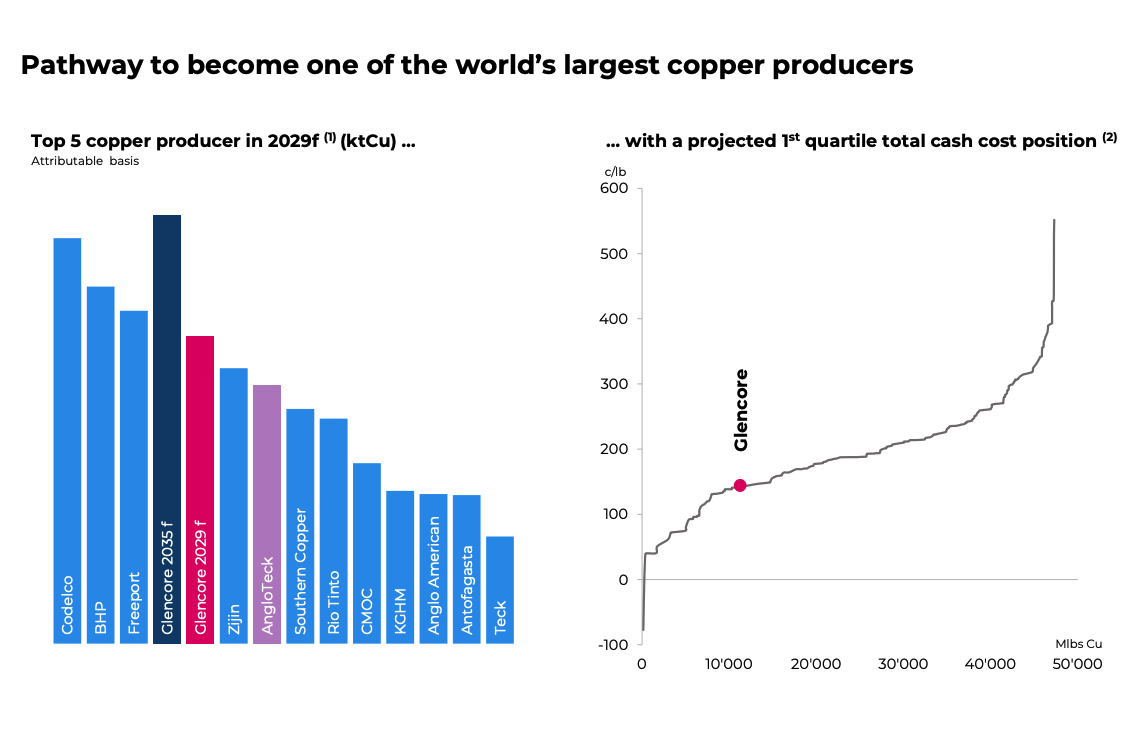
The Swiss firm reiterated that copper output should reach 1 million tonnes by 2028 and said the restart of its Alumbrera mine, in the Catamarca Province of Argentina, will support that ramp-up.
The operation is expected to restart in Q4 2026, with first production in the first half of 2028. Once fully operational, it is expected to produce about 75,000 tonnes of copper, 317,000 ounces of gold and 1,000 tonnes of molybdenum over four years.
“These projects are mostly brownfield and expected to be highly capital efficient,” Nagle said. He added that Glencore would be looking for partnerships to “reduce financial and operations risks” in certain projects.
Glencore noted the restart offers strong stand-alone economics and serves as a natural enabler for the Minera Agua Rica–Alumbrera (MARA) project by reducing ramp-up risk for the concentrator and downstream logistics, maintaining and retraining the workforce ahead of first ore, and keeping critical infrastructure active for shared use, generating operational synergies.
In neighbouring Chile, Glencore plans to keep an equal share in its copper joint venture with Anglo American should the partners eventually merge the Collahuasi operation with Teck Resources’ (TSX: TECK.A TECK.B, NYSE: TECK) nearby Quebrada Blanca mine once Anglo acquires Teck. “We won’t be a junior partner,” Nagle said, adding Glencore could inject cash to keep its stake level in any future combination.
Teck and Anglo shareholders will vote next week on the deal to create a copper-rich mining giant, with the two Chilean assets seen as a central motivation. The expectation that Collahuasi and Quebrada Blanca could be integrated to unlock major cost savings has circulated for years.
Nagle said any combination must reflect Collahuasi’s improved relative value after recent setbacks at Quebrada Blanca. “We’re not ignorant to some adjacent potential synergies,” he said. “At a minimum, the value attributed to the two properties, the value has materially moved towards Collahuasi.”

https://www.theepochtimes.com/world/us-kills-14-narco-terrorists-in-four-boats-in-pacific-5935913
The United States killed 14 narco-terrorists in four boats in the Eastern Pacific Ocean on Oct. 27, according to Secretary of War Pete Hegseth.
The three lethal kinetic strikes in international waters targeted vessels operated by terrorist groups, Hegseth said. He did not name the entities.
The first strike took out eight people, the second eliminated four, and the third killed three, according to Hegseth, who said there was one survivor who was being sought by Mexican search-and-rescue crews. All were said to be males.
Hegseth issued a message for those trafficking drugs by sea.
“These narco-terrorists have killed more Americans than Al-Qaeda, and they will be treated the same. We will track them, we will network them, and then, we will hunt and kill them.”
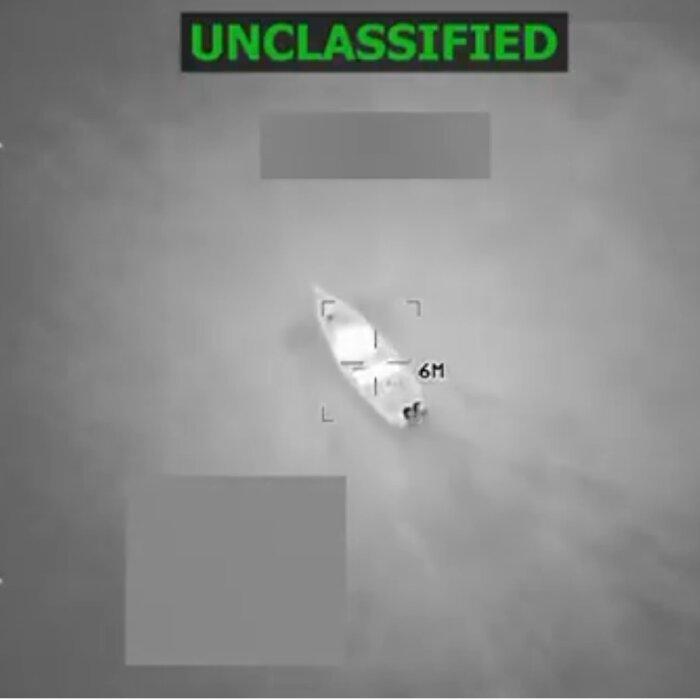
A video posted by Hegseth shows the first strike on two stopped boats, which become infernos. In the second strike, a boat speeding away erupts into fire. The video concludes with another boat loaded with numerous packages being fired upon and going up in flames.
In Congress, Democrats and some Republicans have expressed concerns about the recent U.S. strikes.
House Armed Services Committee Ranking Member Adam Smith (D-Wash.) has called for a hearing on the strikes.
“The House Armed Services Committee must convene a hearing to secure answers to the questions about military operations in the Caribbean and for the [U.S. Southern Command] Commander to testify on these matters.”
Sen. Rand Paul (R-Ky.) was one of the few Republicans to criticize the strikes.

Venezuela's vice president called for the termination of energy agreements with Trinidad and Tobago on Monday, citing what she termed as "hostile" actions by the island nation.
Trinidad is currently hosting one of the U.S. warships involved in a contentious campaign to destroy Venezuelan speedboats allegedly transporting drugs to the United States.
The USS Gravely, a destroyer equipped with guided missiles, docked in Trinidad on Sunday to conduct joint exercises with the Trinidadian navy. It comes as Trump considers expanding US military operations onto land in Venezuela.
Venezuelan authorities have labeled Trinidad's decision to host the ship as a provocation, while Trinidad's government maintains that joint exercises with the U.S. are routine.
"The prime minister of Trinidad has decided to join the war mongering agenda of the United States," Venezuela's Vice President Delcy Rodriguez declared on national television on Monday.
In text messages to The Associated Press, Trinidad and Tobago Prime Minister Kamla Persad-Bissessar expressed no concern over the potential cancellation of the energy agreement, stating that the military training exercises were solely for "internal security" purposes.
"Our future does not depend on Venezuela and never has," Persad-Bissessar wrote. "We have our plans and projects to grow our economy both within the energy and non-energy sectors."
Rodriguez, who also serves as Venezuela's hydrocarbons minister, announced plans to request President Nicolas Maduro to withdraw from a 2015 agreement that allows neighboring countries to conduct joint natural gas exploration projects in the waters between both nations.
The two countries, Trinidad and Venezuela, are separated by a small bay that is just 7 miles (11 kilometers) wide at its narrowest point.
DON'T MISS:
Unlike other Latin American and Caribbean leaders who have likened strikes on alleged drug vessels to extrajudicial killings, Persad-Bissessar has backed the campaign. She has expressed her preference for seeing drug traffickers "blown to pieces" rather than allowing them to harm the citizens of her country.
"I am tired of seeing our citizens murdered and terrorized because of gang violence driven by illegal drugs and arms trafficking," she declared to AP.
Trinidad, home to approximately 1.4 million people, is occasionally used by smugglers as a storage and sorting hub for drugs before they are shipped off to Europe and North America.
The Venezuelan government has labeled the U.S. military buildup in the Caribbean as a threat, with officials there alleging that the deployment of U.S. warships to the region is part of a scheme to overthrow Maduro, who has been widely accused of rigging last year's election.
Last week, tensions between Venezuela and the United States heightened as the Trump administration announced it would deploy its largest aircraft carrier to the southern Caribbean, supplementing a flotilla that already comprises eight warships, a submarine, drones, and fighter jets.
Since September, when it first dispatched ships to the southern Caribbean, the Trump administration has initiated 10 strikes against supposed drug-carrying vessels. These contentious attacks have resulted in at least 43 fatalities.