Tuesday, March 3, 2015

U.S. Running Out of Room to Store Oil; Price Collapse Seen

This March 13, 2012 photo shows older and newly constructed 250,000 barrel capacity oil storage tanks at the SemCrude tank farm north of Cushing, Okla. For the past seven weeks, the United States has been producing and importing an average of 1 million more barrels of oil every day than it is consuming. That extra crude is flowing into storage tanks, especially at the country's main trading hub in Cushing, pushing U.S. supplies to their highest point in at least 80 years, the Energy Department reported Wednesday, Feb. 25, 2015. (AP Photo/Tulsa World, Michael Wyke) KOTV OUT; KJRH OUT; KTUL OUT; KOKI OUT; KQCW OUT; KDOR OUT; TULSA OUT; TULSA ONLINE OUT
Michael Wyke/Tulsa World/APThe oil tanks in Cushing, Oklahoma, are reportedly two-thirds full.

By JONATHAN FAHEY

NEW YORK -- The U.S. has so much crude that it is running out of places to put it -- and that could drive oil and gasoline prices even lower in the coming months.

For the past seven weeks, the United States has been producing and importing an average of 1 million more barrels of oil every day than it is consuming. That extra crude is flowing into storage tanks, especially at the country's main trading hub in Cushing, Oklahoma, pushing U.S. supplies to their highest point in at least 80 years, the Energy Department reported last week. If this keeps up, storage tanks could approach their operational limits, known in the industry as "tank tops," by mid-April and send the price of crude -- and probably gasoline, too -- plummeting.

"The fact of the matter is we are running out of storage capacity in the U.S.," Ed Morse, head of commodities research at Citibank, said at a recent symposium at the Council on Foreign Relations in New York. Morse has suggested oil could fall all the way to $20 a barrel from the current $50. At that rock-bottom price, oil companies, faced with mounting losses, would stop pumping oil until the glut eased. Gasoline prices would fall along with crude, though lower refinery production, because of seasonal factors and unexpected outages, could prevent a sharp decline.

Multiple Factors Involved

The national average price of gasoline is $2.44 a gallon. That's $1.02 cheaper than last year at this time, but up 37 cents over the past month. Other analysts agree that crude is poised to fall sharply -- if not all the way to $20 -- because it continues to flood into storage for a number of reasons:
  • U.S. oil production continues to rise. Companies are cutting back on new drilling, but that won't reduce supplies until later this year.
  • The new oil being produced is light, sweet crude, which is a type many U.S. refineries are not designed to process. Oil companies can't just get rid of it by sending it abroad, because crude exports are restricted by federal law.
  • Foreign oil continues to flow into the U.S., both because of economic weakness in other countries and to feed refineries designed to process heavy, sour crude.
  • This is the slowest time of year for gasoline demand, so refiners typically reduce or stop production to perform maintenance. As refiners process less crude, supplies build up.
  • Oil investors are making money buying and storing oil because of the difference between the current price of oil and the price for delivery in far-off months. An investor can buy oil at $50 today and enter into a contract to sell it for $59 in December, locking in a profit even after paying for storage during those months.
The delivery point for most of the oil traded in the U.S. is Cushing, a city of about 8,000 halfway between Oklahoma City and Tulsa at an intersection of several pipelines. The city is dotted with tanks that can, in theory, hold 85 million barrels of oil, according to the Energy Department, though some of those tanks are used for blending or feeding pipelines, not for storing oil.

There Are Other Numbers to Consider

The market data provider Genscape, which flies helicopters equipped with infrared cameras and other technology over Cushing twice a week to measure storage levels, estimates Cushing is two-thirds full. Hillary Stevenson, who manages storage, pipeline and refinery monitoring for Genscape, says Cushing could be full by mid-April. Supplies are increasing at "the highest rate we have ever seen at Cushing," she says.

Full tanks -- or super-low prices -- are not a sure thing. New storage is under construction at Cushing, and there are large storage terminals near Houston, in St. James, Louisiana, and elsewhere around the country that will probably begin to take in more oil as prices fall far enough to cover the cost of transporting the oil. Also, drillers are cutting back fast because oil prices have plummeted from $107 a barrel in June. And demand is showing signs of rising.

While the Energy Department reported another enormous rise in crude stocks last week, up 8.4 million barrels from the week earlier, it also reported that diesel and gasoline supplies fell more than expected. That leads some to conclude that demand for crude will soon pick up, easing the glut somewhat. But many analysts believe oil prices will fall through the spring, before summer drivers start to relieve the glut.

Netanyahu: Borders Must Reflect 'Dramatic' Changes From 1967


Monday, March 2, 2015

Brent Oil Retreats From 2015 High; WTI Gains on Cushing

A worker of Gujarat State Petroleum Corporation checks oil flow of well PK-2 during its inauguration at Ingoli village, about 40 kilometers (25 miles) southwest of Ahmadabad, India


(Bloomberg) -- Crude retreated from its highest level this year in London on concern a global surplus will linger. U.S. oil futures rebounded after an industry survey was said to report a smaller increase in stockpiles at the main storage hub.

Brent dropped as much as 2.9 percent. Prices need to fall further before production is sufficiently curbed to balance the market, Goldman Sachs Group Inc. estimates. West Texas Intermediate gained after Genscape Inc. was said to report a smaller inventory increase at Cushing, Oklahoma, according to analysts including Phil Flynn, senior market analyst at the Price Futures Group in Chicago. Supplies have more than doubled in the past 12 weeks at Cushing.

“We still have a lot of bearish fundamentals and Brent is under a lot of pressure,” said Tariq Zahir, a New York-based commodity fund manager at Tyche Capital Advisors. “The Cushing report is pushing up WTI but I think it may be short-lived.”

Brent for April settlement dropped $1.57, or 2.5 percent, to $61.01 a barrel at 10:50 a.m. New York time on the London-based ICE Futures Europe exchange. Prices rose 18 percent in February, the biggest monthly gain since May 2009. The European benchmark’s premium to WTI narrowed to $10.67 after widening to the most since January 2014.

WTI crude for April delivery gained 42 cents, or 0.8 percent, to $50.18 a barrel on the New York Mercantile Exchange after earlier falling 2.1 percent. Futures gained 3.2 percent last month. The volume of all futures traded was about 38 percent above the 100-day average for the time of day.

The Genscape report is “supporting WTI,” said Carl Larry, a Houston-based director of oil and gas at Frost & Sullivan. “Brent is under a lot more pressure here.”

Record Stockpiles

Crude stockpiles in the U.S., the world’s biggest oil consumer, increased by 8.43 million barrels to 434.1 million through Feb. 20, the most in EIA weekly data going back to 1982. The U.S. will produce 9.3 million barrels a day of oil this year, up from 8.63 million in 2014, according to the Energy Department’s statistical arm. Output will climb to 9.52 million in 2016.

“Prices will have to move lower first to create a meaningful impact on supply,” Miswin Mahesh, an analyst at Barclays Plc in London, said in a report. “We expect further weakness ahead” in prices.

Rigs targeting oil in the U.S. fell to 986 last week, the lowest since 2011, according to data from Baker Hughes Inc. last week.

Rig Count

The current rig count implies output growth of 385,000 barrels a day by the fourth quarter from a year earlier, down 55,000 barrels a day from last week’s estimate, Goldman Sachs said in an e-mailed report Monday. The slowdown points to growth decelerating close to levels needed to balance the market, it said.

The Organization of Petroleum Exporting Countries boosted output to 30.6 million barrels a day in February, above its target of 30 million, according to a Bloomberg survey.

Saudi Arabia’s output advanced last month by 130,000 barrels a day to 9.85 million a day, the highest level since September 2013, according to the survey. The country pumps the most crude among the 12 nations of OPEC, which supply about 40 percent of the world’s oil.

“The realization that the Saudis are not cutting production is weighing on prices internationally,” said John Kilduff, a partner at Again Capital LLC, a New York-based hedge fund that focuses on energy.

Hedge funds raised bearish wagers on WTI by 17 percent to an all-time high of 117,646 contracts in the seven days ended Feb. 24, U.S. Commodity Futures Trading Commission data show. Net-long positions slid 3.1 percent to 202,609 lots, the lowest in seven weeks.

Money managers raised their net-long positions in Brent crude for a third week in the period to Feb. 24, data from ICE showed. Bullish wagers increased to 182,783 contracts, remaining at their highest level since July in futures and options combined.

To contact the reporters on this story: Moming Zhou in New York at mzhou29@bloomberg.net; Grant Smith in London at gsmith52@bloomberg.net

To contact the editors responsible for this story: Alaric Nightingale at anightingal1@bloomberg.net Stephen Cunningham, David Marino

Friday, February 27, 2015

Markets - China syndrome


http://www.tankeroperator.com/ViewNews.aspx?NewsID=6434

For a long time, China has harboured ambitions to move 85% of its crude imports on Chinese controlled ships, which could have resulted in orders for up to 80 VLCCs.
       
Fortunately for international shipowners, this has not yet been the case as the economic realities of tanker earnings have discouraged investment and Chinese charterers were not prepared to pay in excess of market levels to support such a programme, Gibson said in a report.

Currently the number of VLCCs on order from Chinese controlled companies stands at around 30, with deliveries spread between now and 2017 at around 10 vessels per annum.

These vessels were ordered by relatively few players, such as Associated Maritime, China Shipping, Cosco Dalian, Shandong Landbridge and Grand China.

However, the forthcoming number of deliveries is well above those delivered recently, as just five were delivered in 2013 and eight in 2014 with Brightoil Petroleum and Petrochina among the recipients, in addition to those already mentioned above.

Due to financial pressures, 2014 saw the amalgamation of the Nanjing Tankers and Associated Maritime Co’s fleets under the umbrella of China Merchants creating a large fleet of some 42 VLCCs (once all their 14 newbuildings are delivered) and seven Aframaxes.

Interestingly in the VLCC period fixing frenzy of January 2015, the new entity was reported to have committed three VLCCs out on timecharter for two years to non-Chinese interests and has also chartered out three VLCCs to Trafigura for 12 months trading.

Cosco has also fixed a VLCC to BP for 12 months, Gibson said.

There seems to be a gradual relaxation of state control in some areas, which perhaps explains the Chinese controlled VLCCs being fixed in the international market. It appears that there is a desire to expand their trading partners rather than relying exclusively on Chinese charterers.

This is also reflected in the refining sectors with licences being granted to independent refiners allowing for the import of crude oil. For example, ChemChina was granted a licence to import 200,000 barrels per day.

Politically, the new Chinese premier has made it clear that he supports private commercial initiatives. There is also press speculation that that a merger maybe on the cards between CNOOC and Sinochem, and CNPC and Sinopec.

While it is interesting to see some limited diversification of the Chinese shipping business model, there is no question that crude imports into the country will continue to increase, despite the slowing growth in domestic economic expansion.

An expanding strategic petroleum reserve, more crude heading into commercial inventories and rising refining capacity will significantly lift crude imports, at least in the near term, Gibson concluded.

VLCC crew released


Two Greek crew members and a Pakistani seafarer, taken hostage three weeks ago off the Nigerian coast in an attack on the VLCC ‘Kalamos’ , have been freed.
       
Aeolos Management said in a statement on Wednesday that pending medical examinations the three men would be flown home to recover from their "traumatic experience."

The company said that no details would be released on how the three men were freed, since "this might encourage further attacks and hostage taking" off West Africa.

It expressed its "great sadness" over the death of the vessel`s Chief Officer in the 3rd February attack in the Gulf of Guinea.

At the time, the VLCC was anchored and waiting to load for China at Qua Iboe oil terminal operated by ExxonMobil when it was boarded by the pirates.

Thursday, February 26, 2015

Oil edges higher towards $62, ample supplies still weigh

A pumpjack brings oil to the surface  in the Monterey Shale, California, April 29, 2013.  REUTERS/Lucy Nicholson


LONDON (Reuters) - Oil edged up on Thursday towards $62 a barrel as expectation of a coming recovery in global demand countered a further jump in U.S. crude stockpiles which underlined currently ample supplies.


The U.S. government's latest supply report released on Wednesday said domestic crude inventories rose last week to 434.1 million barrels, hitting a seasonal record high for the seventh week.

Brent crude LCOc1 rose 8 cents to $61.71 by 9.46 a.m. ET, after jumping more than 5 percent on Wednesday. U.S. crude CLc1 fell 96 cents to $50.03 following a more than 3 percent gain in the previous session.

"At present, it would appear that Brent is bottoming out at $60 per barrel," said Carsten Fritsch, analyst at Commerzbank. "The renewed sharp rise in U.S. crude oil stocks ... points to a market that is still oversupplied."

Brimming U.S. crude supplies are increasing the discount at which U.S. crude is trading to Brent. The spread CL-LCO1=R reached $11.81 on Thursday, the widest since January 2014.

Brent collapsed in 2014, falling from $115 reached in June on global oversupply. The decline deepened after the Organization of the Petroleum Exporting Countries (OPEC) chose to defend market share against rival supply sources, rather than cut its own output.

The price has rallied more than 35 percent from a near six-year low of $45.19 reached in January, supported by signs that lower prices are starting to reduce investment in U.S. and other non-OPEC supply.

A growing number of OPEC officials are making cautiously hopeful comments on the demand outlook. This week, Saudi oil minister Ali al-Naimi said demand was growing, while a Gulf OPEC delegate said it would rise more strongly in the second half of 2015.

OPEC officials including Naimi had been making more bearish comments. The Saudi minister was quoted in December as saying OPEC would not cut output even if oil fell to $20.

"No more talk of $20 from al-Naimi," said Olivier Jakob, oil analyst at Petromatrix. "Analysts calling for $20 a barrel oil will be more shy now."


(Reporting by Alex Lawler and Jane Xie; Editing by William Hardy and Mark Potter)

Wednesday, February 25, 2015

Obama vetoes Keystone XL pipeline bill

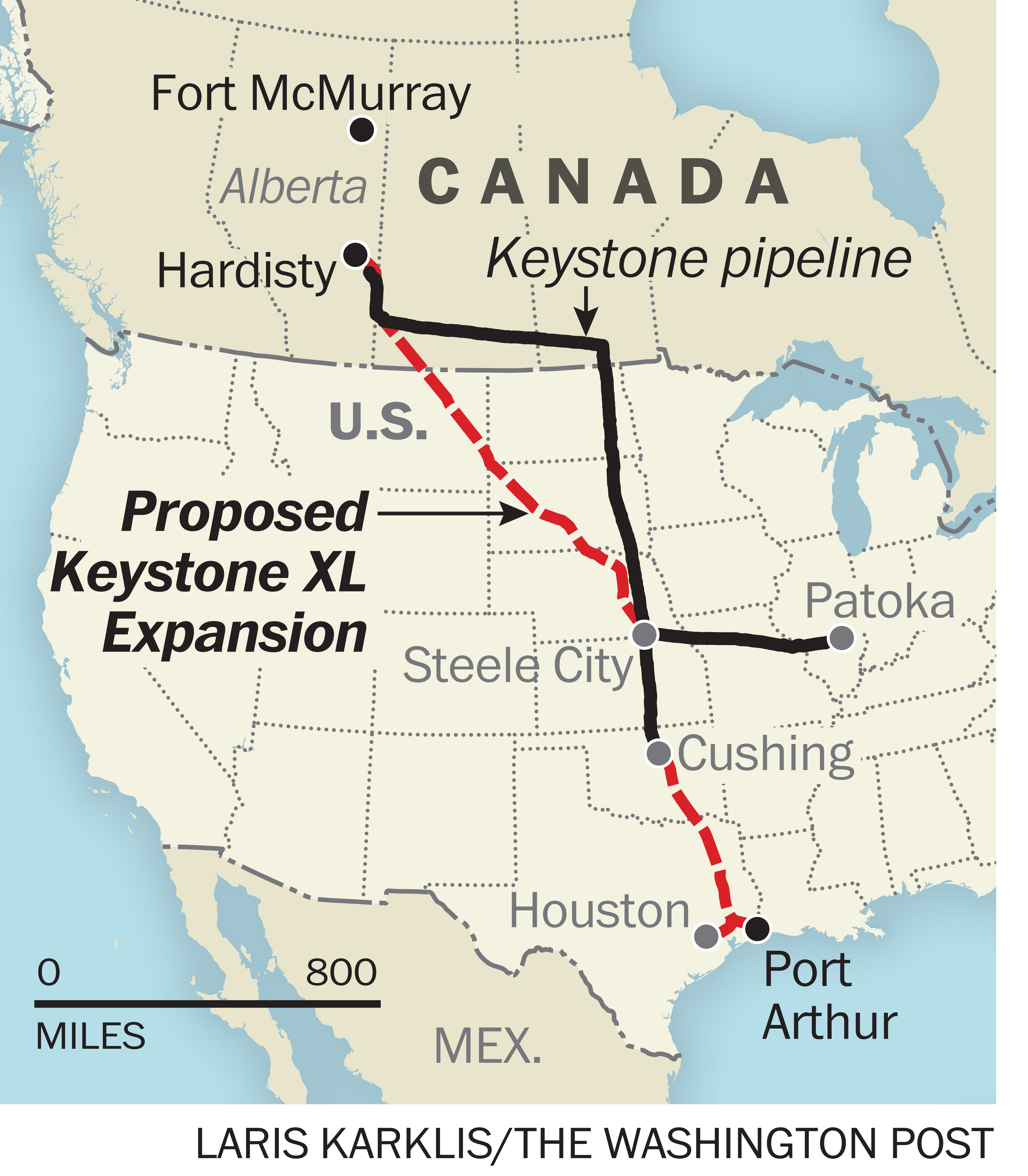
Map by Laris Karklis/The Washington Post via Getty Images


President Obama on Tuesday followed through on his vow to veto bipartisan-backed legislation authorizing the Keystone XL pipeline, marking his first veto of the Republican-led Congress and only the third of his presidency. 

The president, in a brief statement, claimed the bill would "circumvent" the existing process for reviewing the pipeline, which would extend from Canada to Texas. 

"The Presidential power to veto legislation is one I take seriously," Obama said. "But I also take seriously my responsibility to the American people. And because this act of Congress conflicts with established executive branch procedures and cuts short thorough consideration of issues that could bear on our national interest -- including our security, safety, and environment -- it has earned my veto." 

The decision, while expected, was met with tough criticism from Republicans -- and tees up another showdown with Congress in the coming days as GOP leaders try to override. 

"It's extremely disappointing that President Obama vetoed a bipartisan bill that would support thousands of good jobs and pump billions of dollars into the economy," Senate Majority Leader Mitch McConnell, R-Ky., said in a statement. "Even though the President has yielded to powerful special interests, this veto doesn't end the debate." 

House Speaker John Boehner, R-Ohio, called the veto a "national embarrassment." 

McConnell's office said the Senate plans to vote on overriding sometime before March 3. 

But so far, congressional leaders have not demonstrated they have the votes to override, which takes a two-thirds majority in both chambers. 

The Keystone bill garnered 62 yeas in the Senate, but they would need 67 to override. In the House, the bill got 270 votes -- but they would need 281 to override. 

It remains unclear whether moderate lawmakers could be swayed to switch in the coming weeks. 

While Tuesday's veto marked only the third of Obama's presidency -- fewer than any U.S. president since the 19th century -- his sparing use of the presidential tool is likely to change. With Republicans now in control of Congress, their efforts to chip away at the president's health care law and other legislative accomplishments are just as likely to be met with Obama's veto pen. 

To date, Obama rarely has used the veto in part because Democrats for six years controlled at least one chamber in Congress -- acting as a buffer to prevent unwanted bills from ever reaching the president's desk. That buffer is now gone. 

A look back at past presidencies, especially where control of the White House and Congress was split during at least one point, shows far more liberal use of that presidential power. 

In the Clinton presidency, the president issued 37 vetoes in his two terms. President Ronald Reagan issued 78. President George W. Bush issued 12. His father issued 44. 

Not since the Warren G. Harding administration has the number of vetoes been in the single digits; Harding issued six. 

The Keystone bill is as contentious an issue as any for Obama to fire his first veto shot of the new Congress. 

First proposed in 2008, the Keystone pipeline would connect Canada's tar sands to Gulf Coast refineries. 

The White House has said repeatedly it would wait to make its decision about whether to let the project go forward until after a State Department review. It regards the legislation as circumventing that process.