Thursday, March 3, 2022

Gold price falls over 1% as uptick in risk sentiment drives down havens

 Gold price falls over 1% as uptick in risk sentiment drives haven selloff

https://www.mining.com/gold-price-falls-over-1-as-uptick-in-risk-sentiment-drives-down-havens/?utm_source=Precous_Metals_Digest&utm_medium=email&utm_campaign=MNG-DIGESTS&utm_content=gold-price-falls-over-1-as-uptick-in-risk-sentiment-drives-down-havens 

Gold prices dropped from their highest in over a year on Wednesday as risk sentiment was buoyed by reports that Russia is ready to hold a new round of talks with Ukraine.

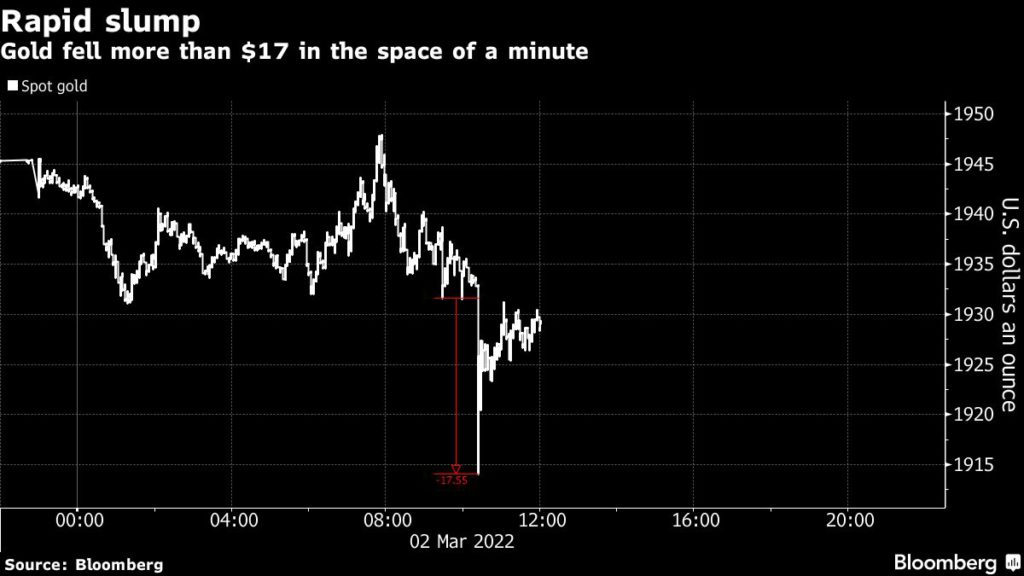
Spot gold declined 1.5% to $1,915.72/oz by 12:10 p.m. ET, still holding near a 13-month high. US gold futures fell 1.3% to $1,919.90/oz on the Comex, which saw a spike in trading volume that led to a $17 decrease within the span of a minute.

[Click here for an interactive chart of gold prices]
Meanwhile, US equities gained and bond yields edged higher after Federal Reserve Chair Jerome Powell signaled interest rate hikes could start this month despite uncertainties surrounding the military conflict in Ukraine.

Bullion is coming off its best monthly performance since May amid mounting concern that the raft of sanctions against Russia could dim the outlook for global growth and further stoke inflation. The metal has edged higher again so far in March, despite the latest blip.

Analysts told Reuters that gold’s moves may have been driven by a large sell order, though it was not clear who or what prompted the move.

Meanwhile, Commerzbank analyst Daniel Briesemann noted that gold prices could go up despite a US rate hike in March as “everything is dependent on how the Russia-Ukraine conflict develops.”

Gold-backed exchange-traded funds continued to increase their holdings over recent weeks, adding 14 tonnes on Tuesday in the biggest daily inflow in more than a month, according to an initial tally by Bloomberg.

Threats to supplies of grain, energy and metals are adding to price pressures, with a Bloomberg index of commodities jumping the most since 2009 to a record high. Gold is widely viewed as a hedge against inflation.

Traders are now dialing down rate-hike bets, including pricing out any risk of a half-point March liftoff by the Fed, according to the Bloomberg report.

(With files from Bloomberg and Reuters)

Copper, nickel prices spike as Europe scrambles for metal

 Copper, nickel prices spike as Europe scrambles for metal

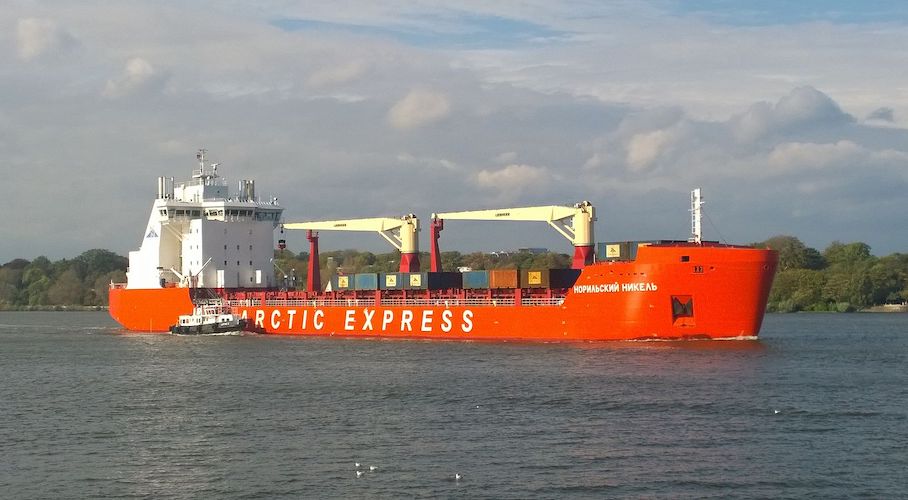
Arctic Sea ship Norilskiy Nickel on the river Elbe with destination port of Hamburg. (Reference image by Buonasera, Wikimedia Commons). 

https://www.mining.com/copper-nickel-prices-spike-as-europe-scrambles-for-metal/?utm_source=Daily_Digest&utm_medium=email&utm_campaign=MNG-DIGESTS&utm_content=copper-nickel-prices-spike-as-europe-scrambles-for-metal 

Arctic Sea ship Norilskiy Nickel on the river Elbe with destination port of Hamburg. (Reference image by Buonasera, Wikimedia Commons).

On Wednesday, copper prices continued to rise with May futures jumping to a high of $4.7050 a pound ($10,373 a tonne) in New York, levels last seen during the bellwether metal’s October spike – in sight of record territory.

Aluminum hit a record high of $3,590 a tonne and the price of nickel raced to an 11-year peak above $25,000 a tonne.

Concerns about supply disruption and low global stockpiles are behind the move higher, trumping concerns over the impact of the Ukraine invasion on global growth, rising interest rates in the developed world and a slowing economy in China.  

Chile, responsible for more than a quarter of global copper production, recorded its lowest January output since 2011, government figures showed on Monday.  

While warehouse inventories have been rising in China as the country’s copper refiners, responsible for more than half the world’s output, restock, global levels remain stressed. In February, global copper inventories held by LME, Shanghai Futures Exchange and Comex in New York fell to just 200,000 tonnes – scarcely enough to cover three days of global consumption.

Russian disruption

“There are more signs that geopolitical risks have turned into supply disruptions,” investment bank ING said in a report quoted by Shanghai Metals Market, after the world’s three largest container shipping companies suspended shipments to Russia.

ING said there are signs metal flows in Russia are increasingly limited due to transport problems.

Rusal is the biggest aluminum producer outside of China and Norilsk accounts for about 10% of refined nickel output globally.  Global nickel stockpiles are at their lowest levels since 2019. 

Bloomberg reports supplies are especially tight in Europe and spiking premiums for cash metal in Europe had prompted traders to switch to break-bulk vessels to ship metal all the way from warehouses in Malaysia’s Port Klang –even before the war broke out:

“Large volumes of aluminum as well as copper flow regularly from St. Petersburg in Russia to the European ports of Rotterdam and Vlissingen and are at threat of disruption as the chaos in shipping markets spreads.”

Breaking News! - SuperYacht Dilbar and other Yachts Seized in EU Sanctions!

Wednesday, March 2, 2022

Brent at $113, WTI at $109 — oil prices are spiking this morning as traders scramble to find alternative sources

Oil prices surged on Wednesday as supply disruption fears mounted following hefty sanctions on Russian banks amid the intensifying Ukraine conflict.

https://financialpost.com/commodities/energy/oil-gas/oil-spikes-as-russian-supply-concerns-increase-amid-sanctions-2 

Prices likely to stay above $100 unless significant alternative supplies enter the market, analysts say 

LONDON — Oil prices surged on Wednesday as supply disruption fears mounted following hefty sanctions on Russian banks amid the intensifying Ukraine conflict, while traders scrambled to seek alternative oil sources in an already tight market.

Brent crude futures rose by more than US$8, touching a peak of US$113.02 a barrel, the highest since June 2014, before easing to US$111.17, up by US$6.20 or 5.9 per cent by 0950 GMT.

U.S. West Texas Intermediate (WTI) crude futures also jumped more than US$8 a barrel, hitting the highest since August 2013 before losing some steam to trade up US$5.86 or 5.7 per cent to US$109.27 a barrel.

“Due to limited diversification options, any disruption to Russia’s energy exports will result in another energy crisis in Europe,” said Kaho Yu, principal Asia analyst at risk consultancy Verisk Maplecroft.

“Although the U.S. has called for a global oil reserve release, oil prices are likely to remain above US$100 unless significant alternative supplies enter the market.”

Russian oil exports account for around 8 per cent of global supply.

Exxon Mobil on Tuesday said it would exit Russia oil and gas operations as a result of Moscow’s invasion of Ukraine. The decision will see the firm pull out of managing large production facilities on Sakhalin Island in Russia’s Far East.

While Western powers have not imposed sanctions on energy exports directly, U.S. traders at hubs in New York and the U.S. Gulf are shunning Russian crude.

U.S. President Joe Biden warned Vladimir Putin that the Russian leader “has no idea what’s coming” in a State of the Union speech dominated by Russia’s invasion of Ukraine.

A coordinated release of 60 million barrels of oil by International Energy Agency member countries agreed on Tuesday failed to reassure the market, and prices rose after the announcement.

Meanwhile the Organization of the Petroleum Exporting Countries, Russia and allies, together known as OPEC+, are due to meet on Wednesday, where they are expected to stick to plans to add 400,000 barrels per day of supply each month.

In a move likely to exacerbate global supply tightness, buyers are avoiding oil from the CPC pipeline originating in Kazakhstan, source of over 1 per cent of the world’s supply, due to sanctions concerns.

© Thomson Reuters 2022

BOOM.

Ted Cruz slams Biden's State of the Union speech

Fact Checkers Caught In INSANE Lie About Oil Under Biden