Tuesday, April 14, 2020

Goldman Sachs still sees crude prices falling after OPEC+ deal

The Goldman Sachs Booth at the New York Stock Exchange

https://www.reuters.com/article/us-global-oil-opec-goldman/goldman-sachs-still-sees-crude-prices-falling-after-opec-deal-idUSKCN21V07H

(Reuters) - Goldman Sachs said on Sunday that oil prices would continue to fall in the coming weeks, reasoning that a “historic yet insufficient” deal by major oil producers to cut output is unlikely to offset a coronavirus-led demand rout.

The Organization of the Petroleum Exporting Countries (OPEC) and its allies, a grouping known as OPEC+, said they had agreed to reduce output by 9.7 million barrels per day (bpd) for May and June to stem a slump in prices. 

The bank saw downside risks to its short-term oil price forecast of around $20 per barrel for Brent, but projected the global crude benchmark would outperform U.S. oil because OPEC+ producers’ exports would likely fall, freeing up floating storage space. 

Even with core-OPEC members fully complying with the cuts, and 50% compliance by all other countries that have agreed to curb production in May, the voluntary cuts would translate into a reduction of only 4.3 million bpd from first-quarter levels, the bank said.

A bigger output cut by G20 nations would also not help much, it said. 

“Ultimately, this simply reflects that no voluntary cuts could be large enough to offset the 19 million bpd average April-May demand loss due to the coronavirus.” 

Both Brent futures, which slumped a record 65.55% in the first quarter, and U.S. West Texas Intermediate (WTI) crude posted tentative gains after the OPEC+ deal. 

Goldman Sachs said, however, that risks surrounding its 2021 price outlook of $52.50 per barrel for Brent were “skewed squarely to the upside”, since the “violent market rebalancing” will be followed by a sharp rebound once demand picks up again.

Another Wall Street bank, Morgan Stanley, raised its oil price forecasts, saying that while the OPEC+ deal will not prevent sharp inventory builds in coming months, it would lead to stock reductions from the second half of 2020 onwards. 

Morgan Stanley raised its third-quarter Brent and WTI price forecasts to $30 per barrel from $25, and to $27.50 per barrel from $22.50, respectively. It likewise raised its fourth-quarter outlook by $5 per barrel for both crude benchmarks, to $35 for Brent and $32.50 for WTI. 

Morgan Stanley projected demand to fall about 14 million bpd year-on-year in the second quarter. 

Reporting By New York Energy Desk, and Arpan Varghese and Shreyansi Singh in Bengaluru; Editing by Himani Sarkar and Tom Hogue

Friday, April 10, 2020

India charterers use force majeure to avoid demurrage


http://www.tankeroperator.com/ViewNews.aspx?NewsID=11499

Indian charterers are citing force majeure to avoid paying demurrage charges for delays in berthing, loading and unloading due to coronavirus, according to The Hindu Business Line.
 
"Ship owners may shun India trade to avoid losses from demurrage denials, potentially disrupting the supply chain of essential imports into the country," it says.

Thursday, April 9, 2020

Homemade Ventilator Is “Last Resort” For Hospitals Amid Coronavirus | Ma...

California developer says virus an act of God, sues Exxon over stalled deal

 
 God the Father by Cima da Conegliano, c. 1515


(Reuters) - A California retail developer claims the state's coronavirus lockdown was an act of God that prevented it from completing a $4.2 million property acquisition, asking a court to prevent owner Exxon Mobil Corp from selling to any other buyers.

Pacific Collective LLC invoked force majeure in its bid to delay an Exxon property acquisition, according to a suit filed in Los Angeles County Superior Court. The legal clause refers to unexpected events that prevent one party to a contract from meeting its obligations.

Sometimes referred to as the act of God clause, force majeure is being invoked elsewhere in energy contracts. BP this month cited force majeure for a one-year delay on a natural gas project, and three Indian refiners have cited it in rejecting crude oil imports.

An Exxon spokesman declined immediate comment, citing pending litigation.

Pacific Collective did not reply to a request for comment and an attorney for the firm declined to comment.

The retail property developer's lawsuit seeks $7.9 million in damages for alleged breach of contract and an injunction prohibiting Exxon from selling the property to someone else.

Pacific Collective invoked force majeure on March 30, a day before the acquisition was to close. Three days later Exxon notified the developer it would cancel the sale and keep the company's deposit, according to the lawsuit.

Exxon's insistence on the scheduled closing required "acts that would qualify as crimes under the current California and County of LA Stay-at-Home Orders," Pacific Collective's complaint said.

Coronavirus could constitute a legal force majeure as long as a company can show it is effectively impossible to perform contractual duties as a result of the outbreak, said legal experts.

The case is Pacific Collective LLC V Exxon Mobil, Los Angeles County Superior Court, No. 20-STCV-13294.

(Reporting by Gary McWilliams; Editing by Christian Schmollinger)

OPEC and allies to decide on historic oil production cut as coronavirus ravages demand

Image 

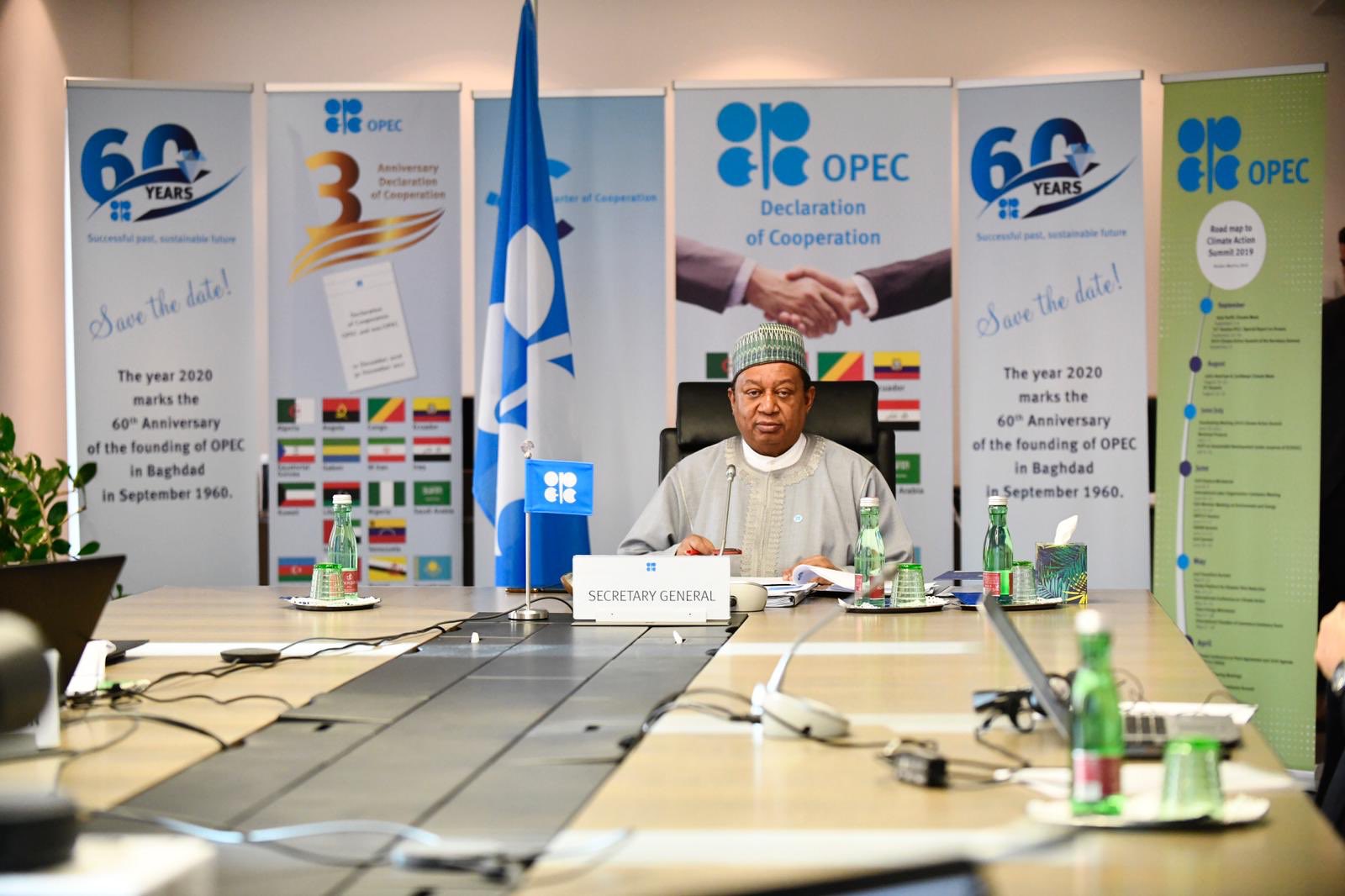
The 9th (Extraordinary) #OPEC and non-OPEC Ministerial Meeting has started. The Meeting is being held via webinar in light of recent developments surrounding the #COVID-19 pandemic.

https://www.cnbc.com/2020/04/09/oil-and-coronavirus-opec-meeting-to-decide-on-historic-output-cuts.html
  • An emergency video meeting between OPEC and non-OPEC partners, sometimes referred to as OPEC+, started shortly after 4:10 p.m. Vienna time.
  • Energy ministers from the Group of 20 (G-20) major economies will convene for their own extraordinary meeting on Friday.
  • International benchmark Brent crude traded at $34.12 a barrel Thursday afternoon, up almost 4%, while U.S. West Texas Intermediate (WTI) stood at $26.18, around 4% higher.
Some of the world’s largest oil producers will try to agree on the terms of historic output cuts on Thursday, as the coronavirus pandemic continues to crush worldwide demand for crude.

An emergency video meeting between OPEC and non-OPEC partners, sometimes referred to as OPEC+, started shortly after 4:10 p.m. Vienna time.

President Donald Trump has fueled hopes of a cut far larger than any deal OPEC+ has ever agreed on before, suggesting the energy alliance could take between 10 to 15 million barrels of crude off the market.

International benchmark Brent crude traded at $34.12 a barrel Thursday afternoon, up almost 4%, while U.S. West Texas Intermediate (WTI) stood at $26.18, around 4% higher.

WTI futures had jumped 12% shortly after Reuters, citing one unnamed OPEC source and one unnamed Russia source, reported OPEC+ had secured a deal — one that could climb as high as 20 million barrels per day (roughly 20% of global supplies).

Oil prices pared most of their gains as the meeting continued, with energy analysts highly skeptical about the reported scale of the production cuts.

A simmering feud between OPEC kingpin Saudi Arabia and non-OPEC leader Russia is thought to be one of many possible complications to an unprecedented production cut.

Saudi Arabia and Russia, who fell out when a previous pact to curb supply broke down last month, have signaled that any decision would depend on the U.S. and other non-OPEC producers joining in.
Trump has shown no appetite to mandate such a policy but suggested earlier this week that oil production in the U.S. had already fallen.

Energy ministers from the Group of 20 major economies will convene for their own extraordinary video conference on Friday.

The G-20 presidency said Tuesday that the meeting would be held “to foster global dialogue and cooperation to ensure stable energy markets and enable a stronger global economy.”

OPEC+ hopes to persuade non-OPEC producers present at the G-20 meeting, such as the U.S., Canada, Norway and Brazil to participate in oil production cuts. Saudi Arabia, OPEC’s de-facto leader, holds the rotating G-20 presidency this year.

Record cuts still not enough

“Assuming that a deal is reached — our base case now — the key question will be whether its size and timing will improve global oil balances sufficiently to support prices above current levels,” analysts at Goldman Sachs said in a research note published Thursday.

“This is key, as a cut that would prove too little too late would lead to storage saturation and additional necessary production shut-in, with distressed producers driving physical crude prices and spot oil prices sharply lower.”

“Our updated 2020 global oil balance suggests that a 10 million barrels per day headline cut would not be sufficient, still requiring necessary price induced shut-ins on top of such voluntary curtailments,” they added.

Bjarne Schieldrop, chief commodities analyst at SEB, told CNBC via email that he expects a deal to either fall apart, or for the assumed 10 million barrels per day production cut to be a medium-term target.

“We don’t expect anything will be decided before the G-20 meeting,” Schieldrop said, partly because the OPEC+ meeting had been “instigated” by President Donald Trump.

“If the G-20 cannot deliver on Friday 10 April according to what is required by OPEC+ on Thursday 9 April, then Saudi Arabia and Russia can blame the G-20 and get some political heat from President Trump off their backs,” he added.

How did we get here?

The coronavirus pandemic has meant countries around the world have effectively had to shut down, with many governments imposing draconian measures on the daily lives of billions of people.

The restrictions have created an unprecedented demand shock in energy markets, just as a price war broke out between powerhouse producers Saudi Arabia and Russia.

Last month, Saudi Arabia recommended cutting production by 1.5 million barrels per day as the coronavirus outbreak curbed demand.

However, Moscow rejected the proposal, thus bringing an end to the group’s three-year production-cutting pact on March 31.

Saudi Arabia, Kuwait and the United Arab Emirates have all since ramped up oil output.