Monday, February 5, 2018

Zebra Fuel raises $2.5M to deliver fuel direct to your vehicle

https://tctechcrunch2011.files.wordpress.com/2018/02/zebrafounders.jpg?w=738

https://techcrunch.com/2018/02/05/zebra-fuel/

Zebra Fuel, a London-based startup that wants to eliminate the inner city gas station by delivering fuel directly to your vehicle, has raised $2.5 million in seed funding.

The round is led by Robin and Saul Klein’s LocalGlobe, with participation from Brent Hoberman’s Firstminute Capital, and Alex Chesterman, the Zoopla founder and one of the U.K.’s more active angel investors.

Despite the familiar investor lineup, it’s actually the first investment made by Firstminute, the recently launched $85 million pan-European seed fund.

Founded in 2016 by Reda Bennis and Romain Saint Guilhem, Zebra Fuel is attempting to bring the convenience of on-demand delivery (or, more accurately, book ahead delivery, since it isn’t really on-demand) to refuelling your car. Via the startup’s smart phone app, you can book a time-slot to have one of Zebra Fuel’s mini-vans and trained personnel come to your location to dispense fuel to your vehicle.

For the time being, the company only offers diesel and delivers to inner city London, although petrol, hydrogen and even electric is on the roadmap. As is expanding to other European cities.

The idea, Bennis told me on a fun and rapid-fire call, is to eliminate the need to ever queue at a gas station again, which is not only inconvenient and time-consuming, but often sees a driver make an additional roundtrip journey and having to leave the engine running while in situ waiting for a pump to become available.

By bringing fuel to you and others in your neighbourhood, a proposition like Zebra at scale could help cut emissions and reduce congestion. Or so the pitch perfect pitch goes.

So what about the business case? The reaction from almost everybody I’ve explained Zebra Fuel to was to presume it will work out more expensive than visiting a gas station. Not so, says Bennis, although he concedes people are sceptical at first (and even more so before the company introduced a small delivery charge, which actually helped increase conversion significantly).

Instead, Zebra claims to be price competitive with inner city gas stations — offering fuel at prices on a par with or cheaper than central London — because it sources fuel from the same wholesale suppliers as the leading petrol stations and doesn’t have to soak up the high costs of rent for each premium gas station location.

In turn, the Zebra Fuel mini-vans themselves don’t need to travel to the wholesale supplier, but are refueled by the Zebra Fuel “mother ship,” says Bennis, a much larger tanker able to restock multiple Zebra Fuel delivery vehicles.

The startup is also well-positioned to offer a B2B service. This sees it bring fuel direct to commercial fleets, which are typically parked overnight in one central location.

In fact, whether consumer or business, overnight refuelling is a popular option. You can even instruct the Zebra Fuel app that you’ve left your fuel cap unlocked to negate having to be present when your vehicle is refueled, an idea first suggested by a disabled driver and early Zebra Fuel customer, and evidence that improving accessibility often benefits everybody. Connected cars could see this integrated at the API level, too: book a Zebra Fuel refill via your dashboard and your car will unlock its fuel cap at the right time.

Like a “Formula 1 pit stop,” is how the Zebra Fuel co-founder describes the service overall, and it’s not hard to imagine the startup expanding into other car health check or maintenance products, such as tire pressure and even MOTs.

The humble motor car, especially for city dwellers, is such an under-utilised asset, yet it consumes a disproportionate amount of its owners time and money. A sentiment and reality this nascent London startup hopes a large business can be built on.

U.S. could ban imports of Venezuelan crude oil

https://fm.cnbc.com/applications/cnbc.com/resources/img/editorial/2017/10/04/104752265-RTS1F45X-rex-tillerson.1910x1000.jpg 

The U.S. administration is considering choking off Venezuela's last remaining and rapidly dwindling source of income: crude oil exports.


Speaking in Argentina, Sec. of State Rex Tillerson said the U.S. was discussing how to raise the pressure on Venezuelan President Nicolas Maduro to restore his country's constitution and hold free and fair elections. 

"Obviously sanctioning the oil, or in effect prohibiting the oil to be sold in the United States... is something we continue to consider," he told reporters on Sunday.

Banning exports of oil or refined oil products to Venezuela was also on the table, Tillerson added.
Oil sanctions are one of the few options President Trump has to really hurt Maduro. 

Venezuelan production has been falling fast since 2014, but the country still pumped 1.7 million barrels a day in December, according to industry estimates

Exports to the U.S. averaged more than 600,000 barrels a day between January and November last year, data from the U.S. Energy Information Agency shows.

The decline in oil production is already deepening the misery for 30 million Venezuelans suffering from food shortages and a lack of basic medicines. Sanctioning oil exports could make matters much worse. 

"The situation is becoming quite dire in Venezuela," said Tillerson, who added that the administration was weighing the effect of sanctions on the Venezuelan people -- and whether they would quickly produce the desired result. 

"Because not doing anything to bring this to an end is also asking the Venezuelan people to suffer for a much longer time," he said.
venezuela flag oil

It's also a complex business equation. The U.S. sends light crude oil to Venezuela, which has heavy crude. The two get mixed together in Venezuela and shipped back to the United States. 

Banning cheap imports from Venezuela would force U.S. refineries to buy elsewhere, and that could push up gas prices.

"We're looking at how to mitigate... the impacts on U.S. business interests," said Tillerson, the former chief executive of Exxon Mobil (XOM)

Analysts say U.S. oil sanctions could completely cripple the Venezuelan economy. 

-- Patrick Gillespie and Claudia Dominguez contributed to this article.

Ethereum Platform For Oil And Gas Industry Planned by ConsenSys, Amalto

https://readwrite.com/wp-content/uploads/ETHEREUM-LOGO_LANDSCAPE_Black.png

Software development company Amalto has partnered with blockchain firm ConsenSys to develop a blockchain platform for the oil and gas industry.

Founded in 2005 in Paris, Amalto develops and operates business-to-business (B2B) document exchange software solutions and provides system integration services. It serves the oil and gas, industrial, environmental, and enterprise markets.

Amalto is a private company owned by its management, employees, and venture capitalists. It has offices in the US, France and Canada. ConsenSys is a blockchain technology company founded by Joseph Lubin.

The company is developing a variety of applications which operate on the global distributed computing platform. Its focus is on facilitating the empowerment of people and enabling decentralized governance through the development of software tools that devolve power from the traditional “command and control hierarchies inappropriate for a networked world.

The two companies, along with entrepreneur and startup investor Sandro Giannetti, will fund and create an ethereum blockchain platform called Ondiflo. The platform will be designed to transform the complex and time-consuming ticketing-based processes in the oil and gas industry.

It will leverage each company’s pre-existing products – Amalto’s Platform 6 and ConsenSys’ cloud-based dashboard TMS – to create the first end-to-end solution for the industry.

The companies said the platform will be launched as a consortium, where operators, suppliers, and financial institutions will lead the initial adoption of the solution by the industry, leveraging existing standards like PIDX. It will be headquartered in Houston, Texas.

As one of our first ventures into the oil and gas supply chain industry, Ondiflo will offer a solution where all operators and service companies can benefit from digitization, automation, and the seamless exchange of data and immutability of their records, made possible by the ethereum platform,” said Joe Lubin, co-founder of ethereum and founder of ConsenSys.

Ondiflo will deliver efficiency to processes, which today are still largely manual and paper-based, like field ticketing or bill of lading, and are ready for the blockchain.

By seamlessly managing data from Internet of Things (IoT) sensors at the well site or the storage terminal to the fulfillment stage—and, eventually, to the payment stage, and by bringing all stakeholders and trading partners to the blockchain, Ondiflo is going to radically change how the industry manages its back-office,” said Jean-Pierre Foehn, CEO of Amalto.

It will increase the level of trust between operators and suppliers, and also improve regulatory compliance.

TankTerminals.com - ExxonMobil Plans to Triple Oil Production from Permian Basin By 2025

http://www.abc.org/portals/1/new%20exxon%20logo.jpg

ExxonMobil is planning to tripe its crude oil production capacity in the Permian Basin by 2025 and expand its transportation infrastructure.

The firm intends to reach daily production capacity to more than 600,000 oil-equivalent barrels from its operations in the Permian Basin in West Texas and New Mexico, by 2025.

ExxonMobil said that its tight oil production from the Delaware and Midland basins will be increased five-fold by that year.

In order to boost its Permian operations, the oil firm plans to invest more than $2bn on Wink terminal and add key infrastructure upgrades.

The expansion of crude storage terminal is expected to help the firm to effectively handle Permian crude oil and condensate supply to Gulf Coast refineries and marine export terminals.

ExxonMobil XTO Energy subsidiary president Sara Ortwein: “Our geographic and competitive advantages in the Permian position the company for strong growth and long-term value creation.

We can deliver profitable production at a range of prices, and we have logistics and technology advantages over our competitors.

The company said that the increased volumes will be driven by reduced drilling costs, technology improvements and expanded acreage.

Ortwein added: “With this production growth, we are well positioned to maximize value as increased supply moves from the Permian to our Gulf Coast refineries and chemical facilities where higher-demand, higher-value products will be manufactured.

As part of the new expansion effort, ExxonMobil plans to increase the horizontal rig count in the Permian to a further 65% over the next several years.

The firm said that the expanded production capacity will provide low-cost supply and feedstocks to its downstream and chemical operations in Baytown, Beaumont and Mt. Belvieu, Texas, and Baton Rouge, Louisiana, US.

As a result, the firm will have the capacity to meet growing demand for high-performance plastics and advanced synthetic lubricant base stock products.

In a blog post, ExxonMobil chairman and CEO Darren Woods said that the company will invest $50bn over the next five years to expand its business in the US.

Woods said: "The recent changes to the U.S. corporate tax rate coupled with smarter regulation create an environment for future capital investments and will further enhance ExxonMobil’s competitiveness around the world."

Friday, February 2, 2018

Do oil companies want to drill in Arctic National Wildlife Refuge?

https://file.ejatlas.org/img/Conflict/oil-drilling-in-anwr-us/ANWRmap.bmp

https://www.houstonchronicle.com/business/article/Do-oil-companies-want-to-drill-in-Arctic-National-12502890.php

Congress, in approving a sweeping tax overhaul, opened the Arctic National Wildlife Refuge to oil and gas drilling, betting that energy companies would be willing to brave the harsh conditions of northern Alaska and generate royalties to help offset the costs of tax cuts.

Congress is hoping to reap $1.1 billion from ANWR over the next decade, but the short drilling season and high costs of development in a low-price environment may tamp down oil companies' interest in exploiting ANWR tracts.

But Kara Moriarty, director of the Alaska Oil and Gas Association, recently cautioned against making comparisons between the National Petroleum Reserve Alaska and ANWR.

In an interview with the Associated Press, she said ANWR holds 10 times the oil and gas deposits of the National Petroleum Reserve Alaska.

"They may both be in Alaska," she said, "but the reserve estimates are night and day."

Late last month, however, on the same day President Donald Trump signed the tax bill, the Department of Interior released findings that the National Petroleum Reserve Alaska and surrounding lands contained 8.7 billions barrels of crude - more than five times what was estimated in 2010.

That brings it close to the levels scientists believe are contained within ANWR. The most recent U.S. Geological Survey in 1998 put ANWR's oil reserves at between 5.7 billion and 16 billion barrels.

But even if oil companies buy ANWR leases, they won't necessarily start drilling, said Niel Lawrence, an attorney with the Natural Resources Defense Council, a national environmental advocacy group. "The industry likes to open up land and lock it up, said Lawrence. "But that doesn't mean they'll produce on it."

950 gold miners trapped underground in South Africa

http://www.goldfields.com/reports/rr_2008/images/beatrix_mine2.jpg
Beatrix Gold Mine / South Africa

https://www.yahoo.com/news/950-gold-miners-trapped-underground-south-africa-161323030.html

Theunissen (South Africa) (AFP) - About 950 gold miners were stuck underground in South Africa on Thursday after a power cut, the mine's owner said, though the workers were not reported to be in immediate danger.

The Sibanye-Stillwater mining company said a massive power outage caused by a storm had prevented lifts from bringing the night shift to the surface at the Beatrix gold mine, in the small town of Theunissen near the city of Welkom.

"We have got 955 employees still underground, they are in a confined and safe area, it's the shaft waiting area (and) there is ventilation, we are supplying them with water and food," James Wellsted, spokesman for Sibanye-Stillwater, told AFP.

"So everybody is fine at the moment. We are trying to restore power so we can start hoisting them to the surface," he said, speaking on the phone from the mine. 

He said the depth where the miners were trapped was uncertain, but the mine has 23 levels, going down to about 1,000 metres (3280 feet) below ground.

One cable was restored during the day and 272 workers were rescued, but 955 remained trapped by early evening, the company said.

They have been underground for over 24 hours and nervous family members patiently gathered along the road to the shaft, kept a distance by security guards. A generator at the shaft had started working.

"The last time I heard from him was at 9:00 pm (1900 GMT on Wednesday). We believe nobody is hurt. But it is becoming long. The generator is not strong enough to pull the cage. God I hope he is going to come out tonight." a woman, whose husband was among those trapped, told AFP smoking a cigarette while sitting in her car. She refused to give her name.

Another woman waiting for her husband, who only gave her first name as Innocentia, said: "we are pretty optimistic. They say they are safe".

Earlier Wellsted had said that engineers were struggling with a software fault to get emergency generators to operate and re-start the lifts following the storm.

"We are having some issues -- probably related to the power surge linked to the storm -- in getting the winders working, so we are busy working on that issue at the moment," he added.

"Last night there was a severe storm in the Free State (province) that affected two different power cables... and cut off all electricity supply to the mine, so we were unable to bring the night shift up."
The rescue efforts would continue throughout the night, he said

The Beatrix mine is in Free State province, 290 kilometres (180 miles) southwest of Johannesburg.

AMCU, the Association of Mineworkers and Construction Union, said that the workers stuck underground were facing major health and safety risks.

"AMCU views this incident as extreme due to the sheer number of workers involved," it said in a statement.

"The incident raises serious concern regarding the lacking emergency contingency plans at the mine for alternative and back-up power generation."

Another mining union the National Union of Mineworkers (NUM) complained about mine safety and called on mineworkers to refuse to work in "dangerous conditions".

"Major multinational corporations like Sibanye-Stillwater which should be industry leaders in creating a safety culture are doing far too little to prevent accidents," the union said in a statement.

A parliamentary committee on mining expressed outrage at the accident, calling for "drastic" action to be taken against the mining company and saying it was "utterly unacceptable" that the mine had no backup plan to bring the workers to the surface. 

An ANC member, Siyabonga Sikade, whose uncle was also among those trapped asked:"Why are our people still trapped when (mine owners) are making so much money? What is their plan in case of a catastrophe?"

Last August five mineworkers died after sections of a gold mine collapsed outside Johannesburg.

The country possesses rich mineral reserves and has some of the world's deepest gold mines.

Gold was for many decades the backbone of South Africa's economy, but production has declined sharply due to depletion of reserves.

Thursday, February 1, 2018

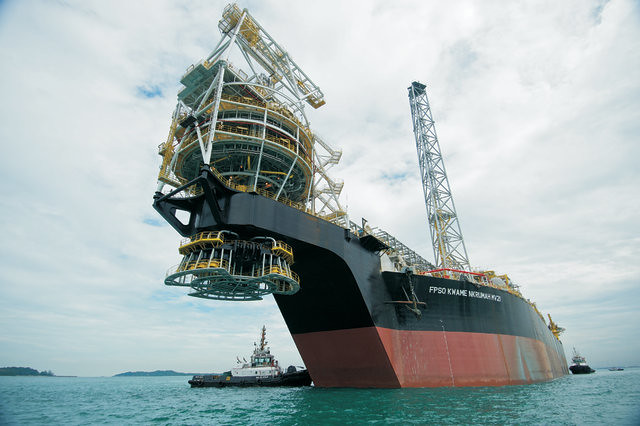
Ghana Jubilee oil production vessel FPSO shut down for repair

https://c1.staticflickr.com/6/5241/5268901324_39cf343f42_z.jpg

http://www.xinhuanet.com/english/2018-02/01/c_136942434.htm

Partners in Ghana's Jubilee oil field commenced a shutdown of the production Vessel FPSO Kwame Nkrumah here on Thursday to enable repair works on the damaged Turret Bearing on the vessel be effected, a release has said.

according to the release issued by operator, Tullow Oil late Thursday, the shut down is the first of two planned for the first quarter of the year.

"It is also another chance to conduct scheduled maintenance to improve process reliability," the statement added.

The partners had planned a total of three shut-down periods for the year, two in the first quarter and one in the last quarter for remedial works on the FPSO Turret Bearing and rolling back into place.

"The first shut-down which begins Thursday February 1, 2018 will be for an estimated three-week period. This shut-down coincides with the planned Ghana National Gas Company (GNGC) shutdown of the Atuabo Gas Processing Plant. Therefore there will be no supply of gas to the plant," the statement added.

The statement further stated that there would be a second shutdown starting from March 19 also for an estimated three-week period for the completion of works. During the second shutdown period gas supply from the Jubilee field will be replaced by gas supply from the Tweneboa-Enyenra-Ntomme (TEN) to GNGC, added the statement.

Already civil society actors have expressed worry over frequent shutdowns of the FPSO Kwame Nkrumah with the fear that the West African gold, cocoa and oil producer would end up with huge revenue losses.

Natural Resource Governance analyst with Ghana Oil and Gas for Inclusive Growth (GOGIG) Samuel Bekoe said the situation was alarming, especially in an era of falling global crude prices.

He recalled the shutdowns last year during which time the global prices were low, "and did not allow us to hit our revenue targets. That was a problem already last year."

"This year with the Turret Bearing and the Mooring issues it is important that as a country, we do detailed analyses of how these frequent shutdowns will affect the economy in general

"In terms of building other FPSO's we need to make sure we do not face such challenges," Bekoe said here on Wednesday in an interview.

Due to the uncertainty of the global oil market, the analyst argued that it was better to derive revenues now than to defer to the future.

However, Head of the Oil and Gas Unit at the Ministry of Finance, Joseph Asenso allayed the worries, explaining that since the shutdowns had been planned earlier these were factored into revenue projections in the 2018 budget, and Gross Domestic Product (GDP) projections, hence there would be no revenue loss or drop in GDP as far as projections were concerned.

"So the impact if it stays within the time frame, then it will not be felt, but if it exceeds, which is quite unlikely that is when will have a problem," Asenso indicated.

Ghana's assumed price for crude in the 2018 budget was 57.3 U.S. Dollars. However, prices on the global stage have already hit 65 dollars per barrel, and Asenso was optimistic that would mean revenue overshot for the country which would be paid into the Petroleum Holding Funds.