Tuesday, November 7, 2017

Oil surges on Saudi purge, Trump’s Asia trip in focus
Crude oil prices surged to their highest level since June 15 as
Saudi’s anti-corruption purge catalysed new waves of concerns over the
stability of the world’s largest oil exporter.
Dozens of princes, ministers and business leaders were arrested under
corruption and money laundering charges by Crown Prince Mohammed bin
Salman. The news even triggered some profit taking and panic selling
during early Asian trading hours on Monday. The crackdown’s full impact
to the oil market remains to be seen, but usually market have short
memory on regional political events and the impact tends to be impulsive
and short-lived.
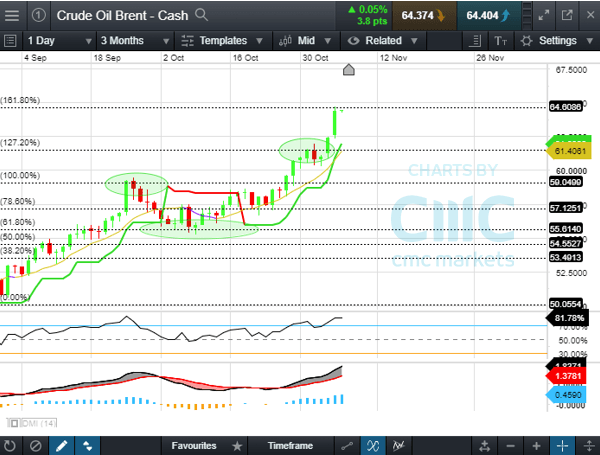
Technically, Brent’s price broke out above $61.4 resistance and is
facing some selling pressure at around $64.6 area (161.8% Fibonacci
extension level). The 10-day simple moving average line and SuperTrend
(10, 2) are both sloped upwards, suggesting the current bull trend
remains intact. Momentum indicator MACD remains strong, showing no sign
of slowdown. The RSI, however, has entered into overbought zone at
around 80%, suggesting that some technical pullback is possible in the
days to come.
President Donald Trump announced there is a ‘very unfair trade
situation’ with US’ largest trading partners including Japan during his
visit in Tokyo yesterday. It is widely expected that he will further
address the trade deficit and intellectual property disputes with
Chinese leader Xi in his upcoming visit to Beijing, in an attempt to win
a ‘free trade, fair trade, or reciprocal trade’ between US and China.
Outside of trade agreements and investments, North Korea is also on top
of his agenda this time.
Technical Analysis:
Brent – Cash
- The 10-Day Simple Moving Average and SuperTrend (10,2) are both sloped upwards, suggesting uptrend remains intact
- Facing strong resistance level at around $64.6 area, which is the 161.8% Fibonacci Extension level
- Momentum indicator MACD and RSI suggest strong upward sentiment
Monday, November 6, 2017
Ship recycling - rays of hope

http://www.tankeroperator.com/ViewNews.aspx?NewsID=9134
After
what has been a rather dour period for the international ship recycling
markets, the first glimmers of stability finally started to emerge last
week.
After local steel plate prices declined by almost $50 per ldt,
currencies battled a firming US dollar and recycled steel from ships
imported over the summer months, increasingly failed to shift from
domestic yards (resulting in growing stockpiles), the stabilising prices
are a welcome breath of fresh air, especially to cash buyers and
shipowners who are still looking to offload their prospective units, GMS
said in its weekly roundup.
Over several weeks, China has entered into a state of artificial stasis
as the Communist Party Conference continues locally. However, with news
that President Xi is undertaking another five-year stay at the helm,
hopes are high that this will in turn, help boost the domestic economy
once again. For the time being however, many industries (including the
domestic ship-recycling sector) have been in lockdown whilst all eyes
fall on Beijing as the seldom seen Communist Party Conference concludes.
The ship recycling market in China has also endured a near and total
shut down as officials attempt to tackle pollution/environmental
concerns and bring figures in line with what is expected to be the
outcome of this critical conference. The ongoing shut down has now
resulted in levels declining by about $30 per ldt, subsequently securing
China’s tail-end position in the market rankings. The domestic steel
industry has also been sluggish and this has had a knock on effect on
some of the competing markets.
As indications from the various markets have slipped over the recent
weeks and Pakistan is now the only market where an $+400 per ldt offer
can be expected for the right unit, it is safe to presume that the
industry overall is now a sub-$400/tonne sector. Given that the supply
of tonnage (especially from the drybulk and container sectors) has
diminished considerably of late, an overall slowdown of potential
candidates may help revive prices in the near future, GMS concluded.
Brokers reported that the 1995-built MR ‘Admiral 1’ had been committed
to Bangladesh recyclers at an unknown price level, while Indian
recyclers were said to have taken the 1990-built Handysize ‘Champion’
for $395 per ldt.
Sunday, November 5, 2017
Saudi arrests of princes consolidates another's power grab

Saudi billionaire Prince Alwaleed bin Talal al-Saud
https://www.msn.com/en-ph/news/world/saudi-arrests-of-princes-consolidates-anothers-power-grab/ar-AAus6Nv
RIYADH, Saudi Arabia — Saudi Arabia's heir to the throne is
overseeing an unprecedented wave of arrests of dozens of the country's
most powerful princes, military officers, influential businessmen and
government ministers — some of them potential rivals or critics of the
crown prince, whose purported anti-corruption sweep sent shockwaves
across the kingdom Sunday as he further consolidated power.
Among
those taken into custody overnight Saturday were billionaire Prince
Alwaleed bin Talal, one of the world's richest men with extensive
holdings in Western companies, as well as two of the late King
Abdullah's sons.
The arrest of senior princes upends a
longstanding tradition among the ruling Al Saud family to keep their
disagreements private in an effort to show strength and unity in the
face of Saudi Arabia's many tribes and factions. It also sends a message
that the 32-year-old crown prince, Mohammed bin Salman, has the full
backing of his father, King Salman, to carry out sweeping
anti-corruption reforms targeting senior royals and their business
associates, who have long been seen as operating above the law.
Reports
suggested those detained were being held at the Ritz Carlton in Riyadh,
which only days earlier hosted a major investment conference that the
crown prince attended with global business titans. A Saudi official told
The Associated Press that other five-star hotels across the capital
were also being used to hold some of those arrested.
The Ritz
Carlton had no availability for bookings until Dec. 1, 2017 — a possible
sign that an investigation of this scale could take weeks. Marriott
International said in a statement that it is currently evaluating the
situation at the Ritz-Carlton in Riyadh, but declined to comment
further, citing privacy concerns.
A Saudi government official with
close ties to security forces said 11 princes and 38 others were being
questioned. The official spoke to the AP on condition of anonymity
because he was not authorized to speak to the media.
The surprise arrests were immediately hailed by pro-government media
outlets as the clearest sign yet that Prince Mohammed is keeping his
promise to reform the country as it moves to overhaul its economy away
from dependence on oil and liberalize some aspects of the
ultraconservative society.
The kingdom's top council of clerics
issued a public statement overnight saying it is an Islamic duty to
fight corruption — essentially giving religious backing to the
high-level arrests.
It's unclear if the U.S. had any advance word
of the arrests. President Donald Trump's son-in-law and White House
adviser Jared Kushner and others made an unannounced trip recently to
Riyadh. Earlier on Saturday, Trump said he spoke to King Salman, though
the White House readout of that call did not include any reference to
the impending arrests.
The Saudi government says the arrests are
part of a wider effort to increase transparency, accountability and good
governance — key reforms needed to attract greater international
investments and appease a Saudi public that has for decades complained
of rampant government corruption and misuse of public funds by top
officials. Volatility from surprise moves reshaping the kingdom,
however, are likely to worry investors.
Among those reportedly
taken into custody were two sons of the late King Abdullah: Prince Miteb
bin Abdullah, who Saturday evening was ousted from his post as head of
the prestigious National Guard tasked with protecting the Al Saud
family, and Prince Turki bin Abdullah, who was once governor of Riyadh.
Prince
Miteb was once considered a contender for the throne, though he has not
been thought of recently as a challenger to Prince Mohammed.
Saudi
Twitter accounts released several other names of those arrested,
inclduing Alwalid al-Ibrahim, a Saudi businessman with ties to the royal
family who runs the Arabic satellite group MBC; Amr al-Dabbagh, the
former head of the Saudi Arabian General Investment Authority; Ibrahim
Assaf, a former finance minister, and Bakr Binladin, head of the Saudi
Binladin Group, a major business conglomerate.
Analysts have
suggested the arrest of once-untouchable members of the royal family is a
clear sign that the crown prince is sidelining potential rivals for the
throne.
The young prince has risen from near obscurity to become
Saudi Arabia's most talked about and powerful prince in less than three
years since his father ascended to the throne. The prince's swift rise
to power has unnerved more experienced, elder members of the royal
family, which has long ruled by consensus, though ultimate
decision-making remains with the monarch.
The moves in Saudi
Arabia mirrored those in China, where President Xi Jinping has used
corruption charges "as a battering ram to consolidate his own power and
authority," said John Hannah, the senior counselor at the Foundation for
Defense of Democracies, a conservative think tank in Washington.
Hannah
said Prince Mohammed has "latched onto corruption as a way to
consolidate his power and remake the regime in his image," purging those
who might be resistant.
It is not clear what Prince Alwaleed or the others were being investigated for.
Without
naming those arrested, the Attorney General's office said "the suspects
are being granted the same rights and treatment as any other Saudi
citizen." The statement did not disclose specific details about the
investigation, but stressed that no assets have yet been frozen and that
individuals are presumed innocent until proven guilty.
A
high-level employee at Prince Alwaleed bin Talal's Kingdom Holding Co.
told the AP that the royal was among those detained. The senior
employee, who spoke on condition of anonymity due to fear of
repercussions, said security bodies informed him of the arrest.
Prince
Alwaleed's many investments include Twitter, Apple, Citigroup, and the
Four Seasons hotel chain. He is also an investor in ride-sharing
services Lyft and Careem. He was once a significant shareholder in
Rupert Murdoch's News Corporation, but sold much of those shares in
2015.
The prince, pictured sometimes on his 85-meter (278-foot)
super-yacht in the Mediterranean, is among the most outspoken Saudi
royals and a longtime advocate of women's rights. He is also majority
owner of the popular Rotana Group of Arabic channels.
After word of his arrest, his company's stock dropped 7.6 percent in trading Sunday on the Saudi stock exchange.
An earlier crackdown this year on perceived critics of the crown prince included clerics and lesser-known princes.
In
July, Prince Mohammed's most formidable challenger to the throne,
Prince Mohammed bin Nayef, was plucked from the line of succession and
ousted from his post as interior minister, overseeing internal security.
This laid the groundwork for the king's son to claim the mantle of
crown prince.
Prince Mohammed's gambles have not always succeeded . A yearslong war he has overseen as defense minister against Iranian-allied rebels in Yemen has not made the kingdom safer.
As
news was unfolding about the anti-corruption probe, Saudi Arabia said
late Saturday it had intercepted a ballistic missile fired from Yemen at
Riyadh International Airport, on the outskirts of the capital.
"The
dismissals and detentions suggest that Prince Mohammed rather than
forging alliances is extending his iron grip to the ruling family, the
military, and the national guard to counter what appears to be more
widespread opposition within the family as well as the military to his
reforms and the Yemen war," James M. Dorsey, a Gulf specialist and
senior fellow at Nanyang Technological University in Singapore, said in
an analysis of the shake-up.
Batrawy reported from
Dubai, United Arab Emirates. Associated Press writers Jon Gambrell and
Fay Abuelgasim in Dubai, Jonathan Lemire aboard Air Force One and Maggie
Michael in Cairo contributed to this report.
Friday, November 3, 2017
Venezuela: We can't pay our debts anymore!

http://money.cnn.com/2017/11/02/news/economy/venezuela-debt-restructuring/index.html
Venezuelan President Nicolas Maduro finally admitted his government can't afford to pay all of its mounting bills.
Maduro said in a televised speech Thursday that Venezuela and its state-run oil company, PDVSA, will seek to restructure their debt payments.
The oil company made a $1.1 billion payment on Thursday, he said, a sizable amount for a country with only $10 billion left in the bank.
"But after this payment, starting today, I decree a refinancing and a
restructuring of the external debt," Maduro told the country.
Venezuela is already deep into a humanitarian crisis, with people suffering from food and medical shortages. Many can't afford to buy basic items because prices are skyrocketing faster than wages. The country's currency, the bolivar, is worth less than a tenth of a U.S. penny.
If Maduro's government can't reach a new agreement with bondholders over the debt restructuring -- which often means trying to pay less money -- it will end up defaulting.
That would trigger a potentially ugly series of events.
Investors in the U.S. and elsewhere could seize Venezuelan oil as collateral.
Oil is the government's only significant source of external revenue and
therefore its only way to buy food and medicine for its 30 million
citizens. Because the government mismanaged vast swaths of farmland, it
must import almost all food.
Agreeing on a new payment schedule is no easy feat with Wall Street investors. Just ask Argentina. Its government fought in U.S. courts for 15 years to resolve its unpaid debts.
Argentina's government was shut out of international debt markets over
that time, which ultimately crippled its economy. Argentines called the
investors "vulture funds" because they bought the bonds on the cheap and
then sued the government to get much higher payments. The two sides
reached a settlement in early 2016, shortly after a new Argentine
government took office.
Venezuela's experience at the negotiating table could actually be much
worse. All told, Venezuela owes about $65 billion in bonds denominated
in foreign currencies, mostly in dollars, according to research firm
Capital Economics. Venezuela also owes debts to China, Russia, oil
service providers, airlines and a slew of other entities.
Its top negotiator also has a problem: He can't do business in the U.S.
Maduro has appointed Vice President Tareck El Aissami to lead the debt
restructuring efforts. In February, the U.S. Treasury Department accused El Aissami of drug trafficking and froze his assets in the U.S. El Aissami denies the accusations.
Meanwhile, Maduro and others in his government have tried to pin the
blame on President Trump for Venezuela's debt problems after Trump slapped stiff financial sanctions on the country in August.
After the state oil company, PDVSA, made a large debt payment last week, it didn't mince its words.
The company said
it made the payment, "despite the economic war, unjustified imposition
of sanctions by Donald Trump, and the sabotage, persecution and
financial blockade to which the Republic and its institutions have been
subjected by a significant portion of the international financial system
as commanded by imperialism."
Thursday, November 2, 2017
Top OPEC Ministers Say Longer Cuts Needed But Duration Undecided
https://www.bloomberg.com/news/articles/2017-11-02/oil-ministers-wanting-to-extend-cuts-haven-t-decided-on-how-long
-
“Mission is not accomplished”: Al-Falih on output deal aim
-
Producers discussing timing of potential extension: Kuwait
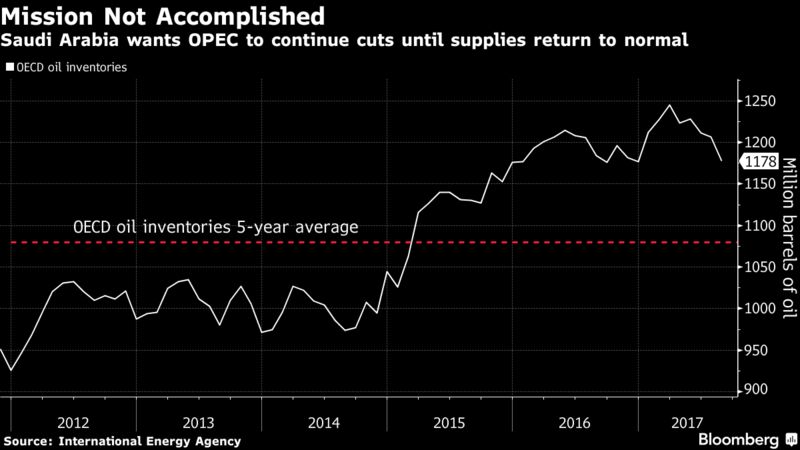
While OPEC and its allies agree their output-cut deal needs to be
prolonged as bloated inventories won’t shrink to normal levels by March,
they’re yet to reach consensus on how long the pact must be extended,
according to ministers from three of the top producers.
Global
stockpiles are declining and demand is increasing, but there’s still a
significant inventory overhang in the market, Khalid Al-Falih, Saudi
Arabia’s oil minister, said at the Asian Ministerial Energy Roundtable
in Bangkok on Thursday. Issam Almarzooq, his Kuwaiti counterpart, said
producers are in the process of discussing and finalizing a decision on
the extension of output curbs by the Organization of Petroleum Exporting
Countries and partners such as Russia.
“We
are looking now for the mechanism for the time, how long that would be
and what would be more suitable to achieve the rebalancing of the
market,” Almarzooq said in an interview with Bloomberg in Bangkok. While
he expects an extension of the output curbs to be announced at the Nov.
30 meeting, details about the length or any changes in conditions may
come only in February or March when more information is available, he
said.
Almarzooq’s comments echo those from the United Arab
Emirates’ Energy Minister Suhail Al Mazrouei in Bangkok on Wednesday.
Since the agreement began getting implemented in January this year, the
producers have moved toward their goal of balancing the oil market, but
“aren’t there yet,” he said on Thursday in an interview with Bloomberg.
Crude
prices have surged into a bull market amid speculation that OPEC and
its allies will prolong their deal as well as a revival in demand. Saudi
Arabian Crown Prince Mohammed bin Salman said last month that he backed
the extension of the curbs beyond March 2018. Russian President
Vladimir Putin also gave provisional backing to lengthening the
restrictions, a signal that Riyadh and Moscow are ready to prolong their
collaboration to lift energy prices.
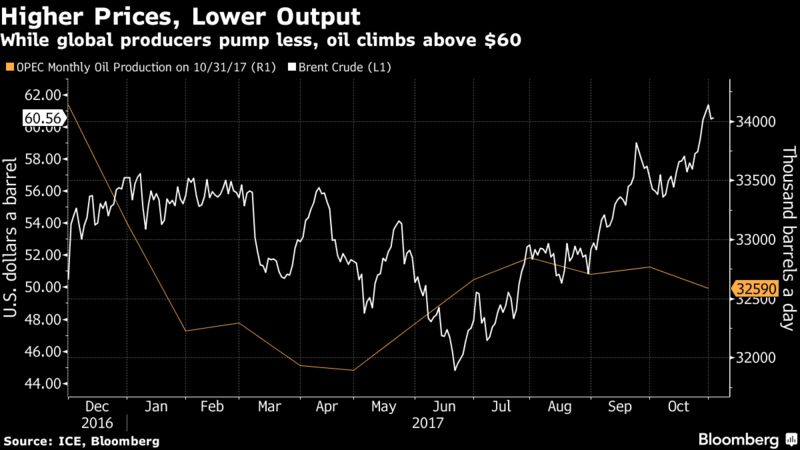
Growth
in global oil demand has reached 1.6 million barrels a day, up from 1.3
million at the start of the year, Saudi Arabia’s Al-Falih said Thursday
at the Bangkok event organized by the International Energy Forum. And
in October, there was a significant decline in inventories. “Despite
that, unfortunately, the mission is not accomplished yet,” he said.
“We
are discussing with all countries, and I haven’t been able to reach
each and every one of them,” he said. “But what we want to do is reach a
full consensus.”
Wednesday, November 1, 2017
Petroleum reserves could sustain UK oil production for two decades, finds report
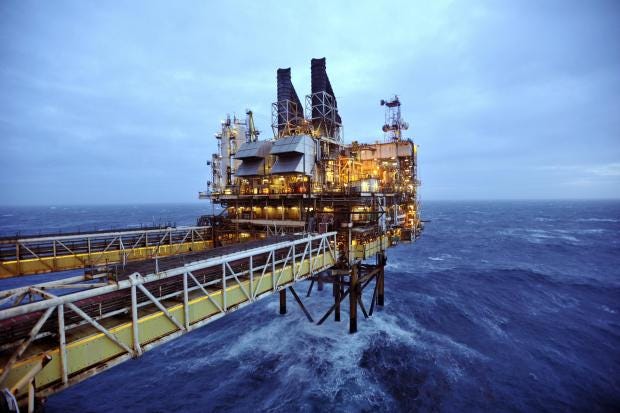
The oil and gas regulator estimates 7.4 billion barrels are available
from undeveloped resources in already discovered locations REUTERS
http://www.independent.co.uk/news/business/news/uk-oil-production-petroleum-reserves-prices-industry-north-sea-aberdeen-oga-a8029101.html
The UK has "significant petroleum reserves" which could sustain
production for at least the next two decades, according to a new
report.
The Oil & Gas Authority (OGA) estimates the overall
remaining recoverable reserves and resources range between 10 to 20
billion barrels of oil equivalent (BOE).
It estimates there are approximately 5.7 billion BOE of proven and probable UK reserves.
These alone, based on current
production forecasts and not taking into account potential future
exploration successes, have the capacity to sustain production for at
least the next two decades, the report stated.
Production could go on even longer if additional undeveloped
resources can be matured, the UK Oil and Gas: Reserves and Resources
report said.
The OGA estimates there are 7.4 billion BOE of discovered
undeveloped resources, much of which is in mature developed areas and
under consideration for development.
The maturation of contingent resources - those which are not
yet considered mature enough for commercial development - presents
"significant opportunity for the continued development of the UK's
petroleum resources", it added.
However, this will require "substantial investment
Four new discoveries from exploration successes in 2016 added 210 million BOE to the contingent resource base.
The report also estimates there are six billion BOE of
prospective (undiscovered) resources, ranging from a lower estimate of
1.9 billion BOE to an upper estimate of 9.2 billion BOE.
OGA operations director Gunther Newcombe said: "The UKCS is a
world-class petroleum province with 10 to 20 billion barrels of
remaining discovered and undiscovered potential.
"The OGA has an important role in helping to steward this
resource base, revitalize exploration and maximize economic recovery,
working closely with industry and government.
"Future success of the basin requires attracting additional
investment, implementing technology and company collaboration on new and
existing developments."
The report said the replacement of proven and probable reserves remains a concern.
In 2016, approximately 600 million BOE were produced but only
80 million BOE of contingent resources were matured to become reserves
that can be recovered.
This indicates a reserve replacement ratio of 13 per cent.
Some £9bn will need to be invested to achieve a reserve
replacement ratio of 25 per cent over the next five years at an average
unit development cost of £12 per BOE, the report added
Subscribe to:
Posts (Atom)