Wednesday, August 17, 2016

Among Battered Oil Currencies, Nigeria’s Is Biggest Loser: Chart


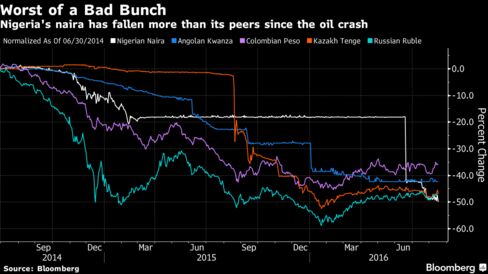
Oil currencies have been hammered since crude prices crashed in mid-2014, and none more so than Nigeria’s naira. It’s lost almost half its value against the dollar, the most among the currencies of OPEC members and more than Russia’s ruble, which is down 47 percent. For foreign investors, that may be a cue to re-enter the West African country as a weaker currency makes its bonds and stocks cheaper.

Here’s Who’s Buying Up U.S. Oil

Seventeen countries now receive long-banned American crude exports.

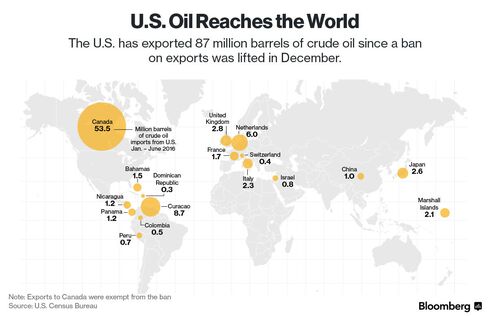
U.S. crude oil is reaching all corners of the world, after a 40-year ban on exports was lifted at the end of last year.

More than 87 million barrels of crude and condensate have been shipped to 17 countries in the first half of 2016, based on Bloomberg calculations from Census Bureau data. Most has gone to Canada, which received 53.5 million barrels, followed by Curacao, which took 8.68 million, and the Netherlands with 6 million. Canada was already a customer, having been largely exempt from the limits.
The U.S. Congress and President Barack Obama agreed in December to end the trade restrictions, which were established after OPEC oil embargoes that crippled U.S. supplies in the 1970s.

Other buyers include the U.K, Japan and even the Marshall Islands, according to U.S. Census Bureau data.

"The data for shipments to the Marshall Islands could have been a mistake, those were probably tankers with the Marshall Islands flag,” said John Auers, executive vice president of Turner Mason & Co., a Dallas-based consulting firm. “It’s possible that those cargoes were headed for Asia."

There are still many countries that have yet to buy any American oil this year. India, South Korea and Germany are among the top crude importers in the world, according to data from the Joint Organizations Data Initiative (JODI). Yet none has received U.S. crude after the ban was lifted.

With assistance from Dave Merrill and Alex Nussbaum.

Tuesday, August 16, 2016

Atmos releases leak detection solution for pipelines

Atmos International Logo

http://fluidhandlingmag.com/display_news/10877/atmos_releases_leak_detection_solution_for_pipelines/

Atmos International has launched a line of software and hardware designed to fill the gaps in leak detection and detect pipeline leaks faster than conventional leak detection systems.

The hardware options of the Pipeline Guardian solution are intended for pipelines where a lack of sufficient instrumentation, power, or poor telecommunications has hindered leak detection.

The Pipeline Guardian hardware is well-suited for adding sensitive, reliable, and accurate leak detection on high consequence areas, such as river crossings and environmentally sensitive ecosystems.

The hardware can also be strategically placed to isolate pipeline sections prone to column separation, allowing optimal threshold settings on both the tight and the slack sections of a pipeline.

An intelligent control panel, containing an on-board data storage back up to prevent data loss, collects, analyses, and transmits leak detection data.

Data can be processed locally or sent back to the pipeline control center for processing through TCP/IP, line-of-sight radio, GSM, and satellite.

The clamp-on flow meters are customized for highly repeatable measurement when paired with Atmos leak detection software options, and they require little flow conditioning, allowing for installation in tight spaces.

In addition to inexpensive, high resolution pressure sensors, hardware options also include the Halo clamp-on pressure sensor, which attaches to the outside of the pipeline, eliminating the need for pipeline tapping.

Acoustic sensors are available to detect leaks by correlating the noise fluid makes as it escapes the pipeline.

The leak detection software modules include intelligent flow balance, negative pressure wave, dynamic pressure and flow rate modelling, and acoustic noise correlation.

Monday, August 15, 2016

Russia Open to Cooperation With OPEC, Minister Tells Al-Awsat


putin salman saudi arabia russia


Russia is open for talks with other major oil producers on freezing output as the market is unlikely to balance until next year, Energy Minister Alexander Novak said in an interview with Asharq Al-Awsat.

The country is committed to continuing dialogue to stabilize the market, Novak said, according to the Saudi-owned newspaper.

The minister’s comments follow a rebound in oil last week on speculation that informal OPEC talks in September may result in measures to prop up prices. While several members of the Organization of Petroleum Exporting Countries have called for a brake on production, an earlier round of discussions collapsed when Saudi Arabia refused to sign a deal without the participation of rival Iran.

Those talks, in April, showed that producers can at least work together, Novak said, according to Asharq Al-Awsat. Russia is open to “joint measures” since the current cycle of low crude prices is unlikely to end until late 2017, he said.

OPEC President Mohammed bin Saleh Al-Sada said Aug. 8 that the group will hold informal talks in Algiers next month. Saudi Arabia, OPEC’s de facto leader, subsequently signaled it’s prepared to discuss taking action.


West Texas Intermediate crude climbed 6.4 percent last week, its biggest weekly advance since April, helping to pare declines the past two months. Futures traded up 0.5 percent at $44.70 a barrel as of 12:16 p.m. London time on Monday.

The proposed Algiers talks will take place during the ministerial meeting of the International Energy Forum, which Saudi Arabia and Russia both plan to attend. Proponents of a freeze may face push-back from several OPEC members that are pumping below capacity.

Iran hasn’t yet recovered pre-sanctions production levels, while Nigeria and Libya are also operating at reduced output, Giovanni Staunovo, an analyst at UBS Group AG, said by e-mail.

Commerzbank AG was also skeptical a broad agreement will be possible. Russia’s expression of willingness to engage in talks “is likely to prove little more than lip service, as so often in the past,” the bank said in a report.

Friday, August 12, 2016

Markets - Bumping along the bottom

VLCC- very large crude carrier


A slightly more active week for the VLCCs, as the MEG August loading programme is about to end. 
 
Rates in the early part of the week dropped considerably, both in MEG and in West Africa, with earnings falling close to opex, Fearnleys reported.

However, owners started to resist and have managed to turn things around, although only marginally. As a result, rates came off the bottoms but further upside is likely to be hard work. Simply put - inadequate demand and too many ships for all the major VLCC routes, the broker said.

Suezmaxes in West Africa saw nochange from last week with rates continuing to suffer at a year low.
The list of available ships was still too large for any change to take place at the time of writing (Wednesday) and charterers were picking up ships quietly off market for the few cargoes worked.

If the current situation keeps up for long, it will only be a question of time before we see owners start to slow steam to try change the market balance. At time of writing with both Nigeria and Libya not even close to producing at a normal pace, we don’t see any rapid change to the prevailing market, Fearnleys said.

In the Med/Black Sea, the same scenario is evident, a surplus of ships in position for the few cargoes that are materialising, which is keeping rates at a Low ebb.

Aframax rates in the North Sea and Baltic softened even further compared to last week’s levels. Despite increased activity for both North Sea and Baltic, rates remained at bottom levels.

Until the abundance of available tonnage is mopped up, we don’t expect any immediate recovery in rates.

Med and Black Sea markets keeps breaking records, in a bad way. WS70 was the market number seen last week. This week mid-WS60s was fixed several times. For longer cross Med voyages, numbers went below WS60.

Owners were frantically trying to hide their positions, but were brutally caught out when 15 offered for a Sidi Kerir/Portugal cargo, Fearnleys concluded.

In other chartering news, Ocean Yield said it had taken delivery of the LR2 ‘Navig8 Supreme’ from Sungdong.

Following her delivery, she commenced a 13-years ‘hell and high water’ bareboat charter to Navig8 Product Tankers.

This is the last vessel out of four LR2s chartered by Ocean Yield to Navig8 Product Tankers.

A few storage fixtures were reported recently, including Tullow Oil taking the 2008-built VLCC ‘Kokkari’ for 7-9 months at $28,000 per day and Litasco fixing the 2015-2016-built Aframaxes ‘STI Oxford’ and ‘STI Grace’ for six months at $18,500 per day each.

Clearlake was believed to have fixed the 2016-built Suezmax ‘Seavigour’ for six months for $23,000 per day, while unknown interests were said to have fixed the MRs ‘Hellas Aphrodite’ and ‘Hellas Nemesis’ for six months at $14,500 per day.

In the S&P market, Navig8 Product Tankers, a joint venture between the Navig8 Group and DVB Bank, has entered into sale and leaseback agreements for three LR2s.

Signed with Bank of Communications Finance Leasing (BoComm), net proceeds will amount to up to $118.8 mill.

The company said that it intended to use part of the proceeds to repay existing loans used to finance the vessels’ newbuilding contracts under a multi-bank loan facility .

The sale and leaseback agreements will see the LR2s sold and delivered to BoComm under 10-year bareboat charters back to Navig8.

Included in the deal are purchase options to re-acquire the vessels during the charter period.

Winson was reported to have purchased the 2001-built VLCC ‘ Genmar Victory’ for $29 mill. She was believed to be earmarked for conversion to an FSO>

Singapore interests were said to be behind the purchase of the 2009 and 2010-built MRs ‘North Duchess’ and ‘North Marchioness’ for $20.7 mill and $22.3 mill, respectively. The deal also includes a bareboat charter to ENOC.

Two Handies were reported sold. Sea World Management was reported to have picked up the 2004-built ‘Oliphant’ for $13.5 mill, which includes a 2-year timecharter back to her owner at $14,500 per day. NORDEN was said to have disposed of the 2006-built Handy ‘Nord Mermaid’ for a price in the region of mid $13 mill. 

Reported leaving the fleet were the 1982-built FSO ‘Federal 1’ said to have been taken by Pakistan breakers for $205 per ldt under tow, basis ‘as is’ Jambi.

The Handysize parcel tanker ‘Stolt Emerald’ was sold to Indian breakers on P&C terms. She was beached at Alang on 4th August, according to GMS.

Meanwhile Gothenburg-based Ektank’s new 18,600 dwt intermediate product/chemical tankers newbuildings were designed jointly by Swedish ship designer Fartygskonstruktioner (FKAB) and Ektank.

Project, FKAB T28 is a 22,700 cu m, oil product & chemical Tier II tanker, designed for low fuel consumption and high cargo capacity with a density of 1.54 tonnes per cu m.

The vessels were ordered from Chinese shipbuilder CSSC Chengxi Shipyard in April, 2016 for delivery in 2018.
Draft set for new Panama locks

Panama Canal Prepares Workforce for New Locks


The Panama Canal Authority (ACP) has updated the maximum draft allowed for Neopanamax vessel transits to 13.41 m Tropical Fresh Water (TFW), effective 5th August.
 
This was based on the water level at Gatun Lake and the near term weather forecast

The maximum authorised transit draft had been previously set at 11.74 m TFW.

This announcement comes on the back of the suspension of the third draft restriction scheduled to become effective on 6th June, 2016, due to dry weather conditions brought about by El NiƱo.

Wednesday, August 10, 2016

Ghana taking steps to wean itself off Nigerian gas

Mr Emmanuel Armah-Kofi Buah
Emmanuel Armah-Kofi Buah


The Minister of Petroleum, Mr Emmanuel Armah-Kofi Buah, in a mid-year review meeting with the heads of agencies under the Petroleum Ministry, said plans are advanced for the country to be self-sufficient in gas supply.

Ghana has seized the opportunity provided by Nigeria's inability to meet regular gas supply to improve its energy security.

The Minister of Petroleum, Mr Emmanuel Armah-Kofi Buah, in a mid-year review meeting with the heads of agencies under the Petroleum Ministry, said plans are advanced for the country to be self-sufficient in gas supply.

He pointed to gas supply from the Jubilee oilfields to the Atuabo gas plant and the expected gas supply from the Tweneboa, Enyenra and Ntomme (TEN) project to the Atuabo gas plant.

Irregular gas supply from Nigeria has compounded Ghana's almost three years energy crisis.

There have been acts of vandalism of gas pipelines by militants in Nigeria's oil-producing Delta State which feeds into the West Africa Gas Pipeline.

The TEN oil field is expected to start oil production on August 18, 2016, and gas production in the first quarter of 2018.

TEN is expected to produce about 300 million barrels of oil, equivalent to 20 years lifespan of the project, and 80% of the oil would be gas.

Tullow Oil owns 47.185% of the TEN project, Ghana National Petroleum Corporation.

In addition, Mr Buah said the commencement of the Offshore Cape Three Points Integrated Oil and Gas Project at Sanzule in Ellembele District in the Western Region by Italian energy giant ENI will bring on stream addition gas.

The project is expected to produce dry gas of 180 million standard cubic feet per day for a period of not less than 20 years.

It is estimated that estimated that the facility will generate 1000 megawatts of electricity per day when its first gas is produced in the first quarter of 2018.