Tuesday, July 11, 2017

OPEC Caps for Libya and Nigeria Wouldn't Be Enough to Fix Oil Glut

  • Two nations added enough output to offset Saudi Arabia’s cut
  • OPEC and its allies would need to review every nation’s quota
https://www.bloomberg.com/news/articles/2017-07-10/opec-caps-for-libya-nigeria-wouldn-t-be-enough-to-fix-oil-glut

A proposal that Libya and Nigeria could have to accept limits on their crude production probably wouldn’t be enough to put OPEC’s faltering efforts to eliminate a global supply glut back on track.

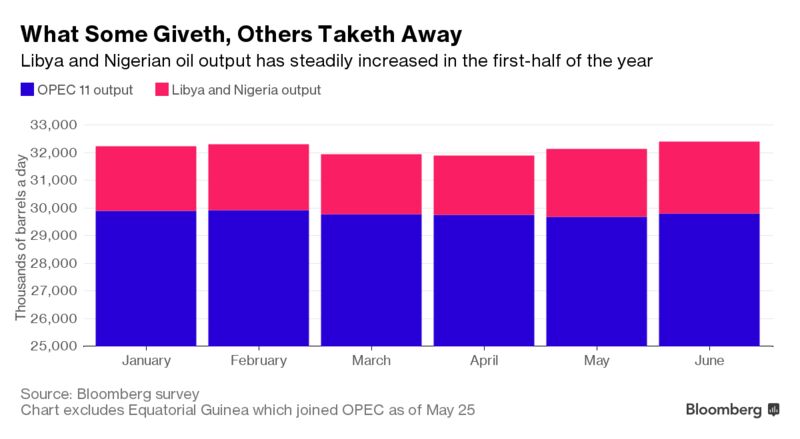
The two African nations -- exempt from the supply curbs agreed last year due to internal strife -- have added enough production in the last two months to offset Saudi Arabia’s cut. Should the pair accept a cap at their desired levels of output, OPEC and allies including Russia would still have to adjust their own quotas to compensate for the increase, said Nordine Ait-Laoussine, president of Geneva-based consultants Nalcosa and former energy minister of Algeria.

“It’s not going to be easy just to say ‘Maybe we should just bring Nigeria and Libya into the line and it will be fine’,” Ait-Laoussine said by phone. Adding those two countries without agreeing on new production ceilings for the other participants in the deal would simply be “exacerbating the problem of excess supply,” he said.

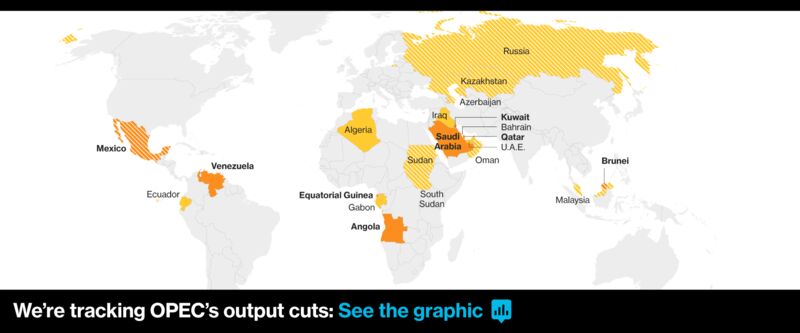
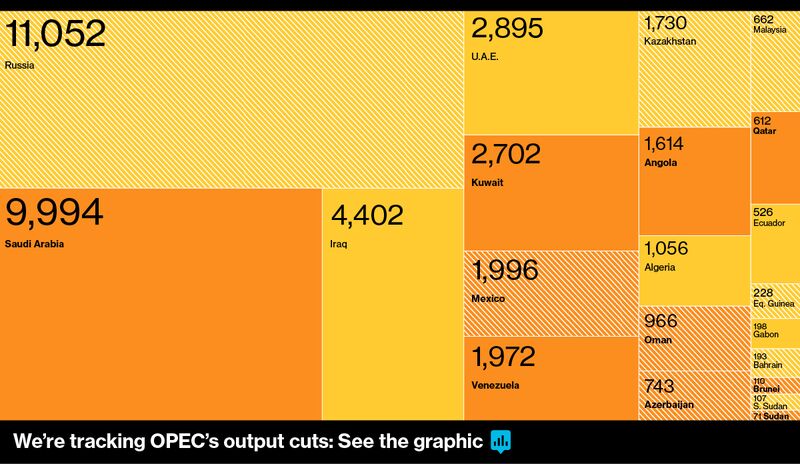
Several nations from the Organization of Petroleum Exporting Countries plus non-members Russia and Oman will meet in St. Petersburg on July 24 to check up on the success of their agreement to curb output, reduce swollen global inventories and boost oil prices. Since ministers from the group last met in May, oil has fallen into a bear market as analysts and traders lose faith that the cuts are working. Market watchers including Goldman Sachs Group Inc. say deeper cuts are needed to finish the job.
Can of Worms

Changing quotas for existing participants in the agreement would be “opening a big can of worms,” said Thomas Pugh, commodities economist at Capital Economics Ltd. The group briefly considered and rejected the idea of deeper cuts back in May and Pugh doubts there is much political will to revise the accord now.

Crafting last year’s cuts agreement was a major undertaking. Talks started early in 2016 after prices fell to the lowest in 12 years, but a first round of talks in Doha in April ended in failure. They reconvened in Algiers in September and an accord to collectively reduce the output of 11 OPEC and 11 non-OPEC nations by as much as 1.8 million barrels a day was finally clinched in December.

With deeper cuts currently not on the agenda, according to OPEC Secretary-General Mohammad Barkindo, the group is exploring other ways the agreement could be adjusted. They have invited Libya and Nigeria to the meeting in Russia to discuss the stability of their production, said Issam Almarzooq, Kuwait’s oil minister.

Monthly data compiled by Bloomberg show the two nations added 440,000 barrels a day of production in May and June as they resolved disruptions at oil fields. Saudi Arabia, OPEC’s de-facto leader, has reduced output by 460,000 barrels a day this year.
Libya’s production even went above the symbolic 1 million barrels-a-day mark earlier this month, the first time in four years. However, the country remains politically volatile and oil output and exports could still be vulnerable to disruptions by armed factions and restive workers.

Desired Output

International crude benchmark Brent, which has lost about 18 percent this year, fell 0.6 percent to $46.59 a barrel at 10:41 a.m. London time on Tuesday.

The “rather muted” price reaction to potential production ceilings for Libya and Nigeria “highlights that there is probably little conviction out there that such a cap would actually end up being lower than current production levels,” JBC Energy GmbH said in a note on Tuesday.

Ait-Laoussine shared this view. He was skeptical that Libya or Nigeria would agree on caps that were lower than their desired production levels since they have been “deprived” of their full capacity for some time.

Should they reach their daily output goals of 1.25 million and 1.8 million barrels, respectively, overall OPEC production by year-end may be close to 33 million, he estimates. That’s 1 million higher than the group’s estimate of demand for its crude this year.

“OPEC would be producing too much if the other quotas are left unchanged,” Ait-Laoussine said.

Monday, July 10, 2017

India buys first ever U.S. crude oil, to step up purchases

A logo of Indian Oil is picture outside a fuel station in New Delhi, India August 29, 2016. REUTERS/Adnan Abidi

https://www.reuters.com/article/us-india-usa-oil-idUSKBN19V07E

India, the world's third-largest oil importer, will import crude oil from the United States for the first time after Indian Oil Corp bought a cargo that will be delivered in October.

The purchase comes after Indian Prime Minister Narendra Modi's visit to the U.S. in June when President Donald Trump said his country looked forward to exporting more energy products to India.

IOC bought 1.6 million barrels of U.S. Mars crude, a heavy, high-sulfur grade, and 400,000 barrels of Western Canadian Select that will be delivered onboard a Very Large Crude Carrier, IOC's head of finance, A.K. Sharma, told Reuters.

PetroChina was awarded the tender to sell the cargoes and is expected to load the oil off the U.S. Gulf Coast, said a trading source with direct knowledge of the sale.

The cargo was priced on a delivered ex-ship basis, which is "very competitive" to that of Basra Light, Sharma said.

"So long as the prices remain competitive, we will buy more of the U.S. crude," he said.

IOC had to obtain special permission from the shipping ministry to buy the cargo on a delivered basis as local regulations favor the use of Indian flagged carriers for imports, Sharma said.

India is the latest Asian country to buy U.S. crude after South Korea, Japan, China, Thailand, Australia and Taiwan as the countries seek to diversify oil imports from other regions after the OPEC cuts drove up prices of Middle East heavy-sour crude, or grades with a high sulfur content.
Indian refiners are seeking these heavy, high-sulfur grades as feedstocks after modifications at their plants make it easier to process these types of crudes, which typically sell at a lower cost relative to other oil types. The U.S. could become an alternative source for the Indian companies for these grades.

A second Indian refiner Bharat Petroleum Corp Ltd also planned to buy its first ever U.S. crude oil cargo and has issued a purchase tender.

(Reporting by Nidhi Verma in NEW DELHI and Florence Tan in SINGAPORE; Editing by Gopakumar Warrier and Christian Schmollinger)

Friday, July 7, 2017

Oil prices fall 2 percent on signs market still oversupplied


A maze of crude oil pipes and valves is pictured during a tour by the Department of Energy at the Strategic Petroleum Reserve in Freeport, Texas, U.S. June 9, 2016. REUTERS/Richard Carson

https://www.reuters.com/article/us-global-oil-idUSKBN19S08X

Oil prices fell more than 2 percent on Friday after data showed U.S. production rose last week just as OPEC exports hit a 2017 high, casting doubt over efforts by producers to curb oversupply.

Global benchmark Brent futures LCOc1 were down $1.01, or 2 percent, at $47.10 a barrel at 1341 GMT, after falling to as low as $46.63, the weakest level in more than a week.

U.S. West Texas Intermediate (WTI) crude futures CLc1 traded at $44.53 a barrel, down 99 cents or 2.2 percent. Their session low of $44.05 was also the lowest in over a week.

"Bearish news from the supply side has dragged prices down. The spotlight seems to be on the problem of oversupply once again," said Frank Schallenberger, head of commodity research at LBBW in Stuttgart.

Weekly U.S. government data showed on Thursday that U.S. oil production C-OUT-T-EIA rose 1 percent to 9.34 million barrels per day (bpd), correcting a drop in the previous week that was down to one-off maintenance work and hurricane shutdowns.

The rise in U.S. output coincides with exports from the Organization of the Petroleum Exporting Countries climbing for a second consecutive month in June to the highest level this year.

Russia, which is cooperating with OPEC in a deal to stem production, said on Friday it was ready to consider revising the parameters of the deal if needs be.

A group of oil producing countries monitoring the output deal will meet on July 24 in Russia at which point they could recommend adjusting the pact.

OPEC sources welcomed Russia's comments on Friday, saying they provided a good basis for discussions on deepening production cuts.

The market largely ignored news from the U.S. Energy Information Administration (EIA) that U.S. crude inventories USOILC=ECI fell by 6.3 million barrels in the week to June 30 to 502.9 million barrels, the lowest since January.

The push-and-pull between bearish and bullish factors will keep volatility high, said Hans van Cleef, senior energy economist at ABN Amro.
"In the near term this leaves us with a volatile trading range of roughly $45-50 a barrel."

If OPEC was unable to balance the market change would likely be forced on it by oil prices, said Morgan Stanley.

The U.S. bank said a WTI price of $46 to $50 per barrel would likely prevent U.S. production rising in the mid- to long-term, but prices need to be "in the low $40s" for U.S. output to fall significantly.
Morgan Stanley said it expected WTI to remain below $50 until mid-2018.

(Additional reporting by Henning Gloystein in Singapore and Aaron Sheldrick in Tokyo; Editing by Edmund Blair, Greg Mahlich)

Thursday, July 6, 2017

Any Move to Deepen OPEC Cuts at Talks


Which Countries Reached Their Output Target in May?

Eight of 21 countries involved reached their target

  • Ministers will discuss supply curbs in St. Petersburg July 24
  • Changing the current deal would send wrong message: official
Russia wants to stick to the current OPEC deal and would oppose any proposal for deeper production cuts at the group’s ministerial meeting later this month, said four Russian government officials.

Any further supply reductions so soon after the existing agreement was extended would send the wrong message to the oil market, said one of the people. Such a move would suggest that OPEC, Russia and their allies are nervous that their pact to reduce output by a combined 1.8 million barrels a day through March 2018 isn’t doing enough to support prices, the official said. All four people spoke on condition of anonymity.

Russia plans to host a meeting of some ministers from the Organization of Petroleum Exporting Countries and several non-members in St. Petersburg on July 24. They will discuss progress toward eliminating a global supply glut, just as doubts swirl about whether the cuts will be successful amid a resurgence in U.S. shale output. While Brent crude has rebounded from a seven-month low reached in June, analysts including Goldman Sachs Group Inc. say the supply curbs need to be intensified.

Russia’s publicly traded oil producers, both state-led and non-state, have voluntarily reduced output by about 300,000 barrels a day from a post-Soviet record reached in October in order to support prices. Energy Minister Alexander Novak agreed in May to extend that reduction for nine months to the end of the first quarter of 2018.

Part of the government opposes both more cuts and any further prolongation of the deal, another of the people said. The longer the output curbs remain in place, the worse the volatility when producers are released from the accord, the person said.

Brent oil in London was 5 cents lower at $49.56 a barrel as of 12:04 p.m. in Hong Kong on Wednesday. Front-month prices fell Tuesday for the first time in nine sessions. The global benchmark crude lost 9.3 percent in the previous quarter.

Wednesday, July 5, 2017

Enjoy Your Super-Low Gas Prices While You Can - They Could Be Gone Soon

http://media.salon.com/2014/01/shutterstock_70780636.jpg


U.S. gas prices hit a 12-year low over the Fourth of July holiday, eliciting praise from President Donald Trump and setting up a much-needed summertime boost for struggling American retailers.

GasBuddy, which has been tracking U.S. gas prices for 17 years, said the average national price of a gallon of gas hit $2.21 over the Independence Day period, the lowest since 2005 and the first time ever that prices were lower on July 4 than they were on January 1. The AAA said prices averaged $2.23 per gallon. The moves correspond with the worst six month stretch for global oil prices since 1997, driven by a surge in U.S. production and a global supply glut.

The price declines were cheered by Trump, who referenced the moves in a series of Tweets over the July 4 holiday that indicated a hope that they would fall even further. 
That could prove difficult, however, given that at least 10 U.S. states will enact gasoline tax increases in the second half of the year and global crude prices are beginning to increase amid signs that U.S. production may be slowing from its torrid first-half pace.

West Texas Intermediate crude futures, which offer a proxy for oil costs in the month of August, were last seen changing hands at $47.09 after hitting a one-month high of $47.31 in Tuesday trading. 

The current low prices, however, could provide a temporary spending boost for U.S. consumers over the summer period, as Americans direct more cash to the broader economy. The SPDR S&P 500 Retail ETF (SPY) , one of the broadest measures of U.S. retail stocks, fell just under 7% over the first half of the year compared to an 8.26% gain for the S&P 500 benchmark.

Monday, July 3, 2017

U.S. Diesel Imports Boost European Stocks

https://s-media-cache-ak0.pinimg.com/736x/5b/25/4c/5b254c72d2a32ebebd4c35fb3cc89cba.jpg

Large imports of U.S. diesel boosted Amsterdam-Rotterdam-Antwerp diesel and gasoil stocks to a six-week high in the week to June 29, Breda-based oil storage consultancy PJK International said today.

Combined gasoil and diesel stocks were up 78,000 tons, or 2.7%, over the week to 2,945,000 tons, PJK said.

The rise in U.S. imports compensated for low imports from the Middle East, while loading restrictions along the Rhine river also served to cap barge movements, the consultancy added.

Ample diesel stocks have coincided with some ARA-bound vessels diverting to other ports.

The BW Cheetah, previously heard bound from the U.S. for northwest Europe, started signaling that it will discharge its 38,000-ton cargo at Jorf Lasfar.

The STI Texas City, chartered by Valero to haul 38,000 from the U.S. for an Amsterdam discharge, is now signaling for Pembroke.

Two U.S.-loading vessels, the Seaways Sifnos and the Elka Hercules, have, however, started to signal for Amsterdam and Rotterdam, respectively.

Jet stocks rose by 34,000 tons, or 5.5%, to 655,000 tons in the week to June 29 despite the onset of higher summer demand, said PJK. Aviation stocks were boosted by two large cargoes arriving from the United Arab Emirates and Bahrain.

Fuel oil held in independent storage rose by 29% in just a single week, said the consultancy. No VLCCs departed any of the ARA ports over the last week, while three Aframaxes arrived from Russia.