Monday, May 22, 2023

US Forest Service pauses timeline for Rio Tinto Arizona copper mine

US appeals court hints at support for Rio's Resolution copper mine

https://www.mining.com/web/us-forest-service-pauses-timeline-for-rio-tinto-arizona-copper-mine/?utm_source=Daily_Digest&utm_medium=email&utm_campaign=MNG-DIGESTS&utm_content=us-forest-service-pauses-timeline-for-rio-tinto-arizona-copper-mine 

The US Forest Service has told a federal court it is not sure when it could approve a land swap allowing Rio Tinto Plc to develop the Resolution Copper mine in Arizona, a surprising reversal that boosts several Native American groups opposed to the project.

The complex case involves a long-running conflict between a mining company hoping to supply more than a quarter of US copper demand for the green energy transition and Indigenous groups seeking to preserve Arizona’s Oak Flat campground, a site of religious importance that would be destroyed by the mine’s construction.

In 2014, the US Congress approved a land swap that required an environmental report to be published, which former President Donald Trump’s administration did shortly before leaving office. President Joe Biden unpublished that report in March 2021 to give his administration time to review concerns from Native Americans, though he was not able to permanently block the mine.

The case has wound its way through several courts. Joan Pepin, an attorney for the Forest Service, told judges during a March hearing the report would be republished “this spring.”

Rumors have swirled in recent weeks that the Biden administration was on the verge of re-publishing that report, and several Rio executives made plans to travel to Arizona next week.

Late Thursday night, though, Pepin sent a letter to the court saying government officials were still meeting with Native American tribes.

“The department has not yet identified a timeframe for completing its review,” Pepin said.

Neither Pepin nor other US Forest Service officials could be reached for additional comment.

Previously, officials had said they would alert the court at least 60 days before re-publishing the report. Once re-published, officials would have an additional 60 days to transfer the land to Rio Tinto.

Rio Tinto said it would continue to try to talk with tribes and believes there is significant local support for the mine. “Our team is ready to advance the project in collaboration with Native American tribes, local communities, and labor,” said Vicky Peacey, general manager of the Resolution project.

BHP Group Ltd, which is helping Rio develop the mine, declined to comment.

“It’s quite unusual for the government to have to take back something their attorney told the court under questioning,” said Luke Goodrich of Becket Law, a religious liberty legal group involved in the case.

Representatives for the San Carlos Apache tribe have vowed that if they lose, they will appeal the ruling to the US Supreme Court.

“There is overwhelming opposition in Indian Country to the Resolution mine and that will not change,” said Terry Rambler, San Carlos Apache tribal chairman.

Local officials who support the project said they were angered by Pepin’s letter.

“Every time there’s another delay to this process means that investors in our community may decide this isn’t the place to invest because the federal government can’t make up its mind,” said Mila Besich, the Democratic mayor of Superior, a town of 2,500 that abuts the mine site.

(By Ernest Scheyder; Editing by David Gregorio)

New York City Loses Nearly a Half-Million Residents Since COVID-19

An aerial view of scenes around Manhattan from a Royal Navy helicopter in New York on Oct. 19, 2018. (Christopher Furlong/Getty Images)

An aerial view of scenes around Manhattan from a Royal Navy helicopter in New York on Oct. 19, 2018. (Christopher Furlong/Getty Images)

https://www.theepochtimes.com/new-york-city-loses-nearly-half-a-million-residents-since-covid-19_5280468.html?utm_source=andshare 

New York City has lost nearly a half-million residents in the wake of the COVID-19 pandemic, with most of them flocking to southern states, the U.S. Census Bureau estimates.

The U.S. Census Bureau revealed on May 18 that more than 468,200 residents left the Big Apple between April 2020 and July 2022; that’s a 5.3 percent decrease. The most significant decline occurred between 2020 and 2021, with a loss of slightly over 281,000 individuals.

Only three U.S. cities surveyed during the same time frame suffered a worse population decline. San Francisco experienced a loss of 7.5 percent of its residents, while Lake Charles, Louisiana, and Revere, Massachusetts, lost 6.9 percent and 5.9 percent respectively.

New York City still remains America’s most populated city, with more than 8.3 million individuals calling it home. Previous census data released in March showed that Manhattan was the only borough to see a resurgence in its population in the past few years, with an increase of 17,472 residents in 2022.

Los Angeles, the country’s second most populous city with over 3.8 million residents, also saw a population decline of about 76,000. Chicago, which ranked third with an estimated 2.7 million residents as of last July, has seen a decrease of more than 81,000 since April 2020.

Rounding out the top five most-populated U.S. cities as of July 2022 were Houston and Phoenix.

While Houston’s population declined from 2020 to 2021, it surged to more than 2.3 million by last July. Phoenix has seen a steady increase of nearly 46,000 people during the three years, recording an estimated 1.64 million residents in July 2022.

Reasons for population changes vary from city to city, driven by housing costs, jobs, births, and deaths. According to Postal Service data seen by Forbes, many Americans are leaving large cities and chilly states for “less congested areas and warmer climes.”

Growth in Southern States

According to the census data, most city-dwellers fled to the South. Nine of the nation’s 15 fastest-growing cities were in the South, six of which were in Texas.

Georgetown, Texas, situated about 30 miles north of Austin, had the largest population boom among major cities last year, with 14.4 percent more people living in the city.

“Georgetown, Texas, remained the fastest-growing city by percent change in 2022, with the highest rate of growth among all U.S. cities and towns with at least 50,000 people,” said Crystal DelbĂ©, a statistician in the Census Bureau’s Population Division.

However, DelbĂ© said, it wasn’t the only city to retain its distinction over the year.

Following Georgetown, Texas, was Santa Cruz, California, with a 12.5 percent increase, adding roughly 7,000 people to its population. The next three fastest-growing cities were also in Texas—Kyle, Leander, and Little Elm.

Experts say the Southern allure has to do with a mix of housing affordability, lower taxes, the popularity of remote work during the pandemic era, and baby boomers retiring.

The state of Florida gained more than 655,200 people between 2020 and 2022, the data shows.

Data from Florida’s Department of Highway Safety and Motor Vehicles revealed that more than 126,000 New Yorkers had exchanged their Empire State licenses for Florida IDs since the beginning of 2021.

If the trend continues through the rest of this decade, by 2030, the mean center of the U.S. population will head due south from a rural county in the Missouri Ozarks, without a westward extension for the first time in history, according to urban planner Alex Zakrewsky, who models the population center.

The Associated Press contributed to this report.

Saturday, May 20, 2023

US Investors Funding China-Based Companies That Steal American IP


https://www.theepochtimes.com/us-investors-funding-china-based-companies-that-steal-american-ip_5279017.html?utm_source=ref_share&src_src=ref_share&utm_campaign=cw-cc&src_cmp=cw-cc 

WASHINGTON—U.S. investors are funding China-based companies that steal intellectual property from American companies, experts say.

China-based companies that replicate stolen IP in critical technologies like semiconductors are even more likely to be funded by U.S. investors, because they become subsidized by the Chinese Communist Party (CCP), according to Derek Scissors, a senior fellow at the American Enterprise Institute.

“On the Chinese side, if you become successful at stealing IP, you become subsidized and [thus] more attractive to American investors,” Scissors said during a House Indo-Pacific Subcommittee hearing on May 18.

“American money and technology should not be allowed to help [China] become better at coercing our allies and us in harming our interests.”

Scissors cautioned that the United States was effectively encouraging China’s communist regime to become a better “predator” of IP due to its failure to place restrictions on investments in Chinese companies that steal from American companies, including those engaged in the manufacture of products banned from export to China.

The most notable example is Chinese companies that steal the IP necessary to help develop advanced semiconductors. These semiconductors are now banned from being sold to China, Scissors said, but there are no restrictions to prevent Americans from funding Chinese companies that build them in China with stolen technology.

“If we don’t let the Chinese buy it here because we’re protecting the technology, we should not allow American funding to develop it in China,” Scissors said. “That is not a sensible action on our part.”

US Legal System ‘Not Adequate to the Task’

Alon Raphael, CEO of FemtoMetrix, described how his company was victimized by multiple Chinese nationals who infiltrated the company and stole vast troves of proprietary data, with which they then created a new company in China.

The three Chinese who engaged in the scheme included a vice president of the company and another employee who had been hired at his recommendation.

It was later discovered that the three employees had been able to steal thousands upon thousands of files from each of their departments and then combine them to essentially replicate FemtoMetrix’s software, which is used in the creation of advanced semiconductors.

The three formed their own company in China, Weichong Semiconductor, going so far as to use FemtoMetrix’s slides (still featuring the FemtoMetrix logo) during presentations to potential investors.

“I have not done business with China, but apparently China has done business with me,” Raphael said to the committee.

“The American legal system is not designed to address deliberate international thefts of this kind and is not adequate to the task.”

Raphael added that his company is trying to pursue legal action against Weichong. The China-based company, however, suddenly developed very deep pockets and hired one of the world’s most expensive law firms out of Britain. This possibly suggested that it is receiving funding from the Chinese Communist Party (CCP), which rules China as a single-party state.

What’s more, Raphael said, even if FemtoMetrix’s litigation is successful and Weichong is banned from selling their copied products overseas, nothing will prevent the company from continuing to develop the highly sought-after technology for the CCP.

“Weichong is not an outlier but an exemplar for the theft of American intellectual property,” Raphael said.

Scissors suggested that the Biden administration appeared reluctant to use all of the tools at its disposal to counter the threat from China and truly combat the continued theft of American IP.

“The Biden administration has been extremely hesitant in its responses in my view,” Scissors said. “We choose not to respond to Chinese coercion. We have the capability to do so.”

Friday, May 19, 2023

Miners in Chile to pay more taxes as long-awaited reform approved

Miners in Chile to pay more taxes as long-awaited reform approved 

La Moneda Palace has housed the presidential branch of Chile’s national government since 1846. (Image courtesy of Chofaska | Wikimedia Commons.
 

Chilean lawmakers have approved an amended mining royalty bill, in the works for almost two years, which will require companies operating in the country pay more taxes and royalties to the government.

The bill, endorsed by the Senate last week, was approved by a vote of 101 in favour to 24 against on Wednesday evening. It now requires only the signature of President Gabriel Boric, who has publicly backed it, to become law. 

The bill sets up a maximum tax rate of around 47% for companies that produce over 80,000 tonnes of fine copper a year, considered high by the industry.

It also imposes a flat-rate ad valorem tax of 1% on miners that produce more than 50,000 tonnes per year, as well as an additional 8% to 26% tax depending on the miner’s operating margin.

Depreciation, as well as supply and work costs, would be taken into consideration in calculating a company’s returns.

Mining companies in Chile, the world’s top producer of copper and the no.2 producer of lithium, currently have a tax burden of 41% to 44% which is what main competitors, such as Peru, impose on large producers.

The tax ceiling for units of giant mining companies, including BHP (ASX: BHP), Anglo American (LON: AAL) and Teck Resources (TSX: TECK.A | TECK.B) (NYSE: TECK), was the focus of debate for months as Boric’s administration attempted to increase its take of earnings, without undermining Chile’s competitiveness.

End to uncertainty

Mining association Sonami expressed relief that the measure ended uncertainty over the type of reform lawmakers would ultimately adopt.

“It puts an end to a period of almost 5 years of uncertainty for the sector, which hurt the country’s main productive activity,” Sonami president Jorge Riesco said in a statement.

The association described the final legislative language as “better” than what was initially proposed by the government, giving credit to Finance Minister Mario Marcel for introducing industry-friendly revisions.

The divisive bill has not left everyone satisfied, with some criticizing the “ad valorem” clause. “It creates the obligation to pay the tax even when there are no profits,” explained mining law advisor and academic Maria Paz Pulga.

“If you sell in periods of low prices, you make a loss not only in terms of profit, but also because you have to pay the tax,” Puga noted.

The approved bill indicates that firms with negative operating profits will not have to pay the ad valorem component of the tax.

Marcel applauded the vote result, highlighting that the higher government take required of miners would address past abuses.

“With this legislation, we seek to avoid what happened many times with our country’s natural riches: they were exploited, they disappeared, which left very little for the country and its future development,” he said in a statement.

The new tax scheme, effective on January 1st, 2024, would inject about $1.5 billion a year into the state’s coffers, according to official figures. From that figure, nearly $450 million will be distributed to regional governments for social spending.

US home prices fall by most in 11 years

Image

https://gritcapital.substack.com/p/us-home-prices-fall-by-most-in-11 

Sales of existing US homes declined 3.4% in April to the lowest in 3 months.

  • Monthly sales have dipped in 14 out of the last 15 months.

  • On a year-over-year basis, sales are down 23% and have shown a decline for 20 consecutive months.

  • Meanwhile, the median price of those homes fell by the most in 11 years, declining 1.7% in April from a year earlier to $388,800.

Thursday, May 18, 2023

US crude stockpiles soar on SPR release; gasoline draws down on strong demand -EIA

https://www.nydailynews.com/resizer/jgJUgpcpITXUtk9AEFFmAt7fU_Y=/800x992/top/arc-anglerfish-arc2-prod-tronc.s3.amazonaws.com/public/ND6UMSKN47O3UMVCAODWIUI2BE.jpg

https://www.reuters.com/article/usa-oil-eia-idAFL1N37E1NU 

HOUSTON, May 17 (Reuters) - U.S. commercial crude oil stockpiles jumped unexpectedly last week due to another release from the Strategic Petroleum Reserve, while gasoline inventories dropped as demand surged to its highest since 2021, the Energy Information Administration said on Wednesday.

Crude inventories rose by 5 million barrels in the week to May 12 to 467.6 million barrels, compared with analysts’ expectations in a Reuters poll for a 900,000-barrel drop.

SPR stocks drew for a seventh week in a row, falling by 2.4 million last week to 359.59 million barrels, their lowest since September 1983, due to last year’s congressionally mandated release.

Inventories at the Cushing, Oklahoma, delivery hub for U.S. crude futures rose by 1.5 million barrels last week, the EIA said.

Oil prices pared gains after the data. Brent and U.S. crude futures were trading just over 0.2% higher at $75.11 per barrel and $71.05 per barrel, respectively, by 10:39 a.m. ET (1439 GMT).

U.S. oil production also dropped by 100,000 to 12.2 million barrels per day last week.

Refinery crude runs rose by 245,000 barrels per day and refinery utilization rates rose by 1 percentage point in the week to 92% of total capacity.

The increase in refinery runs suggest crude supplies are going to tighten, said Phil Flynn, an analyst at Price Futures Group.

“Overall, big picture demand is still strong. Even with the surprise build, supplies are still tight,” Flynn added.

Gasoline stocks fell by 1.4 million barrels in the week to 218.3 million barrels, the EIA said, compared with analysts’ forecasts for a 1.1 million-barrel drop.

The four-week average of gasoline product supplied - a proxy for demand - rose 1.1% to 9.1 million bpd, its highest level since December 2021.

Distillate stockpiles, which include diesel and heating oil, rose by 0.1 million barrels in the week to 106.2 million barrels, versus expectations for a 100,000 barrel rise, the EIA data showed.

U.S. crude oil imports rose 24% to 6.9 million barrels, while exports also climbed nearly 50% to 4.3 millions barrels.

Net U.S. crude imports fell last week by 127,000 bpd, the EIA said. (Reporting by Arathy Somasekhar in Houston Editing by Marguerita Choy and David Gregorio)

House Democrats Introduce ‘Discharge Petition’ to Force a Vote on US Debt Limit

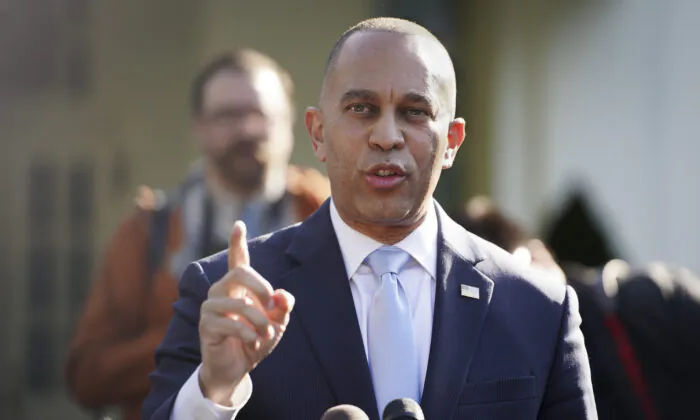
House Minority Leader Hakeem Jeffries (D-N.Y.) speaks to the press after meeting President Joe Biden and other leaders at the White House in Washington on May 9, 2023. (Madalina Vasiliu/The Epoch Times)

House Minority Leader Hakeem Jeffries (D-N.Y.) speaks to the press after meeting President Joe Biden and other leaders at the White House in Washington on May 9, 2023. (Madalina Vasiliu/The Epoch Times)

https://www.theepochtimes.com/house-democrats-introduce-discharge-petition-to-force-a-vote-on-us-debt-limit_5274395.html?utm_source=andshare 

House Democrats on Wednesday formally introduced a procedural resolution referred to as a “discharge petition” in an effort to try and force a floor vote on a U.S. debt limit increase without needing the approval of House Speaker Kevin McCarthy (R-Calif.).

The discharge petition was introduced at 10 a.m. as part of a clandestine scheme that had been quietly set in motion since the start of January. The top House Democrat, Rep. Hakeem Jeffries (D-N.Y.), first alerted fellow Democrat colleagues to the plan on May 2.

At the time, he told colleagues that a bill titled “Breaking the Gridlock Act” was introduced at the start of the 118th Congress that had multiple items on it, but also later had a clean debt ceiling increase attached to it. The bill, brought by Rep. Mark DeSaulnier (D-Calif.) has remained untouched since March 7, when it was referred to 20 different House committees.

A discharge petition, a rarely-used procedural measure, would bring a bill out of committee and force a floor vote, if the bill has remained idle for more than 30 days. This would happen even without the approval of the House Speaker.

On Wednesday, Jeffries urged all members of his caucus to support a discharge petition for DeSaulnier’s bill.

Epoch Times Photo
House Minority Leader Hakeem Jeffries (D-N.Y.) leaves a press briefing with reporters after meeting President Joe Biden and other leaders at the White House in Washington on May 16, 2023. (Madalina Vasiliu/The Epoch Times)

In a “dear colleague” letter (pdf), he expressed hope to find an “acceptable, bipartisan resolution that prevents a default,” but noted that because of the impending June 1 U.S. default deadline, “it is important that all legislative options be pursued in the event that no agreement is reached.”

He said a discharge petition is “a vehicle that may be necessary to protect the full faith and credit of the United States,” adding, “It is imperative that Members make every effort to sign the discharge petition today.”

To file the petition and succeed in forcing a House floor vote, Democrats need the support of a majority of the House or 218 votes. If all 213 House Democrats vote in support, the effort would still require at least five House Republicans to join them.

Currently, it is unclear whether all Democrats support the discharge petition.

Standoff Since January

Since January, President Joe Biden has had a standoff with McCarthy over raising the nation’s $31.4 trillion debt ceiling.

Republicans, who control the House by a 222-213 majority, have been pushing for spending cuts in exchange for a deal with Democrats to raise Congress’s self-imposed debt limit.

The government usually spends more than it takes in taxes, so borrowing is needed each year to meet the spending obligations legislated by Congress, which requires raising the debt limit.

The U.S. Treasury has indicated it will be unable to stay under the limit after about June 1. This means the U.S. government won’t be able to pay its bills if the debt limit isn’t lifted. Economists have said this would trigger a recession.

Deal by May 21 ‘Doable’: McCarthy

After a meeting to discuss the debt ceiling with McCarthy and other leaders on May 16—the second such meeting in eight days—Biden told reporters on May 17 the meeting was “productive,” adding he was “confident” that an agreement would be reached on the budget and there won’t be a federal default.

“The nation has never defaulted on its debt, and it never will,” he told reporters at the White House ahead of his departure that day to attend a G-7 Summit in Hiroshima, Japan.

“And we’re going to continue these discussions with congressional leaders in the coming days until we reach an agreement.”

When asked by reporters at the U.S. Capitol whether it’s possible to reach a debt ceiling deal by the time Biden returns from Asia on May 21, McCarthy said it is “doable.”

“We’re on such a short timeline,” he told reporters. “It makes it almost harder. But there’s one thing you know, for me, I never give up. I have the grit, the perseverance and we’re gonna get it done.”

Epoch Times Photo
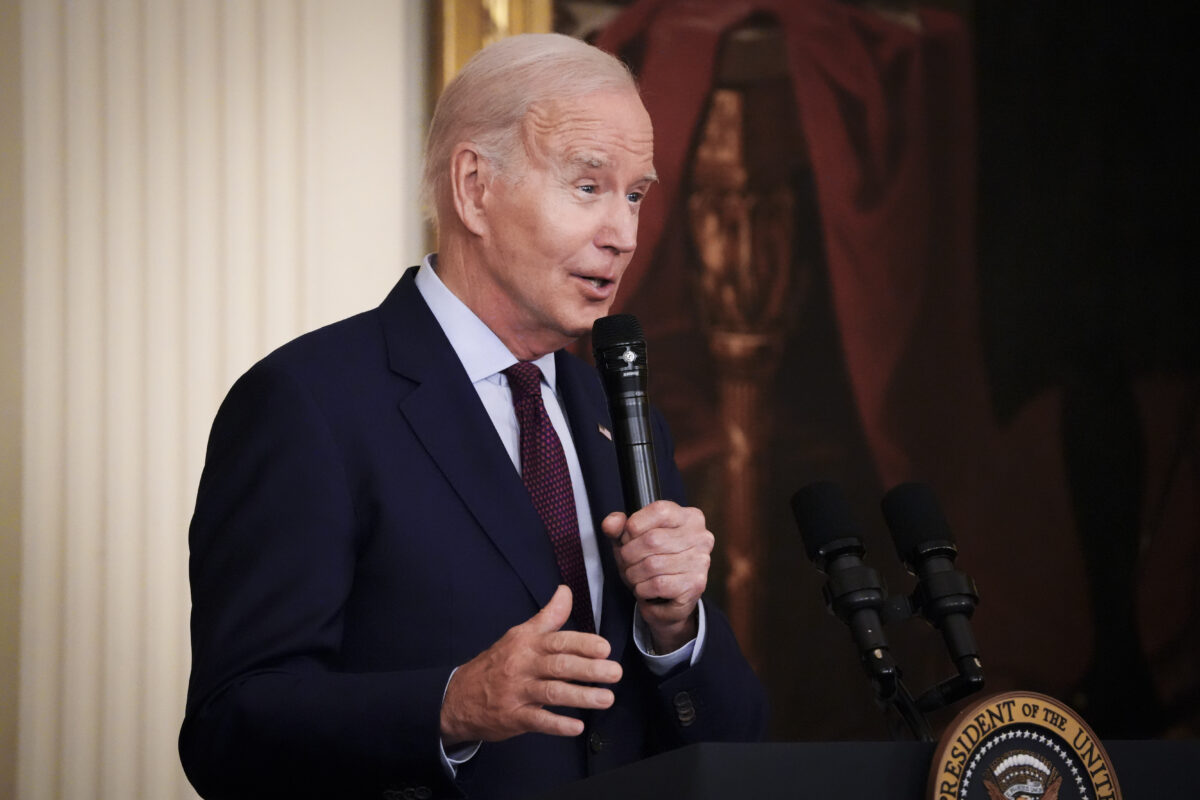
U.S. President Joe Biden speaks during an event celebrating Jewish American Heritage Month at the White House in Washington on May 16, 2023. (Madalina Vasiliu/The Epoch Times)

Biden on Wednesday signaled that he might accept work requirement expansions as part of the compromise with Republicans to raise the debt ceiling, so long as they don’t affect health care programs.

Meanwhile, McCarthy, in a CNBC interview, defended conservatives’ call for work requirements, saying they would help the economy and boost the workforce, and vowed to exclude any discussion of taxes.

Raising taxes on the wealthy and companies to help pay for programs for other Americans is a key part of Biden’s 2024 budget. On Tuesday, Biden said he was disappointed that Republicans would not consider ways to raise revenue.

If a deal is reached in the House and successfully passes, the Senate must still vote on the measure. Democrats hold a 51-49 majority in the Senate. The deal, with the backing of all Senate Democrats, would still require the support of nine Republicans to be passed.

Lawrence Wilson and Reuters contributed to this report.