
Sunday, April 17, 2022

Friday, April 15, 2022

'I prayed for this one,' SpaceX's Elon Musk says after NASA astronauts' splashdown success
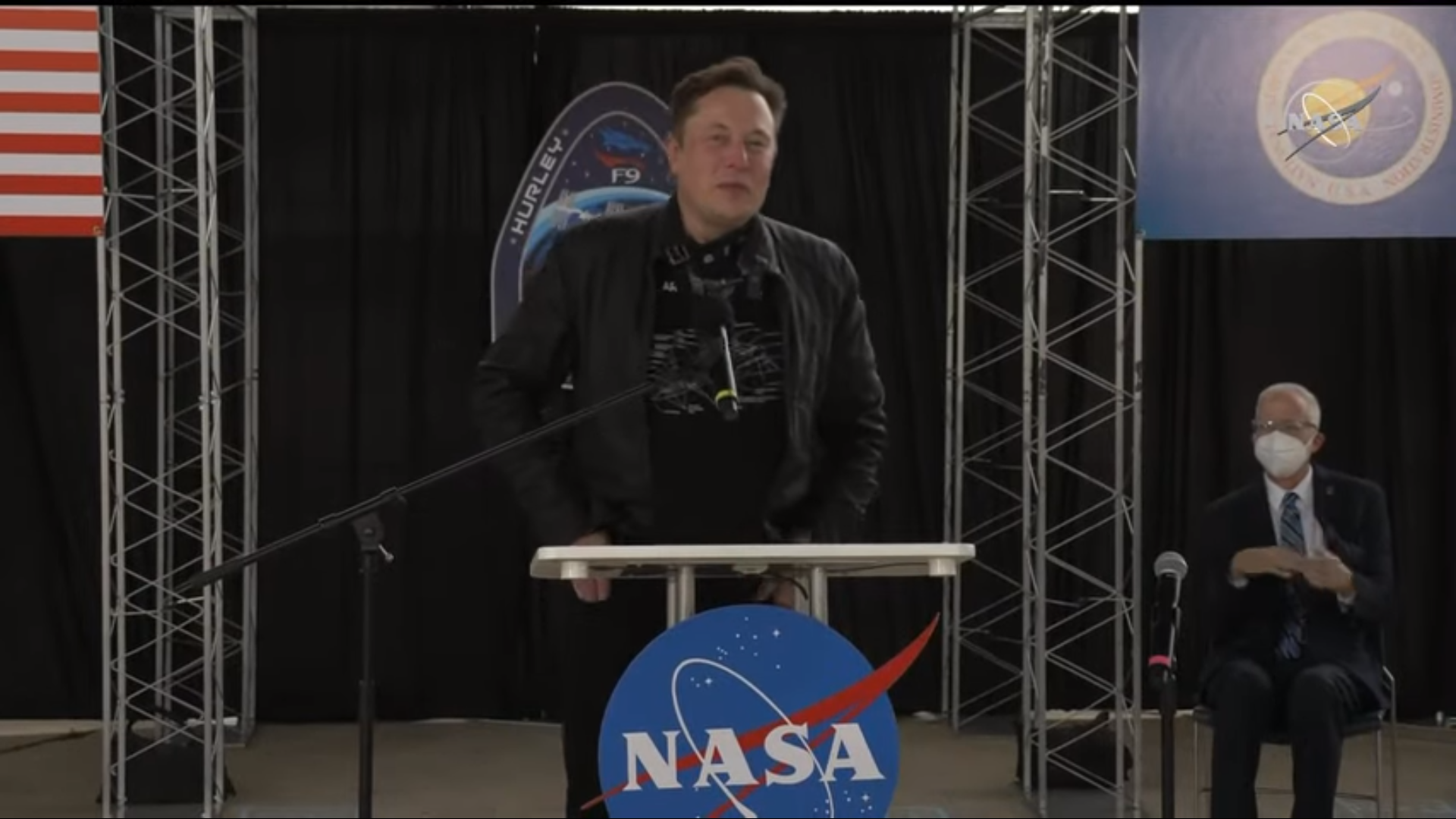
A relieved SpaceX CEO Elon Musk welcomed home the first NASA astronauts to fly to space on his company's Crew Dragon vehicle.
Doug Hurley and Bob Behnken returned to Earth after two months in orbit and safely splashed down in the Gulf Coast waters off Florida on Sunday (Aug. 2). The astronauts, finally back on their home planet, then caught a plane ride home to Houston, where NASA's astronaut corps is based. There, Musk joined NASA Administrator Jim Bridenstine to welcome the pair home from the test flight and share his excitement about what comes next.
"I
do think what this heralds really is fundamentally a new era in
spaceflight," Musk said. "We're going to go to the moon, we're going to
have a base on the moon, we're going to send people to Mars and make life multiplanetary and I think this day heralds a new age of space exploration. That's what it's all about."
Hurley and Behnken's flight, dubbed Demo-2, was the first crewed flight in NASA's commercial crew program to outsource astronaut rides to the space station to companies, an initiative that began in 2014. A second company, Boeing, also holds a contract with the program and is expected to refly an uncrewed test flight of its Starliner vehicle after a mishap in December left the capsule unable to reach the space station.
Spaceflight is always risky, but particularly so during a test flight, a fact that astronauts and mission leaders alike have acknowledged throughout the lead-up to the Demo-2 flight. Musk referenced the riskiness obliquely in his welcoming remarks.
"I think, like, my entire adrenaline just dumped, you know? Like, thank God," Musk said. "I'm not very religious, but I prayed for this one."
Musk also pointed to the context in which Hurley and Behnken made their flight. The pair flew to and from space as a pandemic ravaged the country, among other ongoing crises.
"I think this is something that the whole world can take some pleasure in and can really look at this as an achievement of humanity," Musk said. "These are difficult times, when there's not that much good news. I think this is one of those things that is universally good, no matter where you are on planet Earth. This is a good thing, and I hope it brightens your day."
Email Meghan Bartels at mbartels@space.com or follow her on Twitter @meghanbartels. Follow us on Twitter @Spacedotcom and on Facebook.
Join our Space Forums to keep talking space on the latest missions, night sky and more! And if you have a news tip, correction or comment, let us know at: community@space.com.
Thursday, April 14, 2022
Western Australia is world’s new top mining destination
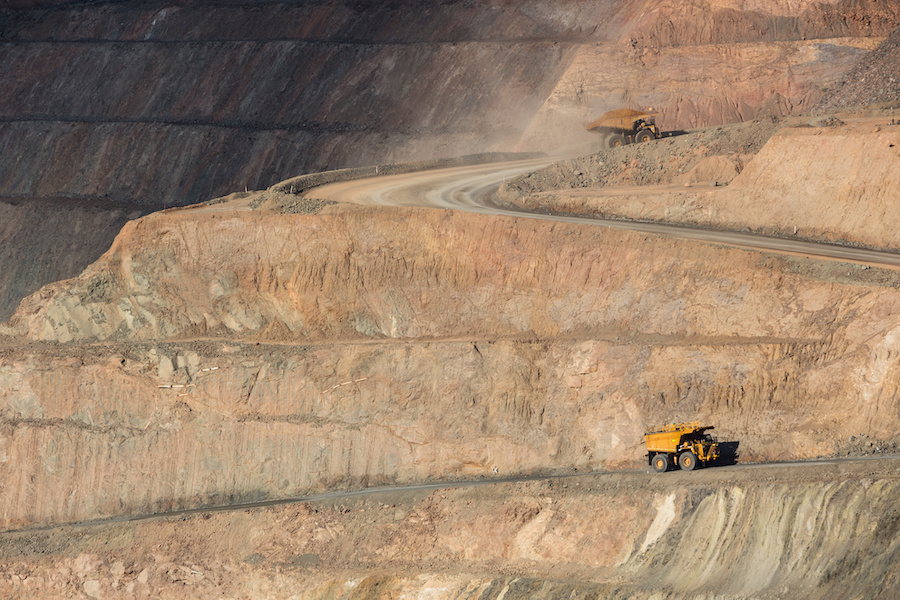
Western Australia has some of the world’s largest iron ore mines and it also hosts gold and lithium assets. (Stock image of the Super Pit in Kalgoorlie.)
Resource-rich Western Australia has been picked the most attractive region for mining investment in 2021, replacing the US state of Nevada, which fell to the third place in the latest annual survey of mining companies released by think-tank the Fraser Institute.

Canada’s Saskatchewan is still on the podium, climbing from a third place overall in 2020 to a second position in the 2021 index, which takes both mineral and policy perception into consideration.
The US was the country with the most jurisdictions considered among the world’s 10 most attractive by mining investors — Nevada, Alaska, Arizona and Idaho. Canada followed closely with three provinces at the top of the index — Saskatchewan, Quebec and the Yukon. Australia only had two states among the best ten destinations — Western Australia and Southern Australia.

As in previous years, the best places to invest in mining are located in developed countries with long histories of success in the industry, which not necessarily is a good thing.
The main issue is that the number of available projects in the top jurisdictions are limited, while some of the world’s best deposits are in places where doing business is, or is perceived as, risky.
Zimbabwe, which has an abundance of resources including gold, platinum, diamonds, lithium, chrome, and coal, ranked as the least attractive jurisdiction in the world for investment followed by Spain, the Democratic Republic of Congo (DRC) and Mali.
Also in the bottom ten, beginning with the worst, are Nicaragua, China, Panama, Argentina’s Mendoza, Venezuela and South Africa.
Permit times
The survey also included a sub-ranking of exploration jurisdictions, based on the length of their permitting process.
This year’s report went beyond Canada, gathering data from Australia, the US and Scandinavia, all regions where mining, environmental and other policies are broadly comparable.
In most Canadian provinces and territories, the majority respondents said they were able to acquire the necessary exploration permits within six months. There were some notable differences among regions, particularly when comparing Manitoba, where 42% of participants said it took them 24 months or more to obtain all necessary permits, versus British Columbia, where the majority said it took between three and six months.
“Overall, senior mining executives continue to cite the uncertainty around protected areas, disputed land claims, and environmental regulations as major areas of concern for Canadian provinces and territories,” said Elmira Aliakbari, director of the Fraser Institute’s Centre for Natural Resource Studies and co-author of the study.
“Policymakers in every province and territory should understand that mineral deposits alone are not enough to attract investment,” Aliakbari said.
Quebec performed the best, with 60% of respondents indicated that they received exploration permits in two months or less. When comparing the four regions included in the survey — Canada, the United States, Australia, and Scandinavia — Canadian jurisdictions have, on average, a higher percentage of respondents indicating that it took six months or less for them to receive their permits.
Western Australia has some of the world’s largest iron ore mines and it also hosts gold and lithium assets. (Stock image of the Super Pit in Kalgoorlie.)
Resource-rich Western Australia has been picked the most attractive region for mining investment in 2021, replacing the US state of Nevada, which fell to the third place in the latest annual survey of mining companies released by think-tank the Fraser Institute.
Canada’s Saskatchewan is still on the podium, climbing from a third place overall in 2020 to a second position in the 2021 index, which takes both mineral and policy perception into consideration.
Nevada, which topped the 2020 ranking, ranked third last year, followed by Alaska, Arizona, Quebec, Idaho, Morocco, Yukon, and South Australia.
The US was the country with the most jurisdictions considered among the world’s 10 most attractive by mining investors — Nevada, Alaska, Arizona and Idaho. Canada followed closely with three provinces at the top of the index — Saskatchewan, Quebec and the Yukon. Australia only had two states among the best ten destinations — Western Australia and Southern Australia.
As in previous years, the best places to invest in mining are located in developed countries with long histories of success in the industry, which not necessarily is a good thing.
The main issue is that the number of available projects in the top jurisdictions are limited, while some of the world’s best deposits are in places where doing business is, or is perceived as, risky.
Zimbabwe, which has an abundance of resources including gold, platinum, diamonds, lithium, chrome, and coal, ranked as the least attractive jurisdiction in the world for investment followed by Spain, the Democratic Republic of Congo (DRC) and Mali.
Also in the bottom ten, beginning with the worst, are Nicaragua, China, Panama, Argentina’s Mendoza, Venezuela and South Africa.
Permit times
The survey also included a sub-ranking of exploration jurisdictions, based on the length of their permitting process.
This year’s report went beyond Canada, gathering data from Australia, the US and Scandinavia, all regions where mining, environmental and other policies are broadly comparable.
In most Canadian provinces and territories, the majority respondents said they were able to acquire the necessary exploration permits within six months. There were some notable differences among regions, particularly when comparing Manitoba, where 42% of participants said it took them 24 months or more to obtain all necessary permits, versus British Columbia, where the majority said it took between three and six months.
“Overall, senior mining executives continue to cite the uncertainty around protected areas, disputed land claims, and environmental regulations as major areas of concern for Canadian provinces and territories,” said Elmira Aliakbari, director of the Fraser Institute’s Centre for Natural Resource Studies and co-author of the study.
“Policymakers in every province and territory should understand that mineral deposits alone are not enough to attract investment,” Aliakbari said.
Quebec performed the best, with 60% of respondents indicated that they received exploration permits in two months or less. When comparing the four regions included in the survey — Canada, the United States, Australia, and Scandinavia — Canadian jurisdictions have, on average, a higher percentage of respondents indicating that it took six months or less for them to receive their permits.
Warning bells sound in London Metal Exchange zinc market
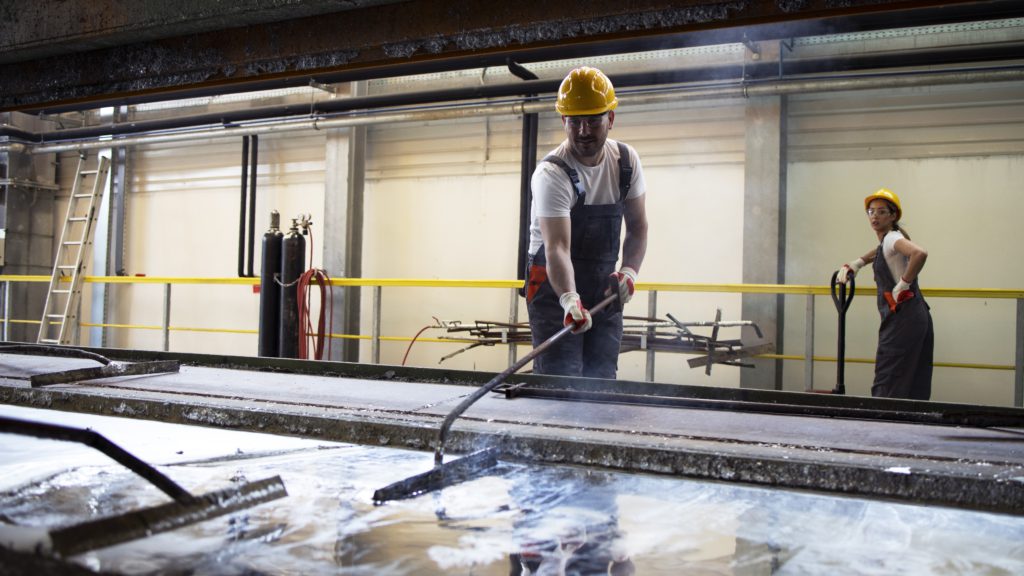
Metal parts being treated with zinc coating. (Stock Image)
(The views expressed here are those of the author, Andy Home, a columnist for Reuters.)
https://www.mining.com/web/warning-bells-sound-in-london-metal-exchange-zinc-market/
Is zinc going to be the next nickel?
Even as the London Metal Exchange (LME) tries to reassemble the
pieces of its broken nickel contract, there are signs that zinc could be
the next metal market to find itself in turmoil.
A raid on LME zinc stocks has seen available tonnage fall to two-year lows. Traders are tapping the market of last resort for metal to ship to Europe, where smelting capacity has been idled by high energy prices.
The effect is to tighten LME time-spreads and keep the outright price pushing higher. Last trading at $4,320 per tonne LME three-month metal is sitting just below a potential options black hole.
There’s a strong sense of deja-vu with both the LME copper market, which had to be restrained last October, and the nickel contract, which had to be suspended in March.

Perfect bull storm
Almost 60,000 tonnes of LME zinc stocks have been cancelled in preparation for physical load-out since the start of the month. Singapore was raided to the tune of 40,000 tonnes with the balance split between Baltimore and New Orleans.Report ad
Total LME stocks look healthy at 123,675 tonnes, but the amount of zinc available for the physical reconciliation of contracts has slumped to 45,925 tonnes, the lowest since February 2020.
The exchange’s European warehouses hold a paltry 500 tonnes – all at the Spanish port of Bilbao – attesting to the squeeze on Europe’s physical supply chain caused by the loss of regional smelter production.
European zinc premiums are at record highs and rising, according to Fastmarkets, which has just lifted its North European assessment by another $10 to $440-500 per tonne over the LME cash price.
It’s no surprise that Trafigura, which operates three European zinc smelters, and others should be tapping the market of last resort to plug the supply gap, as sources have said. Trafigura has declined to comment.
U.S. premiums are also at record highs, reflecting increased competition with Europe for available units and lower-than-expected production at the Valleyfield smelter in Quebec.
Noranda Income Fund, which owns the plant, has cut its 2022 production forecast by 15,000 tonnes to reflect operational problems in the first quarter of the year.
LME stocks in the United States have also been almost cleared out with just 550 tonnes available at New Orleans.
This is a perfect bull storm for the zinc market and analysts have lifted their price expectations accordingly.
Fitch, for example, has raised its 2022 average forecast from $2,900 to $3,500 per tonne, citing the prospect of a deeper supply deficit of 172,000 tonnes this year after an estimated 48,000-tonne shortfall in 2021.
Turbulence ahead?
The depletion of freely available LME stocks has inevitably tightened time-spreads, the cash premium flexing out to $85 at the start of April and valued at a still wide $55.50 at Friday’s close.
The LME imposed backwardation limits on all its physically-deliverable contracts at the start of March, capping the potential cost of rolling a position overnight at 1% of the previous day’s closing price.
There is also a cross-contract 15% cap on daily price moves, which in the case of zinc translates into a swing potential of $638 per tonne.
That’s highly relevant given the potential for price volatility ahead.
LME traders have been eyeing nervously the build-up of open interest on May and June call options with strike prices stretching up to $5,000 per tonne.
Relative to Friday’s closing prices, the total upside volumes in place come to 88,000 tonnes and 93,000 tonnes in May and June respectively.
Those overhanging call options create a vacuum above the market. If the price accelerates into them, sellers will be forced to hedge their exposure by buying the underlying futures, creating a vicious upwards circle.
The risk of a melt-up similar to that which sent nickel briefly above $100,000-per tonne before the LME suspended the market is clearly there in zinc given the low available tonnage in the warehouse system.
Close monitoring
The LME is not responsible for the cracks opening up in the global zinc physical supply chain.
But it is on heightened alert about potential market turbulence after events in the nickel contract, which is still in the critical ward as low liquidity hampers a reconciliation of the big short positions accumulated by China’s Tsingshan Group.
The LME told Reuters “we note the current tightness in the zinc market and are monitoring all metals closely to ensure market activity remains orderly”.
That’s the standard exchange response to any sign of trouble.
However, given the bullish brew in the zinc contract, the LME compliance department’s monitoring is going to have to be anything but standard.
The exchange can’t risk another nickel.
(Editing by Barbara Lewis)
Subscribe to:
Posts (Atom)