Thursday, September 10, 2020

Tanker Rates Have Plummeted And Likely To Remain Depressed Through 2021

crude tanker

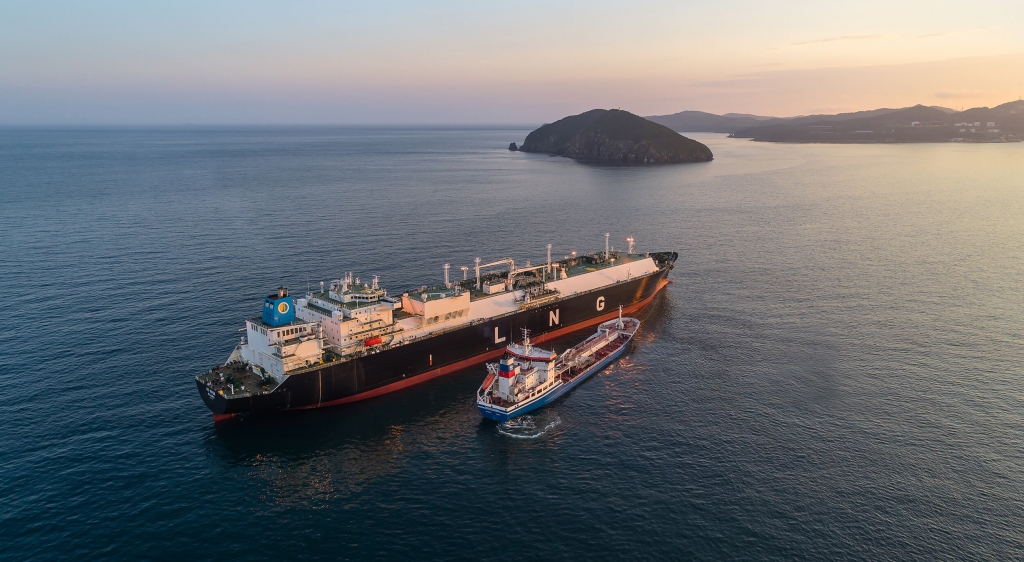
Euronav-owned VLCC (Photo: Euronav)

https://seekingalpha.com/article/4373293-tanker-rates-plummeted-and-likely-to-remain-depressed-through-2021 

Summary

VLCC rates are highly sensitive to oil flow volumes.

VLCC fixtures have plummeted due to lower OPEC+ production and low oil demand.

Transportation uses of oil have collapsed because of the pandemic.

OPEC+ has agreed to keep production down through 1Q2022.

An oversupply of tankers v. demand is therefore likely to keep rates down for an extended period of time.

Looking for more investing ideas like this one? Get them exclusively at Boslego Risk Services. Get started today »

Tanker rates for Very Large Crude Carriers (VLCCs) are highly sensitive to oil transportation volumes, which in turn, are a function of global oil production and consumption. And so it follows that the lower the demand for oil, the lower the demand for tankers.

However, a special case developed in the spring when oil demand plummeted as economies worldwide were shut down to control the spread of COVID-19. The resulting oil price collapse created a demand for tankers as temporary floating storage facilities, and tanker rates spiked. That was an unexpected boon for tanker owners, who, at the beginning of the year, were focused on impacts of the IMO-2020 regulations.

With oil futures prices rebounding, the financial incentive to store oil at sea has dissipated, and so tankers that were taken off trade have returned to market. Port congestion has also eased at Asian ports that were coping with the pandemic. Middle distillate inventories at Asia’s Singapore oil hub have surpassed a nine-year high, according to official data.

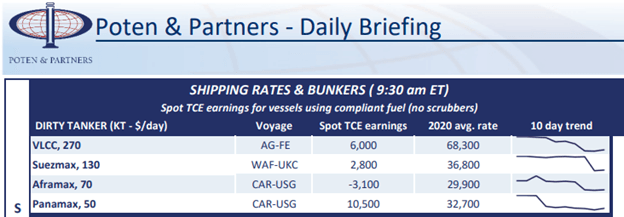
As a result these dynamics, VLCC availability has been rising and tanker rates have plummeted. As of September 4th, Poten & Partners quoted the dirty tanker rate for VLCC, 270 at just $6,000 Spot TCE Earnings. That’s off from an average of $68,300 per day for 2020 year-to-date.
 

Global oil demand could be 9 to 10 million barrels per day lower this year due to the pandemic, Russian Energy Minister Alexander Novak was quoted. Transportation fuels, which account for the bulk of global oil demand, continue to be depressed due to travel restrictions and fears by would-be travelers of contracting the disease.

U.S. airport travel data show that throughput is still more than 60 percent lower than last year, as of September 5th.
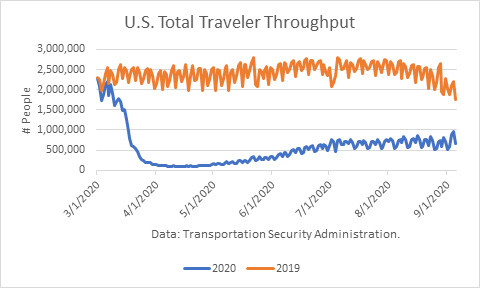
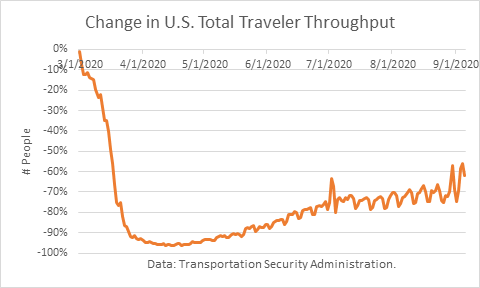
U.S. demand for jet fuel was down 47% over the past 4 weeks from a year ago. Jet fuel consumption is a little less sensitive to the number of persons on board compared to the number of flights.
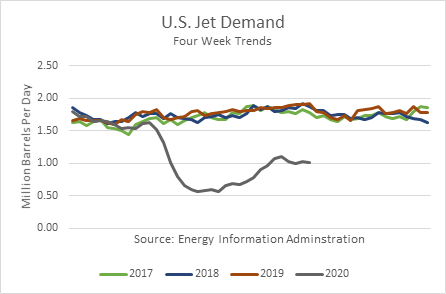
And this is about three months after travel restrictions have eased in the States. Infection rates did not ease during the warm summer months as many had expected. And the death toll has reached 188,000 in the U.S.. According to Dr. Anthony Fauci, the death toll could reach 410,000 by January.

The US Centers for Disease Control and Prevention sent guidance last week that vaccines could be distributed as early as the end of October in what they have called Phase 1.

Availability for Vaccine A will be approximately 2 million doses by late October; 10-20 million by late November; and 20-30 million doses by the end of December. Availability for Vaccine B will be approximately 1 million doses by late October; 10 million by late November; and 15 million doses by the end of December.”

It should be noted that the initial trials of vaccines are given to people meeting very high health standards, but that 8 out of 10 people who have died have been 65 or older and many suffering from underlying conditions. And so it may be unclear for an extended period of time before there is data on how safe and effective the vaccines may be for the high risk group, and according to Bill Gates, whose foundation is heavily involved in the vaccine effort, 40+ percent of the population may not want to take a vaccine when one becomes available—at least not until the vaccine's effectiveness and the safety statistics are well established.

Furthermore, work-at-home and online Zoom meetings may have a long-term impact on travel demand for fuels. The cost and time effectiveness of meeting online instead of in-person is profound and may be disruptive to physical travel.

All three of the primary oil forecasting agencies, the International Energy Agency, the U.S. Energy Information Administration, and the Organization of Petroleum Exporting Countries, have published forecasts through 2021, and none foresee global demand returning to pre-COVID levels prior to 2022.

OPEC+ made an agreement to cut their combined crude production by 7.7 million barrels a day from baselines from May to July for the balance of 2020 and then to 5.8 million barrels during 2021 and the first quarter of 2022 to drawdown global inventories from glutted levels. Saudi Aramco (ARMCO) oil shipments to the USA have averaged 310,000 b/d in the 4 weeks ending August 28th, down 31% from a year ago.

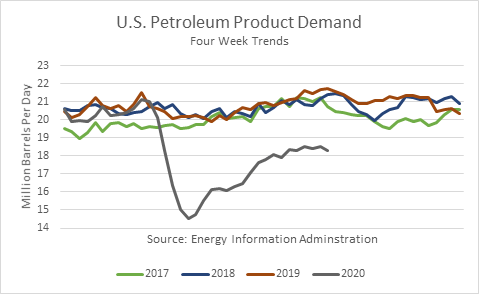
The rebound in U.S. petroleum product demand has stalled with demand off 15.9 % v. last year. A recent report showed U.S. job growth slowed further in August, as financial assistance from the government ran out.
Conclusions

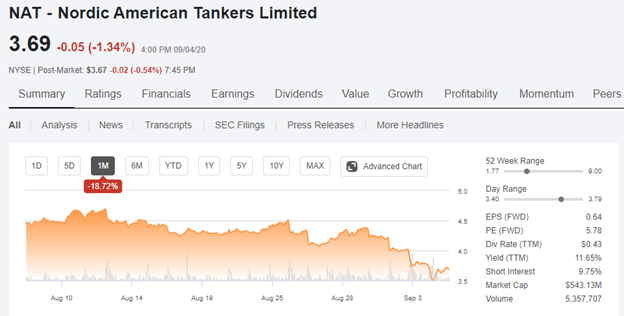
Tanker rates have crashed and the share prices of tanker owners such as Nordic American Tankers (NYSE:NAT) have recently dropped. I expect to see further downside as the drop in oil demand extends into the months ahead.
To guide investors who are interested in profiting from outstanding opportunities in the energy sector, I provide a service on Seeking Alpha’s Marketplace oriented toward individual investors, Boslego Risk Services. A long/short Model portfolio is continuously updated, along with on-going analysis of the oil market.

I am now accepting new members to Boslego Risk Services and invite you to sign-up. There are monthly and annual pricing options as described here. You may also read reviews posted by members here

Disclosure: I am/we are short NAT. I wrote this article myself, and it expresses my own opinions. I am not receiving compensation for it (other than from Seeking Alpha). I have no business relationship with any company whose stock is mentioned in this article.

Wednesday, September 9, 2020

South Korea Imports Oil from China Storage in Rare Flow

[Reuters] – South Korean refiners have bought nearly 2 million barrels of Omani crude from Chinese storage tanks in the past two months, seldom seen trades created by low prices and high inventories, according to trade sources and shipping data on Refinitiv Eikon.

The cargoes were among the first to be lifted from bonded storage tanks operated by Shanghai’s International Energy Exchange (INE) for delivery to South Korea, the sources said.

Strong buying from Chinese investors betting on a rebound in oil prices earlier this year pushed Shanghai crude futures to a premium over global benchmark Brent.

The trend reversed from July, though, prompting refiners to buy crude from the exchange at prices lower than spot supplies, the sources said.

One source with direct knowledge of the matter said SK Trading International in July bought 700,000 barrels of Omani crude from Litasco, trading arm of Russian oil producer Lukoil.

Another source said GS Caltex bought two Omani crude cargoes in July and August via traders from the exchange.

Three tankers delivered oil from ports in Shandong and Hainan provinces to Yeosu and Ulsan in the past two months, Refinitiv data showed.

Chinese refiner Hengli Petrochemical also made its first purchase from the INE in August, lifting a 500,000-barrel Upper Zakum crude cargo from Dalian storage, a source familiar with the matter said.

Middle East crude sold via the exchange are “a couple of dollars” cheaper than spot supplies, but procedures such as customs clearance are complicated, he said.

The sources declined to be named due to the sensitivity of the matter. SK Innovation owner of SK Energy – and GS Caltex and Hengli declined to comment.

Shanghai Futures Exchange, which owns INE, and Litasco did not respond to requests for comment.

INE’s storage peaked at more than 45 million barrels at end-July to early August, according to data on its website.

Buyers of INE crude have to be flexible as the cargoes typically ship within weeks and the crude grade and loading port are decided by the exchange, the sources said.

Asian refiners normally buy crude two months ahead.

https://tankterminals.com/news/south-korea-imports-oil-china-storage-rare-flow/?utm_medium=email&utm_campaign=Newsletter%20Other%20-%20Week%2037&utm_content=Newsletter%20Other%20-%20Week%2037+CID_098fbe615f99a71faeae7f397b5a028b&utm_source=weekly&utm_term=Read%20more 

Tuesday, September 8, 2020

Japan Dispatches Third Disaster Relief Team to Mauritius Oil Spill Site

Credit...Agence France-Presse — Getty Images

https://www.petroleumafrica.com/japan-dispatches-third-disaster-relief-team-to-mauritius-oil-spill-site/ 

Dispatch of the third Japan Disaster Relief (JDR) Team in response to the oil spill off the coast of the Republic of Mauritius

The team will leave Japan on September 2nd to undertake on-site environmental assistance activities after arriving in the country

TOKYO, Japan, September 1, 2020/ — Japan has decided to dispatch the third Japan Disaster Relief (JDR) Expert Team, which consists of 6members, to the Republic of Mauritius to deal with the oil spill from the bulk carrier “WAKASHIO” which has been stranded off the coast of the country since July 25th. The team will leave Japan on September 2nd to undertake on-site environmental assistance activities after arriving in the country.

  1. The accident has caused serious damage to the environment in the Republic of Mauritius, which could have a serious impact on the country’s tourism industry as well. Japan has decided to dispatch the team out of comprehensive and holistic consideration of all circumstances, including the request of assistance from the Government of the Republic of Mauritius and the friendly relationship between the two countries.
  2. Japan will continue to closely cooperate with the Government of the Republic of Mauritius as well as relevant countries and organizations, and make utmost efforts to contribute to the restoration of natural environment and the recovery of economic activities of the Republic of Mauritius.

Distributed by APO Group on behalf of Ministry of Foreign Affairs of Japan.

Friday, September 4, 2020

US sanctions 11 foreign firms for helping Iran export petroleum

The sanctions 'reaffirm the United States's commitment to denying the Iranian regime the financial resources it needs to fuel terrorism and other destabilising activities', US Secretary of State Mike Pompeo said in a statement [File: Nicholas Kamm/Reuters] 

The sanctions 'reaffirm the United States's commitment to denying the Iranian regime the financial resources it needs to fuel terrorism and other destabilising activities', US Secretary of State Mike Pompeo said in a statement [File: Nicholas Kamm/Reuters]

The US said the companies helped facilitate Iran's export of petroleum and petrochemicals in violation of its sanctions.

https://www.aljazeera.com/ajimpact/sanctions-11-foreign-firms-helping-iran-export-petroleum-200903165942631.html 

The United States on Thursday imposed sanctions on 11 foreign companies, accusing them of helping to facilitate Iran's export of petroleum, petroleum products and petrochemicals in violation of American sanctions.

The Treasury said it slapped sanctions on six companies based in Iran, the United Arab Emirates and China that it said enable the shipment and sale of Iranian petrochemicals and support Triliance Petrochemical Co Ltd, a Hong Kong-based company blacklisted by the US.

Triliance, a Hong Kong-based broker, was hit with sanctions in January over accusations it ordered the transfer of the equivalent of millions of dollars to the National Iranian Oil Co as payment for Iranian petrochemicals, crude oil, and petroleum products.

The Treasury also blacklisted UAE-based Petrotech FZE and Trio Energy DMCC, Hong Kong-based Jingho Technology Co Ltd and Dynapex Energy Ltd, as well as China-based Dinrin Ltd, accusing them of being front companies for Triliance and Zagros.

"The Iranian regime uses revenue from petrochemical sales to continue its financing of terrorism and destabilizing foreign agenda," Treasury Secretary Steven Mnuchin said.

Tensions between Washington and Tehran have spiked since Republican President Donald Trump unilaterally withdrew in 2018 from the Iran nuclear deal struck by his Democratic predecessor, Barack Obama, and began reimposing sanctions that had been eased under the accord.

SOURCE: Reuters news agency

Triliance, a Hong Kong-based broker, was hit with sanctions in January over accusations it ordered the transfer of the equivalent of millions of dollars to the National Iranian Oil Co as payment for Iranian petrochemicals, crude oil, and petroleum products.

The Treasury also blacklisted UAE-based Petrotech FZE and Trio Energy DMCC, Hong Kong-based Jingho Technology Co Ltd and Dynapex Energy Ltd, as well as China-based Dinrin Ltd, accusing them of being front companies for Triliance and Zagros.

"The Iranian regime uses revenue from petrochemical sales to continue its financing of terrorism and destabilizing foreign agenda," Treasury Secretary Steven Mnuchin said.

Tensions between Washington and Tehran have spiked since Republican President Donald Trump unilaterally withdrew in 2018 from the Iran nuclear deal struck by his Democratic predecessor, Barack Obama, and began reimposing sanctions that had been eased under the accord.

SOURCE: Reuters news agency

WTI Drops Below $40 Amid Stock Market Rout

A trader works on the floor of the New York Stock Exchange.

https://oilprice.com/Energy/Oil-Prices/WTI-Drops-Below-40-Amid-Stock-Market-Rout.html 

Oil prices tumbled on Friday morning, preparing to finish out the week $3 per barrel less than last Friday’s level. It is the largest weekly drop since June.

U.S. oil futures were already at their lowest point since July on Wednesday.

At 11:00 am EDT, the WTI spot price was $40.26 (-2.68%), nearly $3 under last week’s level. Brent crude was trading $43.04 (-2.34%), roughly $2 per barrel less than last week.

The fall can likely be attributed to the strong dollar, after earlier reports that the U.S. unemployment rate dropped to 8.4%--as well as reports of faltering domestic gasoline demand in the United States.  A strong dollar makes U.S. oil more costly for other countries to purchase, and therefore typically has an inverse relationship with crude.

The drop comes despite a significant draw in crude oil inventories this week, but the hurricane-related nature of the draws dampened the enthusiasm for the inventory draw.

The price drop comes on the same day that Russia’s energy minister Alexander Novak predicted that oil prices would stay in the $50-$55 per barrel range next year, as the world continues to grapple with the pandemic and as an emphasis on renewables factors more into the energy landscape.

WTI futures for October were trading down $1.25 on Friday, at $40.12.

Further dents to crude oil demand are expected over the next month, as the driving season comes to a close and refinery maintenance season fast approaches.

By Julianne Geiger for Oilprice.com

Thursday, September 3, 2020

SEA-LNG Chairman explains why LNG is the “only viable fuel” to reduce shipping’s GHG footprint

http://www.tankeroperator.com/ViewNews.aspx?NewsID=11812 

Peter Keller, Chairman of SEA-LNG, the multi-sector industry coalition advocating for LNG as a marine fuel throughout the entire value chain, has published a new report which offers an in-depth insight into LNG as a marine fuel and its clear pathway for the shipping industry’s decarbonisation.

The report outlines how LNG as a marine fuel is the only viable option for shipping to reach IMO 2030. It argues that LNG-fuelled vessels are “zero-emissions on the water today” as they offer a clear route to IMO 2050 thanks to carbon-free liquefied bio-methane which can be easily adopted by LNG-fuelled vessels and LNG infrastructure.
 
As the debate is fast descending into “my solution versus your solution”, Keller comments that waiting for a “utopian solution” risks locking the maritime industry into the highly polluting conventional oil-based marine fuels for years, if not decades, to come.
 
The report offers an insight into the state of play regarding LNG as a marine fuel. It also highlights the promising role that modern dual-fuel engines’ ability to accelerate decarbonisation while countering the points surrounding methane slip.
 
To read the full report from SEA-LNG chairman Peter Keller, please click here.