Monday, November 5, 2018

‘Lomonosov Prospect’ successfully completes NSR transit

Lomonosov Prospect


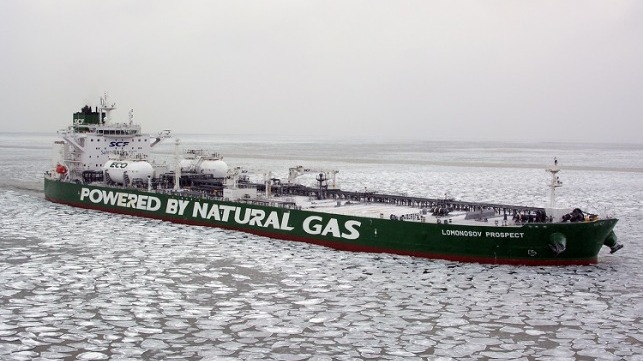
On 30th October, 2018 at 23:59 Moscow time, ‘Lomonosov Prospect’, Sovcomflot's (SCF) Aframax using LNG fuel as its primary fuel, successfully completed a commercial voyage along the Northern Sea Route (NSR).
 
She delivered a petroleum product cargo loaded in South Korea and destined for Northern Europe.

The high-latitude voyage from Cape Dezhnev at Chukotka to Cape Zhelaniya of the Novaya Zemlya archipelago took the Arc4 vessel 7.8 days to complete, during which the tanker covered a distance of 2,194 nautical miles.

During the voyage, the crew successfully tested the ship’s engines and the fuel control systems using LNG, as well as the operation of navigation equipment and machinery in ice conditions and sub-zero temperatures.

The successful voyage has confirmed the vessel’s high manoeuvrability and icebreaking capabilities, as well as being a highly safe, environmentally friendly and efficient vessel, SCF claimed.

The tanker sailed along almost the entire NSR without icebreaker escort, having covered some 950 nautical miles in ice conditions. She was escorted by Atomflot's nuclear-powered icebreaker ‘Taimyr only when traversing the most navigationally and hydrographically challenging area of the Ayon ice massif in the East Siberian Sea.

The tanker’s Master was Dmitry Belozerov, who has extensive high-latitude navigation experience. In 2010, Capt Belozerov served as Chief Officer on SCF's Aframax ‘SCF Baltica – the first large-capacity vessel to complete an NSR transit.

The results obtained during this experimental voyage provided the foundation for developing marine transportation solutions for major industrial projects in the Arctic, such as Yamal LNG and Novy Port.

During the latest voyage, the crew was aided by a second Master/ice advisor.

‘Lomonosov Prospect is the second of six Aframaxes designed to operate on LNG as the primary fuel. She was delivered to SCF last month.

In September, 2018, SCFplaced with Zvezda Shipbuilding Complex orders for a series of two similar LNG-fuelled Aframaxes, both of which will be timechartered to Rosneft for 20 years each, following their deliveries.

In addition SCFwill provide technical supervision during the construction of the five similar LNG-fuelled Aframaxes for Rosneft, also ordered at Zvezda Shipbuilding Complex.
 
Upon the delivery of these vessels, SCF will provide a range of services to ensure the effective and safe management of these vessels, including the recruitment of high-skilled crews and their management.

Sunday, November 4, 2018

Oil rally faces tidal wave of supply

Trump blamed OPEC


By Devika Krishna Kumar and David Gaffen

(Reuters) - The oil market's two-year bull run is running into one of its biggest tests in months, facing a tidal wave of supply and growing worries about economic weakness sapping demand worldwide. 

After topping out at more than $75 and $85 a barrel just a month ago, both U.S. crude and Brent benchmark futures have grappled with near-relentless selling. For a time, prices had some support on hopes that renewed U.S. sanctions on Iran would force barrels off the market. 

That changed in the last week. The world's three largest producers - Russia, Saudi Arabia and the United States - all indicated they were pumping at record or near-record levels, while the United States said it would allow waivers that could allow buyers to keep importing Iranian oil, lessening the threat of a supply crunch. 

Those factors, along with a spate of recent weak economic reports out of China and other emerging markets, have shifted the conversation back toward worries about oversupply, and pushed U.S. futures to lows not seen since April, interrupting an upward move that had consistently found support during the rally's modest pullbacks.

The structure of the U.S. crude futures curve had for several months indicated expectations for tighter supply, but future-dated contracts now suggest investors think markets could be awash in oil over the coming months.

"The magnitude of recent selling is strongly suggesting that global oil demand is weaker than expected as a result of tariff issues, especially between the U.S. and China," said Jim Ritterbusch, president of Ritterbusch & Associates. 

There has been an exodus among speculators as well. In the last two weeks, net bullish bets on oil have declined to the lowest level in over a year. Selling notably accelerated on Thursday after U.S. West Texas Intermediate crude futures fell below $65 a barrel, a level that had stood firm in previous selloffs during the summer and fall. 

The oil market ran higher in anticipation of this week's formal re-imposition of sanctions against Iran by the United States, and on concerns that supply from producers like Saudi Arabia would not be able to make up the difference.

However, the U.S. government said on Friday it will temporarily allow several countries including South Korea and Turkey to keep importing Iranian oil when U.S. sanctions come back into force on Monday, sparing them for now from the threat of U.S. economic penalties.

Still, some analysts believe the current selloff has come too far, too quickly. Major OPEC producers won't be able to add more supply should it become necessary, particularly with production in Iran, Venezuela and Libya still at risk. 

"A loss of 1 million bpd from Iran, further declines in Venezuela, coupled together with geopolitical disruption in Libya and Nigeria could easily wipe out what little spare capacity we have left," Bernstein analysts said this week. 

Output from the Organization of the Petroleum Exporting Countries, led by Saudi Arabia, rose to levels not seen in two years. U.S. production hit a record 11.3 million barrels a day in August, and Russia's output rose to 11.4 million bpd, a post-Soviet era peak. 

For U.S. crude, the key area to watch is between $64.45 and $64.80, where prices had found support in the past, said Fawad Razaqzada, analyst at futures brokerage Forex.com. If oil dips below this point, "the path of least resistance would be to the downside," he said.

For Brent, Razaqzada is watching the range between $69.50 and $69.60 a barrel, and if it were to slip below that, we could see a much larger correction, he said. 

(Reporting By David Gaffen and Devika Krishna Kumar in New York; Editing by Andrea Ricci)

Friday, November 2, 2018

Finance Companies Express Interest in Port Harcourt Refinery


https://www.petroleumafrica.com/finance-companies-express-interest-in-port-harcourt-refinery/

NNPC, Nigeria’s state-owned oil company, revealed that a number of the finance companies it has approached to modernize the country’s refineries have expressed interest in the modernization of the Port Harcourt refinery.

“About three finance companies have expressed interest in the Port Harcourt refinery,” said a NNPC statement signed by NduUghamadu, Group General Manager, Group Public Affairs Division.

The official assured that according to the schedule set by the Ministry of Petroleum, the refineries will be fully operational by 2019 and will add their production capacity to that of the Dangote refinery that is currently under construction. The modernization of its refineries, along with the addition of the Dangote refinery, will bring the West African nation one step closer if not to the final step to the end of costly petroleum product imports.

The combined capacity of the Kaduna, Warri and Port Harcourt refineries is currently 445,000 bpd. The goal of the Nigerian government is to increase this production capacity.

Thursday, November 1, 2018

Trump will reportedly allow India and South Korea to keep buying sanctioned Iranian oil

 
Indian Prime Minister Narendra Modi and U.S. President Trump hold a joint news conferences at the White House. Kevin Lamarque/Reuters


https://www.cnbc.com/2018/11/01/trump-near-deals-with-india-south-korea-on-iran-oil-imports-reports.html
  • The Trump administration has agreed to allow India and South Korea to continue buying some Iranian crude, according to reports.
  • Washington is threatening sanctions against countries that continue importing oil from Iran after a deadline on Nov. 4.
  • Without waivers to continue purchasing Iranian oil after the deadline, foreign firms face the risk of being locked out of the U.S. market.
The United States is poised to grant waivers to India and South Korea that will allow the countries to continue buying oil from Iran, despite the renewal of U.S. sanctions next week, according to news reports.

The Trump administration gave oil buyers 180 days to wind down purchases of Iranian crude in May, when President Donald Trump announced he was abandoning a nuclear accord with Iran and restoring sanctions on its economy. The administration told importers to completely cut off purchases by Nov. 4, but it is widely expected to allow some countries to continue reducing purchases beyond that date.

On Thursday, the Economic Times reported that the administration will allow India to purchase 1.25 million tons of Iranian oil each month through March. A source told the English-language Indian newspaper that India and Washington have "broadly agreed on a waiver" and that "India will cut import by a third."

India, the second largest purchaser of Iranian oil, imported about 22 million tons from Iran in the 2017-2018 period, according to the paper.

High crude prices and a deteriorating Indian rupee have caused oil price inflation in the country and sparked protests over fuel costs. While Brent crude is trading at about $75, India is essentially paying double that after inflation, Fatih Birol, executive director of the International Energy Agency told CNBC this week.

The payment mechanism remains uncertain, but India is expected to continue paying for Iranian oil in euros and rupees, sources said. Iran would use rupees to pay for rice, drugs and other items, while the balance of revenues would be held in escrow until sanctions are lifted, the Economic Times reported.
Bloomberg News later reported that South Korea, in addition to India, has agreed to the outlines for a waiver with the United States. Bloomberg also reported that funds from Indian imports would go into an escrow account.

Sources told both news outlets an announcement from the administration could come in the next few days. The State Department did not immediately return a request for comment.
Several other oil importing nations are also seeking waivers.

Japan's top spokesperson for the government on Thursday said the nation had yet to receive a waiver, Reuters reported. China, Iran's biggest oil customer, has also sought a waiver, and its biggest refiners have reportedly halted imports in November until Beijing gets clarity from Washington.

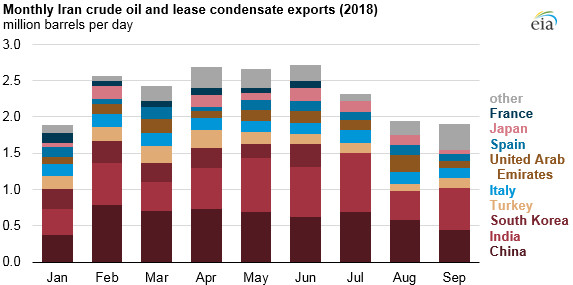
U.S. sanctions have cut Iran's exports by roughly a third, with shipments shrinking to roughly 1.7 million to 1.9 million barrels per day by the end of September, according to estimates from several sources.


The sanctions were developed by Congress and implemented by the Obama administration, which marshaled international support for the policy in order to put pressure on Iran to negotiate restrictions on its nuclear technology program. The United States and five world powers reached a deal with Iran in 2015 that paved the way for sanctions relief the following year.

The Trump administration, hoping to secure a tougher nuclear accord and force changes to Iran's foreign policy, pulled the United States out of the accord in May over widespread international objection. The European Union is trying to preserve the nuclear deal, but the continent's multinational companies have dropped business ties with Iran under threat of U.S. sanctions.

The Obama administration allowed some foreign firms to gradually wind down their purchases from Iran so long as their home country reduced imports by 20 percent every 180 days. The Trump administration has not announced hard terms for waivers.

Wednesday, October 31, 2018

OPEC oil output rises to highest since 2016 despite Iran: Reuters survey

Saudi Aramco has embarked on a programme to develop gas fields not associated with oil production.


OPEC has boosted oil production in October to the highest since 2016, a Reuters survey found, as higher output led by the United Arab Emirates and Libya more than offset a cut in Iranian shipments due to U.S. sanctions. 

The 15-member Organization of the Petroleum Exporting Countries has pumped 33.31 million barrels per day this month, the survey on Wednesday found, up 390,000 bpd from September and the highest by OPEC as a group since December 2016. 

OPEC agreed in June to pump more oil after pressure from U.S. President Donald Trump to curb rising prices and make up for an expected shortfall in Iranian exports. Oil LCOc1 hit a four-year high of $86.74 a barrel on Oct. 3 but has since eased to $76 as concerns over tight supplies faded. 

“Oil producers appear to be successfully offsetting the supply outages from Iran and Venezuela,” said Carsten Fritsch, analyst at Commerzbank in Frankfurt. 

The June pact involved OPEC, Russia and other non-members returning to 100 percent compliance with output cuts that began in January 2017, after months of underproduction in Venezuela, Angola and elsewhere had pushed adherence above 160 percent. 

In October, the 12 OPEC members bound by the supply-limiting agreement lowered compliance to 107 percent as production rose, from a revised 122 percent in September, the survey found.
This is the closest OPEC has moved to 100 percent compliance since the June agreement.

UAE, LIBYA

The biggest increase has come this month from the UAE. 

Output in October rose by 200,000 bpd to 3.25 million bpd, the survey found, and could in theory rise further as the UAE says its oil-production capacity will reach 3.5 million bpd by the year-end. 

The second-largest came from Libya where production averaged 1.22 million bpd, the survey found, a rise of 170,000 bpd. Libyan output remains volatile due to unrest, raising questions about the stability of current OPEC production. 

Saudi Arabia, after opening the taps in June and then scaling back its plans to pump more, supplied 10.65 million bpd in October, more than in June and close to a record high, the survey found. 

The kingdom, OPEC’s top producer, has indicated it is concerned about potential oversupply, raising the prospect that its next production adjustment could be to rein in output. 

OPEC’s second-largest producer, Iraq, also raised output in October. 

Iraqi supply could rise further if Iraq’s new government goes ahead with a deal reached by the outgoing administration and the Kurdistan Regional Government (KRG) to resume exporting Kirkuk crude to Turkey via the KRG. 

Angola, where natural declines at oilfields curbed production in recent years, boosted supply in October due to supply from a new field, Gindungo. Output is still far below its OPEC target. 

Exclusive: Saudi arms deal may create few new U.S. jobs
 
Supply in Nigeria rose by 30,000 bpd. Like Libya, Nigeria is not part of the OPEC supply-cutting pact because it often faces unplanned outages stemming from unrest. 

Output in Kuwait edged lower, the survey found. The country had raised production in July following the OPEC deal, and kept it steady in August and September. 

Among countries with lower output, the biggest drop - 100,000 bpd - occurred in Iran. Exports fell as returning U.S. sanctions discouraged companies from buying the country’s oil, although the decline was lower than some analysts expected. 

“Iran is going to come in above expectations,” said an industry source who tracks OPEC output, referring to Iranian supply in October. 

Production also slipped further in Venezuela, where a lack of funds for the oil industry because of the country’s economic crisis is cutting refinery operations and crude exports. 

Despite these decreases, OPEC output in October has risen to the highest since December 2016, the month before the supply-cutting pact took effect, according to Reuters surveys. 

Some of the extra oil has come from Congo Republic and Equatorial Guinea, which joined OPEC in 2018 and 2017 respectively. 

Before Congo joined, OPEC had an implied production target for 2018 of 32.78 million bpd, based on cutbacks detailed in late 2016 and Nigeria and Libya’s expectations of 2018 output. 

According to the survey, OPEC excluding Congo pumped about 530,000 bpd above this implied target in October. 

The survey aims to track supply to the market and is based on shipping data provided by external sources, Thomson Reuters flows data and information provided by sources at oil companies, OPEC and consulting firms. 

Additional reporting by Rania El Gamal in Dubai; Editing by Dale Hudson

Tuesday, October 30, 2018

Oil Production On Federal Lands To Hit New Record


Image: Drill Rig and American Flag
(Credit: Jessica K Robertson, USGS. Public domain.)

https://oilprice.com/Energy/Energy-General/Oil-Production-On-Federal-Lands-To-Hit-New-Record.html

Crude oil production from onshore federal lands reached a record high over the first seven months of this year, New York Times’ Eric Lipton said in a tweet responding to a claim that oil production in Wyoming had peaked three years ago.

Lipton quoted data from the Department of the Interior, which has not been made public yet, as part of an investigation he and climate reporter Hiroko Tabuchi recently published about a second shale oil boom.

The investigation cites calculations based in Interior Department data made by Taxpayers for Common Sense, which suggests over 12.8 million acres of federal land were offered for leasing to oil and gas companies in FY 2018, which ended last month. This, Lipton and Tabuchi note, is three times more than the average acreage offered for leasing during the second Obama administration.

Take-up has also been higher: leases in the same 12 months were the highest since 2012, the peak of the first shale revolution, as the Trump administration pursues its energy dominance agenda.

The figures from the first seven months of this year follow another record set last year. Reuters reported in June that crude oil production from federal lands and waters rose 7 percent in 2017 to the highest since at least 2007 if not longer. The average daily stood at 2.22 million barrels, compared with 2.07 million barrels daily a year earlier.

Washington has been doing its best to stimulate a second shale boom by rolling back Obama-era regulations that restricted drilling on federal lands. This has naturally sparked a lot of opposition, so part of the changes introduced by the Trump administration have targeted opponents to the oil and gas industry by reducing the opportunities that drilling opponents have to put the brakes on oil and gas exploration.

Earlier this year, the Interior Department approved a policy featuring provisions such as a 60-day deadline for processing proposed lease sales and cutting the protest periods to 10 days. Also, the department repealed a provision approved by the previous administration that gave other users of federal land such as hunters and anglers the power to object to a lease sale.

In addition, the public participation in some lease sale reviews was redirected to lower-level government officials, and environmental reviews of lease sales were reduced to six months with BLM officials no longer required to visit the site of the lease while they conduct the review.

By Irina Slav for Oilprice.com