Wednesday, October 11, 2017

Shrinking Europe Oil Glut Gets Even Smaller After U.S. Hurricane

https://www.bloomberg.com/news/articles/2017-10-10/canadian-oil-s-high-priced-run-set-to-end-as-supply-surges
-
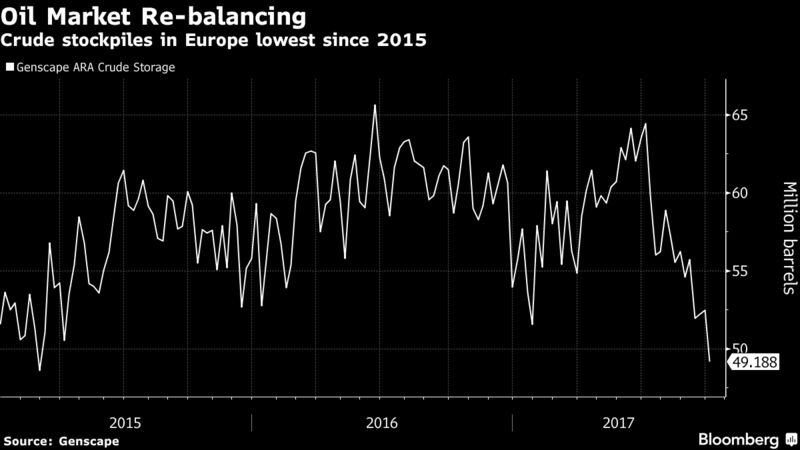
Oil stored in NW Europe falls to lowest since 2015: Genscape
-
Already-shrinking stockpile gets smaller after Harvey hit U.S.
Crude
inventories in the key hub of Amsterdam, Rotterdam and Antwerp -- known
in the industry as ARA -- are now at their lowest level since February
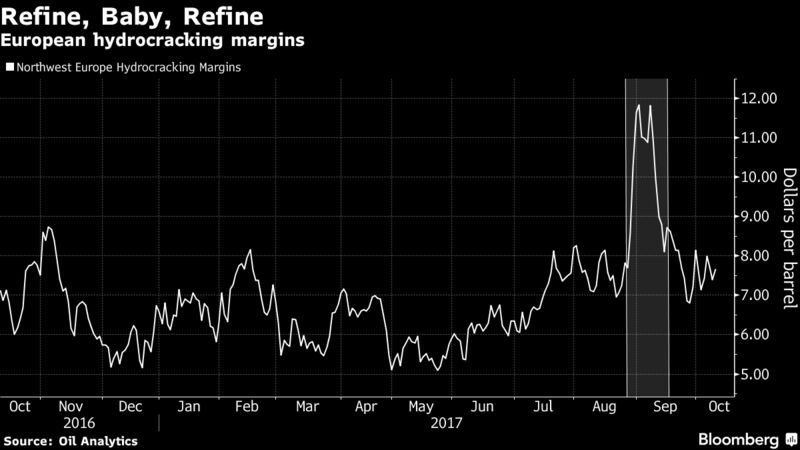
2015. The sharp declines are being driving by a diesel
market that roared over the summer, prompting European refineries to
ramp up their crude processing, according to Carsten Fritsch, a
commodities analyst at Commerzbank AG.
That
accelerated last month as Europe’s plants bolstered processing to fill a
void left by U.S. outages after Hurricane Harvey. In short, Europe
shipped more fuels to the U.S. and got less back, creating even more
tightness in oil product markets and incentivizing refineries to chomp
through as much crude as possible to capture soaring margins.
Add to that a market structure where it is no longer
profitable for traders to keep oil locked up in tanks, and stored
supplies have been quick to disappear.
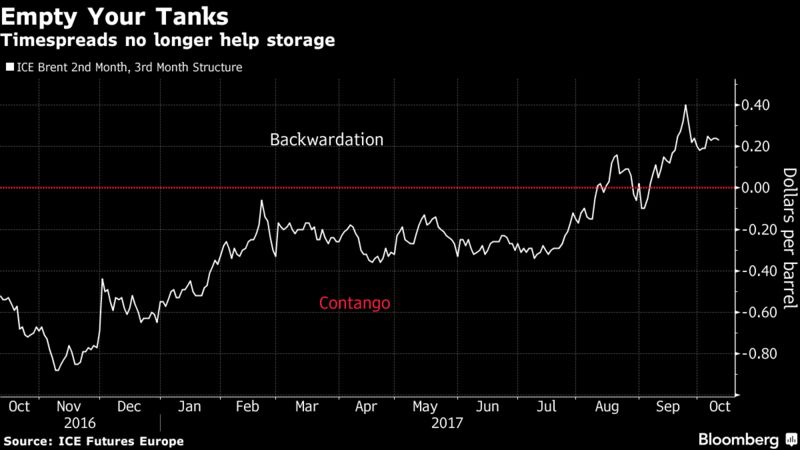
The move in Europe follows a similar emptying of one of the world’s largest hubs, South Africa’s Saldanha Bay, as parts of the Brent crude oil curve became the least profitable for stored supplies in three years.
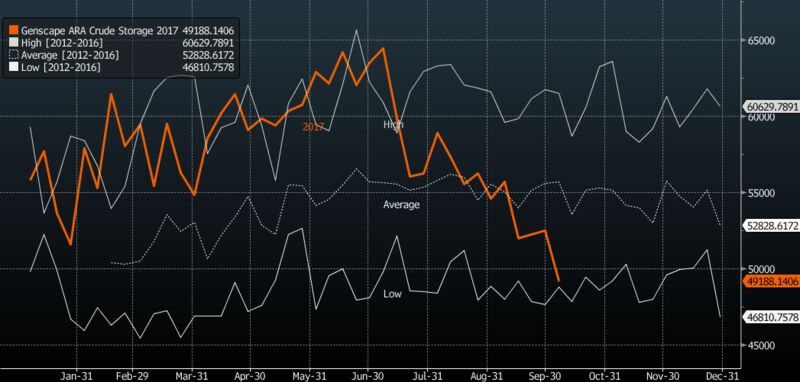
That’s
all good news for the near-record number of speculative Brent crude oil
bulls. This week’s decline means that ARA stockpiles have fallen even
further below their five-year average, which was one of the key
benchmarks OPEC set itself to measure the success of its first output
cuts in 8 years.
Tuesday, October 10, 2017
Dakota Access Pipeline review could run into Spring

http://fluidhandlingmag.com/display_news/12986/dakota_access_pipeline_review_could_run_into_spring/
The Army Corps of Engineers says it is likely that the court-ordered
additional environmental study into the Dakota Access pipeline will
extend until April 2018.
Also known as the Bakken pipeline, the Dakota Access pipeline is a
1,172 mile-long underground oil pipeline which runs from the Bakken
shale oil fields in North Dakota to the oil tank farm in Patoka,
Illinois. Combined with the Energy Transfer Crude Oil pipeline running
from Patoka to Nederland, Texas, it forms the Bakken system. The $3.8
billion pipeline went into commercial service on 1 June, 2017.
The Corps of Engineers had anticipated completing the environmental
study this year. However, attorneys said in court documents filled on 6
October that it would take longer than expected to get information from
Texas-based pipeline developer Energy Transfer Partners and at least one
Native American tribe, reports the Associated Press.
Even though the pipeline is already transporting oil, four Sioux
tribes are still challenging it in court over fears that a leak could
contaminate their water supply.
According to the Associated Press article, US District Judge
James Boasberg ruled in June that more environmental review had to be
carried out. He’s apparently considering shutting down the pipeline
while the review process takes place, although it isn’t yet known when
he’ll make a ruling.
Monday, October 9, 2017
Trump administration to terminate Obama's climate plan

https://www.yahoo.com/finance/news/epa-chief-says-administration-roll-150239621.html
HAZARD, Ky. (AP) -- The head of
the Environmental Protection Agency said Monday that he will sign a new
rule overriding the Clean Power Plan, an Obama-era effort to limit
carbon emissions from coal-fired power plants.
"The war on coal
is over," EPA Administrator Scott Pruitt declared in the coal mining
state of Kentucky. He said no federal agency "should ever use its
authority" to "declare war on any sector of our economy."
For
Pruitt, getting rid of the Clean Power Plan will mark the culmination of
a long fight he began as the elected attorney general of Oklahoma.
Pruitt was among about two-dozen attorney generals who sued to stop
President Barack Obama's push to limit carbon emissions.
Closely
tied to the oil and gas industry in his home state, Pruitt rejects the
consensus of scientists that man-man emissions from burning fossil fuels
are the primary driver of global climate change.
President
Donald Trump, who appointed Pruitt and shares his skepticism of
established climate science, promised to kill the Clean Power Plan
during the 2016 campaign as part of his broader pledge to revive the
nation's struggling coal mines.
In his order Tuesday, Pruitt is
expected to declare that the Obama-era rule exceeded federal law by
setting emissions standards that power plants could not reasonably meet.
Pruitt
appeared at an event with Senate Majority Leader Mitch McConnell at
Whayne Supply, a Hazard, Kentucky, company that sells coal mining
supplies. The store's owners have been forced to lay off about 60
percent of its workers in recent years.
While cheering the demise
of the Clean Power Plan as a way to stop the bleeding, McConnell
conceded most of those lost jobs are never coming back.
"A lot of
damage has been done," said McConnell, a Kentucky Republican. "This
doesn't immediately bring everything back, but we think it stops further
decline of coal fired plants in the United States and that means there
will still be some market here."
Obama's plan was designed to cut
U.S. carbon dioxide emissions to 32 percent below 2005 levels by 2030.
The rule dictated specific emission targets for states based on
power-plant emissions and gave officials broad latitude to decide how to
achieve reductions.
The Supreme Court put the plan on hold last year following legal challenges by industry and coal-friendly states.
Even
so, the plan helped drive a recent wave of retirements of coal-fired
plants, which also are being squeezed by lower costs for natural gas and
renewable power, as well as state mandates promoting energy
conservation.
The withdrawal of the Clean Power Plan is the
latest in a series of moves by Trump and Pruitt to dismantle Obama's
legacy on fighting climate change, including the delay or roll back of
rules limiting levels of toxic pollution in smokestack emissions and
wastewater discharges from coal-burning power plants.
The
president announced earlier this year that he will pull the United
States out of the landmark Paris climate agreement. Nearly 200 countries
have committed to combat global warming by reducing carbon dioxide and
other greenhouse gases that contribute to global warming.
"This
president has tremendous courage," Pruitt said Monday. "He put America
first and said to the rest of the world we are going to say no and exit
the Paris Accord. That was the right thing to do."
Environmental groups and public health advocates quickly derided the decision as short sighted.
"Trump
is not just ignoring the deadly cost of pollution, he's ignoring the
clean energy deployment that is rapidly creating jobs across the
country," said Michael Brune, the executive director of the Sierra Club.
Friday, October 6, 2017
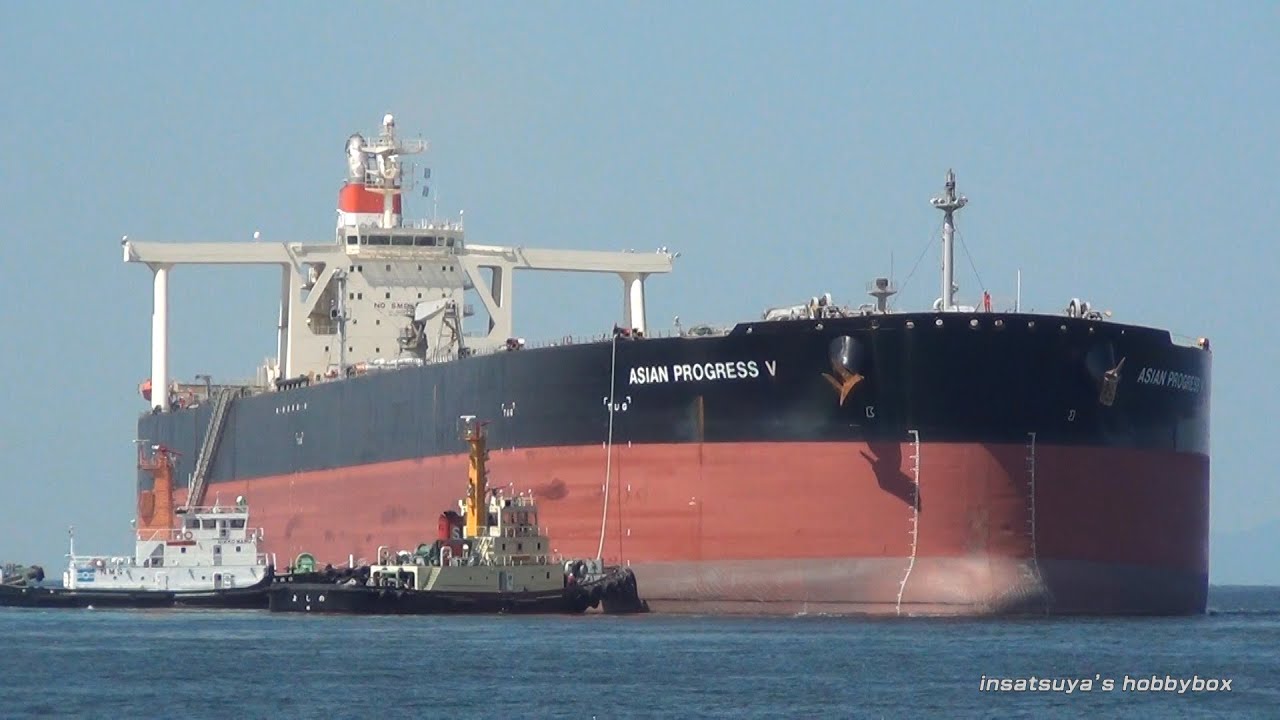
VLCC Markets - Tonnage lists thinning out
http://www.tankeroperator.com/ViewNews.aspx?NewsID=9045
After
weeks of very soft VLCC rates, the steady demand seen recently in the
Caribbean, West Africa and MEG resulted in thinner tonnage availability
lists.
Owners have managed to regain the initiative and rates steadily firmed
towards $20,000 per day, despite the extensive holidays in the Far East,
Fearnleys reported.
The long awaited winter market may well have started but these rates could be temporary, the broker warned.
Regarding Suezmaxes, the market may have run out of steam after a
flurry of activity over a week ago that stimulated a rise in rates on
the back of tightening vessel availability in the west.
Third decade dates in West Africa have been very slow in showing and
naturally there has been rate erosion. TD20 was presently at the WS77.5
level but with the potential to soften.
Meanwhile, the Black Sea saw limited enquiry, which again was the crux
for owners. For example, TD6 is holding shakily at WS85, Fearnleys said.
However, November traded paper paints a different story but how we get
there remains to be seen.
Rates hovering around the bottom are again a reality for Aframaxes
trading in the North Sea and Baltic. The majority of the Baltic stems in
the first decade were covered on own tonnage, which inevitably led to
downward pressure on rates.
In the short term, charterers have a plentiful list of vessels to
choose from. Going forward, rates are not expected to firm until the end
October fixing window, Fearnleys said.
Turning to Asia, crude tanker rates witnessed a rebound from the
multi-year lows seen in the third quarter of this year, Ocean Freight
Exchange (OFE) reported.
Both demand and supply fundamentals point to an ongoing seasonal
recovery in the fourth quarter of this year, although hampered by the
ongoing issues of excess tonnage and OPEC cuts.
On the supply side, fleet growth has been concentrated on the larger
tanker segments. For example, growth in VLCCs and Suezmaxes reached
about 5% and 7%, respectively this year, thus far.
Another 15 VLCCs and 19 Suezmaxes were due for delivery before the year
end but could be held up by slippage, resulting in the delivery picture
easing in 4Q17. The pace of tanker recycling has also picked up since
August - another plus sign.
A seasonal spike in demand this winter plus bad weather delays should
lend support to tanker rates, despite the OPEC cuts, which are due to
last until March, 2018.
In addition, lower crude cut allocations by Saudi Arabia will also
boost cargo demand ex MEG. November loading MEG and regional crude
premiums have been lifted by robust Asian refinery margins, OFE said.
This leads to a bankwardated market, raising the demand for shorter haul
cargoes, as well as the wide Brent/Dubai spread.
Average complex September Asian refinery margins were 34% higher when
compared to the January to August period, while firm demand for regional
grades is expected to benefit the Aframax segment, which saw a rate
bounce last month.
The wide Brent/Dubai spread has rendered West African and North Sea
crude less attractive to Asian buyers. Reduced November loading
programmes from both Nigeria and Angola are expected to further lower
West African crude exports to Asia in 4Q17, impacting on tonne/mile
demand.
However, OFE said that this might be offset by the continued interest
to move crude from the US Gulf/Caribbean to the East, as long as the
Brent/Dubai spread remains above the $5 per barrel mark.
Recently, firm demand for VLCCs to load in the Caribbean drew vessels
from the MEG, thus tightening the position list, especially for modern
VLCCs and underpinning the current rate rally, OFE concluded.
According to Indian reports, the first US crude oil cargo bought by Indian Oil Corp (IOC) arrived at Paradip on 2nd October, 2017.
The 1.6 mill barrel cargo was shipped on the VLCC ‘New Prosperity’. She reportedly left the US Gulf on 19th August.
IndianOil will process the crude at its east coast refineries located at Paradip, Haldia, Barauni and Bongaigaon.
IndianOil, which became the first Indian public sector refiner to
source this crude, has placed an order for 3.9 mill barrel from the US.
Bharat Petroleum and Hindustan Petroleum, India’s two other public
sector refiners, have also placed orders for about 2.95 mill barrels and
1 mill barrels, respectively from the US for their Kochi and Vizag,
local reports said.
Elsewhere, KNOT Offshore Partners completed its acquisition of the
ownership interests in the company that owns and operates the shuttle
tanker ‘Lena Knutsen’ last week.
The aggregate purchase price was $142 mill, less $133.8 mill of
outstanding debt, plus about $24.1 mill for a receivable owed by Knutsen
NYK to KNOT 26 and around $1 mill for certain capitalised fees related
to the vessel’s financing.
‘Lena Knutsen’ is an 156,559 dwt shuttle tanker, built by Hyundai Heavy
Industries and delivered in June, 2017. She is operating in Brazil
under a five-year timecharter with a subsidiary of Royal Dutch Shell,
which will expire in the third quarter of 2022.
The charterer has options to extend the charter for another two five-year periods.
Elsewhere, US-based Gener8 Maritime has reached an agreement with
Hanjin Heavy Industries and Construction Philippines (HHIC-Phil) to drop
the price for the company’s final VLCC newbuilding.
Under the 26th September amendment, the parties agreed a
$19.3 mill reduction in the contract price, including $5.4 mill in
liquidated damages related to the late delivery of the ship.
As a result, the contract price has been reduced from $96.4 million to
$77.1 mill, and the final instalment due from the company upon delivery
of the VLCC, to be named ‘Gener8 Nestor’, on 9th October, 2017 will be reduced from $48.2 mill to $29 mill.
Furthermore, HHIC-Phil must pay $30,000 per day from 9th October, 2017 until the vessel is completed. If the vessel is not completed on or before 23rd
October, the company has the option to complete the vessel on its own
or using its own sub-contractors at the builder’s cost and liquidated
damages will continue to be payable at the rate of $30,000 per day,
Gener8 said in a US SEC filing.
In the charter market, brokers reported that the 2010-built VLCC
‘Atlantas’ had been fixed to undisclosed interests for $23,000 per day,
while the 2005-built Aframax ‘Radiant Star’ had been taken by Unipec for
12 months for $14,000 per day.
ExxonMobil reported fixed the 2008-built MR ‘Transsib Bridge’ for 12, option 12 months at $13,750 per day.
Other MRs reported fixed recently included the 2009-built ‘FPMC 20’
thought taken by ST Shipping for 12 months at $12,500 per day, while the
2006-built ‘T Rex’ was believed fixed to Trafigura for the same period
at $13,500 per day.
Trafigura also fixed the near sisters ‘UACC Consensus’, ‘UACC Sound’
and ‘UACC Strait’ for four to six months at $14,750 per day each.
The 2008-built ‘Grand Ace 8’ was said to have attained $12,750 per day
for a six, option six month fixture to Shell, while finally, Asahi
Tanker was reported as taking the 2011-built ‘FPMC 26’ for 12 months at
$13,500 per day.
In the S&P market, Zodiac was said to have splashed out $53 mill on
the 2011-built VLCC ‘Trikwong Venture’, while undisclosed interests
were thought to have paid $22.5 mill for the 2002-built VLCC ‘Gener8
Poseidon’.
Scandinavian interests were reported to be behind the purchase of the
2007-built MR sisters ‘Atlantic Diane’ and ‘Atlantic Blue’ for $17 mill
each.
Thursday, October 5, 2017
Oil Trades Near $50 as U.S. Exports Soar, Putin Comments on Cuts

https://www.bloomberg.com/news/articles/2017-10-04/crude-oil-extends-drop-below-50-amid-record-shipments-from-u-s
Oil traded near $50 a barrel in New York as traders weighed a flood
of U.S. crude exports against the possibility of extended production
cuts by OPEC and Russia.
Futures
were little changed after settling at a two-week low on Wednesday.
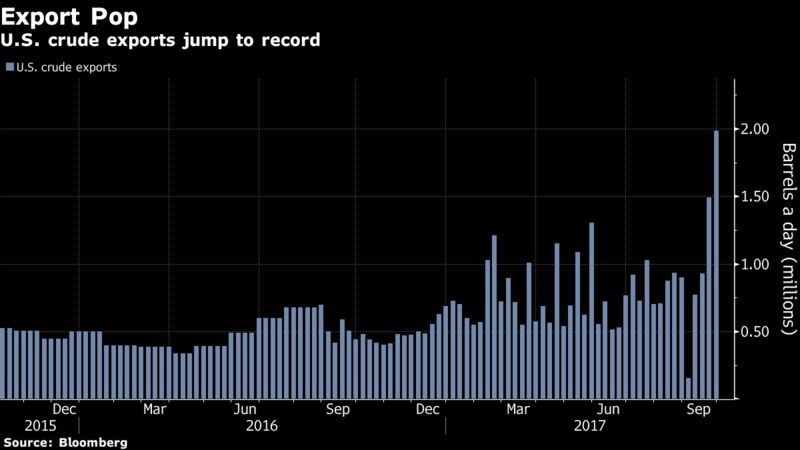
Overseas shipments from the U.S. jumped to a record last week
as production rose, government data showed. In Russia, President
Vladimir Putin said he’s open to prolonging
a deal with OPEC to curb supplies, though a decision won’t be made
until the current agreement nears expiry in March. Saudi King Salman bin
Abdulaziz began a four-day visit to the nation on Wednesday.
Though
a rally in September helped propel oil into a bull market, prices have
slipped back amid concern the market remains oversupplied despite
cutbacks by the Organization of Petroleum Exporting Countries and its
allies including Russia. A possible extension of the deal “should be at
least until the end of 2018,” Putin said in Moscow.
“U.S. production is almost at a record-high level, and
exports are record-high,” said Michael Poulsen, an analyst at Global
Risk Management Ltd. “As this U.S. production is a fundamental part of
the oil market, such news weighs heavily.”
West
Texas Intermediate for November delivery fell 4 cents to $49.94 a
barrel as of 12:55 p.m. London time. Total volume traded was about 35
percent below the 100-day average. Prices fell 44 cents, or 0.9 percent,
to $49.98 on Wednesday.
Brent for December settlement gained 24
cents to $56.04 a barrel on the London-based ICE Futures Europe
exchange, after declining 20 cents on Wednesday. The global benchmark
crude traded at a premium of $5.74 to December WTI.
Lower demand from U.S. Gulf Coast refiners that are still recovering from Hurricane Harvey
in August has caused crude sellers to seek markets abroad, triggering
shipments of 1.98 million barrels a day, the highest level in weekly
government data compiled since 1993. The figure was about a third higher
than the previous record, set the prior week.
Traders are again bracing as a tropical depression
that could grow into a hurricane is forecast to strike the Gulf Coast
late Sunday, potentially forcing offshore oil and natural-gas rigs to
shut.
King Salman of Saudi Arabia, OPEC’s biggest producer, is due
to meet Putin on Thursday. The Russian president’s comments on Wednesday
about the oil-cuts deal are the strongest signal yet that the Kremlin
is willing to redouble efforts to raise global energy prices. OPEC
Secretary-General Mohammad Barkindo called them a “very strong
endorsement” of the accord.
Oil-market news:
- Russia’s cooperation with OPEC has “breathed life” back into the organization, Saudi Arabia’s Energy Minister Khalid al-Falih said in Moscow.
- The kingdom’s plan for an initial public offering of state-owned Saudi Aramco is on track for the second half of next year, Al-Falih said.
— With assistance by Serene Cheong, and Stephen Stapczynski
Subscribe to:
Posts (Atom)