Monday, March 6, 2023

Federal Agency Advances Gas Stove Proposal From Commissioner Who Floated Ban

 A gas stove in a file photgraph. (Joe Klamar /AFP via Getty Images)

A gas stove in a file photgraph. (Joe Klamar /AFP via Getty Images)

https://www.theepochtimes.com/federal-agency-advances-gas-stove-proposal-from-commissioner-who-floated-ban_5097960.html 

A U.S. agency has advanced a request for information on gas stove hazards after it was filed by a commissioner who has floated banning the stoves.

The U.S. Consumer Product Safety Commission announced on March 1 it is seeking information from the public “on chronic chemical hazards from gas ranges.”

The commission released a draft public notice on the request for information, but has not released the final notice. The final one should be published in the Federal Register next week, a commission spokesperson told The Epoch Times via email.

Members of the public are being told they’re welcome to submit comments on how many U.S. homes have gas ranges, how the commission should evaluate risks related to gas stove usage, and what information should be part of labels with warnings about hazards on stoves, among other aspects of the issue.

The commission is also requesting “proposed solutions to those hazards.”

The vote to approve publication of the notice was 3–1, a commission spokesperson told The Epoch Times in an email. Commissioners Mary Boyle, Richard Trumka Jr., and Chair Alexander Hoehn-Saric voted in favor, while Commissioner Peter Feldman voted against.

Trumka, a Biden appointee, floated a ban on gas stoves in January.

“Any option is on the table. Products that can’t be made safe can be banned,” he told Bloomberg at the time.

Trumka also wrote in an internal memorandum that “the need for gas stove regulation has reached a boiling point” and that the commission “has the responsibility to ban consumer products that emit hazardous substances, particularly, when those emissions harm children, under the Federal Hazardous Substances Act.”

“There is sufficient information available for CPSC to issue an NPR in FY 2023 proposing to ban gas stoves in homes,” Trumka also wrote. NPR stands for notice of proposed rulemaking.

The White House and Hoehn-Saric later said they weren’t in favor of banning gas stoves. Some lawmakers have introduced bills that would block the CPSC from banning gas stoves.

The approved request for information (RFI) “does not constitute or propose any regulatory action or ban,” Hoehn-Saric said in a statement this week. “The chronic hazards that can arise from toxic emissions should be studied and that is what we are doing with this RFI. I welcome the public’s input and data during the comment period.”

The RFI was initiated by Trumka during an October 2022 meeting.

Trumka

Trumka was prepared to introduce a rule that would direct staff to prepare and submit to the commission a notice of proposed rulemaking for gas stoves. However, acknowledging a lack of support for the rule, Trumka offered a substitute amendment instead, that would direct staff to prepare an RFI. The prepared RFI was later approved.

Trumka said in a new statement after the approval that “step one in confronting a potential hazard is understanding its scope and the options for addressing it.”

He said he was looking forward to “learning more about the chronic health effects of nitrogen dioxide emissions and particulate matter emissions from gas stoves.”

He added later, “Are there technologies that can eliminate any unreasonable hazards? If technologies to improve the performance of gas stoves are not commercially viable or not demonstrated to be safe, what options remain?”

Rep. Debbie Lesko (R-Ariz.) said in a statement that the administration “is once again taking steps toward possibly regulating gas stoves.”

She added, “Make no mistake—this is NOT about product safety, it’s about government control.”

Trumka and other gas stove critics have pointed to research including a study from the Rocky Mountain Institute, an environmental group, to support their efforts to restrict or ban the stoves. That group, though, later said the study did not assume a causal relationship between the stoves and asthma.

Proposed Rules

The RFI comes after the Department of Energy proposed new rules for gas stoves and other cooking appliances.

“As required by Congress, the Department of Energy is proposing efficiency standards for gas and electric cooktops—we are not proposing bans on either,” a spokesperson for the department said in February.

The proposal would block approximately half of the gas cooking appliances currently on the market, the DOE said in a recent analysis.

Jill Notini, industry spokesperson for the Association of Home Appliance Manufacturers, told The Epoch Times that the proposed rules were “stringent” and that the department appears to be intending to “eliminate gas products from the market.”

Jack Phillips and Allen Zhong contributed to this report.

US Army Surging Munitions Production Amid Shortage Fears

 Servicemen of Ukrainian Military Forces move U.S.-made FIM-92 Stinger missiles and the other military assistance shipped from Lithuania to Boryspil Airport in Kyiv, on Feb. 13, 2022. (Sergei Supinsky/AFP via Getty Images)

Servicemen of Ukrainian Military Forces move U.S.-made FIM-92 Stinger missiles and the other military assistance shipped from Lithuania to Boryspil Airport in Kyiv, on Feb. 13, 2022. (Sergei Supinsky/AFP via Getty Images)

https://www.theepochtimes.com/us-army-surging-munitions-production-amid-shortage-fears_5098925.html?src_src=uschinanoe&src_cmp=uschina-2023-03-04&est=0y7ndzGEKjoq1SDy%2B%2B%2BkUoqKzIrU399XH9EKnIbcEpvmKJ7tz5k%2BTxFipO5v5G8aeMusMg%3D%3D 

The United States is working to overhaul its acquisition of certain high-end munitions which experts fear would be depleted in the event of a war with China.

U.S. Army officials are in the process of ramping up production to overcome challenges associated with replenishing domestic stockpiles of munitions that were either sold to Ukraine or which would be needed for a fight in the Indo-Pacific, according to Assistant Secretary of the Army Douglas Bush.

“Starting early last summer… we went through a deliberate effort to start planning for the production ramp-ups that are now underway,” Bush said during a March 3 talk at the Center for Strategic and International Studies (CSIS), a security-focused think tank.

“We are creating this production capacity, trying to create options for future decisions in terms of how much we’ll need. But if we don’t do the production ramp-ups we won’t have those choices to make in the first place.”

Bush said that the Army is “now in execution mode,” ramping up production to refill quickly draining stockpiles, but that production timelines for many munitions were complicated by complex supply chains and security requirements.

Moreover, Bush said, it was impossible to tell just what the United States’ stockpile needs would be in the future due to the open-ended nature of the war in Ukraine, but stocking requirements would likely be higher due to heightened international tensions.

“The long-term challenge will be how much of that capacity can we sustain over time, post conflict,” Bush said.

“… We don’t know how long the conflict will last. We don’t know how low our stocks will be.”

To overcome the uncertainty and supply chain weaknesses, Bush said the United States was working closely with allies in Europe and elsewhere to create redundancies and increase production capacity.

“We have to have more than one source for these things and an allied source, that they sustain but we can draw on that’s just a total win-win,” Bush said.

“That’s all the democracies in the world working together to be a giant arsenal and not just us doing it.”

Still, Bush said, there were difficult problems that could not be overcome by simply expanding government production facilities.

The Army’s supply of precision munitions, also known as smart munitions, for example, are wholly produced by private companies that maintain their own supply chains.

“Our precision munitions production is all in the private sector,” Bush said.

As such, Bush said that the Army was working with the Biden administration to subsidize increases to private production, to increase production, which would otherwise be financed by the companies responsible for production.

US Could Run Out of Missiles in War with China

Scaling up the military’s production of munitions has become something of a hot-button issue over the last year, as the United States continues to sell vast quantities of its own stockpiles to Ukraine while also attempting to deter aggression from communist China in the East and South China Seas and Taiwan Strait.

A CSIS report released in January, for example, found that the United States would quickly run out of critical munitions during a war with China over the future of Taiwan, as “the U.S. defense industrial base lacks adequate surge capacity for a major war.”

While the United States has ample amounts of small arms ammunition, the report found, relatively low stockpiles and incredibly slow acquisition and manufacturing processes could see the nation run out of critical long-range anti-ship missiles (LRASMs) in less than one week of war.

“The U.S. defense industrial base is not adequately prepared for the competitive security environment that now exists,” the report said.

“In a major regional conflict—such as a war with China in the Taiwan Strait—the U.S. use of munitions would likely exceed the current stockpiles of the U.S. Department of Defense (DoD), leading to a problem of ‘empty bins.’”

Bush acknowledged the difficulty of both surging the appropriate capacity of munitions and also positioning and using those munitions over the vast territory of the Pacific.

“The Pacific in particular is one of the most difficult logistical challenges in the world… for sustaining large-scale combat operations,” Bush said.

“The broader joint view is, of course, that a fight with China will be very much a precision munitions fight.”

Still, Bush expressed optimism that new efforts to increase military production capacity and to grow the private industry responsible for building smart munitions would prove up to the task of preparing the United States for a conflict in the Indo-Pacific.

“It is definitely a daunting challenge,” Bush said, “but… I think there’s a lot of good work going that direction.”

Saturday, March 4, 2023

Biden Walks Away From Question About Holding China Accountable for COVID Origin

President Joe Biden speaks to reporters as he departs the White House on March 3, 2023. (Win McNamee/Getty Images)

President Joe Biden speaks to reporters as he departs the White House on March 3, 2023. (Win McNamee/Getty Images)

https://www.theepochtimes.com/biden-walks-away-from-question-about-holding-china-accountable-for-covid-origin_5099171.html?src_src=uschinanoe&src_cmp=uschina-2023-03-04&est=89%2BBCArxgh1EzLO%2Fd3HNT7nn%2BPh17hbvmoRSSZH7iLrwwW2ew1TPuy5q2rIWjWksxpDqdA%3D%3D 

Days after FBI Director Christopher Wray said the origin of the COVID pandemic is “most likely a potential lab incident in Wuhan,” President Joe Biden abruptly walked away from the White House press corps when asked about whether he intends to hold China accountable.

On March 3, the president approached the waiting press corps on his way from the White House residence to Marine One.

As he came within earshot, a reporter asked him, “On COVID origin, will you hold China accountable?”

At the question, Biden “put both hands up in a shrug, seeming annoyed, and then turned and walked away toward Marine One,” according to a White House pool report.

The president’s apparent reluctance to speak about the issue came after the recent revelation that the Department of Energy, which oversees 17 U.S. laboratories, believes as early as 2021 that COVID-19 most likely emerged from a lab leak.

Epoch Times Photo
President Joe Biden reacts to questions from journalists moments before departing from the South Lawn of the White House in Washington, on March 3, 2023, as he travels to Wilmington, Delaware. (Roberto Schmidt/AFP via Getty Images)

The conclusion, reached with “low confidence,” was made in an updated classified intelligence report to the White House and key congressional members in 2021, according to The Wall Street Journal.

The FBI had previously arrived at the same conclusion earlier in 2021 with “moderate confidence.”

Wray confirmed in a Fox News appearance earlier this week that his agency still holds that view.

“The FBI has for quite some time now assessed that the origins of the pandemic are most likely a potential lab incident in Wuhan,” Wray said.

“Let’s step back for a second. You know, the FBI has folks, agents, professionals, analysts, virologists, microbiologists, etc, who focus specifically on the dangers of biological threats, which include things like novel viruses like COVID and the concerns that they’re in the wrong hands,” he said, “some bad guys, a hostile nation state, a terrorist a criminal, the threats that those could pose.

“Here you’re talking about a potential leak from a Chinese government-controlled lab that killed millions of Americans.”

Wray added that the Chinese regime “has been doing its best to try to thwart and obfuscate the work” that his agency, as well as the U.S. government and close allies, are doing to uncover the pandemic’s origin.

The Chinese regime has long dismissed the possibility of a lab leak and has resisted international efforts to investigate the virus’s origins.

The Wuhan Institute of Virology had for years taken U.S. federal funds funneled through the U.S. nonprofit EcoHealth Alliance to work on coronavirus-related research, as previously reported by The Epoch Times.

In a report released on Jan. 25, investigators with the Office of Inspector General for the Department of Health and Human Services said that National Institutes for Health officials had failed to effectively monitor the nature of the research EcoHealth conducted and take timely action to address the company’s compliance with grant terms.

The potential connection between the Wuhan lab and the origin of COVID-19 has recently garnered greater attention in Congress. On March 1, the Senate unanimously passed a bill requiring the Biden administration to declassify intelligence related to the virus origin.

OPEC-11 crude loadings climb in February preventing dip in global seaborne supply

https://vuringroup.com/wp-content/uploads/2016/09/Opec.jpg

https://www.vortexa.com/insights/crude/opec-11-crude-loadings-climb-in-february-preventing-dip-in-global-seaborne-supply/ 

In this insight, we investigate the different trends emerging in crude/condensate loadings from key producers and the impact on global supplies.

OPEC-11 crude/condensates loadings show a preliminary gain this month of 500kbd from January levels, as key Middle East nations are raising waterborne supplies. Higher loading activity from the key regional producers has helped nudge global loadings marginally higher over the same period despite weak loadings from other regions.

This marginal rise in near-term waterborne supplies, under a current environment of recessionary demand concerns and weakening global refining margins (especially on diesel) lends further support to a bearish price outlook going forward, at least in the near term.

OPEC loading activity highlights divergence between members

Total OPEC-11 loadings (i.e. excluding Iran and Venezuela) stand at just shy of 21mbd for February, an increase of about 0.5mbd from full-month January levels. But on closer inspection, we see in our February data a strong divergence in the performance of the big Middle East producers versus the rest of the OPEC group.

For the core Middle East nations, the overall theme observed in February flows is rising loading activity, after recovering from a weak January, and a very strong shift by some producers to target specific markets:

  • Saudi loadings rose 150kbd m-o-m to 7.3mbd after having dropped in January to the lowest total since August 2021. Flows to Ain Sukhna (and therefore likely eventually to Europe via the SUMED pipeline) are on track to climb for the fourth consecutive month
  • Iraqi loadings have grown strongly so far in February, up by almost 300kbd m-o-m, with flows to Europe rising even more sharply at 500kbd
  • UAE loadings rose only marginally (<100kbd) m-o-m, but also show increased flows to Europe
  •  Kuwaiti flows (to all destinations) are up 200kbd m-o-m, but those to China have picked up even more strongly and rising to a multiyear record of 1mbd so far in February – well above the 600kbd average flow in 2022

Away from the Middle East, other OPEC producers, namely those in West Africa, are showing signs of falling behind again, after a relatively strong Q4 22.

  • Nigerian supplies have fallen in February, for the second consecutive month, with loadings down m-o-m 170kbd from the December peak of 1.6mbd.
  • Angolan loadings, at 1.1mbd so far in February are marginally lower m-o-m. There is a notable absence of flows to India – the nation is second only to China in historical imports of Angolan crude but is likely seeing more value importing long-haul Russian crude

Non-OPEC supply dips in February

Outside of OPEC supplies, the most important consideration for global crude supply is Russian activity. The start of this year marked a very sharp recovery in Russian exports in the aftermath of a very low December export programme – coinciding with the 5 December EU import sanctions deadline.

February exports, at 3.3mbd, are around 270kbd below January levels. But this should not be seen as a reflection of Russia’s recent comments to cut production by 500kbd as of March. When viewed under historical context, we see m-o-m declines in February are a seasonal phenomenon, as Russian refineries typically maximise product output around this period, with no maintenance work at this time of the year. Another factor to note is that under current market prices for Russian oil, whether under the price cap mechanism or not, Russia will naturally try to maximise product (especially diesel) exports over crude exports, where possible.

The other key component of non-OPEC supply is the Atlantic Basin. Loadings from the latter had been a crucial incremental source of supply in H2 22, especially for the European market. But the latest readings suggest while supply is still ample, it is plateauing.

Total Atlantic Basin loadings – defined as Europe, Med/NAfr, WAfr(non OPEC) and East Coast Americas are almost flat (+50kbd m-o-m) so far in February:

  • The only major producers to have posted a m-o-m increase in loadings are the US, UK and Argentina, all in the order of 120-140kbd
  • Brazil, Norway, and Egypt (incl via SUMED), which had all upped flows to Europe in recent months, posted total loading declines in the order of 50-100kbd

Taking into consideration the above, for now it seems global supplies are ample and are keeping a lid on prices – which have failed to break the $90bl level for more than three months now. However, looking ahead, the main concern over the medium to longer term is the one of spare capacity. Should there be a strong US gasoline driving season and/or a resurgence in Chinese products consumption, or even a wider/surprising increase in global oil demand, it is hard to see where extra supply could come from. Because of this, despite the recent bearish sentiment on crude prices, there is a fundamental, longer-term support factor that cannot be overlooked.

Iron ore price jumps on China data, bullish steel demand outlook

Iron ore price

https://www.mining.com/web/iron-ore-price-jumps-on-china-data-bullish-steel-demand-outlook/ 

Iron ore futures jumped on Wednesday, as better-than-expected China manufacturing activity data raised hopes for a demand rebound in the world’s top steel producer.

The most-traded May iron ore futures contract on the Dalian Commodity Exchange (DCE) ended daytime trade 2.42% higher at 908.5 yuan ($131.64) a tonne, after closing about 0.8% lower in the previous session.

On the Singapore Exchange, the benchmark April iron ore was up 2.17% at $126.05 a tonne, as of 0703 GMT, extending gains.

China’s manufacturing purchasing managers’ index (PMI) climbed to 52.6 last month, the highest reading since April 2012, up from 50.1 in the previous month.

“We believe the better-than-expected data has injected some confidence into the market. Also, the expectation of continued improvement in downstream (steel) demand lent support to the prices of raw materials including iron ore,” said Yu Chen, a Shanghai-based senior iron ore analyst at consultancy Mysteel.

Chinese steel mills are expected to replenish iron ore inventories to meet production needs after some mills resumed production, analysts from Huatai Futures said in a note, adding that the hot metal output had improved steadily.

Coke, one of steelmaking ingredients, also showed signs of strength. Coke rose 1.86%, while coking coal was little changed at 2,033.5 yuan a tonne.

Along with improved demand from downstream steel consumption sectors, strong raw material prices also lent support to the steel market.

Rebar on the Shanghai Futures Exchange rose 1.1%, hot-rolled coil climbed 1.1% and wire rod moved up 0.98%. Stainless steel fell 1.36%, though.

“Demand (for stainless steel) is typically lacklustre in the first quarter (of a year). Moreover, the comparatively high stocks in Wuxi and Foshan warehouses also weighed on prices,” said Ellie Wang, a Shanghai-based senior nickel analyst from consultancy CRU Group.

China revised its total crude steel output to approximately 1.018 billion tonnes for 2022, marking a year-on-year fall of 1.7%, NBS data released on Tuesday showed. Previously, it had reported 2022 output at 1.013 billion tonnes, down 2.1% year-on-year.

($1 = 6.9016 Chinese yuan)

(By Amy Lv and Dominique Patton; Editing by Subhranshu Sahu)

Governments spent record $1 trillion last year subsidizing fossil fuels


https://www.mining.com/web/governments-spent-record-1-trillion-last-year-subsidizing-fossil-fuels/ 

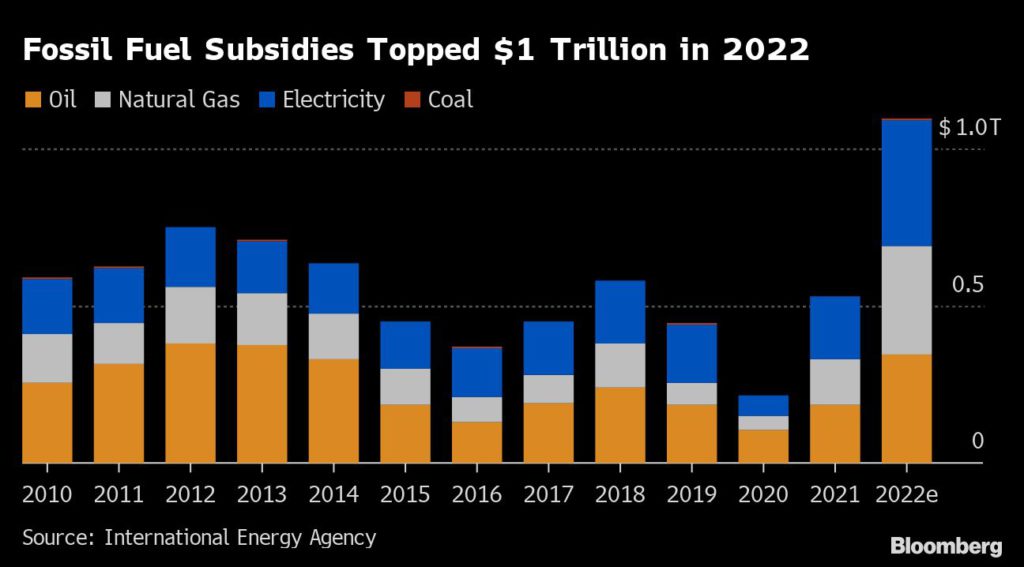
Even as global governments raise their ambitions to cut fossil fuels in the future, they spent a record $1 trillion last year subsidizing energy sources that are the main driver of climate change.

That’s the finding from the International Energy Agency, which estimates that the combined subsidies for oil, natural gas, electricity and coal hit an all-time high in 2022 as soaring energy prices crippled economies. It underlines the challenge for policy makers trying to grapple with the immediate threat of runaway fuel inflation, while still trying to push a shift to low-carbon sources.

The spending by governments in 2022 was more than double total global investment in renewable energy sources, according to figures from BloombergNEF. The splash of state cash on energy last year followed climate talks in November 2021 when world leaders pledged to end such subsidies.

“The Glasgow Climate Pact emphasized that phasing out fossil fuel subsidies is a fundamental step toward a successful clean energy transition,” the IEA said in its report. “However, today’s global energy crisis has also underscored some of the political challenges of doing so.”

The subsidies helped shield consumers from soaring energy prices as many economies were still recovering from the impact of the pandemic. As Russia cut supplies of natural gas following its invasion of Ukraine last year, the European Union spent $349 billion to reduce consumer energy bills.

(By William Mathis)

Harmony Gold CEO says gold sector consolidation ‘inevitable’


(Image: Kusasalethu gold mine. Courtesy of Harmony Gold)

https://www.mining.com/web/harmony-gold-half-year-profit-up-18/ 

Gold mining sector mergers and acquisitions are inevitable due to the need to replace depleting mineral reserves, Harmony Gold chief executive Peter Steenkamp said on Wednesday.

US-based Newmont Corp, the world’s top gold producer, last month tabled a $16.9 billion bid for Australia’s Newcrest Mining, igniting speculation of a new wave of M&A activity in the gold industry.

Although other gold majors Barrick, Gold Fields and Sibanye Stillwater have sought to cool down talk of imminent big M&A activity, Harmony’s Steenkamp said there was more to come.

“I think it’s going to be inevitable that there will be some sort of consolidation because exploration has been lacking for such a long time and for people to replace assets they will have to look at what their neighbours have and what the opportunities will be,” Steenkamp told Reuters in an interview.

Harmony is transforming into a gold-copper producer, having acquired Australia’s Eva copper project for $170 million in December 2022, to add to its Wafi-Golpu gold-copper project in Papua New Guinea, a joint venture with Newcrest.

The company is also exploring opportunities to acquire more assets in Africa, Australia and Papua New Guinea, Steenkamp added.

Harmony’s shares slid 2% on Wednesday after it posted an 18% increase in half-year profit but refrained from declaring an interim dividend, citing the need to allocate capital to growth projects.

Its headline earnings per share (HEPS) – the most common profit measure in South Africa – were 2.93 rand ($0.1603) in the six-month period ended Dec. 31, compared with 2.48 rand a year ago.

The miner reported a 5% decline in gold production to 740,655 ounces from 778,879 ounces in the previous year, following the closure of its Bambanani mine at the end of June 2022.

The lower output was offset by a 12% increase in the average rand gold price Harmony received during the six months – attributable to a stronger dollar – as well as a 5% improvement in average grades in the South African underground mines.

Harmony expects to produce between 1.4 and 1.5 million ounces in the year to June 2023.

($1 = 18.2836 rand)

(By Nelson Banya; Editing by Tom Hogue, Sherry Jacob-Phillips and Bernadette Baum)