The
Financial Times reports that Saudi state oil tanker company is
suspending shipments through Hormuz following Iranian missile strikes on
US military bases in Iraq.
“I think a lot of people are waiting to see if there is any attacks or
direct involvement of tankers,” said Richard Matthews, head of research
at Gibson shipbrokers was reported as saying. “Beyond the obvious
heightened risk, most people are in wait-and-see mode. We haven’t seen a
significant shift in tanker rates or insurance rates yet, but it is
still very much early days.”
WASHINGTON (Reuters) - The Trump administration is considering
sanctions against some of the Venezuelan lawmakers who took part in a
bid supported by President Nicolas Maduro to wrest control of the
country’s congress from U.S.-backed opposition leader Juan Guaido,
according to two people familiar with the matter.
Deliberations
over the possible sanctions targets, including Maduro-backed lawmaker
Luis Parra and more than a dozen others, are in the early stages, and a
final decision is not imminent, the sources told Reuters on Tuesday.
Venezuelan
troops blocked Guaido from entering parliament on Sunday for what was
expected to be his re-election as head of congress, allowing Maduro’s
socialist party to hand the post to Parra. Later in the day, opposition
legislators quickly re-elected Guaido - recognized by dozens of nations
as Venezuela’s rightful interim leader - at the offices of a
pro-opposition newspaper.
“We go after those who
undermine the constitution,” said one of the sources, a high-ranking
U.S. government official who declined to be named because details of the
deliberations have not been made public. “This is no different.”
The White House declined comment. The State Department did not immediately respond to a request for comment.
The
measures against the lawmakers could start with bans on their travel to
the United States, a restriction that Washington has already slapped on
dozens of Maduro allies, and might later involve financial sanctions
against them, according to a person familiar with the matter.
Special envoy Elliott Abrams said the United States was looking at
additional sanctions to step up pressure on the Venezuelan government on
Monday, but did not specify potential targets.
Last January,
Washington recognized Guaido as the OPEC nation’s legitimate interim
president and began ratcheting up sanctions and diplomatic pressure in
an effort to oust Maduro.
A year later, Maduro remains in power,
backed by the military as well as Russia, China and Cuba. A senior
administration official told Reuters in October that Trump’s frustration
over the lack of results had spurred aides to ready further actions.
Reporting by Matt Spetalnick and Alexandra Alper; Editing by Peter Cooney, Leslie Adler and Lisa Shumaker
Venezuelan opposition leader Juan Guaido on Tuesday reclaimed the
National Assembly that he heads, pushing past armed guards two days
after President Nicolas Maduro’s loyalists blocked him from attending
his own re-election.
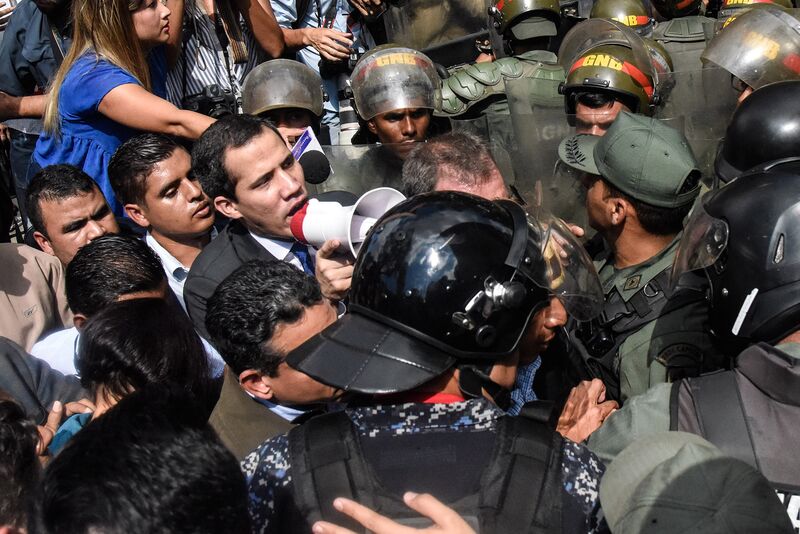
Juan Guaido speaks with a megaphone to the crowd as he attempts to enter the National Assembly in Caracas on Jan. 7, 2020.Photographer: Carolina Cabral/Getty Images
After struggle with police, opposition made it into building
Pro-government faction tried to hold session without quorum
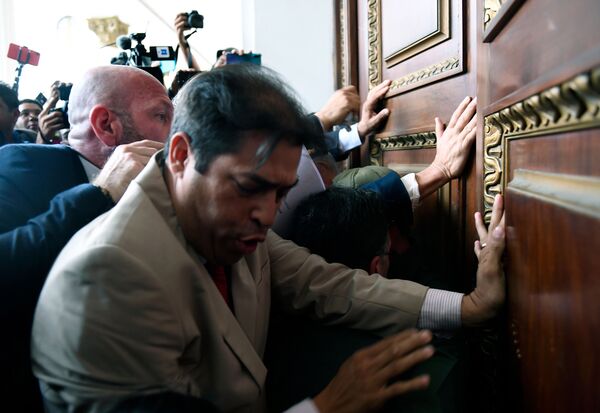
Guaido
and his allies burst through the legislative palace’s doors minutes
after a pro-government group led by lawmaker Luis Parra, who had claimed
the presidency of the body, scurried to a next-door building for
refuge.
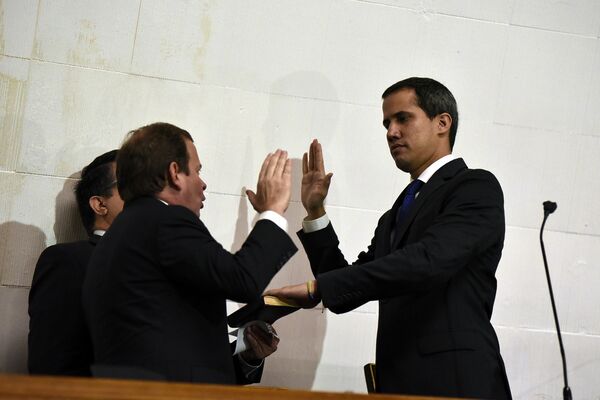
Guaido
climbed to the dais and took the microphone as opposition lawmakers
sang the national anthem, which include the words “Death to oppression.”
Lawmakers then voted to recognize Guaido’s re-election as head of the
National Assembly for 2020. They rejected Parra’s attempt to claim the
role thanks to a Sunday vote taken amid chaos in the chamber as Guaido’s
supporters were barred, preventing a quorum.
“It’s a great feat for us to be here today,” Guaido said
Tuesday after reclaiming his place. “This is proof of what’s possible if
we’re firmly united and organized.”
Electricity was cut off at one point, prompting lawmakers to
read the attendance list with the help of mobile phone lights and
without microphones. Outside, armed civilian groups known as colectivos
cornered and forcibly removed a group of journalists and lawmakers,
beating and stealing from some of those gathered.
“The president of the National Assembly is Luis Parra; whoever is with Guaido must leave now,” they shouted.
The attempted takeover of what was Venezuela’s last
democratic institution has deepened the standoff between Maduro and
Guaido, who last year was recognized as the nation’s legitimate leader
by more than 50 countries. The government had yet to comment on Guaido’s
return to the assembly Tuesday.
“The opposition comes out well, in the sense that it managed
to enter its natural space and hold a session,” said Ricardo Sucre, a
political analyst and professor at Venezuela’s Central University. “It
sends an image of a cohesive, organized opposition, that could achieve a
concrete effect.”
Venezuela, a formerly prosperous petrostate, has spiraled
into misery after decades of misrule under Maduro and his predecessor,
Hugo Chavez. The failure of their socialist program has been exacerbated
by a plunge in oil prices and U.S. sanctions. Crucial oil
infrastructure is defunct, hyperinflation has ravaged the economy and
food and medicine are scarce.
Venezuelan opposition lawmakers force their way into the National Assembly in Caracas.
Photographer: Federico Parra/AFP via Getty Images
During
Tuesday’s session, Guaido pledged to find a solution to Venezuela’s
crisis “so we can live with dignity and prosperity” and said the next
session would take place Jan. 14. On the way out of the legislative
palace, Guaido and his deputies covered their eyes and mouths as they
were met with tear gas.
At a news conference later in the day, he
demanded that the regime explain why it deployed military personnel to
blockade the assembly building and called for protests and rallies. He
said the opposition would appoint ambassadors to Bolivia, El Salvador
and Uruguay.
Parra, whom the assembly is investigating in
connection with a graft case, claims to have been voted in legitimately
as the new national assembly head on Sunday. The U.S. is considering
sanctioning lawmakers who supported his claim, according to a person
familiar with the deliberations.
Guaido for his part, was confirmed Sunday by 100 lawmakers in an off-site vote after he was barred from entering the chamber.
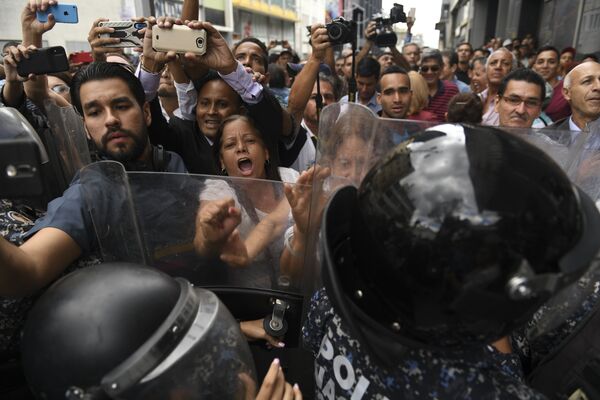
Supporters of Guaido confront members of the Bolivarian National Guard outside the National Assembly building in Caracas.
Photographer: Carlos Becerra/Bloomberg
“The
opposition lawmakers are putting on a little show,” socialist lawmaker
and former labor minister Francisco Torrealba said Tuesday. “This
confrontation within the right is embarrassing, they’re hitting each
other instead of solving the crisis fueled by U.S. politics.”
— With assistance by Nicolle Yapur, and Nick Wadhams
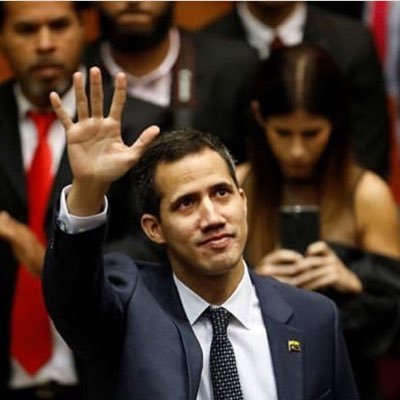
Venezuela's National Assembly president
Juan Guaido gestures before a crowd of opposition supporters Vargas,
Venezuela, on January 13, 2019; Nicolas Maduro speaks from the balcony
of Miraflores presidential palace in Caracas, Venezuela, Wednesday, Jan.
23, 2019.Venezuela's
National Assembly president Juan Guaido gestures before a crowd of
opposition supporters during an open meeting in Vargas, Venezuela, on
January 13, 2019; Ariana Cubillos/AP
CARACAS, Venezuela — The government of President Nicolás Maduro
attempted a de facto takeover of Venezuela's legislature on Sunday,
swearing in its own candidate as head of the National Assembly in a move
apparently orchestrated to rob international credibility from Juan Guaidó, who had led the body and has staked a rival claim as head of state.
The
dramatic events marked a sharp escalation in Maduro’s gambit to end
Guaidó’s quest to unseat him and sparked immediate condemnation by
Washington, which has strongly backed the 36-year-old opposition leader.
Opposition officials declared the move an effective “parliamentary
coup” meant to consolidate Maduro’s near-dictatorial powers.
“Today,
they dismantled the rule of law, assassinating the republic, with the
complicity of a group of traitor lawmakers,” Guaidó told reporters
outside the parliamentary building.
Later
Sunday, Guaidó sought to counter the move by gathering opposition
lawmakers at the headquarters of El Nacional, a local newspaper, to cast
an official vote. In a 100-to-0 tally — enough to put him over the top
in a full session of the 167-seat chamber — those present reelected
Guaidó as head of the legislature. Twenty-eight of the 100 were votes
from stand-ins of exiled lawmakers.
But Maduro, in an address to the nation, hailed what he called the National Assembly’s “new leadership.”
“A
very corrupt person leaves the presidency of the National Assembly
today, as a millionaire, a billionaire,” said Maduro, referring to
Guaidó. He added, “to justify their defeat, they say that a security
operation was launched” to stop them.
The
attempt to replace Guaidó — who declared himself interim president a
year ago and promised to oust Maduro for claiming reelection in a
tainted 2018 vote — appeared to be a carefully organized plan many weeks
in the making.
Opposition
officials have warned since last month that Maduro’s government was
handing out suitcases of cash to woo lawmakers. But they thought they
had successfully countered the operation, and on Sunday, Guaidó began
the day anticipating his reelection as head of the National Assembly,
viewed internationally as the last democratic institution in the
authoritarian South American state. Guaidó’s claim as the nation’s true
president — recognized by nearly 60 countries, including the United
States — has been based on his status as the assembly’s chief.
But
security forces loyal to Maduro formed a cordon early Sunday around the
assembly building in central Caracas, blocking some opposition
lawmakers from entering. Lawmakers who back Maduro — including several
allegedly involved in a government plot to buy votes — were allowed to
pass. At one point, Guaidó sought to scale the spiked wrought-iron fence
surrounding the assembly and force his way in, according to a video
issued by the opposition.
At
the same time, Luis Parra — a former opposition politician who was one
of several lawmakers accused last month of accepting government bribes —
announced his surprise candidacy against Guaidó via Twitter on Sunday
morning. Hours later, his swearing-in was shown on state television.
Security
forces loyal to the Maduro government stand guard outside the National
Assembly on Sunday. (Yuri Cortez/AFP/Getty Images)
Parra
is thought to have had the support of at least 40 lawmakers from
Maduro’s party and an unknown number of others who the opposition claims
have been bribed. But there was no evidence that an actual vote had
taken place. The opposition also insisted that there had been no legal
quorum because Guaidó, the chamber’s leader, had not been present to
validate the session.
Sedition
within the opposition, however, appeared to run deeper than some had
feared. For instance, Luis Stefanelli, an opposition lawmaker who fled
the country after claiming to reject a government bribe, had appointed a
“loyal” stand-in to vote in favor of Guaidó on Sunday. But he said in a
tweet that his stand-in had “betrayed him” and had instead stood with
the government’s pick, Parra.
The
government’s action appeared designed to complicate Guaidó’s
international recognition and provide some nations that might be
considering pulling their support for him additional legal cover to do
so.
But
the move also creates new logistical and technical hurdles for an
already beleaguered opposition, including how and where to continue
meeting and passing legislation.
Guaidó’s
strongest backers — particularly in Washington — disregarded Sunday’s
maneuvers in the National Assembly as dictatorial theatrics. The move
comes as the United States — which has slapped tough sanctions on
Maduro’s government, including an oil embargo — is weighing more
confrontational steps, such as a possible naval blockade of Venezuelan
oil being shipped to Cuba, the Maduro government’s chief regional ally.
In
a statement, Secretary of State Mike Pompeo congratulated Guaidó on his
“re-election” and condemned the “failed efforts” by Maduro to “negate
the will of the democratically elected National Assembly.”
He
charged Maduro’s government with seeking to “forcibly” deny access to
Guaidó and other lawmakers after realizing its campaign of “bribery and
intimidation” had failed to secure enough votes to oust him.
“Juan
Guaido personifies the Venezuelan people’s struggle to reclaim the
prosperity and democracy they once enjoyed,” Pompeo said in the
statement. “No regime thugs, no jail cells, and no bribery or
intimidation can subvert the will of the Venezuelan people.”
Few
immediately saw Maduro as gaining international support from the move. A
host of nations, including Brazil, Canada and Chile, quickly rejected
Sunday’s attempt to install Parra. In a statement, the European Union
said Sunday’s “serious irregularities” constituted “a new step in the
deterioration of the Venezuelan crisis. As a consequence, the E.U.
continues to recognize Juan Guaidó as the legitimate President of the
National Assembly until the conditions for a proper voting session can
be assured.”
The
Maduro government has made attempts to declaw the National Assembly
since the opposition won a sweeping majority in 2015. In 2016, the
pro-Maduro Supreme Court officially stripped it of its legislative
authority. A year later, the court announced it would dissolve the
institution, a threat it never followed through on after the ruling
generated internal controversy and street protests. In 2017, Maduro’s
government created a “Constituent Assembly,” made up exclusively of its
own backers, which sought to supplant the National Assembly’s authority.
But
the opposition has managed to keep the institution at the center of its
fight to oust Maduro, holding sessions weekly and using it as a legal
backup to Guaidó’s claim to the presidency. It has given Guaidó
constitutional legitimacy in the eyes of foreign powers, based on the
fact that he and his supporters were elected by a majority in 2015 — the
last time a vote here was seen as generally democratic.
The
government’s bold move on Sunday comes at a dangerous time for the
opposition. After a year in which many Venezuelans believe he
overpromised how quickly Maduro could be forced from office, Guaidó has
seen his popularity sharply slip. Attempts to turn the nation’s top
military brass against Maduro have failed, and the opposition is reeling
from accusations of turncoats and festering corruption within its own
ranks.
Last
month, Parra was ejected from one of the main opposition parties,
Primero Justicia, after being accused of accepting bribes in exchange
for lobbying on behalf of pro-Maduro business executives. Opposition
officials also claim that he is one of several lawmakers who have
accepted bribes to abandon Guaidó — an allegation Parra has denied even
as he has begun to openly criticize Guaidó.Guaidó’s
team, in anticipation of victory on Sunday, had drafted plans to
“relaunch” his presidency — including increasing the pressure on Maduro
and spearheading more and better distribution of medicine and food in a
nation brought to its knees by one of the world’s worst economic
collapse’s in recent history.“This
is the equivalent of a coup against an institution that was
legitimately elected,” said Luis Vicente León, director of the
Caracas-based Datanalisis polling agency. “We only add one more
illegitimate institution to the game that will not be recognized by the
opposition’s international allies.”
“But,”
he added, “for an opposition that had already been weakened, this is
not good news. It loses operational capacity and becomes more dependent
on an international community that doesn’t have much more maneuvering
power left.”Faiola reported from Miami. Mariana Zuñiga in Caracas contributed to this report.
Saudi Aramco's
market value has fallen by $200 billion since its mid-December peak,
and the stock's downtrend is accelerating in the wake of heightened
tensions between the US and Iran.
The world's most highly valued company fell 1.7% Sunday and
as much as 1.2% Monday. The two-day drop placed shares at their lowest
level since the firm's December 11 IPO.
Saudi Aramco's
market value has tanked by $200 billion since its post-IPO peak, and
the stock is falling faster in the wake of heightened tensions between
the US and Iran.
The world's most highly valued company fell 1.7% Sunday and as much as 1.2% Monday. Aramco became the first company to hit a $2 trillion valuation on December 12, but its market cap now sits at roughly $1.8 trillion.
Aramco shares have since pared some losses through Monday, trading
roughly 0.1% lower at 34.50 riyals ($9.20) per share. The two-day drop
placed shares at their lowest point since the firm's December 11 initial
public offering, and just 7% higher than its offering price of 32
riyals ($8.53).
Aramco stock fell despite oil surging to $70 per barrel, suggesting higher oil prices were overshadowed by boosted risk in the Gulf region.
Some analysts have said Iran could target oil infrastructure
and raise the commodity's cost to hit back at the US. Any such
retaliation could resemble the attacks on Aramco facilities in
September. The firm's oil production was cut in half after
explosive-armed drones disabled several of its facilities. The US and
Saudi Arabia blamed Iran for the strike, while Houthi rebels from Yemen
claimed responsibility.
Aramco returned to its normal output levels in just one month and
pushed forward with its IPO, but the attacks left many investors mulling
the company's exposure to geopolitical risk.
Though the US airstrike pushed Aramco lower, the state-run company
has several defenses to keep its shares from falling too far. Saudi
Arabia government institutions sank $2.3 billion into the company's stock ahead of its record-breaking IPO, giving the kingdom a stronger hold on Aramco's stock price.
Saudi Arabia has also marketed Aramco shares as a stable investment
in the kingdom's future. The oil giant and its December IPO are key
components in the government's plan to diversify away from oil.
The kingdom could intervene to keep the stock price stable, Asha Mehta,
Acadian Asset Management senior portfolio manager, told Bloomberg in December.
"There's broad awareness that the government is a large investor and
that they're willing to step in during times of market volatility to
protect prices," Mehta said.
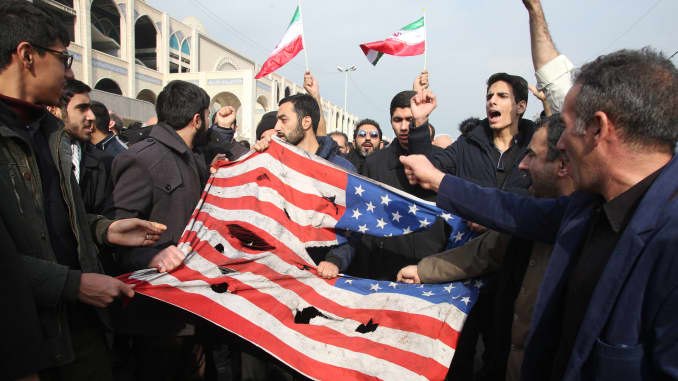
Iranians tear up a US
flag during a demonstration in Tehran on January 3, 2020 following the
killing of Iranian Revolutionary Guards Major General Qasem Soleimani in
a US strike on his convoy at Baghdad international airport.
Stocks fell sharply on Friday after the U.S.
confirmed that an airstrike killed Iran’s top military commander,
sending oil prices surging and hiking geopolitical concerns.
The
Dow Jones Industrial Average plunged 212 points, or 0.8%. The S&P
500 slid 0.8% along with the Nasdaq Composite. The Dow briefly dropped
more than 360 points at the open.
U.S.
crude oil futures shot up around 3.5% to $63.31 per barrel, raising
concerns about an energy shock on the global economy. Airline stocks
fell broadly on the threat of higher oil prices. United, American and
Delta all dropped more than 2%.
“Global oil markets will be
volatile for weeks to come,” said Greg Valliere, chief U.S. policy
strategist at AGF Investments, in a note. “There’s a reason, finally,
for caution in the stock market.”
“Eventually there will be an
uneasy truce ... But that’s a long, long way off; this will get worse
before it gets better,” he added.
Investors largely fled risk
assets such as stocks in favor of gold and Treasurys and other
traditional safe havens. Gold futures jumped 1.3% to $1,547.80 per
ounce. The benchmark 10-year Treasury yield, which moves inversely to
the price, dropped to around 1.83%.
The Cboe Volatility Index
(VIX), widely considered to be the best fear gauge on Wall Street,
traded about 2 points higher, or 18.4%, at 14.77.
Energy
stocks were the lone winner on Friday. The Energy Select Sector SPDR
Fund (XLE) rose more than 1%. Concho Resources and Marathon Oil rose
more than 2% each while Apache jumped traded more than 1.5% higher.
The U.S. announced late Thursday that it had killed Iran’s top commander, Gen.
Qasem Soleimani, in Baghdad in an airstrike. Soleimani had been a key
figure in Iranian politics, and his death has raised concerns over a
potential retaliation from the Iranian forces.
“It’s a game-changer,” Dryden Pence, chief investment officer at Pence Wealth Management, told CNBC’s “Squawk Box”
on Friday. “We now have vast, broader array of weapons systems that the
president has at his disposal. We’ve been able to weaponize economic
sanctions now where we can go after individuals … but now I think the
ultimate sanction that the president is able to use is an airstrike.”
Pence added, however, that any market volatility “will be short-lived.”
Wall
Street loaded up on safer assets on fears that an oil spike might spark
a recession. That risk is also heightened by the fact that the global
economy has been struggling amid a global manufacturing slowdown.
The
market moves come after U.S. equities rose to all-time highs on
Thursday on the back of a strong performance in the tech sector.
However, the optimism entering the new year seems to be fading amid
political tensions, including North Korea and the impeachment of
President Donald Trump.



 Security
forces loyal to the Maduro government stand guard outside the National
Assembly on Sunday. (Yuri Cortez/AFP/Getty Images)
Security
forces loyal to the Maduro government stand guard outside the National
Assembly on Sunday. (Yuri Cortez/AFP/Getty Images)