Sunday, September 15, 2019

Friday, September 13, 2019
Oil prices fall 1.2% on U.S.-China trade doubts, OPEC+ talks
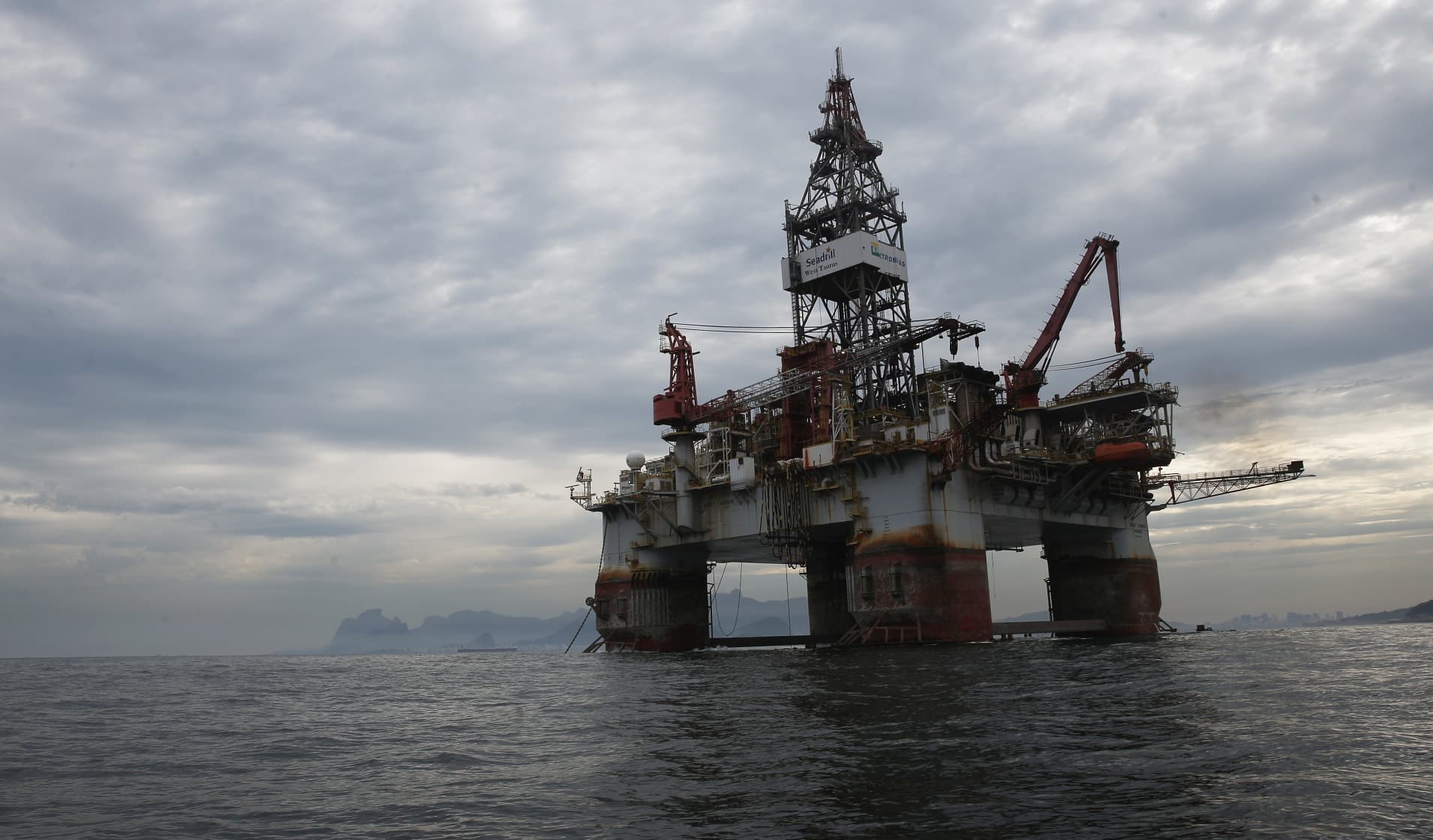
A Petrobras oil platform floats in the Atlantic Ocean near Guanabara Bay in Rio de Janeiro.
Getty Images
Oil prices fell about 1.5% on Thursday after a media report cast
doubt on the possibility of an interim U.S.-China trade deal and as a
meeting of the OPEC+ alliance yielded no decision on deepening crude
supply cuts.
Oil was pressured further after the European Central
Bank cut its deposit rate to a record low -0.5% from -0.4% and said it
will restart bond purchases of 20 billion euros a month from November to
prop up euro zone growth.
Brent
crude futures were down 74 cents, or 1.2%, at $60.07 a barrel by 1:54
p.m. EDT (1754 GMT). U.S. West Texas Intermediate crude futures fell 92
cents, or 1.7%, to $54.83 a barrel. Both were heading for a third
session of losses.
Both Brent and WTI fell below the $60 and $55 a barrel marks during the session, triggering auto-selling.
Oil
futures extended their losses after a senior White House official
denied a Bloomberg News report that the United States was considering a
temporary trade agreement with China, according to CNBC.
The
prospect that the world’s two largest economies made some concessions in
a protracted trade war, according to a previous report, supported
prices earlier in the session.
“All of a sudden we had a ray of hope,” said Phil Flynn, an analyst at Price Futures Group in Chicago.
“Now that they’re downplaying that and, immediately, the stocks went back down, gold came back up and oil went back down.”
Also
hitting oil prices were comments by Saudi Arabia’s new energy minister,
Prince Abdulaziz bin Salman, who said deeper cuts would not be decided
upon before a meeting of the Organization of the Petroleum Exporting
Countries planned for December.
The meeting yielded a promise to
keep countries within the production quotas they committed to in a
global supply deal, which would limit oil coming to the market as
Nigeria, Iraq and Russia have, at times, produced more than their
allocations.
A statement from OPEC and its allies, a grouping
known as OPEC+, said oil stocks in industrial countries remained above
the five-year average. Oman’s energy minister said “the outlook is not
very good for 2020.”
Prince Abdulaziz said Saudi Arabia would keep
cutting by more than it pledged in the pact that has throttled supply
from OPEC+ by 1.2 million barrels per day.
Also feeding the
bearish sentiment, the International Energy Agency said surging U.S.
output would make balancing the market “daunting” in 2020.
“Booming
shale production has allowed the U.S. to close in on, and briefly
overtake, Saudi Arabia as the world’s top oil exporter ... in June,
after crude exports surged above 3 million bpd,” said the agency that
advises industrial economies on energy policy in its monthly report.
Wednesday, September 11, 2019

Trump Eyes Crackdown on Homelessness as Aides Visit California
 CreditCreditMike Blake/Reuters
By Maggie Haberman and
https://www.nytimes.com/2019/09/10/us/politics/trump-homelessness-california.html
WASHINGTON —
President Trump is pushing aides to find ways to curtail the growing
number of homeless people living on the streets of Los Angeles, part of
broader discussions his aides have held for weeks about urban problems
in liberal locales, according to his personal lawyer and administration
officials.
A team of administration
officials is in California on what was described as a “fact-finding”
mission as they weigh proposals to address the burgeoning crisis. But it
is not clear what steps the administration could legally take on an
issue that has traditionally been handled at the local level.
“Like
many Americans, the president has taken notice of the homelessness
crisis, particularly in cities and states where the liberal policies of
overregulation, excessive taxation and poor public service delivery are
combining to dramatically increase poverty and public health risks,”
said Judd Deere, a White House spokesman. He said that the president
signed an executive order to ease affordable housing development in
June, and that he had “directed his team to go further and develop a
range of policy options for consideration to deal with this tragedy.”
The visit of the administration officials to California was first reported by The Washington Post.
The intensified discussions took place as the president, who has
frequently criticized how urban areas in Democratic states are managed,
prepares for a swing through California next week.
California has the largest homeless population in the country, according to a 2018 report compiled by the Department of Housing and Urban Development, at an estimated 130,000 people.
And
the nature of homelessness in California is markedly different than in
other parts of the country; the state also has the highest percentage of
homeless who are unsheltered, with nearly 70 percent of the homeless —
or about 90,000 people — living on the street. That report estimated
that nearly half of all people without shelter in the United States were
in California in 2018. New York State had the second largest homeless
population, nearly 92,000, according to the report. But of those, fewer
than 5 percent lacked shelter.
Rudolph W. Giuliani, the president’s personal lawyer and former mayor of New York, who was known for his aggressive crackdowns on street-bound homelessness, said he had been discussing the issue with administration officials.
“I
think they feel that there’s got to be something that creates an
incentive, carrot and stick, for cities to do something about it,” Mr.
Giuliani said, adding that the discussions had been going on for two
months
Word of the efforts by the
administration, which has repeatedly sought to cut housing assistance in
its budget requests, alarmed advocates for the homeless and angered
city leaders across California.
“Simply cracking
down on homelessness without providing the housing that people need is
not a real solution and will likely only make the situation worse,” said
Mayor London Breed of San Francisco, whose city has been an object of the president’s scorn.
An estimated 59,000 homeless people live in Los Angeles County, according to a count conducted this year
by the county, about a 12 percent increase over 2018. Of those, an
estimated 44,000, or 75 percent, were unsheltered. Within the city of
Los Angeles, which is distinct from the county, there were 36,000
homeless, including 27,000 who were unsheltered, according to that same
count.
Los Angeles’s mayor, Eric M.
Garcetti, and other political leaders faced intense scrutiny this summer
after the release of the results of the 2019 count, which also showed
that the number of homeless had increased 16 percent in the city. The
surge was especially shocking because the government spent hundreds of
millions of dollars in 2018 to address the problem.
Voters
approved two high-profile initiatives in recent years to fund homeless
services in the region, including a 2016 city bond that earmarked $1.2
billion to build housing for the homeless and a 2017 county quarter-cent
sales tax increase to raise about $355 million annually for 10 years.
The mayor’s defenders and city officials have pointed out that the city
housed nearly 22,000 people in 2018, a record number for the government
and an increase of 23 percent from 2017. But even amid those efforts,
the high cost of housing in Los Angeles, one of the priciest rental markets in the country, has continued to push more individuals and families out of their homes.
While
Skid Row in downtown Los Angeles has often been a focal point for
national conversations about homelessness, the high rate of unsheltered
people has become a source of friction across the state, in cities
including Eureka, Oakland and San Francisco. With nowhere else to go,
the homeless often set up encampments on sidewalks and beneath highway
overpasses. Increasingly, encampments are nestling against wild lands,
raising concerns amid increasingly intense and volatile wildfire
seasons.
But while the displeasure of
middle-class urban residents often receives attention, the homeless
themselves — many of whom have full-time jobs but cannot afford
California’s high rents — have the most to be frustrated about. Safety
is a huge concern: An analysis published earlier this year by Kaiser Health News found that a record 918 homeless people died last year in Los Angeles County.
The
administration has discussed refurbishing homeless facilities or
building new ones, The Post reported. An administration official said
that while those ideas have been discussed, nothing has been settled.
Friday, September 6, 2019
Oil Rises After EIA Reports Crude Inventory Draw

https://oilprice.com/Energy/Crude-Oil/Oil-Rises-After-EIA-Reports-Crude-Inventory-Draw.html
A day after the American Petroleum Institute once again surprised traders by reporting an estimated build in U.S. crude oil inventories, the Energy Information Administration released its own estimate, saying inventories had shed 4.8 million barrels in the week to August 30.
This compares with a draw
of as much as 10 million barrels for the previous week, which propped
up prices, reversing yet another slide brought about by concerns about
U.S.-China trade relations.
It was news on the same topic that yesterday lifted
prices, despite API’s estimate of an inventory build. U.S. Trade
Representative Robert Lighthizer and Treasury Secretary Steven Mnuchin
told media yesterday that talks with Chinese officials have been
scheduled for “the coming weeks” in Washington. This rekindled hopes for
a deal despite the recent exchange of yet more tariffs between the two.
Meanwhile,
the EIA also reported a gasoline inventory draw of 2.4 for the last
week of the summer driving season, with distillate fuels shedding 2.5
million barrels in the period. This compared with a 2.1-million decline
in gasoline inventories in the week before, and the same-size draw in
distillate fuel inventories.
Refineries processed 17.4 million bpd
of crude last week, producing 10.3 million bpd of gasoline and 5.2
million bpd of distillates. This compared with a flat processing rate a
week earlier, with gasoline production at 10.7 million bpd and
distillate fuel production at 5.2 million bpd.
The trade war
between the U.S. and China has become the number-one factor to watch
when forecasting oil demand trends, overtaking even OPEC policies and
the rising U.S. crude oil production. With the trade conflict already
hurting economies around the world, all eyes are on the negotiating
table with hopes this time the talks would yield a deal.
It’s anyone’s guess whether this will happen, however.
Neither side seems all too willing to make any concessions even though
both economies have suffered the consequences of the conflict.
By Irina Slav for Oilprice.com
Tuesday, September 3, 2019
Monday, September 2, 2019

Subscribe to:
Posts (Atom)