Thursday, June 20, 2019

US Navy drone shot down by Iranian missile over Strait of Hormuz in 'unprovoked attack,' central command says


U.S. military officials returned fire -- verbally -- hours after Iran blasted a Navy high-altitude drone out of the sky over the Strait of Hormuz, with U.S. Central Command leaders on Thursday slamming the "unprovoked" strike and Tehran's subsequent "false" justifications for it.
President Trump said on Twitter that Iran "made a very big mistake!"

The downing of the drone, via surface-to-air missile, is only the most recent Iranian provocation in the region, coming on the heels of a disputed attack on a pair of oil tankers in the Gulf of Oman last week. U.S. officials say Iran was behind the tanker attacks, however, the Islamic Republic has not claimed responsibility and even suggested American involvement in the plot. -- but American officials stated unequivocally the incident occurred in international airspace.

Similarly, Iran claimed the U.S. drone on Thursday was over Iranian airspace when it was shot down -- but American officials stated unequivocally the incident occurred in international airspace.
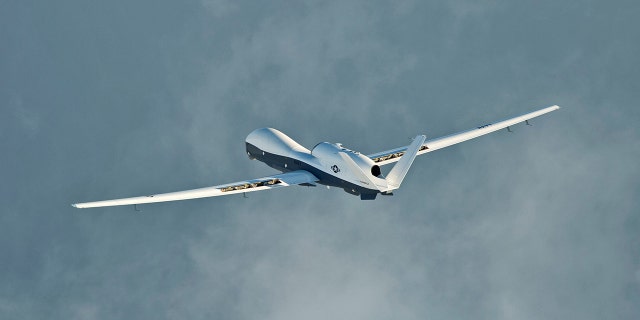
The U.S. Navy’s RQ-4A Global Hawk drone deployed to the Middle East in the past few days as part of reinforcements approved by President Trump last month.
The U.S. Navy’s RQ-4A Global Hawk drone deployed to the Middle East in the past few days as part of reinforcements approved by President Trump last month. (U.S. Navy/Handout via REUTERS)
U.S. Central Command said in a statement that a U.S. Navy Broad Area Maritime Surveillance ISR aircraft, known as a BAMS-D, was shot down at approximately 7:35 p.m. ET on Wednesday.

"Iranian reports that the aircraft was over Iran are false," Capt. Bill Urban, a U.S. Central Command spokesman, said in a statement. "This was an unprovoked attack on a U.S. surveillance asset in international airspace."

The U.S. Navy’s RQ-4A Global Hawk drone was over international airspace and about 17 miles from Iran at the time, a military source told Fox News.  The drone provides real-time intelligence, surveillance, and reconnaissance missions  "over vast ocean and coastal regions," according to the military.

Iran also tried to shoot down another drone, but missed, U.S. officials told Fox News. Officials are now scrambling to find the wreckage in the water before Iranian forces recover it.
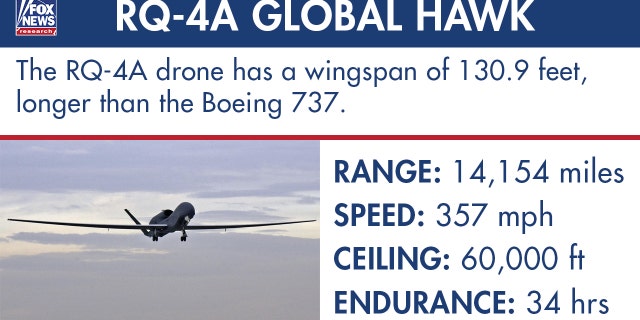
The Navy RQ-4A Global Hawk drone that was shot down by Iran.
The Navy RQ-4A Global Hawk drone that was shot down by Iran. (Fox News)
The Navy RQ-4A Global Hawk drone deployed to the Middle East in the past few days as part of reinforcements approved by President Trump last month.

The high-altitude drone can fly up to 60,000 feet or 11 miles in altitude and loiter for 30 hours at a time. It's used to spy on Iranian military communications and track shipping in the busy waterways. Each drone costs up to $180 million dollars. 
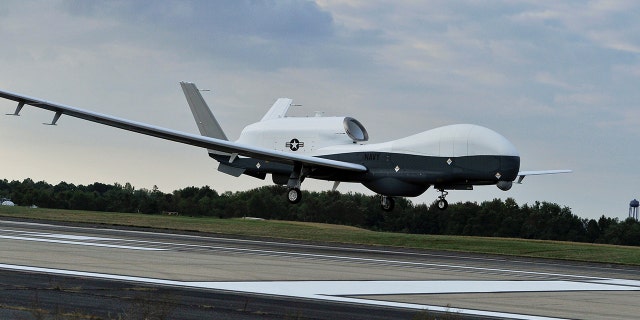
The U.S. Navy’s RQ-4A Global Hawk drone is a high-altitude drone can fly up to 60,000 feet or 11 miles in altitude and loiter for 30 hours at a time.
The U.S. Navy’s RQ-4A Global Hawk drone is a high-altitude drone can fly up to 60,000 feet or 11 miles in altitude and loiter for 30 hours at a time. (U.S. Navy/Handout via REUTERS)
Besides the drone incident, U.S. officials told Fox News that Iranian-backed forces fired cruise missiles Wednesday night into Saudi Arabia, hitting a power plant. The spate of recent attacks come amid the backdrop of heightened tensions after the U.S. decision a year ago to withdraw from Tehran's nuclear deal reimpose sanctions.

A commander for Iran's Revolutionary Guard claimed the drone was shot down over Iranian airspace to send a "clear message" to the U.S., and marked the first direct Iranian-claimed attack of the crisis.
"We do not have any intention for war with any country, but we are fully ready for war," Revolutionary Guard commander Gen. Hossein Salami said in a televised address.
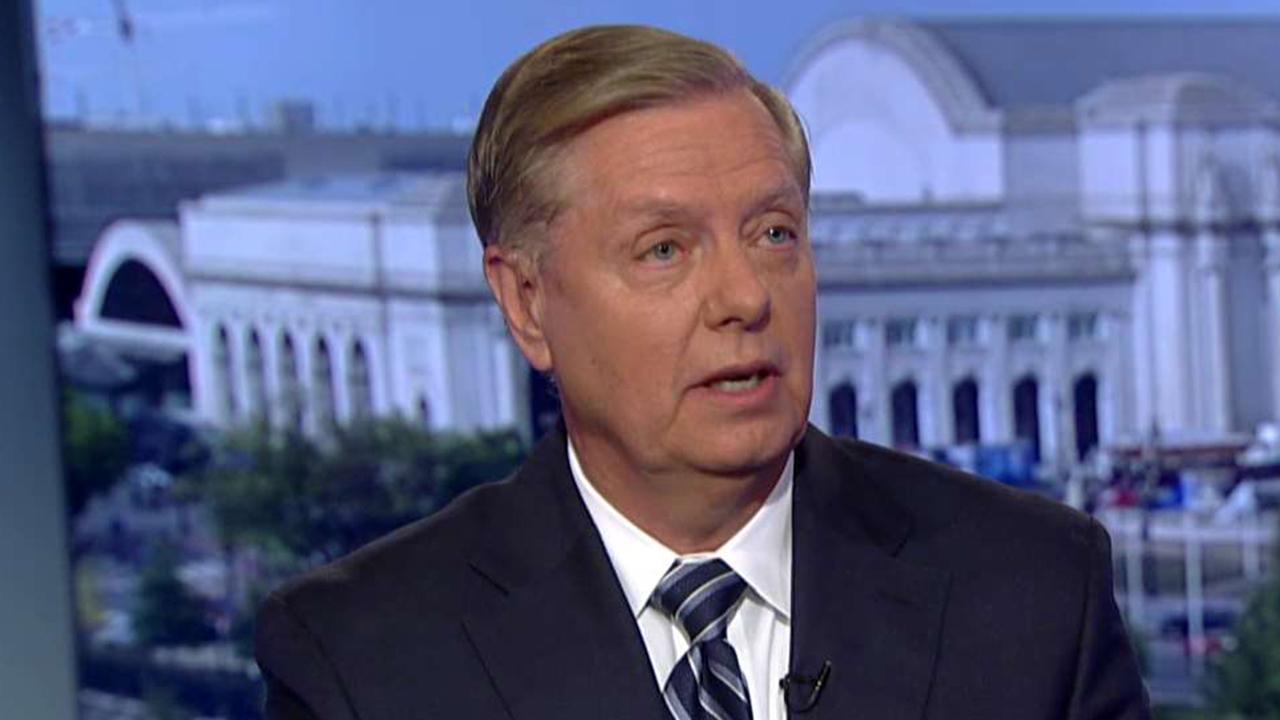
Iran's paramilitary Revolutionary Guard, which answers only to Supreme Leader Ayatollah Ali Khamenei, said it shot down the drone on Thursday morning -- causing some confusion about the timeline of the incident -- when it entered Iranian airspace near the Kouhmobarak district in southern Iran's Hormozgan province. Kouhmobarak is some 750 miles southeast of Tehran and close to the Strait of Hormuz.
 
The Guard said it shot down the drone at 4:05 a.m. after it collected data from Iranian territory, including the southern port of Chahbahar near Iran's border with Pakistan. Iran used its air defense system known as Third of Khordad to shoot down the drone — a truck-based missile system that can fire up to 18 miles into the sky, the semi-official Fars news agency reported.
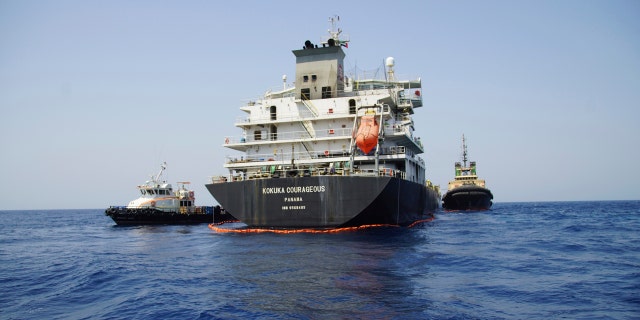
The Panama-flagged, Japanese owned oil tanker Kokuka Courageous, that the U.S. Navy says was damaged by a limpet mine, is anchored off Fujairah, United Arab Emirates, during a trip organized by the Navy for journalists, Wednesday, June 19, 2019.
The Panama-flagged, Japanese owned oil tanker Kokuka Courageous, that the U.S. Navy says was damaged by a limpet mine, is anchored off Fujairah, United Arab Emirates, during a trip organized by the Navy for journalists, Wednesday, June 19, 2019. (AP Photo/Fay Abuelgasim)
The Guard described the drone as being launched from the southern Persian Gulf but did not elaborate. American RQ-4A Global Hawks are stationed at the Al-Dhafra Air Base in the United Arab Emirates, near the capital, Abu Dhabi.

Salami, speaking to a crowd in the western city of Sanandaj, described the American drone as "violating our national security border."

"Borders are our red line," Salami said. "Any enemy that violates the borders will be annihilated."

The U.S. said Iran fired a missile at another drone last week that responded to the attack on two oil tankers near the Gulf.

Another senior U.S. official told Fox News last week that an MQ9 Reaper drone was fired on by the Iranians shortly after it arrived at the scene where the MV Altair tanker sent out a distress signal.
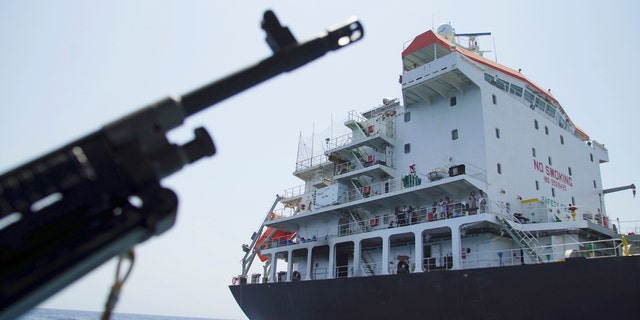
Sailors stand on deck above a hole the U.S. Navy says was made by a limpet mine on the damaged Panama-flagged, Japanese owned oil tanker Kokuka Courageous, anchored off Fujairah, United Arab Emirates, during a trip organized by the Navy for journalists, Wednesday, June 19, 2019.
Sailors stand on deck above a hole the U.S. Navy says was made by a limpet mine on the damaged Panama-flagged, Japanese owned oil tanker Kokuka Courageous, anchored off Fujairah, United Arab Emirates, during a trip organized by the Navy for journalists, Wednesday, June 19, 2019. (AP Photo/Fay Abuelgasim)
Secretary of State Mike Pompeo has blamed Iran for the "blatant assault" on oil tankers in the Gulf of Oman.

After the tanker incident, Pompeo said his assessment was based on "intelligence, the weapons used, the level of expertise needed to execute the operation, recent similar Iranian attacks on shipping, and the fact that no proxy group operating in the area has the resources and proficiency to act with such a high degree of sophistication.”

Fox News' Jennifer Griffin, Lukas Mikelionis and The Associated Press contributed to this report

Wednesday, June 19, 2019

Limpet mine used in oil tanker attacks 'bears striking resemblance' to similar Iranian Mines, US Navy says


The limpet mine used on a Japanese-owned oil tanker in the Strait of Hormuz “bears a striking resemblance” to other Iranian mines, U.S. Navy officials said.
The limpet mine used on a Japanese-owned oil tanker in the Strait of Hormuz “bears a striking resemblance” to other Iranian mines, U.S. Navy officials said. (U.S. Navy)

https://www.foxnews.com/world/limpet-mine-oil-tanker-striking-resemblance-iranian-mines

The limpet mine used on a Japanese-owned oil tanker in the Strait of Hormuz “bears a striking resemblance” to other Iranian mines, U.S. Navy officials said Wednesday.

Cmdr. Sean Kido of the U.S. Navy’s 5th Fleet claimed Wednesday that the damage done to the tanker was “not consistent with an external flying object hitting the ship.”

The remark contradicts the claim made by the ship’s owner who insisted that eyewitnesses aboard saw “flying objects” before the attack in the Gulf of Oman.

The Navy official added that investigators have recovered fingerprints and a handprint from the side of the ship after the attack.

The revelation follows ever-increasing tensions in the region. The Iraqi military said three rockets hit an installation north of Baghdad on Monday that was used by Iraqi troops American trainers.

The attack on camp Taji, about 17 miles north of Baghdad, was the second on a military post housing U.S. personnel. An attack on an airbase, also housing U.S. trainers, north of Baghdad on Saturday caused a small fire.

The U.S. claimed the Iranian regime was responsible for the “blatant assault” on two oil tankers last week, bringing the Middle East on a brink of a military conflict.

Secretary of State Mike Pompeo said Iran’s culpability was based on “intelligence, the weapons used, the level of expertise needed to execute the operation, recent similar Iranian attacks on shipping, and the fact that no proxy group operating in the area has the resources and proficiency to act with such a high degree of sophistication.”

The so-called limpet mines got the name from the real limpets, small sea snails that easily cling to hard surfaces and rocks.

The weapon was first developed by the British during World War 2 and is often used in covert action in order to damage ships because they are easily attachable.

There are certain variations, with some detonated by a time fuse while others explode only after the vessel to which the mine is attached travels a specific distance.

In most cases, the mines are magnetic and are easily attachable to the hulls of a ship. They normally just disable rather than sink a vessel.

This wouldn’t be the first time Iran used the mines to attack oil tankers. In the 1980s, the “Tanker War” erupted in the midst of the eight-year conflict between Iran and Iraq, threatening to disrupt the global oil supply.

The U.S. government has been working to provide enough credible evidence linking Iran with the oil tanker attacks. Pictures of pieces of a limpet mine were released as part of that effort by the U.S. Navy on Tuesday.

Last week, U.S. officials released a video last week supposedly showing Iran’s Revolutionary Guard removing an unexploded limpet mine from one of the vessels.
Image result for black and white photo of iran ship 

The black-and-white footage, as well as still photos released by the U.S. military’s Central Command on Friday, appeared to show the limpet mine on the Japanese-owned Kokuka Courageous, before a Revolutionary Guard patrol boat pulled alongside the ship and removed the mine, Central Command spokesman Capt. Bill Urban said.

U.S. Central Command (CENTCOM) also released additional images Monday showing the aftermath of mine attacks against the oil tankers, including some images purporting to show Iranian forces removing an unexploded device from the hull of one of the vessels.

Iranians dismissed the allegations, with Iranian Defense Minister Gen. Amir Hatami saying they were unfair and aimed at tarnishing the country’s image.
“The accusation against Iran is totally a lie and I dismiss it firmly.”
— Iranian Defense Minister Gen. Amir Hatami
“The accusation against Iran is totally a lie and I dismiss it firmly,” he said, according to the semi-official Fars news agency on Wednesday.

While the U.S. claims of Iran’s responsibly are viewed cautiously in Europe, with Britain being a notable exception, some European countries are warning that the risk of war cannot be ruled out.

German Foreign Minister Heiko Maas said the risk of war in the Persian Gulf region is not ruled out amid the heightened tensions and said the “the situation is serious” and “everything must be done” to avoid further escalation of the tensions in the region.

Iran, meanwhile, said Wednesday that Europe won’t be granted extra time beyond the July 8 deadline to come up with improvements in the nuclear deal to protect the Iranian economy amid U.S. sanctions, Reuters reported.

The spokesman for Iran’s Atomic Energy Organization said Iran will begin enriching uranium to a higher level if Europe did improve the nuclear accord.
The Associated Press contributed to this report.

Tuesday, June 18, 2019

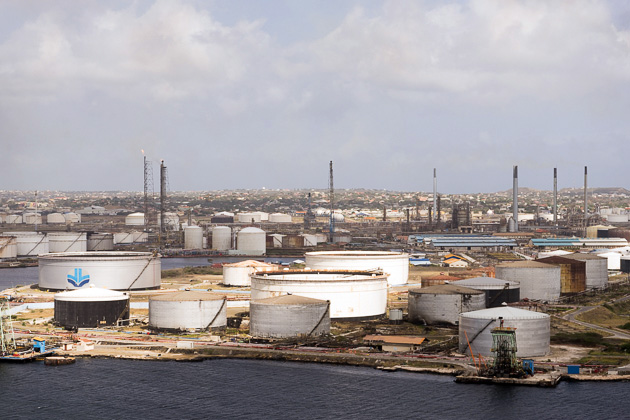
Struggling PDVSA Plans To Restart Curacao Refinery

La Isla Refinery Curacao


Venezuela’s struggling oil company PDVSA plans to resume operations at its Isla refinery on Curacao, a company official who wished to remain unnamed told S&P Global Platts.

The refinery has a nameplate capacity of 335,000 but its actual throughput is a maximum of 270,000-290,000 bpd. It is operated by a local company, Rafineria di Korsou, “under the direction of PDVSA,” according to the company official.

The refinery has suffered its share of the fallout from the U.S. sanctions against Venezuela with scarcity of feedstock forcing all but the suspension of operations. This, in turn, has made the Curacao autonomous government, with which PDVSA has a contract for the operation of the refinery, to look for an alternative operator.

As a result of all this, Isla is facing bankruptcy: "PDVSA will have to make the decision to send some 3 million barrels of crude to generate cash flow to cover expenses from September to December 2019 or send $60 million to honor the contract and avoid claims,” the company official told S&P Global Platts. "If not, Isla will have to declare force majeure and bankruptcy. The refinery is now totally paralyzed. PDVSA promised the reactivation and offered to supply crude in July but through an intermediary."

The Isla refinery received an exemption from the January sanctions the U.S. slapped on Venezuela. Under the exemption, the refinery can continue working with U.S. companies until January 15, 2020 but it has not helped it much, it seems. On top of all its other troubles, it was also targeted by ConocoPhillips in an asset seizure move against PDVSA.

The scenario with PDVSA sending crude for the refinery is the less likely one, as another company official explained. "For PDVSA the refinery has a low priority. Crude production in Venezuela has decreased significantly. In this scenario, sending crude to Curacaco makes no sense, especially when you take in to account that PDVSA cannot sell products from Curacao because of the embargo."

For Curacao, however, the refinery is high priority: it accounts for a tenth of the island’s GDP and a solid portion of its employment.
 
By Irina Slav for Oilprice.com

Monday, June 17, 2019

Stocks Drop Across the Gulf as Oil Tankers Incident Fuels Risk

Equities in Dubai, Qatar, Oman and Saudi Arabia decline. The U.S. Fifth Fleet says two oil tankers were damaged.

Every major stock index in the Gulf retreated after an incident in the Sea of Oman threatened to inflame the already tense relationship Iran has with its neighbors. Bonds also fell.

The benchmark equity indexes in Dubai, Kuwait, Riyadh, Muscat and Doha fell 1% or more. The yield on its 2028 dollar bonds climbed 7 basis points, the most among Gulf peers.

The U.S. Fifth Fleet said two oil tankers were damaged near the Strait of Hormuz, with one of the ships’ operators describing the incident as a suspected attack. The development comes after attacks on oil tankers near the Persian Gulf last month and raises the possibility of a disruption of crude flows.

This is the second time in a month’s time. That is worrying. Shows how sensitive the region is to such news,” said Joice Mathew, head of equity research at United Securities in Muscat. “One can’t really see what’s going to happen, especially when all sides are very stubborn.

The Strait of Hormuz, at the entrance of the Persian Gulf, is a waterway for about 40% of the world’s seaborne oil shipments. While most economies in the region are trying to diversify their income away from crude, revenue from energy sales still accounts for a large proportion of their cash inflow.

The decline may be a knee-jerk reaction, said Nader Naeimi, the head of dynamic markets at AMP Capital Investors Ltd. in Sydney. “Even if it’s not an accident, we have seen incidents like this before and they usually pass, without a prolonged effect. Unless, of course, if a war breaks out!”

Saudi Arabia’s Tadawul All Share Index dropped 1.6% on Thursday, the first decline in five sessions. Al Rajhi Bank, Saudi Basic Industries and National Commercial Bank contributed the most to the decrease.

The question is if we see escalation from here, or efforts to calm tensions,” said Timothy Ash, a strategist at Blue Bay Asset Management in London. “Trump appeared eager to call off the attack dogs in his administration last month. He seems eager to avoid a major war in the Middle East, involving U.S. troops.

Friday, June 14, 2019

Gulf of Guinea piracy continues to threaten seafarers

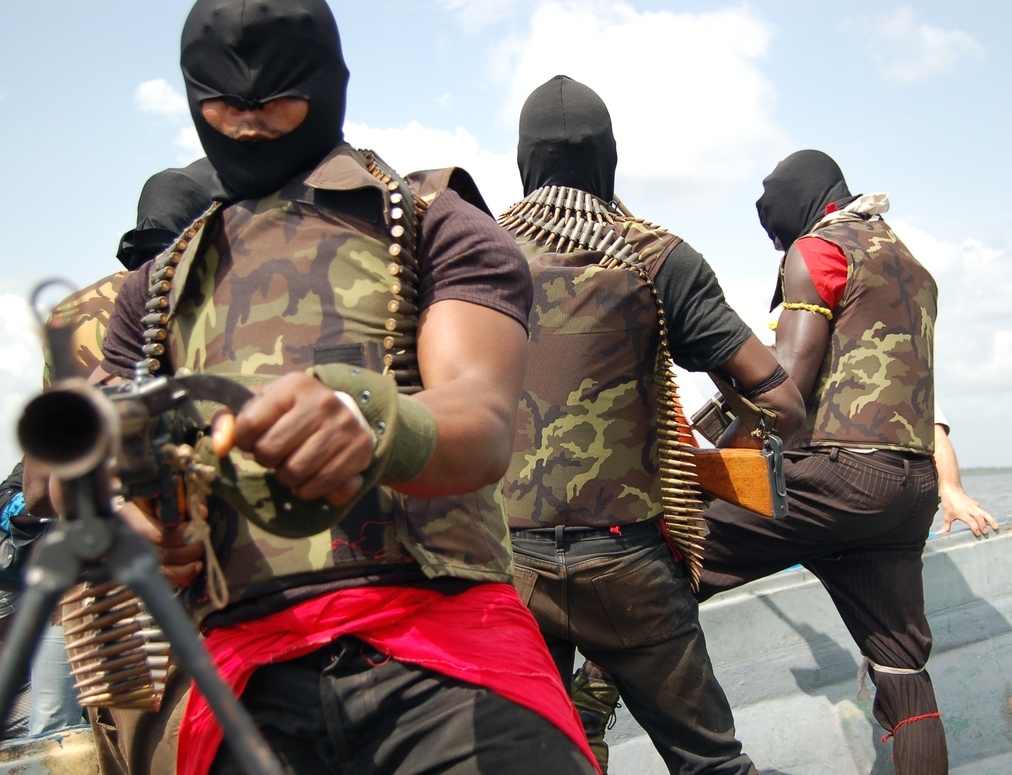
An undated photo of West African pirates.


Members of the shipping community, flag states and agencies from Gulf of Guinea (GoG) gathered at the IMO Headquarters for a day-long symposium on maritime security in the region. 
 
The event, organised to highlight the continuing danger to seafarer in the GoG, was co-sponsored by BIMCO, IMCA, ICS, ITF and OCIMF, featured speakers from regional maritime agencies, as well as shipping officials, academics and military staff.  
 
In opening the symposium, Dr Grahaeme Henderson, Chair of the UK Shipping Defence Advisory Committee and Vice President of Shell Shipping & Maritime, said; “Simply put, the high level of piracy and armed robbery attacks in the Gulf of Guinea is not acceptable. Yet it is happening every day and this is not business as usual. We need to take urgent action now.”
 
Concerns raised by industry were supported by figures from the IMB, which showed that the number of attacks in the GoG region had doubled in 2018. There was also a marked  increase towards kidnapping for ransom and armed robbery incidents.
 
Piracy expert Prof Bertand Monnet, who has interviewed pirate gangs in the Niger Delta, estimated that there were around 10 groups of pirates that were responsible for the majority of attacks in the area, and they were well organised and motivated.  
 
Dr Dakuku Peterside, Director General and CEO of the Nigerian Maritime Authority and Safety Agency (NIMASA),acknowledged the maritime security risks present in the GoG, but stated that new initiatives underway to improve the joint capacity of Nigerian law enforcement and Navy capabilities could make seafarer kidnappings “history” within a matter of months.
 
He went on to say that he is keen to improve international co-operation, particularly with the shipping industry.
 
Dr Peterside said;: "We have no option but to work together, but we cannot have imposed solutions.” He also stated that "NIMASA and the Nigerian Navy will also be hosting a Global Maritime Security Conference in October to seek tailored short and long term solutions to strengthen regional and international collaborations in the Gulf of Guinea."
 
The forum also included an interview led by Branko Berlan, the ITF representative to the IMO, with a seafarer who had been attacked and kidnapped in a recent incident. He said the attack appeared to be well organised and led from ashore. “The first indication I had of the attack was a knock on my cabin door and two men holding guns appeared.” He was subsequently held in a camp onshore along with other members of his crew until his release could be secured.
 
Other speakers at the event emphasised the region was starting to build capacity and joint co-operation to fight maritime crime through the Yaoundé Process, which focuses on joint co-operation across the region for reporting and response. The international community is also sponsoring long-term capacity building and partnerships. 
 
However, the shipping industry, seafarer groups and flag states were keen to identify actions that can have an immediate impact. For example, delegates heard about recent Spanish Navy action to assist Equatorial Guinea to rescue seafarers from a piracy attack last month, as well as the new US programme to embark law enforcement officers on regional vessels. Jakob Larsen, BIMCO’s Head of Security pointed out that regional states needed to play their part as well.
 
“Nigerian piracy mainly affects a small geographical area of around 150 x 150 nautical miles. The problem can be solved easily and quickly, especially if Nigeria partners with international navies. Nigeria holds the key to solving this problem,” Larsen said.
 
The symposium was held in the lead-up to a series of meetings focused on seafarer safety and security at the IMO. Concerns over increased piracy in the GoG have resulted in several member states submitting proposals that could help address the crisis. 
 
According to Russell Pegg, OCIMF Security Adviser, “We are encouraging all stakeholders to take a pro-active role on this issue and are working with member states to support those proposals that could help mitigate the risks to seafarers.”  
 
Guy Platten, ICS Secretary General, concluded, “It is unacceptable that seafarers are being exposed to such appalling dangers and we need the authorities to take action now.”

Thursday, June 13, 2019

Tanker attacks in Gulf of Oman stoke security and oil fears

Oman oil tanker attack
The attacks on the tankers took place near the Strait of Hormuz. (AP)

https://www.reuters.com/article/us-mideast-tanker/two-oil-tankers-struck-in-suspected-attacks-in-gulf-of-oman-shipping-firms-idUSKCN1TE0OI

DUBAI (Reuters) - Two oil tankers were attacked and left adrift on Thursday in the Gulf of Oman, driving up oil prices and stoking fears of a new confrontation between Iran and the United States.

The White House said U.S. President Donald Trump had been briefed on the issue, after Washington accused Tehran of being behind a similar incident on May 12 when four tankers were attacked in the same area, a vital oil shipping route. 

Russia was quick to urge caution, saying no one should rush to conclusions about Thursday’s incident or use it to put pressure on Tehran, which has denied the U.S. accusations. 

There were no immediate statements apportioning blame after Thursday’s incidents, nor any claims of responsibility.

The crew of the Norwegian-owned Front Altair abandoned ship in waters between Gulf Arab states and Iran after a blast that a source said might have been from a magnetic mine. The ship was ablaze, sending a huge plume of smoke into the air. 

The crew were picked up by a passing ship and handed to an Iranian rescue boat. 

The second ship, a Japanese-owned tanker, was hit by a suspected torpedo, the firm that chartered the ship said. Its crew were also picked up safely. 

The Bahrain-based U.S. Navy Fifth Fleet said it had assisted the two tankers after receiving distress calls.

Crude prices climbed 4% after the attacks near entrance to the Strait of Hormuz, a crucial shipping artery for Saudi Arabia, the world’s biggest oil exporter, and other Gulf energy producers. 

“We need to remember that some 30% of the world’s (seaborne) crude oil passes through the straits. If the waters are becoming unsafe, the supply to the entire Western world could be at risk,” said Paolo d’Amico, chairman of INTERTANKO tanker association.

“SUSPICIOUS”

Tensions have risen in the region since the United States pulled out of a deal between Iran and global powers that aimed to curb Tehran’s nuclear ambitions. 

Japanese Prime Minister Shinzo Abe, who was visiting Tehran when Thursday’s attacks occurred, carried carrying a message for Iran from Trump, who has demanded that the Islamic Republic curb its military programs and its influence in the Middle East.

Abe, whose country was a big importer of Iranian oil until Washington ratcheted up sanctions, urged all sides not to let tensions in the area escalate. 

Iranian Foreign Minister Mohammad Javad Zarif described Thursday’s incidents as “suspicious” on Twitter, noting they occurred during Abe’s Tehran visit. The minister called for regional dialogue. 

Iran also said it would not respond to Trump’s overture, the substance of which was not made public. 

Britain said it was “deeply concerned” about the attacks. Germany, which like Britain remains a signatory to the nuclear pact with Iran, said the “situation is dangerous” and all sides needed to avoid an escalation. 

The Arab League said some parties were “trying to instigate fires in the region”, without naming a particular party.

Oman and the United Arab Emirates, which have coastlines on the Gulf of Oman, did not immediately issue any public comment. 

Saudi Arabia and the UAE, both majority Sunni Muslim nations that have a long-running rivalry with predominantly Shi’ite Iran, have previously said attacks on oil assets in the Gulf pose a risk to global oil supplies and regional security.

HULL BREACHED

Bernhard Schulte Shipmanagement said the Japanese tanker Kokuka Courageous was damaged in a “suspected attack” that breached the hull above the water line while transporting methanol from Saudi Arabia to Singapore. 

Japan’s Kokuka Sangyo, owner of the Kokuka Courageous, said the ship was hit twice over a three-hour period.

A shipping broker said the vessel might have been struck by a magnetic mine. “Kokuka Courageous is adrift without any crew on board,” the source said. 

The crew of about 21 or 22 people was picked up by the Coastal Ace vessel, Denis Bross of Acta Marine in the Netherlands told Reuters. He said they were handed to a U.S. Navy vessel. 

Taiwan’s state oil refiner CPC said the Front Altair, owned by Norway’s Frontline, was “suspected of being hit by a torpedo” around 0400 GMT carrying a Taiwan-bound cargo of 75,000 tonnes of petrochemical feedstock naphtha, which Refinitiv Eikon data showed had been picked up from Ruwais in the UAE. 

Frontline said its vessel was on fire but afloat, denying a report by the Iranian news agency IRNA that the vessel had sunk. 

Front Altair’s 23-member crew abandoned ship after the blast and were picked up by the nearby Hyundai Dubai vessel. The crew was then passed to an Iranian rescue boat, Hyundai Merchant Marine said in a statement.

Iran’s IRNA reported that Iranian search and rescue teams picked up 44 sailors from the two damaged tankers and took them to the Iranian port of Jask. The numbers in the Iranian media report could not be independently confirmed. 

Thursday’s attacks came a day after Yemen’s Iran-aligned Houthis fired a missile on an airport in Saudi Arabia, injuring 26 people. The Houthis also claimed an armed drone strike last month on Saudi oil pumping stations. 

Iranian Supreme Leader Khamenei told Abe during his visit to Iran that Tehran would not repeat its “bitter experience” of negotiating with the United States, state media reported. 

“I do not see Trump as worthy of any message exchange, and I do not have any reply for him, now or in future,” the Iranian leader said. 

Reporting by Koustav Samanta and Jessica Jaganathan in Singapore, Liang-Sa Loh and Yimou Lee in Taipei, Terje Solsvik in Oslo, Ghaida Ghantous in Dubai, Hyunjoo Jin in Seoul and Jonathan Saul in London; Writing by Edmund Blair; Editing by Jon Boyle and Alison Williams

Wednesday, June 12, 2019

Oil prices down more than 2% on U.S. inventories, demand worries

oil barrels

https://www.reuters.com/article/us-global-oil/oil-falls-over-2-on-weaker-demand-growth-gain-in-u-s-crude-stocks-idUSKCN1TD03H

NEW YORK (Reuters) - Oil prices fell more than 2% on Wednesday, pressured by an unexpected rise in U.S. crude inventories and by a weaker outlook for global oil demand.

Brent crude futures, the international benchmark for oil prices, fell $1.36, or 2.2%, to $60.93 a barrel by 11 a.m. EDT (1500 GMT). U.S. West Texas Intermediate crude futures were down $1.39, or 2.6%, to $51.88 a barrel. 

Oil futures extended losses after the U.S. Energy Information Administration (EIA) reported domestic crude stockpiles climbed last week by 2.2 million barrels. Analysts had forecast a decrease of 481,000 barrels. 

Gasoline stocks also increased more than expected.

“The report was mostly bearish, given the sizeable crude oil inventory build,” said John Kilduff, a partner at Again Capital LLC in New York. “It was also impressive that gasoline inventories rose, despite very strong demand on the week.” 

The EIA on Tuesday cut its forecasts for 2019 world oil demand growth and U.S. crude production. 

Trade tensions between the United States and China, the world’s two biggest oil consumers, also weighed on prices. U.S. President Donald Trump said he was holding up a trade deal with China. 

European shares pulled back from three-week highs on Wednesday as this month’s recovery rally ran out of steam on the back of soft Chinese factory activity and trade frictions.

Hedge fund managers are liquidating bullish oil positions at the fastest rate since the fourth quarter of 2018. 

With the next meeting of the Organization of the Petroleum Exporting Countries set for the end of June, the market is looking to whether the world’s major oil producers will prolong their supply cuts. 

OPEC countries and non-member producers including Russia, have limited their oil output by 1.2 million barrels per day this year to prop up prices. 

Goldman Sachs said an uncertain macroeconomic outlook and volatile oil production from Iran and others could lead OPEC to roll over supply cuts. 

“The sell off in recent weeks shows how vulnerable the market is and it may force Russia’s hand in extending the deal,” said Warren Patterson, head of commodities strategy at ING.

The energy minister of the United Arab Emirates, Suhail bin Mohammed al-Mazroui, said on Tuesday that OPEC members were close to reaching an agreement on continuing production cuts. 

OPEC is due to meet on June 25 after talks with its allies led by Russia on June 26, although sources have told Reuters that Russia has suggested a date change to July 3 to 4. 

Additional reporting by Julie Payne in London; Editing by David Gregorio