Sunday, December 16, 2018

Friday, December 14, 2018
Thursday, December 13, 2018
Iran falls to 6th biggest oil supplier to India in November, from 4th in October
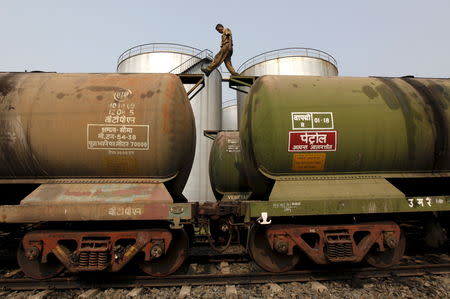
A worker walks atop a tanker wagon to check the freight level at an oil
terminal on the outskirts of Kolkata in this November 27, 2013 file
photo. REUTERS/Rupak De Chowdhuri/Files
NEW DELHI (Reuters) - India's monthly oil imports from Iran plunged
to their lowest in a year in November with Tehran dropping two places to
become only the sixth biggest supplier after New Delhi cut purchases
due to the impact of U.S. sanctions, according to ship tracking data and
industry sources.
Last month, the United States introduced tough sanctions aimed at
crippling Iran's oil revenue-dependent economy. Washington did, though,
give a six-month waiver from sanctions to eight nations, including
India, and allowed them to import some Iranian oil.
India is restricted to buying 1.25 million tonnes per month, or about 300,000 barrels per day (bpd).
In November, India imported about 276,000 bpd of Iranian oil, a
decline of about 41 percent from October and about 4 percent more than
the year-ago month, ship tracking data obtained from shipping and trade
sources showed.
After abandoning the 2015 Iran nuclear deal, U.S. President Donald
Trump is trying to force Tehran to quash not only its nuclear ambitions
and its ballistic missile programme but its support for militant proxies
in Syria, Yemen, Lebanon and other parts of the Middle East.
India's imports from Iran in November, included some parcels that
were loaded in October. In November, Iraq and Saudi Arabia continued to
be the top two oil sellers to India.
The UAE, which was the sixth biggest oil seller to India in October,
became the third top seller to India in November, knocking down
Venezuela by a notch to fourth position.
Nigeria continued at No. 5 position, while Iran slipped to sixth place.
"Iran do not have vessels to export oil on time ... some November
loading vessels will arrive in December," said an industry source, with
knowledge of the matter.
Local and international shippers are not carrying Iranian cargoes
despite India winning a waiver, this source said. The key problem is
that while India can import Iranian oil without falling foul of
Washington, that may not apply to a shipping company signing a new
delivery contract.
Instead, India is relying on Iranian tankers for crude imports and Iran is using many of its vessels for crude storage.
The sources declined to be identified citing the confidentiality of the numbers.
Indian refiners, wary of the impact of U.S. sanctions, had boosted
imports from Iran ahead of their introduction, with imports averaging
about 563,000 bpd in April-November, a growth of about 32 percent from a
low base in the previous fiscal year, the data showed.
In the previous financial year to March 2018 India had cut oil
imports from Iran due to a dispute over development rights of a giant
gas field.
Iran was hoping to sell more than 500,000 bpd of oil to India in
2018/19, its oil minister Bijan Zanganeh said in February, and had
offered almost free shipping and an extended credit period to boost
sales to India.
Government sources say Reuters' calculations showing India's oil
imports from Iran in this fiscal year would be higher than the 452,000
bpd, or 22.6 million tonnes, it imported in the previous year, are
correct.
During January-November this year India's oil imports from Iran rose by an annual 18.4 percent to 552,000 bpd, the data showed.
(Reporting by Nidhi Verma; Edited by Martin Howell and David Evans)
Wednesday, December 12, 2018
China's flawed futures contract pushes oil trade to record high in 2018

Shanghai’s new yuan-denominated derivatives contract is set to propel
global crude oil futures trading volumes to a record high in 2018,
eating into the market share of the two most active crude contracts,
Brent and WTI.
Launched in late March by Shanghai International Energy Exchange
(INE), China’s first serious attempt to establish an Asian oil price
benchmark has seen strong take-up, grabbing a spot market share of
around 6 percent versus international Brent LCOc1 and U.S. West Texas
Intermediate (WTI) CLc1, taken equally from both benchmarks.
Spot
crude oil volumes have more than doubled globally over the past five
years, but exchange data shows Brent and WTI activity will dip this year
for the first time since 2013.
Brent and WTI volumes slipped to
207.2 million lots of 1,000 barrels each for this year by Dec. 10, down
from 220.17 million lots in 2017.
However, adding 13 million
lots of Shanghai crude oil futures ISCc1 to those of Brent and WTI, and
last year’s levels have been reached with around two weeks of trading
left this year.
“If
a new exchange achieves 6 percent market share vs the two incumbents
within the first year of trading that’s fairly impressive,” said John
Driscoll, director of Singapore-based consultancy JTD Energy.
Shanghai
crude’s first year will have been better than Brent’s, which took 3.1
percent share from dominant WTI in its 1988 launch-year.
(GRAPHIC: Shanghai crude oil futures vs Brent & WTI - tmsnrt.rs/2Pu8WeJ)
FLAWED CONTRACT
Despite
the successful launch, Shanghai crude futures are fraught with problems
preventing them from becoming an efficient hedging tool for oil
producers and, ultimately, a benchmark on par with Brent or WTI.
One of the main issues is a lack of international market participants.
Matt
Stanley, a fuel broker with Starfuels in Dubai, said most participants
in Shanghai crude futures were Chinese individuals who don’t trade on
market fundamentals.
“It really has no bearing on the two main
benchmarks (Brent and WTI) as it is a Chinese market for the Chinese,
not a Chinese market for a global trading audience,” he said.
Traders
said to become more successful, the market needed a more diverse group
of participants, including producers, end-users and international
shippers to offset the dominance of the Chinese traders.
“Chinese
retail traders follow patterns that we in the oil industry don’t, while
China’s oil majors also have very differing interests to us. Add
intermittent trading, and this exposes us to the risk of being stuck
with positions we don’t want to carry,” said one trader with an
international oil major.
He declined to be named as his company was still in talks on joining Shanghai crude futures.
Other
issues include incompatible trading hours with the rest of the world,
including two short sessions between 0100 and 0700 GMT and a night
session, and limited physical deliverability of its underlying crude
grades in China.
CHOPPY TRADING
Inconsistent trading volumes make it difficult to use Shanghai crude as a financial hedge.
“For
industrial investors, they would need smooth trading of front-month to
hedge risks,” said Chen Kai, head of research with Chinese brokerage
Shengda Futures.
Stock selloff snowballs on fresh fears for world growth
After
a roaring start between March and August, front-month Shanghai crude
futures virtually stopped trading until November, after which activity
picked up again.
Chen Kai said this behaviour by retail traders was common in China, with similar patterns seen in asphalt and metals futures.
INE declined to comment for this article.
To
create more liquidity, the exchange is trying to attract so-called
market makers, usually major oil producers, merchants or banks, often
deployed by international exchanges such as CME Group (CME.O) and Intercontinental Exchange (ICE.N) to generate activity in contracts by providing constant bids and offers on the platform that counterparties can engage with.
Jiang
Yan, chairman of INE’s parent, the Shanghai Futures Exchange, said
earlier this month in Shenzhen “gradual improvement of relevant domestic
laws and regulations” would in time “greatly enhance” Shanghai crude’s
recognition with international investors.
Outside China, the
contract’s denomination in yuan as part of Beijing’s drive to push its
currency into global markets has also scared off some traders as it
introduces foreign exchange risk to the market.
To attract
international participants, Stanley said a global exchange could “have a
look-a-like contract in U.S. dollars, thereby eliminating any FX risk.”
Stanley pointed to iron ore futures, where Singapore Exchange
(SGX) SGX1.SG mirrors a yuan-denominated contract from the Dalian
Exchange in U.S. dollars.
Even without its flaws, some doubt whether Shanghai crude can break the dominance of Brent and WTI.
“Liquidity
is very hard to displace,” said Martijn Rats, Global Oil Strategist at
U.S. bank Morgan Stanley, adding that any new product would need some
big advantages to sap liquidity from the most active futures contracts.
JTD’s Driscoll said the jury is still out but added: “It’s likely things will gradually move, mature and develop.”
Reporting
by Henning Gloystein in SINGAPORE; additional reporting by Meng Meng in
BEIJING and Florence Tan and Roslan Khasawneh in SINGAPORE; Editing by
Sonali Paul
Tuesday, December 11, 2018
Monday, December 10, 2018
US Leads New-Build Capex Globally Across Oil and Gas Value Chain, Says GlobalData

November 23, 2018 [Oil Review Middle East] – US is expected to spend
US$521.4bn capital expenditure (capex) on 484 oil and gas projects by
2025, according to data and analytics company GlobalData.
A total capital expenditure (capex) of US$3.6 trillion is expected to
be spent globally across oil and gas value chain on planned and
announced projects during 2018 to 2025, the company added.
The company’s report: ‘Q3 Global Oil and Gas Capital Expenditure
Outlook – Gazprom Leads New-Build Capex Outlook Among Companies has
revealed that, globally, the US, Russia, and Canada are the top
countries to lead the new-build capex outlook.
Russia and Canada are expected to spent US$317.3bn (192 projects) and US$309.8bn (119 projects), respectively.
In the upstream sector, Russia is expected to lead among countries
with capex of US$77.5bn to be spent on 54 planned and announced fields
globally. Brazil and the US follow, each with almost the same capex of
US$70bn.
GlobalData’s report found that the US is expected to lead in the
pipelines segment with capex of US$123.6bn to bring 165 planned and
announced projects online by 2025.
In the gas processing segment, Russia is to spend US$40.8bn on 13 new
projects, expected to come online during the outlook period. On the LNG
liquefaction front, the US leads with estimated capex of US$216.4bn on
32 upcoming liquefaction terminals by 2025, while China leads in
regasification capex, with US$18.1bn to be spent on 22 upcoming
regasification terminals.
In the underground gas storage segment, Turkey leads with estimated
capex of US$11.4bn to be spent on seven planned gas storage terminals by
2025, while for liquids storage terminals, the US leads with capex of
US$9.3bn expected to be spent on 32 upcoming projects.
On the downstream side, India is expected to lead with estimated
capex of US$89bn on the development of nine crude oil refineries
globally by 2025. In the petrochemical sector, China is expected to lead
with estimated capex of US$76bn to be spent on 215 upcoming
petrochemical plants.
Lopez Obrador Says Mexico to Build an $8 Billion Refinery

Andres Manual Lopez Obrador
Photographer: Cesar Rodriguez/Bloomberg
-
Mexico to start awarding construction contract by March 2019
-
Pemex plans to improve operations of current six refineries
Mexico plans to start awarding the construction of its seventh
refinery as soon as March 2019, President Andres Manuel Lopez Obrador
said at an event at the Dos Bocas port, in Tabasco, even as the nation´s
refining system is operating at its lowest levels in three decades.
Unveiling
a plan for the nation’s refining system, Lopez Obrador said Mexico will
invest $8 billion in the new processing facility at Dos Bocas. "We are
going to start the bidding process for the refinery by March at latest,"
he said to a cheering crowd in the sun-drenched town in the Gulf of
Mexico, reiterating his intentions to boost fuel self-sufficiency and
end long-term declines in oil output. Mexico’s oil production, on track
for its 14th consecutive yearly decline, will rise "realistically" to
2.4 million barrels per day by 2024, he said.
Lopez Obrador said a lot of 566 hectares of federal land is
ready for the new plant, which will have crude processing capacity of
340,000 daily barrels, making it Mexico’s biggest refinery. It will
include 17 processing plants, and 93 storage tanks or facilities, and
link up to the Dos Bocas maritime terminal. A pipeline will be built
connecting the refinery to the port.
Companies such as Ica Fluor, a joint venture between Mexico’s
Empresas ICA SAB and Fluor Corp. in the U.S., and U.S.-based Bechtel,
have previously expressed interest in participating in the public tender
for the refinery project. Lopez Obrador didn´t said if the state-owned
oil company, Petroleos Mexicanos, will operate the new facility.
"In
three years we will be producing the gasoline that we consume in the
country, so that now we can lower the prices of the fuel," he said.
Lopez Obrador also said the government will increase Pemex’s
budget by 75 billion pesos for 2019 so the company will be able to
invest in a series of new projects to improve its operations. He
reiterated his government will submit the 2019 budget to the Congress on
December 15 and said the nation won’t use the oil contingency fund to
finance the new oil policy.
Subscribe to:
Posts (Atom)