Tuesday, October 9, 2018

Tehran says Saudi Arabia unable to replace lost Iranian oil

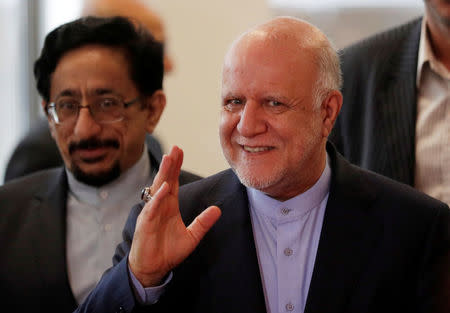
Iran's Oil Minister Bijan Zanganeh arrives for an OPEC meeting in Vienna, Austria, June 22, 2018. REUTERS/Heinz-Peter Bader/File Photo


DUBAI (Reuters) - Iran's Oil Minister Bijan Zanganeh has dismissed as "nonsense" claims by the Saudi crown prince that Saudi Arabia can replace sanctions-hit Iranian oil in the market.

"(Mohammed) bin Salman's remarks and such bragging can only satisfy (U.S. President Donald) Trump. No one else will believe him. Iran's oil cannot be replaced by Saudi Arabia nor any other country," Zanganeh was quoted as saying on his ministry's website. 

Prince Mohammed told Bloomberg on Friday that the kingdom had met its promise to Washington to make up for Iranian oil supplies lost through U.S. sanctions, reimposed when the United States exited a 2015 nuclear deal between Tehran and six powers.

Washington is pushing allies to cut imports of Iranian oil to zero and will impose a new round of sanctions on Iranian oil sales in November.

But Iran, OPEC’s third-largest producer, has repeatedly said that its oil exports cannot be reduced to zero because of high demand levels in the market and has blamed Trump for an oil price rally caused by imposing sanctions on Tehran.

"The price hike in the market is the best evidence to state that ... the market faces a supply shortage and it is worried," Zanganeh said. 

Zanganeh accused Tehran's regional rival Saudi Arabia of bowing to U.S. pressure, saying such remarks had no "real impact on the market" but were part of a psychological war launched against Iran.

"Any country that makes such claims ... just wants to display its support for the U.S. sanctions against Iran," Zanganeh was quoted as saying.

"What the Saudis had been supplying the market with, were not from Riyadh's spare capacity but from tapping its oil stocks," Zanganeh said, according to the website.

Iran has warned that if it cannot sell its oil due to U.S. pressure, then no other regional country will be allowed to do so either, threatening to block the Strait of Hormuz. 

A U.S. government official said on Friday that the administration was considering waivers on Iran's oil sanctions. Oil dropped to around $83 a barrel on Monday. 
 
(Writing by Parisa Hafezi; editing by Dale Hudson and Jason Neely)

Thursday, October 4, 2018

Saltpond Being Decommissioned / Ghana


https://www.petroleumafrica.com/saltpond-being-decommissioned/

Ghana’s state-run oil firm, GNPC, has reported that its longest producing field is in the process of being decommissioned.  According to GNPC, the actual process will start after the decommissioning plan has been finalized by a consultant and approved by the Minister of Energy.

GNPC General Manager, Geoscience, Benjamin Kwame Asante, in an interview with Ghana Business & Finance Magazine said that although operations had ceased at the field, there was a skeletal staff maintaining it ahead of the decommissioning, on the sidelines of the just ended 2018 Ghana Gas Forum.

The field is operated by the Saltpond Offshore Producing Company Limited (SOPCL).

Wednesday, October 3, 2018

U.S. crude oil shipments to China 'totally stopped' amid trade war: shipping executive

Crude oil trading terminal of Qingdao Port, China, China's crude oil imports in the largest berthing large 30-ton tanker Stock Photo - 23421171
Crude oil trading terminal of Qingdao Port, China, China's crude oil imports in the largest berthing large 30-ton tanker

https://www.reuters.com/article/us-usa-china-trade-oil/us-crude-oil-shipments-to-china-totally-stopped-amid-trade-war-shipping-executive-idUSKCN1MD0O1

U.S. crude oil shipments to China have “totally stopped”, the President of China Merchants Energy Shipping Co (CMES) said on Wednesday, as the trade war between the world’s two biggest economies takes its toll on what was a fast growing businesses.

Washington and Beijing have slapped steep import tariffs on hundreds of goods in the past months. And although U.S. crude oil exports to China, which only started in 2016, have not yet been included, Chinese oil importers have shied away from new orders recently. 

“We are one of the major carriers for crude oil from the U.S. to China. Before (the trade war) we had a nice business, but now it’s totally stopped,” Xie Chunlin, the president of CMES (601872.SS) said on the sidelines of the Global Maritime Forum’s Annual Summit in Hong Kong. 

Ship tracking data in Refinitiv Eikon confirmed that U.S. crude oil shipments to China ground to a halt in September. 

“It’s unfortunately happened, the trade war between the U.S. and China. Surely for the shipping business, it’s not good,” the CMES president said. 

601872.SSShanghai Stock Exchange
+0.16(+4.49%)
601872.SS
He also said the trade dispute was forcing China to seek soybeans from suppliers other than the United States, adding that China now bought most its soybeans from South America.

Tuesday, October 2, 2018

Bill allowing U.S. to sue OPEC drawing renewed interest


With oil prices hitting fresh four-year highs, long-dormant proposals to allow the United States to sue OPEC nations are getting a fresh look in Congress, though they were once considered a longshot to becoming law. 

A U.S. Senate subcommittee on Wednesday will hear testimony on the so-called No Oil Producing and Exporting Cartels Act, or NOPEC, which would revoke the sovereign immunity that has long shielded OPEC members from U.S. legal action. 

The bill would change U.S. antitrust law to allow OPEC producers to be sued for collusion; it would make it illegal to restrain oil or gas production or set those prices - removing sovereign immunity that U.S. courts have ruled exists under current law. 

Past U.S. leaders have opposed the NOPEC bill, but the possibility of its success may have increased due to President Donald Trump’s frequent criticism of the Organization of the Petroleum Exporting Countries, and as some predict that Brent crude, the international benchmark, could reach $100 a barrel before long. 

“OPEC is a pet peeve for him,” said Joe McMonigle, senior energy policy analyst at Hedgeye Potomac Research. “Everybody thinks he could easily support NOPEC.” 

Saudi Arabia is lobbying the U.S. government to prevent the bill’s passage, sources familiar with the matter said. Business groups and oil companies also oppose the bill, citing the possibility of retaliation from other countries. 

OPEC controls output from member nations by setting production targets. Prices are up 82 percent following the cartel’s decision to cut output at the end of 2016, hitting $84 a barrel on Monday, and lawmakers have trained their ire on the group, saying it is again harming consumers and represents interference in free markets. 

Wednesday’s hearing before the Senate Subcommittee on Antitrust, Competition Policy and Consumer Rights could give insight into the executive branch’s stance, McMonigle said. One of the witnesses will be Makan Delrahim, assistant attorney general for the Justice Department’s Antitrust Division, who has written in support of such legislation. 

A version of NOPEC passed both houses of Congress in 2007 but was shelved after President George W. Bush said he would veto the legislation. Chances of passage this year are slim, as the U.S. House of Representatives is scheduled to be in session only 16 days the rest of this year, leaving little time for anything but must-do legislation like keeping the government funded. 

Saudi Arabia, the world’s top oil exporter, is worried that NOPEC could turn into another Justice Against Sponsors of Terrorism Act (JASTA) law, which allows victims of the Sept. 11 attacks in the United States to sue Riyadh, the sources said. The JASTA law is seen as key to why state-run Saudi Aramco was hesitant in publicly listing its shares on U.S. markets in an IPO that has since been shelved. 

With close to $1 trillion in investments in the United States, Riyadh has a lot to lose if NOPEC becomes law. Saudi Energy Minister Khalid al-Falih raised concerns about it with U.S. officials, including U.S. Energy Secretary Rick Perry, during private meetings in recent months, two sources told Reuters on condition of anonymity. 

Earlier this year, the U.S. Chamber of Commerce and American Petroleum Institute told Congress they opposed the bill, saying surging U.S. energy output had mitigated OPEC’s influence. 

Since the U.S. renewed sanctions on Iran this May, other nations, including Saudi Arabia, have agreed to increase production. However, that has not yet stopped oil’s upward climb.

Monday, October 1, 2018

China LNG Tariff Casts Shadow Over New U.S. Export Terminals


China set a 10 percent tariff on U.S. liquefied natural gas (LNG) imports, extending a trade dispute into energy and casting a shadow over U.S. export terminals that would propel the United States into the world's second-largest LNG seller.

Beijing on Tuesday said it would tax U.S. products worth $60 billion effective Sept. 24 in retaliation for tariffs imposed by U.S. President Donald Trump in an escalating trade war.

The rate was smaller than the 25 percent tariff China had touted earlier, which offered some relief and helped shares in listed U.S. LNG companies climb.

The tariffs undermine Trump's drive to use U.S. shale oil and natural gas to turn the United States into a global energy leader. The U.S. is on track to export over 1,000 billion cubic feet (bcf) of gas as LNG in 2018. One billion cubic feet is enough to fuel about 5 million U.S. homes for a day.

But China, which purchased about 15 percent of all U.S. LNG shipped in 2017, is now on track to buy less than 100 bcf of U.S. LNG in 2018, less than last year, according to Thomson Reuters vessel tracking and U.S. Department of Energy data.

The country has taken delivery from just four vessels since June versus 17 during the first five months of the year.

Proposed U.S. export terminals, many expected to supply Chinese customers, were expected to account for 60 percent of all new LNG production coming to market by 2023, according to industry data.

LNG, which involves super-cooling natural gas so it can be transported by ship rather than pipeline, has become one of the fastest growing commodity trades as nations seek cleaner fuels.

The tariff's extension to an energy commodity much in demand in China was a worrisome sign for trade relations and for billions of dollars in proposed U.S. terminals, said trade group executives.