Friday, February 16, 2018

IMO agrees ban on carriage of non-compliant HSFO
http://www.tankeroperator.com/ViewNews.aspx?NewsID=9426
MO has agreed to
move forward with prohibiting the carriage of fuel oil for use on board
ships, when it is not compliant with the new low sulfur limit, which
comes into force from 2020.
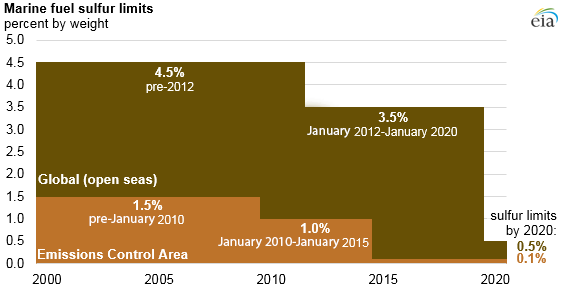
The 0.5% limit on sulfur in fuel oil on board ships (outside designated
ECAs, where the limit is 0.1%) will come into effect on 1st January,
2020.
To help ensure consistent implementation of this regulation, IMO’s
Sub-Committee on Pollution Prevention and Response (PPR), which met
between 5th-9th February, agreed draft amendments to MARPOL Annex VI to
prohibit the carriage of non-compliant fuel oil, such that the sulfur
content of any fuel oil used or carried for use on board ships shall not
exceed 0.5%.
The exception would be for ships fitted with an approved ‘equivalent
arrangement’ to meet the sulfur limit – such as an exhaust gas cleaning
system (EGCS), which are already allowed under regulation 4.1 of MARPOL
Annex VI.
These arrangements can be used with ‘heavy’ high sulfur fuel oil as an
EGCS cleans the emissions and therefore can be accepted as being at
least as effective at meeting the required sulfur limit.
Under regulation 3.2 of MARPOL Annex VI a ship undertaking trials for
ship emission reduction and control technology research can be exempted
by a signatory to Annex VI.
The Sub-Committee forwarded the proposed draft amendments to the MEPC
72 meeting in April, 2018, for urgent consideration. Once approved, the
draft amendments could be adopted at MEPC 73 (October, 2018) and could
enter into force on 1st March, 2020 - two months after the 0.5% limit
comes into effect.
The urgency of the matter was recognised to the extent that MEPC 72
will be requested to consider whether the output on ship implementation
planning for 2020 from the PPR inter-sessional meeting in July, 2018
should be forwarded to MEPC 73.
Consistent implementation of the 0.5% sulphur limit for all ships will
ensure a level playing field is maintained, with the result that the
expected improvement of the environment and human health will be
achieved, IMO said.
In addition, the IMO has been looking at how to measure and report on
Black Carbon emissions, as part of its work to consider the impact on
the Arctic of emissions.
The Sub-Committee agreed the reporting protocol for voluntary
measurement studies to collect Black Carbon data, as well as most
appropriate Black Carbon measurement methods for data collection.
The Sub-Committee encouraged member states and international
organisations to continue to collect Black Carbon data, using the agreed
reporting protocol and the agreed measurement methods, and submit
relevant data to the next session of the Sub-Committee.
PPR also agreed draft 2018 Guidelines for the discharge of exhaust gas
recirculation (EGR) bleed-off water, for submission to MEPC 73, with a
view to adoption.
Also agreed were draft amendments to the NOX Technical Code 2008
relating to certification requirements for selective catalytic reduction
(SCR) systems.
In addition, PPR considered matters relating to the implementation of the Ballast Water Management Convention.
Draft guidance on system design limitations of BWMS and their
monitoring, was agreed, for submission to MEPC 73 with a view to
approval.
Meanwhile, the Sub-Committee invited submissions to the next session on
specific examples of contingency measures acceptable to port states and
implemented by the shipping industry, which could then be included in
an annex to the guidance on contingency measures under the BWM
Convention; and further submissions related to ports with challenging
water quality.
PPR agreed to draft Guidelines for the use of electronic record books
under MARPOL, for submission to MEPC 73 for consideration, with a view
to approval in principle and subsequent adoption at MEPC 74, in
conjunction with associated draft amendments to MARPOL and the NOX
Technical Code.
The Sub-Committee also completed its revision of the IBC Code, including revised product lists and index.
The revised chapters 17 (summary of minimum requirements), 18 (list of
products to which the code does not apply), 19 (index of products
carried in bulk) and 21 (criteria for assigning carriage requirements
for products subject to the IBC Code) and other amendments will be
forwarded to MEPC 73 and to the Maritime Safety Committee (MSC 100)
later this year for approval and subsequent adoption.
Thursday, February 15, 2018
Nigeria’s Oil Producers Are Itching to Pump More

https://www.bloomberg.com/news/articles/2018-02-14/opec-russia-to-discuss-new-oil-inventory-measurements-in-april
-
Nigeria limiting oil production to 1.8 million barrels a day
-
Domestic companies are planning to bolster their output
Add independent Nigerian drillers to the list of oil producers
itching to supply more crude at a time when OPEC and allies like Russia
are trying to restrict output and prop up prices.
Domestic
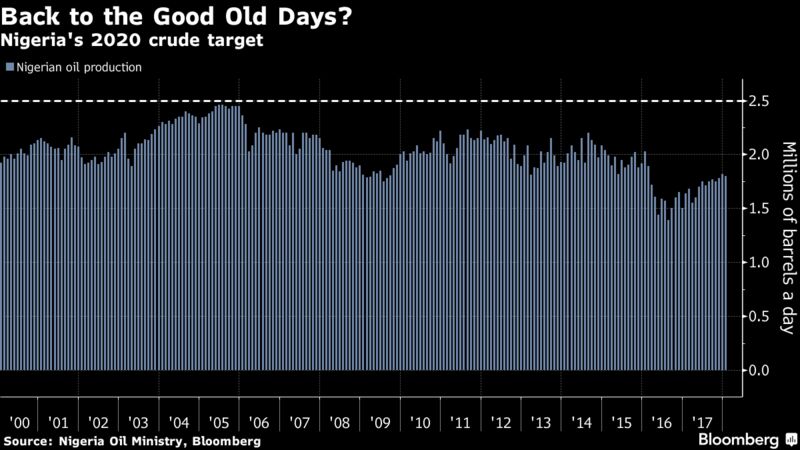
Nigerian producers are aiming to pump almost 250,000 barrels a day more
crude by 2020 as part of a wider plan for the nation to lift output to
2.5 million a day, Oil Ministry data show. Shoreline Group, the third-biggest independent, wants to double output by December with Seplat Petroleum Development Co., the second-largest, also intending to produce more.
They
are planning to add barrels at the same time as Nigeria participates in
a global pact to restrict oil supply that’s being led by the
Organization of Petroleum Exporting Countries and non-member nations
including Russia. If any one country relents -- and similar internal
pressures are bubbling up elsewhere -- then the entire deal could come
under strain.
“If they can pump more in Nigeria, I don’t see why they
wouldn’t,” said Warren Patterson, a commodity strategist at ING Bank NV.
“If you get Nigeria exceeding the cap, then you’re going to get others
who pump a little bit more. The longer the deal goes on for, the more
likely it’s going to fall apart.”
Not Alone
Countries
and companies both inside and outside OPEC are looking to add
production. Iraq is building infrastructure to allow a huge increase in
capacity, while Iran’s oil minister has said the country can produce
more almost instantly. An Angolan field will come on stream by year end
and add 250,000 barrels daily, while companies in Russia pushed to pump
more before the country renewed its supply-curbs deal with OPEC late
last year.
Along with Libya, Nigeria’s involvement was critical
when OPEC agreed with non-member producers to extend global curbs to oil
production until the end of 2018. It pledged not to let output exceed
1.8 million barrels a day in 2018.
The country’s total planned
increase is 700,000 barrels a day. Just over a third will come from the
state-run Nigeria Petroleum Development Co., a third from independents,
and the remainder from oil majors. The expansion depends, among other
things, on peace being maintained in the Niger Delta. A militant group said last month it would attack oil and gas facilities.
Refinery Feed
One
probability is at least some of the extra Nigerian supply will end up
feeding the Dangote oil refinery, the continent’s largest, which is due
to start operating next year. While doing that would help rid Nigeria of
its dependence on fuels produced overseas, it wouldn’t extricate the
country from its commitments to OPEC.
Back in 2016, Shoreline had to cancel a planned $500 million
Eurobond. With oil prices rallying, the company is making a comeback. It
agreed a $530 million deal with financiers led by Vitol Group, the world’s biggest independent oil trader, as it seeks to double crude output to 100,000 barrels a day by year end.
“It
represents a massive vote of confidence in the future growth of our
operations and of Nigerian upstream producers,” Kola Karim, chief
executive officer of Shoreline, said in an interview.
Shoreline’s
progress mirrors that of other Nigerian independents. Seplat, said to be
among companies bidding for Petroleo Brasileiro SA’s African oilfields,
expects to ramp up drilling this year after output recovered from
militant attacks and low prices, according to company statements.
“We
are on course,” Emmanuel Kachikwu, Nigeria’s Minister of State for
Petroleum Resources, said Thursday of the goal to pump 2.5 million
barrels a day by 2020. “Capacity-wise, the volumes are there.
Infrastructure-wise we suffer a little bit in terms of being able to
deliver.”
There are at least a dozen small to mid-sized Nigerian
producers pumping between 5,000 and 100,000 barrels each day. Together,
they plan to add incremental supply of at least 150,000 barrels a day
this year. Aiteo E & P Ltd., Nigeria’s largest independent, didn’t
immediately comment about its expansion plans.
Half a decade ago,
these producers were hailed as the future of Nigeria’s production
because of their potential to pump 40 percent of the OPEC member’s
output. They had bought oilfields that hold at least a third of the West
African nation’s 37.5 billion barrels of crude reserves from companies
including Royal Dutch Shell Plc, Total SA and Eni SpA.
Their
day may still come. The OPEC deal is currently in place until the end
of this year and global demand is rising fast. The International Energy
Agency this month revised up its growth estimate for world oil
consumption by 100,000 barrels a day, taking it up to 1.4 million.
“As
the oil market rebalances in the years ahead, OPEC will have to lift
its production cap,” Pabina Yinkere, an energy analyst at Lagos-based
Vetiva Capital Management, said by phone, adding that a lot of extra
Nigerian crude could be used to feed the Dangote refinery. “Moves to
raise production is in view of expected demand growth.”
— With assistance by Alex Longley
Wednesday, February 14, 2018
OPEC will be forced to 'play second fiddle' to the US in 2018, analyst says
Brittany Sowacke | Bloomberg | Getty Images
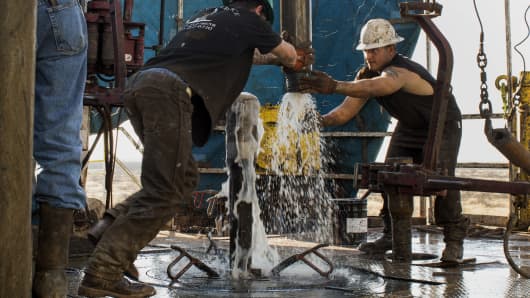
Workers connect drill bits and drill
collars, used to extract natural petroleum, on Endeavor Energy Resources
LP's Big Dog Drilling Rig 22 in the Permian basin outside of Midland,
Texas.
https://www.cnbc.com/2018/02/14/opec-will-be-forced-to-play-second-fiddle-to-the-us-in-2018-analyst-says.html
- Oil prices have skyrocketed around 40 percent since the middle of 2017, with Brent crude rising to multi-year highs above $71 a barrel, before a pullback last week wiped out its gains for 2018.
- The main price driver has been an OPEC-led supply cut from major oil-producing group OPEC, which started to withhold output in January last year.
- "This year, however, (OPEC's) production curbs will increasingly have to make do with playing second fiddle to a Texas-sized wave of U.S. shale growth," Stephen Brennock, oil analyst at PVM Oil Associates, said in a research note Wednesday.
U.S.
shale producers are churning out crude oil at such a relentless pace
that the country will soon become the most influential player in the
energy market, according to an analyst.
"Few can dispute that 2017 belonged to OPEC after it successfully reasserted its pricing influence over the oil market," Stephen Brennock, oil analyst at PVM Oil Associates, said in a research note Wednesday.
"This year, however, its production curbs will increasingly have to make do with playing second fiddle to a Texas-sized wave of U.S. shale growth," he added.
"Few can dispute that 2017 belonged to OPEC after it successfully reasserted its pricing influence over the oil market," Stephen Brennock, oil analyst at PVM Oil Associates, said in a research note Wednesday.
"This year, however, its production curbs will increasingly have to make do with playing second fiddle to a Texas-sized wave of U.S. shale growth," he added.
Price rally
Oil prices have skyrocketed around 40 percent since
the middle of 2017, with Brent crude rising to multi-year highs above
$71 a barrel, before a pullback last week wiped out its gains for 2018.
The main price driver has been an OPEC-led supply cut from major oil-producing group OPEC, which started to withhold output in January last year. The production cuts agreed by Saudi Arabia, Russia and 10 other allied producers are aimed at clearing a supply overhang and propping up prices. The deal is scheduled to last throughout 2018.
However, rising U.S. crude exports and a stronger-than-anticipated price rally in recent months have threatened to loosen Russia and Saudi Arabia's grip on key overseas markets.
The main price driver has been an OPEC-led supply cut from major oil-producing group OPEC, which started to withhold output in January last year. The production cuts agreed by Saudi Arabia, Russia and 10 other allied producers are aimed at clearing a supply overhang and propping up prices. The deal is scheduled to last throughout 2018.
However, rising U.S. crude exports and a stronger-than-anticipated price rally in recent months have threatened to loosen Russia and Saudi Arabia's grip on key overseas markets.
'Hardly a supportive environment'
In a closely-watched monthly report
published by the International Energy Agency (IEA) on Tuesday, the
Paris-based organization said a rise in global oil production — led by
the U.S. — was on track to outpace growth in demand this year.
"Even though oil stocks
are fore¬cast to draw this year, non-OPEC growth supply will still
exceed the growth in global oil demand. This is hardly a supportive
environment and is not conducive to a sustained price recovery,"
Brennock said.
The IEA also forecast
that the U.S. would be well-placed to overtake the likes of Saudi
Arabia and Russia as the world's leading energy producer by 2019.
Recent U.S. government data
showed that American drillers began pumping more than 10 million
barrels of crude oil daily in November, more than top OPEC producer
Saudi Arabia.
Tuesday, February 13, 2018
Shell behind test-run VLCC crude oil export out of US' LOOP terminal, market sources say

Shell will claim the continental US' first true VLCC export of crude --
an export without the need for reverse lightering -- when the vessel Shaden
sails from the Louisiana Offshore Oil Port later this week laden with a medium
sour crude, according to market sources.
The Louisiana Offshore Oil Port said late Monday it "has moored a VLCC and initiated its detailed test and checkout procedure." The Shaden will receive crude from LOOP's newly bidirectional pipeline connecting LOOP's onshore infrastructure with an offshore deepwater mooring station.
Market sources said Shell chartered the Shaden, a Saudi Arabian-flagged VLCC owned by Bahri (the top VLCC owner globally) that entered service at the end of 2017, and will take the crude into its refining system. Market sources were split on what grade Shell is taking, with two saying offshore Gulf of Mexico, Shell-produced Mars and another two saying the crude blend LOOP Sour. Both Shell and LOOP declined to comment.
The Shaden was seen Tuesday at LOOP's offshore mooring stations and arrived there February 11 from the Offshore Galveston Lighterage Zone, according to Platts vessel-tracking software cFlow. It arrived at OGLZ on February 3 after having sailed from Ras Tanura, Saudi Arabia, the loading port for Saudi crudes Arab Heavy, Medium, Light and Extra Light.
LOOP HISTORICALLY AN IMPORTS-ONLY FACILITY
The LOOP deepwater port comprises three single-point mooring buoys and a marine terminal about 18 miles offshore in 110 feet of water. A 56-inch-diameter line (100,000 barrels/hour) connects the marine terminal to an onshore pumping facility, which moves the oil 25 miles inland to a terminal with above-ground and underground storage, also known as Clovelly Hub.
Over the past several months, that 56-inch line was converted to become bidirectional, which preserves LOOP's traditional business of receiving crude while adding the ability for LOOP customers to export as well.
LOOP, which began operations in 1981, is the first and only deepwater oil port in the US. It is presently the only US oil facility capable of offloading vessels as large as VLCCs and ULCCs, as well as a range of smaller vessels such as Aframaxes, MR tankers and Articulated Tug Barges. LOOP is owned and operated by LOOP LLC, a joint venture of Marathon Pipe Line, Shell and Valero.
LOOP is likely to continue to be the only USGC port capable of VLCC exports. The Port of Corpus Christi and one of its tenants, Occidental Petroleum-subsidiary Occidental Energy Marketing, are separately working on projects that will allow VLCCs to be partially laden up to 1.2 million to 1.4 million barrels (about 60%-70% full); however, there are currently no announced projects that will allow fully laden VLCCs elsewhere along the USGC.
LOOP's ability to do so removes the need to send crude to St. James, Louisiana, via the 48-inch LOOP-operated LOCAP pipeline, which saves about 8-9 cents/b. It further cuts reverse lightering costs from arbitrage calculations and export math. The daily Aframax rate is currently around $300,000-$340,000, according to market sources, which would be roughly 60-68 cents/b.
Texas and Louisiana exported about 891,000 b/d in 2017, or about 81% of total US crude exports, according to US Census data. Exports were particularly strong in Q4, averaging 1.4 million b/d out of Texas and Louisiana, or 90% of the US total.
MARS, LOOP SOUR FLOATED AS POTENTIAL EXPORTED GRADES
Market sources were split on whether Shell would take Mars or LOOP Sour. Platts assessed Mars at a $1.65/b discount to March cash WTI, while LOOP Sour was a further 80 cents/b cheaper, or cash WTI minus $2.45/b.
"Shell is a big seller of Mars, but a buyer of domestic sours, such as LOOP Sour," a trader said late Monday.
Shell is the majority owner of the Mars field, with BP owning the minority stake. Mars is typically 29.4 API, 1.95% sulfur, and it delivers into the Clovelly Hub, another name for LOOP.
LOOP Sour is comprised of the US Gulf of Mexico grades Mars and Poseidon and a crude blend called Segregation 17, into which the Middle Eastern grades Arab Medium, Basrah Light and Kuwait Export Crude can be delivered. LOOP Sour is typically 30.1 API, and 2.33% sulfur. Basrah Light accounted for 28% of all waterborne imports at LOOP (about 113,000 b/d) in 2017 compared with 17% for Kuwait (67,000 b/d) and 8% for Arab Medium (32,000 b/d). It is important to note that not all LOOP Sour-deliverable crudes that arrive at LOOP will be delivered into the LOOP Sour cavern.
LOOP pipeline receipts of Mars and Poseidon are not available; however, Platts Analytics estimated Mars/Amberjack and Poseidon production to average 532,000 b/d in 2017.
--John-Laurent Tronche, john-laurent.tronche@spglobal.com
--Alan Tomczak, alan.tomczak@spglobal.com
--Sarah Raslan, sarah.raslan@spglobal.com
--Edited by Richard Rubin, richard.rubin@spglobal.com
The Louisiana Offshore Oil Port said late Monday it "has moored a VLCC and initiated its detailed test and checkout procedure." The Shaden will receive crude from LOOP's newly bidirectional pipeline connecting LOOP's onshore infrastructure with an offshore deepwater mooring station.
Market sources said Shell chartered the Shaden, a Saudi Arabian-flagged VLCC owned by Bahri (the top VLCC owner globally) that entered service at the end of 2017, and will take the crude into its refining system. Market sources were split on what grade Shell is taking, with two saying offshore Gulf of Mexico, Shell-produced Mars and another two saying the crude blend LOOP Sour. Both Shell and LOOP declined to comment.
The Shaden was seen Tuesday at LOOP's offshore mooring stations and arrived there February 11 from the Offshore Galveston Lighterage Zone, according to Platts vessel-tracking software cFlow. It arrived at OGLZ on February 3 after having sailed from Ras Tanura, Saudi Arabia, the loading port for Saudi crudes Arab Heavy, Medium, Light and Extra Light.
LOOP HISTORICALLY AN IMPORTS-ONLY FACILITY
The LOOP deepwater port comprises three single-point mooring buoys and a marine terminal about 18 miles offshore in 110 feet of water. A 56-inch-diameter line (100,000 barrels/hour) connects the marine terminal to an onshore pumping facility, which moves the oil 25 miles inland to a terminal with above-ground and underground storage, also known as Clovelly Hub.
Over the past several months, that 56-inch line was converted to become bidirectional, which preserves LOOP's traditional business of receiving crude while adding the ability for LOOP customers to export as well.
LOOP, which began operations in 1981, is the first and only deepwater oil port in the US. It is presently the only US oil facility capable of offloading vessels as large as VLCCs and ULCCs, as well as a range of smaller vessels such as Aframaxes, MR tankers and Articulated Tug Barges. LOOP is owned and operated by LOOP LLC, a joint venture of Marathon Pipe Line, Shell and Valero.
LOOP is likely to continue to be the only USGC port capable of VLCC exports. The Port of Corpus Christi and one of its tenants, Occidental Petroleum-subsidiary Occidental Energy Marketing, are separately working on projects that will allow VLCCs to be partially laden up to 1.2 million to 1.4 million barrels (about 60%-70% full); however, there are currently no announced projects that will allow fully laden VLCCs elsewhere along the USGC.
LOOP's ability to do so removes the need to send crude to St. James, Louisiana, via the 48-inch LOOP-operated LOCAP pipeline, which saves about 8-9 cents/b. It further cuts reverse lightering costs from arbitrage calculations and export math. The daily Aframax rate is currently around $300,000-$340,000, according to market sources, which would be roughly 60-68 cents/b.
Texas and Louisiana exported about 891,000 b/d in 2017, or about 81% of total US crude exports, according to US Census data. Exports were particularly strong in Q4, averaging 1.4 million b/d out of Texas and Louisiana, or 90% of the US total.
MARS, LOOP SOUR FLOATED AS POTENTIAL EXPORTED GRADES
Market sources were split on whether Shell would take Mars or LOOP Sour. Platts assessed Mars at a $1.65/b discount to March cash WTI, while LOOP Sour was a further 80 cents/b cheaper, or cash WTI minus $2.45/b.
"Shell is a big seller of Mars, but a buyer of domestic sours, such as LOOP Sour," a trader said late Monday.
Shell is the majority owner of the Mars field, with BP owning the minority stake. Mars is typically 29.4 API, 1.95% sulfur, and it delivers into the Clovelly Hub, another name for LOOP.
LOOP Sour is comprised of the US Gulf of Mexico grades Mars and Poseidon and a crude blend called Segregation 17, into which the Middle Eastern grades Arab Medium, Basrah Light and Kuwait Export Crude can be delivered. LOOP Sour is typically 30.1 API, and 2.33% sulfur. Basrah Light accounted for 28% of all waterborne imports at LOOP (about 113,000 b/d) in 2017 compared with 17% for Kuwait (67,000 b/d) and 8% for Arab Medium (32,000 b/d). It is important to note that not all LOOP Sour-deliverable crudes that arrive at LOOP will be delivered into the LOOP Sour cavern.
LOOP pipeline receipts of Mars and Poseidon are not available; however, Platts Analytics estimated Mars/Amberjack and Poseidon production to average 532,000 b/d in 2017.
--John-Laurent Tronche, john-laurent.tronche@spglobal.com
--Alan Tomczak, alan.tomczak@spglobal.com
--Sarah Raslan, sarah.raslan@spglobal.com
--Edited by Richard Rubin, richard.rubin@spglobal.com
Venezuela turns to ally Russia for crude oil imports

Venezuela is increasingly turning to its ally Russia for crude oil, as a
dramatic fall in its crude output is pushing the country to import
crudes for its refineries.
State-owned PDVSA is resorting to importing Russian Urals crude for its 335,000 b/d Isla refinery in the Caribbean island of Curacao as the country's production has fallen to its lowest in almost two decades.
PDVSA is said to have bought almost 3 million barrels of Urals crude this year from trading house Glencore, trading sources told S&P Global Platts.
Three crude oil tankers have already left from the Baltic port of Primorsk for Curacao this year, with one more tanker expected to load this month, sources added.
State-owned PDVSA is resorting to importing Russian Urals crude for its 335,000 b/d Isla refinery in the Caribbean island of Curacao as the country's production has fallen to its lowest in almost two decades.
PDVSA is said to have bought almost 3 million barrels of Urals crude this year from trading house Glencore, trading sources told S&P Global Platts.
Three crude oil tankers have already left from the Baltic port of Primorsk for Curacao this year, with one more tanker expected to load this month, sources added.
The Aframax tankers Mareta and Front Lynx discharged in Curacao in
late-January while the Waikiki is expected to reach the Isla refinery in
Curacao on February 18, data from Platts trade flow software cFlow
showed. Representatives at PDVSA and Glencore were unavailable for
comment.
Russia has been a strong ally to the Latin American country through these difficult times by continuing to bailing out PDVSA.
This comes as the OPEC member finds itself in a crumbling financial state as falling oil production plunges the country into economic chaos.
The country which relies heavily on crude oil export revenues has seen its domestic refining runs falls sharply due to underinvestment amid a lack of crude to process.
Despite being a significant crude oil producer and the holder of the world's largest crude reserves, the country has been increasingly importing crude oil in the past few years.
This imported crude is either used as a diluent in its extra heavy oil fields in the Orinoco Basin or used by its refineries which have been struggling to operate at normal rates due to the ongoing economic situation.
Russia has been a strong ally to the Latin American country through these difficult times by continuing to bailing out PDVSA.
This comes as the OPEC member finds itself in a crumbling financial state as falling oil production plunges the country into economic chaos.
The country which relies heavily on crude oil export revenues has seen its domestic refining runs falls sharply due to underinvestment amid a lack of crude to process.
Despite being a significant crude oil producer and the holder of the world's largest crude reserves, the country has been increasingly importing crude oil in the past few years.
This imported crude is either used as a diluent in its extra heavy oil fields in the Orinoco Basin or used by its refineries which have been struggling to operate at normal rates due to the ongoing economic situation.
CURACAO REFINERY WOES
These crude shipments comes as a lifeline
to the refinery which is facing imminent closure due to delayed
investments amid a scarcity of crude that have left the industrial
services plant nearly paralyzed.
Sources also said that Isla received two shipments of US crude in January.
Venezuela's state-owned PDVSA first imported Russia crude for its Curacao refinery in late 2014 and it bought a moderate amount of Urals in 2015 and 2016 while flows on this route were completely halted in 2017, sources added.
The 335,000 b/d refinery, which has been operated by PDVSA since 1985 under rental agreements with the Dutch Caribbean autonomous territory, is 65 km from Venezuela's coast.
The contract expires in 2019 and PDVSA has been told it will be out as operator because of its failure to fulfill its contractual obligations to modernize the complex.
The decline of Venezuelan crude production, especially light and medium crudes, has impacted Isla's operations as well as PDVSA's four domestic refineries, which are operating at a combined 35% processing rate, according to sources.
Despite recent imports of US crude by PDVSA, the Trump administration is considering new sanctions on Venezuela's oil sector though these are not expected to be put in place till after the presidential elections in April in the OPEC-member country.
Sources also said that Isla received two shipments of US crude in January.
Venezuela's state-owned PDVSA first imported Russia crude for its Curacao refinery in late 2014 and it bought a moderate amount of Urals in 2015 and 2016 while flows on this route were completely halted in 2017, sources added.
The 335,000 b/d refinery, which has been operated by PDVSA since 1985 under rental agreements with the Dutch Caribbean autonomous territory, is 65 km from Venezuela's coast.
The contract expires in 2019 and PDVSA has been told it will be out as operator because of its failure to fulfill its contractual obligations to modernize the complex.
The decline of Venezuelan crude production, especially light and medium crudes, has impacted Isla's operations as well as PDVSA's four domestic refineries, which are operating at a combined 35% processing rate, according to sources.
Despite recent imports of US crude by PDVSA, the Trump administration is considering new sanctions on Venezuela's oil sector though these are not expected to be put in place till after the presidential elections in April in the OPEC-member country.
PRODUCTION DWINDLES
Venezuela has observed a staggering decline in its crude oil production in the past 12 months as its oil sector has been plagued by spiraling debt, mismanagement, corruption, crumbling infrastructure and a lack of investment, Venezuela's output fell to 1.64 million b/d, a fall of 370,000 b/d since January last year, according to S&P Global Platts OPEC Survey data.
This is a low not seen since its oil industry was hit by a major strike from December 2002 to February 2003.
Not counting strike-affected months, Venezuela's production was last this low in June 1988, almost 30 years ago.
Venezuela's output has fallen for six straight months, and analysts say more declines are likely unless the financial environment in the country improves drastically.
--Eklavya Gupte, eklavya.gupte@spglobal.com
--Peter Farrell, peter.farrell@spglobal.com
--John Morley, john.morley@spglobal.com
--Edited by Maurice Geller, maurice.geller@spglobal.com
Subscribe to:
Posts (Atom)