Wednesday, September 6, 2017

USGC Ports Begin to Re-open; Additional FMs Announced

http://www.rednews.com/wp-content/uploads/2016/05/2411.jpg

Port Houston, the second-largest petrochemical port in the world, allowed ships to access one of its two container ports and Norwegian chemical shipper Odfjell's terminal on Friday as energy infrastructure walloped by Harvey continued showing signs of recovery.

Multiple chemical producers still had force majeures in place, telling customers they would not be able to fulfill their contracts because of Harvey, often because logistics were stalled by the storm. Harvey dumped more than 51 inches of rain in the Houston area after coming ashore at the middle of the Texas coast a week ago as a Category 4 hurricane, forcing more than 50% of US ethylene capacity to shut down.

Port Houston said no ships could yet move north of the Bayport container terminal, which is just north of Odfjell's terminal near the mouth of the Houston Ship Channel. However, barges and tug boats could traverse the channel and nearby ports in Galveston, Texas City and Freeport.

However, ports in Beaumont, Port Arthur and Orange in southeast Texas remained closed and may not open to vessel traffic until Tuesday or Wednesday next week, according to the Sabine Pilots, the organization that oversees vessel movements and safety for those ports. Currents from Harvey's floodwaters were too strong to allow vessel traffic.

Logistics

* Port Houston allowed ships to Odfjell's terminal and the port's Bayport container terminal, but restricted all other traffic in the Houston Ship Channel to barges and tug boats.

* Ports in Beaumont, Port Arthur and Orange could remain closed until Tuesday or Wednesday because currents were too unsafe for vessel traffic post-Harvey, Sabine Pilots said.

* The US Coast Guard opened the Port of Corpus Christi in Texas for the first time since Hurricane Harvey landed a direct hit August 25, but kept some restrictions in place because it has not finished surveying all channels and inlets in the harbor.

* The Union Pacific and BNSF railroads continue to assess storm damage and are unsure when rail lines along the Texas-Louisiana coast might reopen.

* Plastic pellet packaging companies were resuming operations, with some pellets arriving by rail and trucks able to move packaged pellets to ports. Marc Levine, CEO of Plantgistix, said he expects business to return to normal once plants restart and ports fully reopen.

Tuesday, September 5, 2017

Deepwater Horizon BOP recovered

Catastrophic Hurricane Irma — now a Cat 5 — is on a collision course with Florida


https://www.washingtonpost.com/news/capital-weather-gang/wp/2017/09/05/catastrophic-hurricane-irma-now-a-cat-5-is-on-a-collision-course-with-florida/?utm_term=.b00691abd4d6

Hurricane Irma is an “extremely dangerous” Category 5, barreling toward the Greater Antilles and Southern Florida. It’s already the strongest hurricane ever recorded outside the Caribbean and the Gulf of Mexico, and it’s likely to make landfall somewhere in Florida over the weekend.

If it does, the impact could be catastrophic.

The storm is life-threatening for the United States and British Virgin Islands, Puerto Rico, the Dominican Republic, Haiti, Cuba and the Bahamas, as well. Hurricane warnings have been issued for portions of the Leeward Islands and the Greater Antilles, including Puerto Rico. A hurricane watch was issued for Hispaniola.

With maximum winds of 180 mph, Irma is the strongest hurricane in the Atlantic Ocean outside the Caribbean or the Gulf of Mexico. By wind-speed, it’s the third-strongest storm on record anywhere in the Atlantic, behind Hurricane Wilma in 2005 and Hurricane Allen in 1980. And in its Tuesday morning discussion, the National Hurricane Center said the storm is in an environment “ideal for some additional intensification.”

The hurricane is expected to remain at least a Category 4 for the next few days with minor fluctuations in intensity. It could even become slightly stronger, but it is already nearing historical precedent and a theoretical limit for how strong it can get.

It cannot be overstated that Hurricane Irma is extremely dangerous and will produce the full gamut of hurricane hazards across the Caribbean and potentially in South Florida, including a devastating storm surge, destructive winds and dangerous flash flooding.

All of Florida — especially South Florida and the Keys — should be preparing for a major hurricane landfall on Sunday. Tropical-storm-force winds are expected to arrive as soon as Friday.

U.S. landfall threat

Computer models are in strong agreement that by Saturday, Irma will be approaching the Florida Keys — where dangerous storm conditions are likely. Then, they show a sharp northward turn by Sunday morning. The precise timing and location of the turn has huge implications for Florida.


Model ensemble guidance out to ten days from the European model (top) and the U.S. model (bottom). (B. Tang, UAlbany)
 
It is impossible to say with certainty if Irma will track up along the eastern side of the Florida peninsula, the western side, or straight up the peninsula. Since the weekend, models have generally shifted westward with the storm’s forecast track, which means interests along the coast of the Gulf of Mexico should also closely monitor this storm.

For a major hurricane, the exact track of the storm’s eyewall — the zone surrounding its calm center — is critical as it will determine where the most severe effects tend to concentrate. The most violent winds coincide with the eyewall, and the biggest storm surge occur just to its right (or north).

But as Irma is such a large and powerful hurricane, very dangerous weather will also occur up to 200 miles away from the eyewall — including coastal surge, flooding rains and potentially damaging winds.
“The hurricane force winds in Irma are wider than Florida,” tweeted Bryan Norcross, hurricane specialist at the Weather Channel. “You won’t need a direct hit to get Wilma-type winds and storm surge on both coasts.”

Beyond the weekend, the scenarios really depend on which side of Florida it tracks. But for now, it’s safe to say that the southeast United States, including the Florida panhandle, Georgia and the Carolinas should also brace for potential impacts, such as flash flooding, storm surge and strong winds.


Seven-day cumulative rainfall forecast. (NOAA/WPC)
 
Impact on the Leeward Islands, Virgin Islands and Puerto Rico

At 8 a.m. Tuesday, the powerhouse storm was positioned 270 miles east of the island of Antigua in the northern Leewards, where it is forecast to make a direct impact early Wednesday. The storm was moving eastward at 14 miles per hour.

Hurricane warnings are in effect for the northern Leeward Islands, the Virgin Islands and Puerto Rico, and new warnings will be added to the west as the storm tracks just north and parallel to the Greater Antilles. Storm surge heights of 7-11 feet are possible in the warning areas, as well as heavy rain that can produce flash flooding and mudslides.

Irma is likely to become the strongest hurricane on record to hit the Leeward Islands, even more intense than David, which raked across the islands in 1979. “David was a horrible hurricane for Leeward Islands: 56 fatalities in Dominica,” tweeted Phil Klotzbach, hurricane expert at Colorado State University.

Antigua, Barbuda, Saint Kitts and Anguilla — in particular — are right in the path of the storm.


“Really feel for the northern Leeward Islands,” tweeted National Hurricane Center forecaster Eric Blake. “A hurricane this strong there only comes around once a generation or two.”

After passing the northern Leeward Islands, the hurricane is directly hitting the British Virgin Islands.
The U.S. Virgin Islands and Puerto Rico may remain south of the storm’s center, so less prone to Irma’s most hostile conditions. But even so, damaging winds and torrential rains are likely.

Irma’s place in history

Irma’s peak intensity so far ranks among the strongest in recorded history, matching the likes of Katrina, Andrew and Camille.
If Irma makes landfall as a Category 4 or higher in the United States, joining Hurricane Harvey, it will become the first time two storms so strong struck the United States in the same season.

Correction: The storm is third-strongest anywhere in the Atlantic, by wind speed. A previous version of this story said it was the second-strongest.

Friday, September 1, 2017

Gas prices surge as Harvey flooding threatens pipelines

https://www.researchgate.net/profile/Arturo_Bujanda/publication/271445226/figure/fig2/AS:295115756195845@1447372487691/Figure-5-Texas-Pipelines-Crude-and-Natural-Gas.png

http://nypost.com/2017/09/01/gas-prices-surge-as-harvey-flooding-compromises-pipelines/

Gas prices have surged in the wake of Hurricane Harvey, including in New York City, where the average price is at a high for the year.

The national average price for a gallon of regular spiked 7 cents overnight, from $2.45 Thursday to $2.52 Friday, according to the American Automobile Association.

In the Big Apple, the average price is up about 13 cents from a week ago, to $2.73.

In metropolitan areas such as Dallas and El Paso, Texas; Athens, Georgia; and Dayton, Ohio, prices jumped at least 15 cents in 24 hours, while several Southern states saw increases of at least 10 cents, the AAA reported.

Two major pipelines — one that ships gasoline from the Southern US to New York and another that runs north to Chicago — have been compromised as a result of flooding from Harvey.

In Dallas, some stations started to run out amid fears of a shortage in the aftermath of the Category 4 storm that made its first landfall in the state last week.

“There’s a worry now that most of the Texas refineries could be compromised for weeks rather than days,” said Tom Kloza, chief oil analyst for the Oil Price Information Service, which tracks prices for AAA, according to CNNMoney.

Kloza noted the national average price for a gallon could get as high as $2.75.

Analysts warned motorists not to panic even as stations run low on gas.

When it comes to gas hoarders, GasBuddy.com analyst Patrick DeHaan says “that’s going to make the problem worse, and prices shoot higher and the event will last longer, with more disruption and shortages.”

He urged drivers to “try to have a sense of calm.”

The Texas Attorney General’s Office advised any motorists seeing gas prices of $4 or higher to report the stations as price-gougers.

Harvey’ batters energy markets

https://media.bizj.us/view/img/5328261/port-of-brownsville-gate-jpg*750xx934-525-124-0.jpg

http://www.tankeroperator.com/ViewNews.aspx?NewsID=8934

According to the US Center for Strategic & International Studies (CSIS), as of 31st August, about 19% of oil and natural gas production in the Gulf of Mexico remained offline. 
 
In addition, the Texas Railroad Commission estimated that between 300,000 and 500,000 barrels per day of crude oil production was shut, mainly in the Eagle Ford region. 

On Thursday, between 4 and 5 mill barrels per day of Gulf Coast refining capacity remained offline or operating at reduced levels. Major ports and loading facilities are either closed (pending completion of damage assessments) or operating under restricted conditions (see below). Flooding has also impacted terminal/fuel racks and truck routes for overland deliveries.

The
closing of refinery operations in Texas and Louisiana has predictably reduced both crude oil demand and, more importanty for now, refined product supply, including gasoline, diesel, and aviation fuels, CSIS said.

Ships agency GAC has sent out regular updates on port conditions. For example, the US Coast Guard Captain of the Port (COTP) Corpus Christi has begun opening certain waterways within the COTP zone.

As of 30th August 30 2017, the following ports and waterways were open:
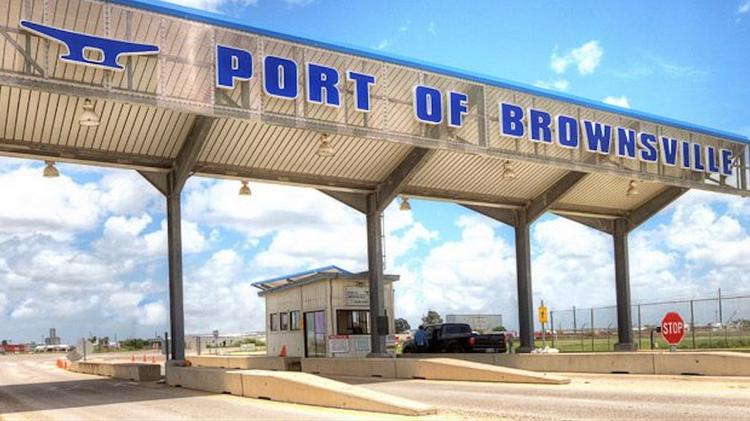
  • Brownsville.
  • Corpus Christi- Tugs and barges with drafts not exceeding 20 ft currently located in the Port of Corpus Christi Inner Harbour may transit freely within the Inner Harbour
At Houston, the Captain of the Port (COTP) set recovery for Houston, Texas City, Galveston and Freeport (Texas) and connecting waterways, effective at 30th August.
  1. For Texas City, Galveston and Freeport (Texas), the draft is restricted to 33 ft or less.
  2. For Houston, the draft is restricted to 37 ft or less.
At Corpus Christi, a grounded drillship kept the port closed to deep draught vessels, while salvage teams attempted to refloat the vessel. 

Since the incident, a tug has been stationed to monitor the ship on a continuous basis. T&T Salvage is on site and pressure is coming from the USCG to get it removed, the dillship’s operator Paragon said. .
The port authority said it was working towards achieving normal business operations by 4th September.

LOOP terminal was reported to be operating normally but under inclement weather conditions.

Later it was reported that the 600,000 barrels per day Saudi Aramco-Motiva facility in Port Arthur, Texas, the US’ largest refinery, closed as the downgraded Tropical Storm ‘Harvey’ made its second landfall in Louisiana. In addition, a power loss closed Total's 200,000 barrels per day Port Arthur refinery. 

The closures bring the total refining capacity affected by the storm to about 4 mill barrels per day, representing nearly one quarter of the US total refining capacity. Analysts' estimated that actual output decline ranged between about 2.5 to 3.3 mill barrels per day. 

Beaumont and Port Arthur, Texas received more than two feet of rain in 24 hours as ‘Harvey’ made its second landfall. Port Arthur is downstream of Beaumont, and flooding on the coastal city may worsen as levels in Beaumont fall.

Products markets get a boost from ‘Harvey’

http://www.corken.com/CMS_Images/Industries_Images/liquid_terminals/tanker_ship_petroleum_terminal.jpg

http://www.tankeroperator.com/ViewNews.aspx?NewsID=8933

A number of European-sourced gasoline cargoes, which were initially bound for West Africa and within Europe, have now changed destination to the US in the wake of Hurricane ‘Harvey’ , according to Colin Halling, Genscape’s senior oil analyst
 
Writing a blog on Thursday, he said that thus far, Genscape had seen around 111,000 tonnes of European gasoline diverted to the US.

Product tankers rates to move gasoline from Europe to North America have increased sharply since the start of this week. As gasoline prices in the US shot up a total of 20 cents per gallon from 25th August, to 30th August, there was increasing interest to ship petroleum products transatlantic from Europe. This sudden doubling in freight costs broke a long recent spell of comparatively cheap transatlantic freight rates.

Transatlantic clean freight rates had previously been stable in a low range of around  WS105-115 throughout most of August prior to’Harvey’, which has caused major disruption to refining operations in the US Gulf, home to around half of the country’s total refining capacity.

As a result, US gasoline prices rose sharply, amid reports of disruption to the Colonial pipeline system, which moves products from the US Gulf to the Northeast of the country.

Some notably strong tanker fixtures already concluded this week included Statoil fixing the ‘Green Planet’ to move around 37,000 tonnes of gasoline to the US East Coast from its refinery in Mongstad, Norway, at WS215, and Repsol, which fixed the ‘Challenge Pearl’ at the same rate out of Northern Spain. Both will load on around 5th to 10th September laycan dates.

Many of new shipments are thought to be on subjects, Halling said and will have a range of discharge destination options throughout both North and South America. Port-specific destinations are generally declared on departure, but often change en route.

Thus far, some 918,000 tonnes of gasoline had been chartered to move transatlantic out of Europe for loading during the end of this week and next. Around 185,000 tonnes is currently loading in European ports (as of 30th August) and is expected to go transatlantic - based on fixture information. Another 310,845 tonnes of gasoline had already left Europe this week to destinations, including New York and Tuxpan.

By comparison, recent weekly totals for transatlantic gasoline exports to North and South America have recently been around plus or minus 600,000 tonnes, although the level did drop as low as 468,000 tonnes in July.

By mid-week, Bloomberg had recorded 20 tanker fixtures to load European fuel for the US. The fixtures are about double the average for August. Shipbrokers said cargo flows to New York will be the highest since November, when a pipeline blast curbed shipments from the Gulf of Mexico.

‘Harvey’ has knocked out almost a quarter of US refining capacity, of which more than half is in the Gulf of Mexico region. As a result, this has lowered domestic crude prices, since fewer plants are able to process it, while simultaneously restricting the supplies of fuel, such as gasoline and diesel.

“It will take several weeks before the whole refining capacity is restored,” said Ehsan Ul-Haq, a London-based director of crude oil and refined products at Resource Economist talking with Bloomberg. “As a result, increased gasoline flows from Europe to the US will continue at least for three to four weeks.”

Shipbrokers anticipated 30 cargoes being booked to load over the next two weeks, Bloomberg said.

Gasoil markets also firmed, as the region depends on Gulf of Mexico refineries for imports. In a market that was already showing signs of tighter supply thanks to major disruption at Pernis in Rotterdam, Europe’s largest refinery, the severe restriction of flows from the US is also providing support. Contracts for October delivery of gasoil are now about $6 per tonne more expensive than those for November, indicating concerns over a scarcity of supply.

Meanwhile, Platts reported on Wednesday, that the hurricane’s aftermath had increased US demand for gasoline and gasoil from Asia. The increase in activity could be seen across all vessel types from LR2s to MRs.

Traders were keeping their options open to deliver jet fuel or gasoline cargoes into the US or South America and are already making changes to their fixtures, said one source.

Additional demand may see gasoil cargoes move from India and the Middle East to Europe and gasoline and jet fuel cargoes to the US. However, uncertainty remains on the extent to which this new or incremental demand can be met from the alternative origins and is likely to push up prices of refined products, sources told the newswire.

BP has chartered an MR for $1.25 mill for 8th September loading Singapore for US West Coast, sources said. There is also an option to take the cargo to the US Gulf Coast by paying an additional $250,000, they said. The rate is significantly higher than the last done levels, they added.