Tuesday, April 11, 2017

China Surpasses Canada as Top Buyer of U.S. Crude


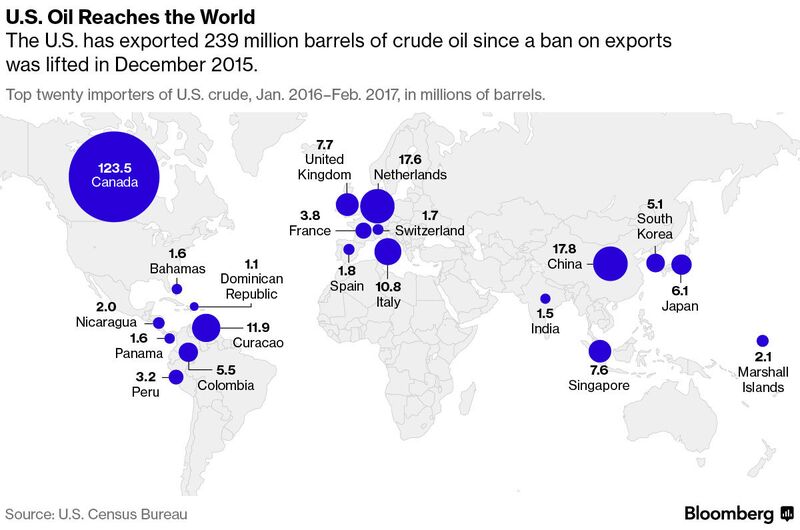
China became the biggest buyer of U.S. crude oil in February, surpassing Canada, at a time when OPEC is cutting back output.

China imported 8.08 million barrels of U.S. light crude, nearly quadrupling its January purchases, according to data released by the U.S. Census Bureau Tuesday. That helped boost U.S. exports to a record 31.2 million barrels during the month. Canada, the U.S.’s largest trade partner, imported 6.84 million, down 20 percent from a month earlier.

The surge in U.S. shipments to Asia, a market long dominated by Saudi Arabia and other Middle East producers, comes as the Organization of Petroleum Exporting Countries trims output in an effort to end a glut that battered the economies of global energy exporters. Saudi Arabia reduced its pricing for some of its April crude sales to Asia as supplies from the U.S. became more competitive.

“The U.S. is a larger exporter of crude than many OPEC countries,” John Auers, executive vice president at energy consultant Turner Mason & Co. in Dallas, said by phone. “That China is buying more means that the U.S. has become a larger player in the global crude export market.”
Ships hauling U.S. crude to Asia included the supertanker Alex, which headed for Ningbo in eastern China after loading 2 million barrels of West Texas Intermediate crude in the Gulf of Mexico in late February, a person familiar with the matter said last month.

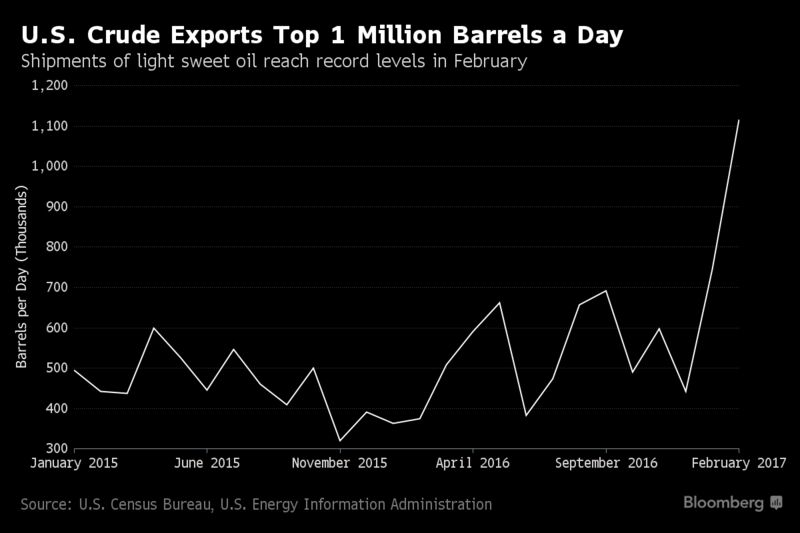
U.S. crude exports in February jumped 35 percent from a month earlier, according to the U.S. Energy Information Administration. While shipments are expected stay above 2016 levels, the boost was likely aided by seasonal maintenance at U.S. Gulf refineries, according to Auers. Also, the production cuts made by OPEC countries made Dubai, an Asian benchmark, more expensive compared to the U.S. counterpart.
WTI on Tuesday was $1.05 a barrel below Dubai, a lower-quality grade, based on front-month swaps data from broker PVM Oil Associates Ltd. It’s averaged a 50-cent discount this year, compared with a $2.43 premium in 2016.

The shipments from the U.S. to China appear to be ongoing. Sinopec bought 1 million barrels of U.S. Mars Blend crude for loading in April, a person familiar with the matter said.

"A very strong WTI-Dubai spread enabled opening in arbitrage opportunities to Asia at a time when there were lots of turnarounds going on in the U.S. Gulf in February," Dominic Haywood, a London-based analyst for Energy Aspects Ltd. said in a phone interview.

U.S. crude inventories have remained stubbornly high despite lower output from OPEC, climbing to 534 million barrels in the latest government data, the highest level going back to 1982. In March, crude prices slumped the most since July amid concerns about global stockpiles.

Singapore imported 2.03 million barrels from the U.S., while countries including Curacao, Italy, Japan, South Korea and the Netherlands bought in excess of 1 million barrels each, government data show. Shipments included condensate derived from natural gas.

Monday, April 10, 2017

Nymex Overview: Looming Cushing Crude Increase Derails Market Advance

nymex

There was a lot of enthusiasm coming into April, and indeed for the entire second quarter, but some of those bullish sentiments were tarnished this morning when reports indicated that Cushing stocks may have built by more than 750,000 bbl through last Friday.

There are a lot of hedge funds and money managers who want to be long in energy, but they've been burned badly by the consistent inventory builds seen across the 93 days of 2017.

So, oil prices backed off around midday Monday, despite the prevailing view that the second half of the month will see stocks dwindle with demand ratcheting higher. WTI sold off fairly aggressively with a 41ct/bbl loss to $50.19/bbl while June Brent lost 43cts/bbl to $53.10/bbl. Higher numbers out on the curve are seeing some producer selling, but $52/bbl or so does not bring much enthusiasm from the E&P companies.

Venezuela, which loomed as a possible source of news heading into the weekend, has been conspicuously quiet so far this morning. The dollar has suppressed crude a bit, thanks to a rise of about 0.25% in the Greenback.

Gasoline prices reversed course in tandem with crude and May RBOB fell 0.68cts/gal to $1.6962. There is very slight backwardation between May and June and other summer months.

Cash prices for gasoline were surprisingly sedate. The red hot Pacific Northwestern market backed off from its assault on $2/gal but still fetches over $1.96/gal, and most U.S. markets lost 0.25-0.75cts/gal. Ethanol, which is a key component in finished motor fuel, rose quite robustly, adding 2.0-2.8cts/gal. Diesel held its own, and remains about 7cts/gal above last week's lows. May ULSD was off 0.67cts/gal at $1.5680/gal on very quiet volume.

Friday, April 7, 2017

SCF partners with Shell for LNG-fuelled Aframaxes

tanker


SCF Group (Sovcomflot) has signed an agreement with Shell Western LNG to supply LNG to fuel what are claimed to be the first Aframax crude oil tankers in the world to be powered by natural gas. 
 
The agreement was announced by Sergey Frank, Sovcomflot president and CEO, and Maarten Wetselaar Shell’s integrated gas and new energies Director.

The agreement calls for Shell to provide the LNG fuel for the new generation of SCF Group’s 114,000 dwt ice classed Aframaxes that are due to enter service at the beginning of the third quarter of 2018.

They will be the first LNG-fuelled Aframaxes built and will operate primarily between the Baltic and Northern Europe transporting crude oil and petroleum products. Shell will fuel the vessels from a specialised LNG bunker vessel at the Gas Access to Europe (GATE) terminal in Rotterdam and other supply points in the Baltic. Each LNG-fuelled tanker will have an Ice Class 1A hull notation enabling year-round export operations from the Russian Baltic.

“SCF Group and Shell have an extensive and successful track record of collaboration and technical innovation, and at the heart of our joint aspirations is the shared desire to play a major role in delivering a cleaner and safer maritime environment. This is why SCF Group and Shell decided to pilot this breakthrough initiative to switch the principal fuel of Aframax tankers, the workhorse of the global tanker industry, to LNG,” said Frank.

“This is an important next step for gas as part of the energy mix. The decision to work with SCF Group to power the world’s first LNG-fuelled Aframax crude oil tankers is evidence of Shell’s commitment to LNG as a transport fuel. LNG will increasingly play a larger role in helping the shipping industry meet new emissions regulations,” added Wetselaar.

The signing of this agreement marks the fulfilment of a MOU signed between Shell and SCF in September, 2015 to develop marine LNG fuelling for large-capacity tankers.

SCF said that it had opted for these innovative technical solutions to ensure that the new generation of Aframaxes exceeds rather than simply complies with emission legislation and sets the standard for shipping in the environmentally sensitive regions in which the fleet operates.

The concept for these tankers was developed jointly by technical specialists from SCF and the shipbuilder, including the Far Eastern Shipbuilding and Ship Repair Centre and Hyundai Heavy Industries, the technology partners of Zvezda shipbuilding complex (Primorsky region of the Russian Far East). This concept was developed as part of the preparation for the construction of of this type of vessel at Zvezda, where it is envisaged that the construction of large-capacity tankers will commence by 2021..

SCF is working towards reducing the environmental impact of its fleet. For example, in 2011-2016, these efforts made it possible to noticeably reduce SOx emissions by 24% per tonne/mile, NOx by 10% per tonne/mile and CO2 by 4% per tonne/mile.

Thursday, April 6, 2017

Nigerian ex-oil minister charged with money laundering - crimes agency

Will Diezani Alison-Madueke spend the Christmas in hospital?
Ex Oil Minister of Nigeria Diezani Alison-Madueke


Former Nigerian oil minister Diezani Alison-Madueke, who held the post for five years between 2010-15, has been charged with money laundering, the country's financial crimes agency said on Wednesday.

Three members of the National Electoral Commission (INEC) "allegedly received bribes" from the minister ahead of the 2015 general election, the Economic and Financial Crimes Commission (EFCC) said in a statement.

One charge read at the Federal High Court in Lagos stated that Alison-Madueke and the officials "conspired among yourselves to directly take possession of 264.9 million naira ($867,813)" on or about March 27, 2015, contrary to money laundering laws.

The former petroleum minister, who served during the presidency of Goodluck Jonathan, was not in court to enter a plea.

Alison-Madueke - who was briefly arrested in London in October 2015, although no charges were brought - has previously denied to Reuters any wrongdoing when questioned about missing public funds and corruption allegations.

Jonathan lost the 2015 presidential election to Muhammadu Buhari, who had campaigned on a ticket to fix the economy of a country where 70 percent of the 180 million people live on less than $2 a day despite the OPEC member's vast energy wealth.

The financial crimes agency has been investigating allegations of illegal transactions in the run-up to the 2015 election for more than a year.

The EFCC said one of the INEC officials, Christian Nwosu, pleaded guilty to receiving 30 million naira. The two others pleaded not guilty to money laundering offences.
The prosecution lawyer said Nwosu had entered into a plea bargain agreement. He also said he had purchased properties with the 30 million Naira.

"Having demonstrated remorse and given useful information to aid the prosecution of the case, he has entered into an agreement to forfeit the properties to the federal government," said prosecution lawyer Rotimi Oyedepo.

"The EFCC has recovered the 5 million naira left from the first defendant, having spent 25 million naira to acquire properties," he added.

Former National Security Adviser Sambo Dasuki, who also served under Jonathan, was charged in December 2015 with money laundering and criminal breach of trust. He pleaded not guilty.

Bello Haliru Mohammed, who was Jonathan's defence minister, was charged in January 2016 with money laundering and criminal breach of trust over 300 million naira that was intended for defence spending. He also pleaded not guilty. (Reporting by Alexis Akwagyiram; Editing by Andrew Bolton)

Wednesday, April 5, 2017

Nigerian oil output slumps to 1.676 mil b/d in March


http://www.platts.com/latest-news/oil/london/nigerian-oil-output-slumps-to-1676-mil-bd-in-26703510

Nigeria's crude oil and condensate production averaged 1.676 million b/d in March, a fall of over 200,000 b/d from the previous month, the country's petroleum ministry said Tuesday.

The ministry said the country's oil output was 1,676,045 b/d in March, down from around 1.9 million b/d in February, but it did not provide the reason for the sharp month-on-month fall.

However, sources close to the matter said output was down mainly due to maintenance at the Bonga field, which averages around 150,000-200,000 b/d.

Shell said in early-March that Bonga production would be shut in for about four to five weeks due to turnaround maintenance and engineering upgrades at the Bonga floating, production, storage and offloading (FPSO) vessel.

Nigerian oil production still remains sharply below its capacity of 2.2 million b/d, with the main export grade Forcados still shut in. But Nigerian oil output has recovered gradually this year as militant attacks have fallen substantially since early January after the government stepped up peace talks with leaders and youths in the Niger Delta to end militancy in the region.

OPEC EXEMPTION

Nigeria is currently exempt from the OPEC production cuts because of the issues it is facing with militancy in the oil rich Niger Delta.

The OPEC deal calls for the producer group to lower output by some 1.2 million b/d from October levels and freeze production at around 32.5 million b/d, while exempting Libya and Nigeria from any cuts.

The six-month deal, which expires in June, will be up for review at OPEC's next meeting on May 25, with some ministers saying the production cuts should be extended to continue drawing down global inventories.

Sources have said that with Nigeria restoring output, it could be asked to join the output cuts, if the deal is extended.

In late November oil minister Emmanuel Kachikwu acknowledged that a fully recovered Nigeria would likely be asked to share in the cuts.

"I don't expect that once you reach your volume you are going to have free rein, so we probably have six months to get our act together and then hopefully zoom back out production and then we will be asked to contribute," Kachikwu told reporters. "That is what I imagine."

The Trans Forcados pipeline is expected to re-open by the end of June, officials from pipeline operator Nigerian Petroleum Development Co. said earlier this year.

Sources have said producers in the region are keen to start exports from the main Forcados terminal as soon as possible, but the government remains cautious due to the fragile security situation.

Nigerian oil output plummeted to near 30-year lows of around 1.2 million b/d in May 2016 from 2.2 million b/d earlier in the year as attacks on oil facilities in the Niger Delta rose at an alarming pace due to resurgent militancy.

--Eklavya Gupte, eklavya.gupte@spglobal.com

--Edited by Jonathan Fox, jonathan.fox@spglobal.com

Tuesday, April 4, 2017

LOOP Sour crude oil benchmark reflects imports, exports needed by USGC refiners


Top 10 USGC-imported crude grades, 2016

http://www.platts.com/videos/2017/march/snapshot-us-loop-sour-crude-oil-033017?utm_source=linkedin&utm_medium=social&utm_term=oil&utm_content=website&utm_campaign=snapshot

By John-Laurent Tronche, managing editor, Americas crude

Welcome to the Snapshot, a series examining the forces shaping and driving global commodities markets today.

The US oil industry is fast approaching the 10-year mark in an unprecedented renaissance. Driven by technological advancements in drilling, crude oil production has reached new record highs and currently hovers around 9 million barrels-per-day, up roughly 70 percent from 2007.

Nearly 75% of US crude output is not a grade typically consumed by a majority of domestic refiners

But nearly three-quarters of that oil production is light sweet crude oil or condensate – the kind of crude oil a majority of US refiners typically do not consume.

Gulf Coast refiners, whose combined capacity of 9.6 million b/d makes up more than half of the US total, are still largely consumers of medium-to-heavy sour crude. While imports of light sweet crudes have tumbled, USGC refiners continue to import significant volumes of heavy sour and medium sour crude.

With so much heavy-to-medium sour crude consumed on the US Gulf Coast, this presents a problem for those wishing to find a pricing benchmark in the region. The current US crude benchmark is the NYMEX light, sweet crude futures contract, which is delivered in the Midwest, at Cushing, Oklahoma. The contract, while very liquid, does not reflect the typically consumed grade and correct location for Gulf Coast refiners.

Plenty of medium-sour crude is produced off the US Gulf Coast and imported into the region. Why not look there?

Platts launches daily price assessments of LOOP Sour, a medium-sour blend of several grades (Platts symbol AALSM01)

This week Platts launched daily price assessments of LOOP Sour, a medium-sour blend of several grades, domestic and imported, stored in one of the eight underground caverns at the Louisiana Offshore Oil Port, also known as LOOP.

The two domestic US crude streams are Mars and Poseidon, and the three Middle-Eastern crude import grades are Arab Medium, Kuwait Export Crude and Basrah Light.

As a blend, LOOP Sour represents a diverse and growing set of market participants involved in the buying and selling of the blend components as well as the final blend itself, ensuring that the price cannot be easily influenced by a small number of producers. A LOOP Sour storage auction and secondary market also provide unique visibility and helps LOOP Sour meets the industry’s need for a versatile and robust benchmark.

The US Gulf Coast is an ideal location for a new sour crude pricing benchmark. The LOOP facility itself has pipeline access to more than 2.5 million b/d of refining capacity in Louisiana, as well as refineries in Texas and as far north as the Midwest.

This does not mean that West Texas Intermediate will no longer be a benchmark or a useful hedging tool, but it does encompass different basis risks in terms of location and crude quality for companies trading sour crude on the Gulf Coast.

LOOP Sour includes imports that continue to comprise a key portion of US refining crude slates

LOOP Sour not only encompasses the price of domestic sour crude barrels, but also imported sour crude barrels that continue to comprise a key portion of US refining crude slates — allowing for a more robust pricing benchmark.

Until next time on the Snapshot, we’ll keep an eye on the markets.

Monday, April 3, 2017

Lower oil prices could lead to supply shortfall

  Oil drips from US 100 Dollar Bill


The impact of the OPEC led production cuts are being digested.
 
The cuts were originally hoped to push up prices whilst absorbing some of the excess global supply.

Whilst the concern today is the oil excess, in the future the opposite could be true, said Gibson Research in a report.

Lower oil prices have resulted in lower investment, leading the IEA to warn of a potential oil supply crunch in the next three to five years. 

Investment in conventional oil exploration and production has declined over the past two years - conventional oil refers to oil produced by traditional drilling methods both on land and offshore, which are often long term projects requiring high levels of CAPEX, with long payback periods.

The IEA estimated that yearly global oil and gas investment dropped by a quarter in 2015 and by an additional 26% in 2016. Meanwhile, oil demand is forecast to grow steadily year-on-year at an average rate of 1.2 mill barrels per day per annum through 2022. 

While the oil majors have not stopped investing in oil and gas completely, a greater emphasis has been placed on investment in short-cycle projects, such as shale oil, which offer quicker returns and less long term risk.

For example, Chevron recently announced it would focus spending on short-cycle projects in the US Permian Basin, a view echoed by ExxonMobil, who confirmed a $6.6 bill acquisition of oil fields in the same region.

Although the potential of these projects is not in doubt, this is not considered enough to fill a potential future supply shortage at current oil price levels. If new oil supply is not brought on stream to meet future demand, markets will begin to place an ever greater reliance on Middle East OPEC producers.

This could be good news for VLCC demand out of the region. However, the cost might be fewer loadings from West Africa and Caribbean/Latin America to the East, where investment levels have been trimmed over the past two years. 

Furthermore, OPEC spare capacity would be reduced, limiting its ability to intervene during times of market instability. Thankfully, oil industry costs are pro-cyclical and the cost of everything from labour to field services, raw material and spare parts tend to rise and fall with the price of oil, Gibson said.

This cycle has helped reduce shale investment costs and also offers hope for future conventional oil investments. Royal Dutch Shell, Chevron and ExxonMobil have all recently signalled their intent to return to deep water drilling in the Gulf Mexico with large investments. 

It may be a little too early to tell what this means for the tanker markets and where the actual balance will lie in terms of the trade flows in the medium term.

However, one thing is clear. The Middle East will continue to play an important role, with crude exports out of the region remaining one of the key demand drivers for the crude tanker market, Gibson concluded.