Monday, January 11, 2021

Caspian Oil Flow Through Baku-Tbilisi-Ceyhan Pipeline Reached 3.5 Billion Barrels by End of 2020


Independent Graphics

A total of 3.5 billion barrels of crude oil had been shipped to the global markets as of the end of 2020 from the marine terminal in the Ceyhan district of Adana province in southern Turkey, the last stop of the Baku-Tbilisi-Ceyhan (BTC) pipeline, according to information provided by Turkey’s Petroleum Pipeline Corporation (BOTAŞ).

The pipeline, inaugurated in July 2006 and dubbed the “energy project of the century,” carries Azerbaijani oil from the Caspian Sea, in addition to volumes from other countries in the region like Russia and Kazakhstan.

A total of 4,659 tankers have operated at the Haydar Aliyev Marine Terminal during the pipeline’s nearly 15 years of operation.

The Turkish section of the 1,076-kilometre-long (669-mile-long) pipeline is operated by BOTAŞ International (BIL). In 2019, 233.1 million barrels of crude oil were shipped from the terminal. In 2020, that figure was 278.2 million barrels.

Last year, the company shipped the most barrels in April despite the worldwide lockdowns that decreased the energy needs, reporting 21.3 million barrels, while November was the lowest month with 15.3 million barrels

https://tankterminals.com/news/caspian-oil-flow-through-baku-tbilisi-ceyhan-pipeline-reached-3-5-billion-barrels-by-end-of-2020/?utm_medium=email&utm_campaign=Newsletter%20Other%20-%20Week%202&utm_content=Newsletter%20Other%20-%20Week%202+CID_ca26f59f41c43a1954259375a94a3c37&utm_source=weekly&utm_term=Read%20more 

Friday, January 8, 2021

Saudi Surprise Cut Continues To Lift Oil Prices

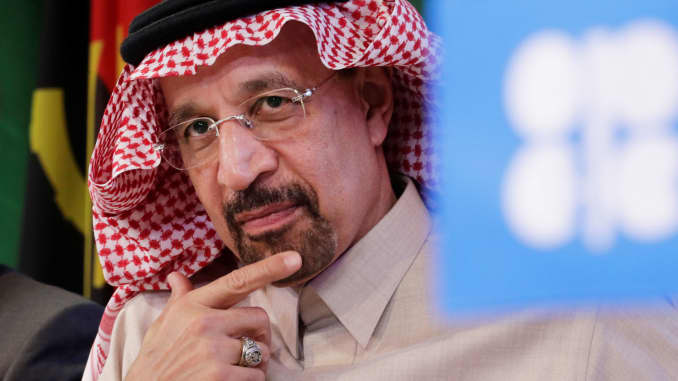
 Saudi Arabia's Oil Minister Khalid al-Falih listens during a news conference after an OPEC meeting in Vienna, Austria, November 30, 2017.

Saudi Arabia’s Oil Minister Khalid al-Falih listens during a news conference after an OPEC meeting in Vienna, Austria, November 30, 2017.
Heinz-Peter Bader | Reuters

https://oilprice.com/Latest-Energy-News/World-News/Saudi-Surprise-Cut-Continues-To-Lift-Oil-Prices.html 

Oil prices remained elevated and were still on the rise on Thursday, hitting an 11-month high, as the effects of Saudi Arabia’s surprise announcement about an additional million barrels of crude oil production cuts still has enough juice to withstand civil unrest in the United States and the global pandemic.

At 4:11 p.m. EST, the WTI benchmark was trading up 0.61% on the day at $50.94. The last time WTI traded above $50 per barrel was February. One week ago, the WTI benchmark closed at $48.52.

The Brent crude benchmark is now trading at $54.50, up 0.37% on the day. February was the last time the Brent benchmark sat above $54.

The oil market seems to be focusing more on what Saudi Arabia can do to rebalance oil’s supply and demand than on any political instability brewing in the United States. The oil markets also seem to be discounting the serious impact that new waves of lockdowns will have on the overall demand picture.

While oil prices did slip briefly on Wednesday as a group of President Trump supports stormed into the Capitol, it was unable to tamp down effects of Saudi Arabia’s gift that keeps on giving. The market is for now satiated.

Still, oil prices are multiple dollars per barrel lower than they were in the summer of 2019, and Brent is still trading $20 per barrel below what it was trading at in the summer of 2018 as the pandemic has stripped millions of barrels per day off of the demand side.

Not even swing producer Saudi Arabia has enough juice to offset that demand destruction. 

By Julianne Geiger for Oilprice.com

Thursday, January 7, 2021

Tankers set course for thick ice as part of experiment on Northern Sea Route

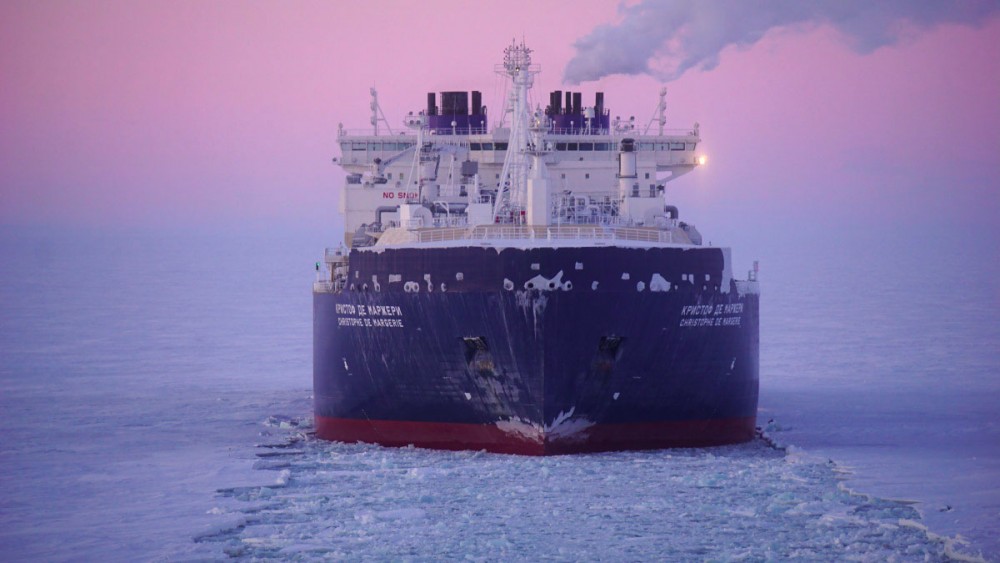
LNG carrier Christophe de Margerie in Arctic sea-ice. Photo: Novatek

https://thebarentsobserver.com/en/arctic-lng/2021/01/tankers-set-course-thick-ice-part-historical-experiment-northern-sea-route

As natural gas carrier Christophe de Margerie sails eastwards towards China, the Nikolay Zubov enters the Bering Strait in the opposite direction. It a first mid-winter operation of the kind, the two commercial ships will cross each others' paths in one of the most icy parts of the Arctic sea route.

It has been under planning for a long time, and repeatedly announced by Russian Arctic developers. On the 5th of January, the Christophe de Margerie set out from LNG terminal Sabetta with east-bound course for Chinese port Dalian. Eleven days earlier did the Nikolay Zubov leave Dalian with course for Sabetta.

While the former is expected to reach its destination in China on the 26th of January, the latter is due to arrive in Sabetta on the 16th of January.

Never before have two commercial ships conducted this kind of parallel voyages on the Northern Sea Route at this part of the year. None of the ships are accompanied by icebreakers.

The operations are part of a series on experimental shipments on the remote and icy shipping route. In July last year, Sergey Frank, board chairman of shipping company Sovcomflot, made clear that ice-class tankers will be sailing on the Northern Sea Route in January and February.

The experiments are conducted in cooperation with natural gas producer Novatek and nuclear power company Rosatom, Frank said. It is part of a bid to show that the route can be used also in winter time. According to ship operators, the NSR can soon be used for sailing up to 10 months of the year.

In May 2020, Sovcomflot sent its Christophe de Margerie across the route in a record-early voyage, more than a month earlier than the previous record.

Previously, voyages across the eastern part of the NSR in January were conducted in 2019 by Boris Sokolov, a condensate tanker, and Yamal LNG carrier Boris Davydov. The two ships sailed from east to west without icebreakers. In January 2018, LNG carrier Eduard Toll made the same voyage.

The natural gas tankers are part of a fleet of 15 vessels that serve the Yamal LNG project. They can carry up to 70,000 tons of liquified nature gas, and all have ice class Arc7, that enables them to autonomously break through up to 2,1 meters of sea ice.

The fleet of LNG carriers are instrumental in the major spike in shipping in the Russian Arctic. In 2020, more than 32 million tons of goods was shipped on the Northern Sea Route, up from 2019 when the volume amounted to 31,5 million tons.

The lion’s share of the goods is LNG.

By year 2024, the Kremlin intends to boost volumes on the NSR to 80 million tons and further to 130 million tons by 2035.

US Imports No Saudi Crude Oil for First Time in 35 Years

An oil pumping jack operates in Texas. (Matthew Busch/Bloomberg News)

An oil pumping jack operates in Texas. (Matthew Busch/Bloomberg News)

https://www.ttnews.com/articles/us-imports-no-saudi-crude-oil-first-time-35-years 

The U.S. didn’t import any Saudi crude the week of Dec. 28 for the first time in 35 years, a reversal from just months ago when the Kingdom threatened to upend the American energy industry by unleashing a tsunami of exports into a market decimated by the pandemic.

The absence of deliveries follows a slump in crude shipments to the U.S. that left the desert kingdom in October. Since tankers from Saudi Arabia take about six weeks to reach import terminals on either the west or Gulf coasts, the drop is only starting to show up now. This is the first week America had no deliveries based on available weekly data through June 2010 from the U.S. Energy Information Administration. A longer history of monthly figures shows this is the first time there were no Saudi imports since September 1985.

Earlier this year, the oil producing countries of the Organization of Petroleum Exporting Countries and 10 non-OPEC allies agreed to cut production by a record 9.7 million barrels a day after a brief production free-for-all that saw prices plunge. The supply cuts have helped shore up crude, even as fuel consumption struggles to return to pre-pandemic levels. In the past month, oil prices have risen on hopes that demand could improve as a number of vaccines have been announced to combat the health crisis.

But America is still in the throes of the pandemic, with record infections in many states forcing new restrictions, while other parts of the world are recovering. U.S. gasoline consumption plunged to the lowest in years during the usual high-demand Thanksgiving holiday period.

The demand loss is so acute some U.S. refineries have been idled. “Throughput is still below where it was before the crisis because of reduced domestic demand. So why send more here when Asia is where recovery has been clear,” said Sandy Fielden, director of oil and products research at Morningstar Inc.

For Saudi Arabia, cutting shipments to the U.S. is the quickest way to telegraph to the wider market that it’s tightening supply. The government is alone in publishing weekly data on crude stockpiles and imports, which carry enormous influence among oil traders. Other big petroleum consuming nations, like China, publish less timely information about oil supplies.

In May and June, Saudi deliveries to the U.S. more than doubled from a year ago. The onslaught prompted Senator Ted Cruz, a Texas Republican, to tweet in April: “My message to the Saudis: TURN THE TANKERS THE HELL AROUND.” American refiners received the final installment of that bumper load in early July.

Since then, Saudi oil shipments to the U.S. have steadily declined. Just two weeks ago, it delivered only 73,000 barrels a day to customers, preliminary U.S. Energy Information Administration data shows.

Still, Saudi Arabia won’t be giving up on supplying the U.S. anytime soon even during this pandemic. Tanker tracking data monitored by Bloomberg show shipments from the kingdom rising in November. Even so, after the first of those ships arrives off the west coast this week, there is a long gap until the next one is due.

“The Saudis will be mindful about not losing any more U.S. market share to other sellers not if they can help it,” said Morningstar’s Fielden. That’s why despite the low seasonal U.S. demand, the Saudis cut prices for January shipments to its American buyers, he added.

Arabian oil shipments to the U.S. have been declining for months.

In the short term, the election of Joe Biden could benefit Saudi Arabia. While transitioning away from hydrocarbons would have a long-term impact on oil demand, hopes to revive the 2015-Iranian nuclear deal would pave the way for more Iranian oil to flow globally. “Those sales will displace Saudi oil and that would mean Arabia would have to turn to the U.S. to maintain sales,” said Andy Lipow, president of Lipow Oil Associates in Houston.

Wednesday, January 6, 2021

End of Qatar blockade is ‘a win for the region,’ Saudi foreign minister says

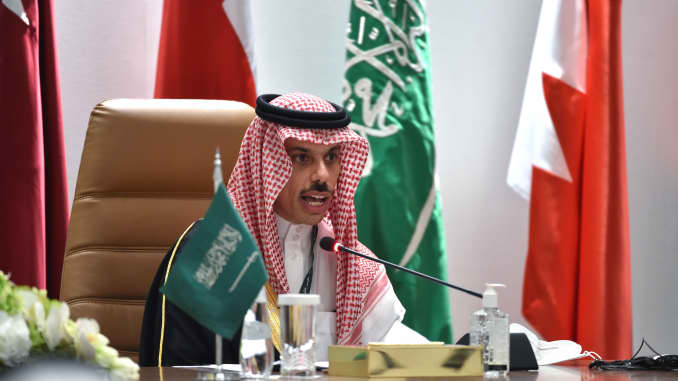
 Saudi Foreign Minister Faisal bin Farhan al-Saud holds a press conferece at the end of the 41st Gulf Cooperation Council (GCC) summit, in the city of al-Ula in northwestern Saudi Arabia on January 5, 2021.

Saudi Foreign Minister Faisal bin Farhan al-Saud holds a press conferece at the end of the 41st Gulf Cooperation Council (GCC) summit, in the city of al-Ula in northwestern Saudi Arabia on January 5, 2021.
Fayez Nureldine | AFP | Getty Images

https://www.cnbc.com/2021/01/06/end-of-qatar-blockade-is-a-win-for-the-region-saudi-foreign-minister.html 

  • The end of the Gulf dispute is a win for the region, Saudi Arabia’s foreign minister, Faisal bin Farhan al-Saud, told CNBC after announcing that relations between Qatar and four Arab countries have been fully restored.
  • The Al-Ula declaration resolves all of the outstanding issues that Qatar and other Arab nations had, said al-Saud.
  • Saudi Arabia, the UAE, Bahrain and Egypt in 2017 imposed a travel, trade and diplomatic blockade on Qatar, accusing it of supporting terrorism. Doha has denied these allegations.

Saudi Arabia on Monday opened its airspace, land and sea borders to Qatar. Saudi Crown Prince Mohammed bin Salman welcomed Qatar’s emir, Sheikh Tamim bin Hamad al-Thani, with a hug when the latter arrived on Saudi soil.

Al-Saud said he thinks the deal will be a “very, very strong basis” for regional stability going forward.

Asked if it was a win for the outgoing Trump administration, al-Saud said: “I think this agreement racks up a win for the region, first of all, a win for all of us.”

Still, he acknowledged support from the U.S. and Kuwait, which has been mediating between Saudi Arabia and Qatar. “Absolutely, President Trump and (White House senior advisor) Jared Kushner contributed to reaching this agreement, working very closely with Kuwait, who has been working on this for some time,” he told CNBC’s Hadley Gamble.

Not about Iran or Washington

Saudi Crown Prince Mohammed bin Salman said on Tuesday that GCC unity is needed to counter challenges in the region, “particularly the threats posed by the Iranian regime’s nuclear program,” according to Arab News.

Foreign minister al-Saud told CNBC the deal is for the good of the region’s security. “This agreement is not about Iran or about anyone else. It’s about bringing our countries together and making sure that we work together to deliver prosperity and security for our people.”

When asked if Saudi Arabia may be trying to get into President-elect Joe Biden’s good graces before the inauguration, he said: “This isn’t about Washington, it’s about the region and the priorities that our countries have.”

Biden is expected to roll back U.S. support for the kingdom when he takes office.

The Saudi foreign minister said the Gulf nations will cooperate on security issues as well as economic integration.

“We believe very strongly that the Al-Ula declaration resolves all of the outstanding issues and concerns that the countries’ parties would have had, and that it lays the basis for now a very strong, cooperative agenda for the GCC, and also for the region,” he said.

‘First step’

However, one diplomat called for caution.

Michael Greenwald, former U.S. Treasury attache to Qatar and Kuwait, said the agreement was just a “first step.”

“This is a political resolution,” he told CNBC’s “Capital Connection” on Wednesday. He said the opening of airspace is helpful ahead of the Qatar 2022 World Cup, and the nations want to “boost themselves economically” while preparing for a new U.S. administration.

But Greenwald, who is also a director at investment management firm Tiedemann Advisors, said more needs to be done. “There needs to be a much stronger, detailed framework put in place so that this does not happen again,” he said.

Tuesday, January 5, 2021

Saudi Arabia restores diplomatic ties with Qatar after three-year rift

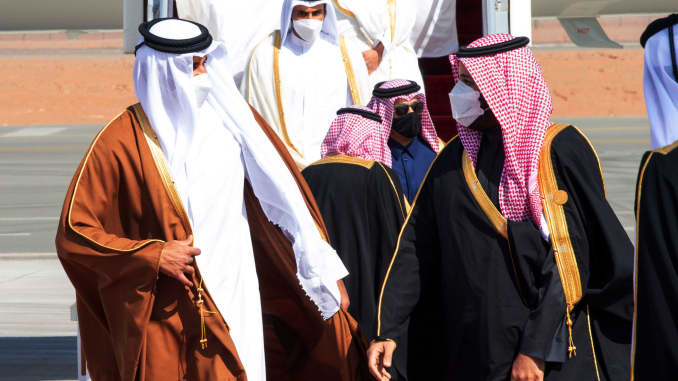
 Saudi Arabia's Crown Prince Mohammed bin Salman welcomes Qatar's Emir Sheikh Tamim bin Hamad al-Thani upon his arrival to attend the Gulf Cooperation Council's (GCC) 41st Summit in Al-Ula, Saudi Arabia January 5, 2021.

Saudi Arabia’s Crown Prince Mohammed bin Salman welcomes Qatar’s Emir Sheikh Tamim bin Hamad al-Thani upon his arrival to attend the Gulf Cooperation Council’s (GCC) 41st Summit in Al-Ula, Saudi Arabia January 5, 2021.
Bandar Algaloud | Reuters

https://www.cnbc.com/2021/01/05/saudi-arabia-restores-diplomatic-ties-with-qatar-after-three-year-rift.html 

  • Saudi Arabia reinstated diplomatic relations with Qatar on Tuesday, more than three years after Riyadh and several other Arab countries severed ties with Doha.
  • Kuwait, a mediator for both sides, announced that Saudi Arabia is reopening its airspace, sea and land borders with Qatar.
  • Saudi Arabia, the United Arab Emirates, Bahrain and Egypt had imposed a diplomatic, trade and travel blockade on Qatar, accusing it of supporting terrorism.

Saudi Arabia has reinstated diplomatic relations with Qatar, more than three years after Riyadh and several Arab countries severed ties with Doha.

Kuwait, a mediator for both sides, announced that Saudi Arabia is reopening its airspace, sea and land borders with Qatar.

Qatar’s emir, Sheikh Tamim bin Hamad al-Thani, arrived in Saudi Arabia on Tuesday for the first time since the dispute erupted in 2017. He was there to attend the annual Gulf Cooperation Council summit in the ancient city of Al-Ula.

Relations among the Arab nations soured in 2017, when Saudi Arabia and its allies — the United Arab Emirates, Bahrain and Egypt — imposed a diplomatic, trade and travel blockade on Qatar. They accused the tiny Gulf nation of supporting terrorism and of being too close to Iran, allegations that Doha has always denied.

The dispute plunged the region into a diplomatic crisis not seen since the 1991 war against Iraq, and exposed deep ideological differences in the region.

Qatar’s emir in 2018 said the dispute was a “futile crisis,” and that Qatar preserved its sovereignty despite “aggression” from its neighbors.

Saudi-owned media Al-Arabiya also reported on Tuesday that Egypt has agreed to reopen its airspace to Qatar.

Ahead of the summit, the UAE’s minister of state for foreign affairs, Anwar Gargash, said in a tweet the GCC meeting will restore Gulf cohesion. “There is still work to be done and we are in the right direction,” he said.

Restoring diplomatic ties between Saudi Arabia and Qatar is part of Washington’s latest effort to broker deals in the Middle East. In a diplomatic win for President Donald Trump, the UAE, Bahrain, Sudan and Morocco normalized relations with Israel in 2020.

Turkey’s ministry of foreign affairs on Monday welcomed the reopening of borders between Qatar and Saudi Arabia.

“It is our hope that a comprehensive and lasting solution to this conflict will be reached on the basis of mutual respect to sovereignty of all countries and that all other sanctions against the Qatari people will be lifted as soon as possible,” the ministry said in a press release.

— CNBC’s Ryan Browne and Mila Latoof contributed to this report.

Monday, January 4, 2021

Iran Completes Loading Operation of 6.3 Kilometers of Oil Terminal's Offshore Pipelines

The loading operation of 6.3 kilometers of the oil terminal”s offshore pipelines was completed from Khorramshahr industrial yard, stated the acting operator of Jask Oil Terminal development project in southern Iran.

With the highest effort of the executive team of this project, the pipelines of the first sea route leading to the single-point mooring (SPM) of Jask Terminal were loaded, stated Vahid Maleki.

Referring to this transnational project, which is being realized at the same time as the country’s oil industry is confronting the most unprecedented illegal sanctions submitted by the US, he indicates despite all the existing restrictions, the Oil Ministry is determined to put into operation the first phase of the country’s second crude oil export terminal on the Makran coast by the end of this year, with the collaboration of domestic companies.

https://tankterminals.com/news/iran-completes-loading-operation-of-6-3-kilometers-of-oil-terminals-offshore-pipelines/?utm_medium=email&utm_campaign=Newsletter%20Other%20-%20Week%2001&utm_content=Newsletter%20Other%20-%20Week%2001+CID_495a9368a08e6161a578007ab119f82f&utm_source=weekly&utm_term=Read%20more