https://www.theepochtimes.com/us/colorado-disqualifies-trump-from-appearing-on-primary-ballot-5547236
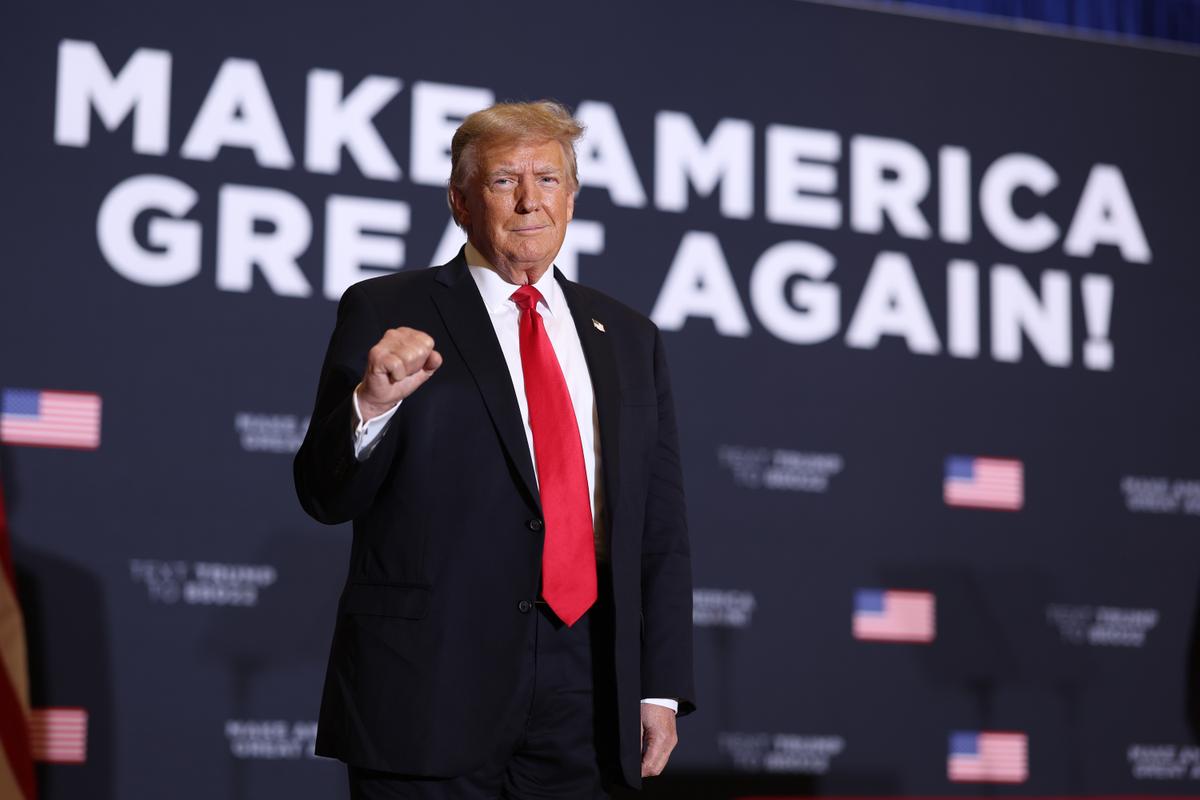
The Colorado Supreme Court ruled on Tuesday that former President Donald Trump is ineligible to appear on the state's primary ballot.
The
extraordinary 4-3 ruling makes Colorado the first and only state to
disqualify President Trump from appearing on a state primary ballot. The
decision revolved around an interpretation of the 14th Amendment, which
bars certain individuals from public office if they have engaged in an
"insurrection."
President Trump has announced he will appeal the decision and denounced it as a partisan attempt to block his White House bid.
The Colorado high court, composed of all Democrat appointees,
stayed its ruling until Jan. 4, 2024, "pending any review by the U.S.
Supreme Court."
If the Supreme Court agrees to review the issue by
Jan. 4, the Colorado Secretary of State will be required to continue to
include President Trump on the primary ballot. Otherwise, he will be
removed from the primary ballot.
"We conclude that because
President Trump is disqualified from holding the office of President
under Section Three, it would be a wrongful act under the Election Code
for the Secretary to list President Trump as a candidate on the
presidential primary ballot," reads the majority opinion.
"Therefore,
the Secretary may not list President Trump’s name on the 2024
presidential primary ballot, nor may she count any write-in votes cast
for him," the order added, as Colorado state law does not permit
write-in votes to be counted for ineligible candidates.
The ruling
reverses a lower court ruling that President Trump was eligible to
appear on the ballot because while he did "engage" in an "insurrection"
on Jan. 6, 2021, Section 3 of the 14th Amendment does not apply to
presidents. The Colorado Supreme Court was unpersuaded by both the lower
court and President Trump's arguments that Section 3 did not apply to
presidents.
"Section Three encompasses the office of the
Presidency and someone who has taken an oath as President. On this
point, the district court committed reversible error," the order reads.
'Uncharted Territory'
The
court affirmed the lower court decision in part, ruling that Congress
does not need to pass legislation in order to implement Section 3 of the
14th Amendment, and that it is self-executing, and not beyond the
jurisdiction of the courts.
As
such, "the district court did not abuse its discretion in admitting
portions of Congress’s January 6 Report into evidence at trial," nor err
in its ruling that the Jan. 6, 2021, events constituted an
"insurrection," the order added.
The Colorado Supreme Court ruled
that President Trump's speech on and before Jan. 6, 2021, "was not
protected by the First Amendment" because it was speech that was "likely
to incite such imminent lawlessness and violence."
The unsigned order acknowledged the gravity of the ruling.
"We do not reach these conclusions lightly. We are mindful of
the magnitude and weight of the questions now before us. We are
likewise mindful of our solemn duty to apply the law, without fear or
favor, and without being swayed by public reaction to the decisions that
the law mandates we reach," the order reads.
"We are also cognizant that we travel in uncharted territory, and that this case presents several issues of first impression."
Similar
challenges have been heard or are pending in half the states across the
nation, and state courts have thus far ruled that they do not have the
jurisdiction to interpret and apply Section 3 of the 14th Amendment for a
presidential primary.
President Trump's campaign called it a partisan ruling.
"Unsurprisingly,
the all-Democrat appointed Colorado Supreme Court has ruled against
President Trump, supporting a Soros-funded, left-wing group’s scheme to
interfere in an election on behalf of Crooked Joe Biden by removing
President Trump’s name from the ballot and eliminating the rights of
Colorado voters to vote for the candidate of their choice," the
statement reads.
"Democrat
Party leaders are in a state of paranoia over the growing, dominant
lead President Trump has amassed in the polls. They have lost faith in
the failed Biden presidency and are now doing everything they can to
stop the American voters from throwing them out of office next November.
"
The campaign reiterated President Trump's intention to appeal the ruling.
"The
Colorado Supreme Court issued a completely flawed decision tonight and
we will swiftly file an appeal to the United States Supreme Court and a
concurrent request for a stay of this deeply undemocratic decision,"
spokesperson Steven Cheung stated. "We have full confidence that the
U.S. Supreme Court will quickly rule in our favor and finally put an end
to these unAmerican lawsuits.”
President Trump legal spokeswoman
Alina Habba stated: “This ruling, issued by the Colorado Supreme Court,
attacks the very heart of this nation's democracy. It will not stand,
and we trust that the Supreme Court will reverse this unconstitutional
order."
Dissenting Opinions
The
200-plus page opinion included dissenting opinions by Chief Justice
Brian D. Boatright, Justice Carlos A. Samour, Jr., and Justice Maria E.
Berkenkotter, who largely echoed the jurisdictional concerns other state
courts have raised.
Justice Boatright agreed with the majority
opinion that the Colorado election code allows for adjudication of a
candidate's qualifications, but opined that a Section 3 disqualification
was too far beyond the scope of what that law allows. He wrote that the
nature of the petition brought before the court and the statutes it
cited were "incompatible."
"Simply put, section 1-1-113 was not
enacted to decide whether a candidate engaged in insurrection," he
wrote. "In my view, this cause of action should have been dismissed."
Justice
Samour was unconvinced that Section 3 is self-executing, noting that
Colorado's election law differs from that of every other state, and
"they won't be able to enforce Section 3" as Colorado has with the
court's new ruling.
"That, in turn, will inevitably lead to the
disqualification of President Trump from the presidential primary ballot
in less than all fifty states, thereby risking chaos in our country,"
he wrote. "This can’t possibly be the outcome the framers intended."
He
added that Section 3 does not spell out how it should be executed,
"that is, it sheds no light on whether a jury must be empaneled or a
bench trial will suffice, the proper burdens of proof and standards of
review, the application of discovery and evidentiary rules, or even
whether civil or criminal proceedings are contemplated."
He was
concerned procedural due process could not be upheld with one state
barring the current leading Republican presidential candidate from the
ballot. Justice Samour added that he would have upheld the district
court's decision, but "on other grounds."
"My colleagues in the
majority turn Section Three on its head and hold that it licenses states
to supersede the federal government. Respectfully, they have it
backwards," he wrote.
Justice Berkenkotter disagreed that the
state's election laws authorize state courts to decide a candidate's
eligibility to appear on a presidential primary ballot, under Section 3
of the 14th Amendment.
She opined that the state legislature has
not conferred courts this power, and therefore the district court erred
in issuing its ruling as well.
Justice Berkenkotter pointed to the court deadlines the election code sets as evidence.
"Three
days to appeal a district court’s order regarding a challenge to a
candidate’s age? Sure," she wrote. "But a challenge to whether a former
President engaged in insurrection by inciting a mob to breach the
Capitol and prevent the peaceful transfer of power? I am not convinced
this is what the General Assembly had in mind." She wrote that the
district court should have dismissed the case.
Overturned Ruling
Colorado
District Court Judge Sarah Wallace had issued the ruling after a
weeklong trial that covered everything from whether the events of
January 6 constituted an insurrection to the application of Section 3 of
the 14th Amendment. It was an unusual move for a state court, and has
to date been the only court that has held a trial for 14th Amendment
challenges to President Trump's eligibility as a candidate for the
presidency.
The 14th Amendment, ratified after the Civil War,
included a third section meant to prevent officers who left their posts
to join the Confederacy from returning to their positions in the
government, unless Congress deemed them eligible with a two-thirds vote.
It has seldom been applied in the post-war era, and scholars have been
vocal in their disagreement over its application since a legal theory
that this could disqualify President Trump from taking office gained
traction.
After the lower court issued its decision, both the petitioners and the intervenors filed to appeal.
The activists argued that the lower court erred in ruling that Section 3 of the 14th Amendment does not apply to presidents.
President Trump argued the lower court erred in issuing
rulings regarding the application of Section 3 of the 14th Amendment
because state courts have no such jurisdiction.
During an earlier hearing, the Colorado Supreme Court mainly heard oral arguments on the issue of jurisdiction.