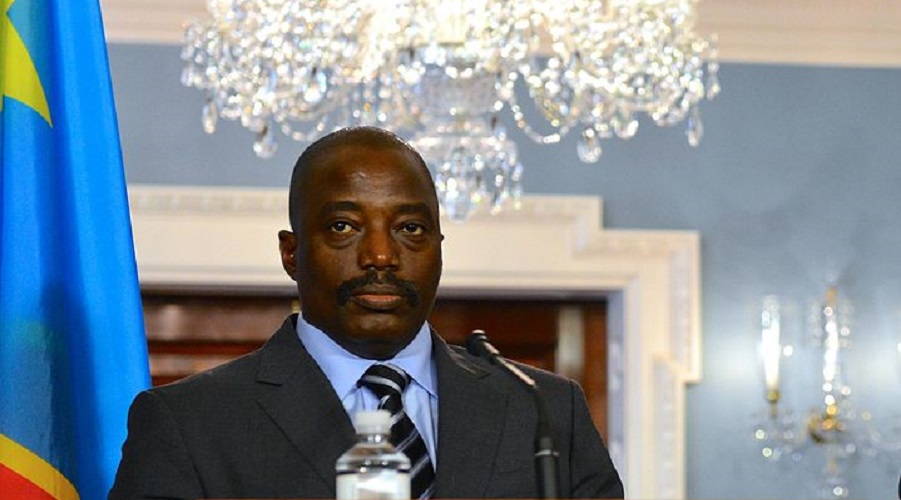
Former DRC President Joseph Kabila. Photo by the US Department of State, Wikimedia Commons.
https://www.mining.com/web/china-built-congo-a-toll-road-that-led-straight-to-the-ruling-family/?utm_source=Daily_Digest&utm_medium=email&utm_campaign=MNG-DIGESTS&utm_content=china-built-congo-a-toll-road-that-led-straight-to-the-ruling-family
For 250 hot and dusty miles, the
two-lane highway cuts through central Africa, its path lined with the
carcasses of trucks, buses, and minivans. But this modest road holds
outsize value for global markets, connecting some of the continent’s
richest mines to the rest of the world—most notably, China.
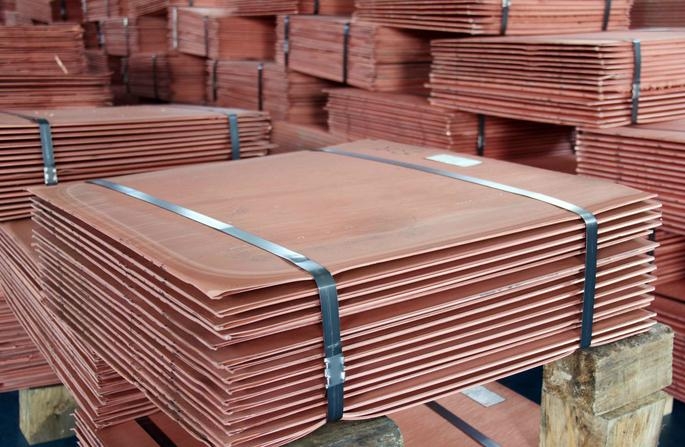
Along this route, thousands of flatbed trucks haul sheets of copper
and sacks of cobalt hydroxide, essential for electric cars and other
21st century technologies. Their drivers must pay steep tolls, as much
as $900 for a round trip.
Sign Up for the Battery Metals Digest
And for almost a decade, records indicate, a cut of those tolls
flowed to the family of one politician: Joseph Kabila, the former
president of the Democratic Republic of Congo.
The toll payments illustrate how Kabila blurred the lines between
state and private business, documents reviewed by Bloomberg News
suggest. By striking such deals with his regime, Chinese companies over
the past 15 years came to dominate Congo’s mining industry, down to the
roads the country’s minerals travel for export.
The relationship with Kabila has been of strategic benefit to China
in its economic rivalry with the U.S. And it has helped Congo, a nation
of 105 million, become Africa’s largest producer of copper and the
world’s biggest source of cobalt. Yet, as on much of the continent, a
foreign power and a country’s elite, not the general population, have
reaped the benefits of natural resources.
Like seams of cobalt, business arrangements around the toll road have
long been buried. The trail begins with the company Kabila’s government
contracted to rebuild and maintain the highway: state-controlled China
Railway Group Ltd., one of the largest construction companies in the
world.
Someone needed to collect the tolls that would pay for the roadwork,
and there the former president’s family saw an opportunity to cash in.
Two management companies, one of which was co-founded by a Kabila family
investment firm, have misappropriated $238 million since 2015, allege a
pair of audits by Congo’s top anticorruption official seen by
Bloomberg. China Railway didn’t respond to emails and phone calls
seeking comment. Nor did Kabila or his family. In an email, the Chinese
embassy in Kinshasa, Congo’s capital, said its government always asks
Chinese companies to respect local laws and regulations and to “never
interfere in Congolese political affairs.”
The Kabilas’ involvement in the toll road came to light through the
biggest leak ever of financial documents from Africa. A consortium of
five nongovernmental organizations and 19 media outlets, including
Bloomberg, gained access to bank records obtained by the Paris-based
Platform to Protect Whistleblowers in Africa and the French news
organization Mediapart.
The resulting articles and reports—published under the name “Congo
Hold-Up”—demonstrate the extent to which the country’s most powerful
family used the Congo unit of Gabon-based Groupe BGFIBank SA to serve
its private interests during a period in which at least $138 million in
state funds passed through the lender to Kabila’s family and associates.
They also show how Chinese companies transferred tens of millions of
dollars to the same network. In December, Kabila’s lawyers denied
wrongdoing and called the reporting “a campaign of defamation,
slanderous denunciations, denigrations, and untruths.”
At the center of many of the toll-road transactions, the
investigation found, is a 59-year-old Chinese businessman, Cong Maohuai,
who arrived in Congo a quarter of a century ago and built an array of
companies with a hand in the country’s most lucrative industries:
infrastructure and the mining of gold, cobalt, copper, tin, and lithium.
Cong also owns the five-star Fleuve Congo Hotel in Kinshasa.
Twenty-two stories tall, the glassy building overlooks the compounds of
foreign embassies and the homes of many of the country’s richest people,
including Kabila, whose main residence in the city is only a few blocks
away. Cong, who works out of an office on the hotel grounds, served as
president of the Chinese Chamber of Commerce in Congo’s copper and
cobalt region from 2008 until 2015, when he became president of the
Congo Overseas Chinese Association. He denies any impropriety and says
he isn’t a middleman for either Kabila or the Chinese government.
The businessman controls the companies that collect tolls on the
mineral highway, one of which he says he acquired from the Kabila family
investment firm. Some of this revenue, bank records show, flowed to a
company that was used to direct funds to the former president’s
relatives and entourage. Although sometimes described in the media as an
adviser to the former president, Cong denies any connection to Kabila,
beyond occasional meetings at public events.
“Just like any other businessperson in the world, I am free to pursue
business opportunities in the DRC or anywhere else in the world, so
long as I carry out my activities in compliance with the governing
laws,” Cong told the consortium. “That has always been my practice.”
Outside powers have a long history of coveting Congo’s natural
resources. It began under Belgian colonial rule and continued during the
country’s tumultuous post-independence period, when Congo was caught
between sides in the Cold War.
Increased scrutiny of Congo’s mining industry comes after a pivotal
moment. Kabila, a former military commander who’d trained in China,
assumed power from his father, who was assassinated in 2001. In 2019,
Felix Tshisekedi succeeded him as president after the two men made a
deal to resolve a disputed election in which another candidate almost
certainly won the vote.
Tshisekedi, the son of a well-known opposition politician, initially
governed Congo in coalition with Kabila, but he’s since sidelined or
co-opted those loyal to his predecessor. Now his administration is
revisiting contracts with Chinese and other foreign companies negotiated
under Kabila that it views as skewed against the Congolese people.
In the early 2000s, as Congo emerged from years of civil war, China
seized an opportunity to buy mines, a process that’s accelerated in
recent years. In 2008 the countries agreed that Chinese companies would
finance $3 billion worth of infrastructure and build a $3.2 billion
copper and cobalt project known as Sicomines, whose tax-free profits
would repay the investments.
China Railway teamed up with state-owned Power Construction Corp. of
China Ltd., also known as PowerChina. Both companies are major players
in President Xi Jinping’s “Belt and Road” initiative, which makes
investments in infrastructure around the world, partly as a way to
project the country’s growing economic power. PowerChina didn’t respond
to requests for comment.
That same year, Congo separately awarded a subsidiary of China
Railway the first of three no-bid contracts to rebuild its main export
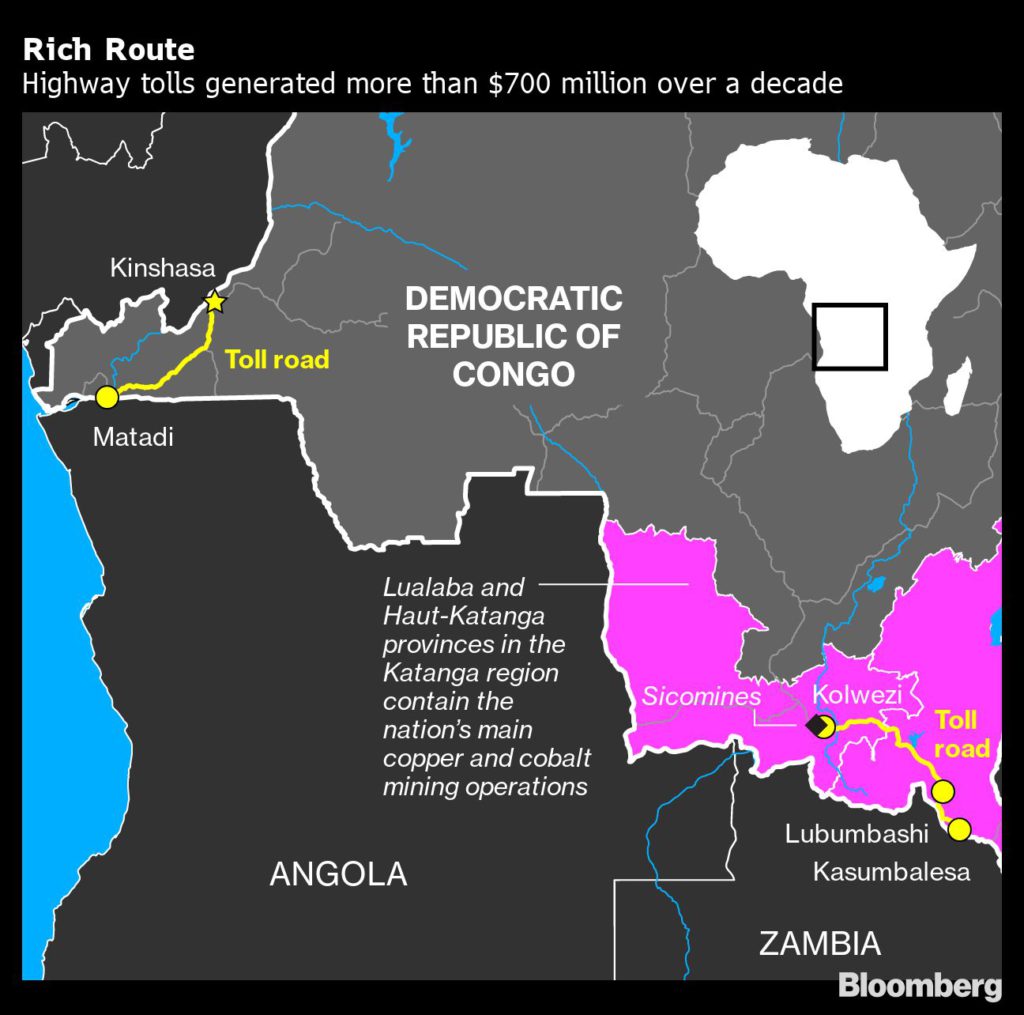
and import routes—including the key mining highway, which runs from
Kolwezi to the Zambian border. Tolls would pay for the roadwork.
The highways were in desperate need of an upgrade, and China Railway
was on the ground and ready. The roads led to riches. Copper and cobalt
exports increased more than 50-fold under Kabila, with about 1.3 million
tons of metal trucked out of Congo in 2018, his final year in power.
Much of the highway goes by the grand name of National Road 1. In a
country with one of the world’s worst road networks, it stands out for a
simple reason: It’s paved. Still, there are few streetlights, and
accidents are common. Pedestrians and cyclists share the route,
transporting food and other goods to Kolwezi, Likasi, and
Lubumbashi—cities along the way founded by Belgian colonists near
Congo’s biggest mines.
The road runs past dozens of communities that have mostly missed out
on the rewards of Congo’s multibillion-dollar mining industry. Makeshift
shacks with orange tarpaulin roofs—the same plastic sheets used to keep
hand-dug tunnels from collapsing in the rain—signal the homes of
Congolese leading migratory lives on the economic fringes of one of the
world’s poorest countries, where three-quarters of the population
subsists on less than $1.90 a day, the international poverty line.
Judith Kasongo works as a cook and cleaner in Kanyaka, a village
along the toll road. She has no clean water to wash her food. “It’s
beyond understanding, and as a Congolese it hurts to see all this wealth
go outside the country, as we remain in poverty,” says Kasongo, 31. “We
see our minerals developing other countries, while in Congo we don’t
have enough roads and face so many difficulties.”
In pictures posted on his Twitter feed, Jules Alingete Key looks more
like a general than an auditor. He’s often scowling, and he sometimes
wears a uniform the sky-blue color of Congo’s flag, accented with
epaulets and gold buttons. Alingete is President Tshisekedi’s inspector
general of finance, or, as one Congolese magazine described him, “the
sheriff of finance and the public good.” He has become an anticorruption
crusader, launching investigations into politicians and businessmen who
were untouchable under Kabila. He says he faces constant threats from
his targets.
As part of his investigations, Alingete has dug into who really
profited from Congo’s most important roads. They were supposed to
benefit the country as a whole. There would be at least $1.1 billion
worth of new and refurbished toll roads: two connected segments in the
Katanga region and another from Kinshasa to the country’s main port of
Matadi.
Instead, a large portion of the $757 million in tolls collected on
the mining route from 2010 through 2020 vanished, according to the
inspector general’s office. On one leg of the highway, in a
five-and-a-half-year period starting in 2015, maintenance spending
amounted to only $50 million, less than one-fifth of what was generated
in tolls during that time, his auditors found. The inspector general’s
conclusion: Hundreds of millions of dollars have been lost to
overbilling and embezzlement. “On the ground, these funds were not used
for roads,” the agency told the consortium, describing a “mechanism of
overcharging.”
Alingete identified the culprits: the two toll operators, which were
entitled to keep only 10% of the fees collected. One, a company called
Société de Gestion Routière du Congo, or SGR, misappropriated $121
million from April 2015 through 2020, according to an audit report seen
by the consortium and verified by Alingete.
The Kabilas have a long association with SGR. So does Cong, the
Chinese businessman. China Railway initially owned SGR in a joint
venture with the Kabila family investment firm, which took full control
in April 2015, records show. Yet, 10 days before that ownership change,
Cong had represented the company in renewing its toll concession with
the Congolese government. He says that SGR’s absent legal
representative, who was a senior China Railway manager, had authorized
him to sign the contract.
Cong says he acquired SGR in November 2016, though Congo’s corporate
registry didn’t reflect the transfer until this year, after the
consortium sent him questions. He said he paid the Kabilas no money and
instead assumed an undisclosed amount of debt that the presidential
family’s company owed China Railway. Cong didn’t provide any
documentation for the transaction or the debt.
In that same five-and-a-half-year period, $117 million disappeared
from the road’s other toll operator, Société de Gestion de Péage au
Congo, or Sopeco, Alingete’s auditors found in a separate report. Cong
owns that company, too. The audits don’t cover what happened before
2015, though most of the funds intended for roadwork also “went up in
smoke” in the preceding years, the inspector general’s office found.
Like SGR, Sopeco has ties to the Kabilas. From 2013 through January
2016, the two toll operators made 44 payments worth a total of $10.4
million to a company called Congo Construction Co., which delivered more
than $30 million to people and entities directly linked to the Kabilas,
Bloomberg reported in November. Almost all the money from the toll-road
businesses was withdrawn from BGFI in cash, documents show.
“These payments created clear conflicts of interest and serious risks
of fraud and bribery,” according to a report by the Sentry, a
Washington-based anticorruption group that was part of the “Congo
Hold-Up” consortium.
BGFI’s Congo unit was itself a Kabila family business: The former
president’s brother was its chief executive officer, and his sister
owned 40% of the bank until 2018, when both were forced out amid
accumulating scandals resulting from an earlier data leak by a
whistleblower. Before her shares were reclaimed by BGFI’s Gabonese
headquarters, Kabila’s sister drew up an abortive plan to sell her stake
to three new shareholders, including Cong, who would have paid $2.9
million for a 7.5% interest, bank records show. Cong said he wasn’t
aware of such a proposal. In a statement after publication of the
first “Congo Hold-Up” stories, the bank acknowledged past governance
problems at its Congo branch but questioned the authenticity of the
leaked documents.
The consortium found no indications that the Kabila-linked company,
Congo Construction, or CCC, did any construction work. Cong said two
Sopeco transfers to CCC’s account at BGFI were for a loan agreement and a
gravel supply deal, but he didn’t know why SGR sent almost $8 million
to the company, because the payments occurred before he took over the
business. Cong has other connections to CCC, which was owned by another
Chinese businessman. His hotel and the company share the same address.
In an email, a bank official described CCC and the Fleuve Congo Hotel
“as sister companies housed in the same building.”
Bloomberg couldn’t verify all the figures from the government
reports, and Alingete didn’t respond to multiple requests for the
complete audit documents. In emails to the consortium, Cong denied the
inspector general’s allegations, saying he’d provided documentation
showing all the money was spent appropriately, and he considers the
matter closed.
L’Agence Congolaise des Grands Travaux, the government agency that
oversees most of Congo’s biggest infrastructure projects, including toll
roads, told the consortium it isn’t aware that either toll-road company
engaged “in any cases of corruption or other improprieties.” But,
according to the audit reports, Alingete has urged the government to
cancel the contracts held by Sopeco and SGR and replace them with “a
much more responsible partner.”
In the waning days of the Kabila administration, Cong won extensions
on his concessions to collect tolls on the mineral highway. The bounty
would continue into 2025 for one stretch of road and to 2043 on the
other, the audits reveal. The companies also signed contracts for tolls
and roadwork on two other mineral supply routes that could amount to
half a billion dollars.
Alingete’s investigation could threaten Cong’s franchise. But for
now, his contracts survive, and business has never been better. Congo’s
mining ministry reported last year that copper exports were on track to
break all records.
(By William Clowes and Michael Kavanagh)