Wednesday, September 5, 2018

Oil demand to hit 100 mln bpd sooner than projected: OPEC's Barkindo

 
 Mohammad Sanusi Barkindo, Secretary General, Organisation of Petroleum Exporting Countries, OPEC


CAPE TOWN (Reuters) - World oil consumption will reach 100 million barrels per day (bpd) later this year, hitting that level much sooner than previously forecast, OPEC’s secretary-general said on Wednesday.

Mohammad Barkindo also told an energy conference in South Africa’s Cape Town that a stable environment was needed to encourage oil industry investment to meet the rising demand.
“The world will attain the 100 million barrels a day mark of consumption later this year, much sooner than we all earlier projected. Therefore stabilizing forces which create conditions conducive to attracting investments are essential,” he said. 

“The priority ... is on ensuring stability is sustainable, spreading confidence in the industry and encouraging an environment conducive to the return of investments,” he added. 

The Organization of the Petroleum Exporting Countries with Russia and other producers have implemented a deal since January 2017 on cutting 1.8 million bpd from output to prop up prices that fell below $30 a barrel in 2016 from over $100 in 2014. 

On Wednesday, benchmark Brent LCOc1 was trading at just below $78. 

Barkindo said oil industry confidence was returning and OPEC was exploring ways of institutionalizing cooperation between OPEC and its non-OPEC allies on their production levels.
Barkindo also told reporters at the conference that global trade disputes could hurt energy demand in future, although he said he was hopeful the uncertainty would lift soon. 

U.S. President Donald Trump’s tariff threats against China, the world’s second-biggest economic power, have caused jitters in markets across the world. 

“The trade disputes that are emerging among some of the leading partners in the world will eventually hurt (global economic) growth and, by extension, demand for energy,” he said. 

“But we are confident ... these parties will be able to overcome some of these challenges,” Barkindo said. “We are hopeful we will be able to overcome this cloud of uncertainty regarding trade as quickly as we can in order to mitigate the contagion.” 

Writing by Alexander Winning and James Macharia; Editing by Edmund Blair

Tuesday, September 4, 2018

What is Saudi Aramco? | CNBC Explains

With pipelines full, oil and gas companies turning to trucks, rail

https://blogger.googleusercontent.com/img/b/R29vZ2xl/AVvXsEg511m5CtXJU_E3Fwj6bs68pFsLc5MLS1bjI6PndZ-IAAsqHkOdmNNDw2WGlnT6EXZneb7hlZwA2MGAv79LIreh8cAwr8HC663IKvcosNem98zRzqfjJF9FpC3rcheVh-nte7Tl2WuParcu/s1600/ethanol+transloading.png


Oil producers in the Permian Basin, dealing with a shortage of pipelines, are increasingly turning to trucks and rail to ship the flood of crude from the West Texas oil field to refineries and export terminals on the Gulf Coast.

These transportation shifts are driven by two simple math problems. First, crude oil production in the Permian has reached 3.6 million barrels a day, while pipeline capacity out of the region is just 3.5 million barrels a day, according to the energy research firm Wood Mackenzie. Next, crude is selling for as much as $10 more a barrel in South Texas, the Gulf Coast and other markets outside of West Texas, where inventories are building in part because of the lack of pipeline capacity

The latest effort to move oil to more lucrative markets was launched earlier this week, when the Houston oil transport company JupiterMLP signed a deal with Vista Proppants and Logistics of Fort Worth to ship West Texas crude by rail from Vista’s loading terminal in Pecos. Vista plans to ship about 400,000 barrels a month from its Pecos terminal through 2019 and potentially into 2020, depending on when pipeline projects are completed.

It’s unclear how much of crude Vista will handle for JupiterMLP, which has completed permitting to build a processing and export terminal at the Port of Brownsville and plans a 670-mile pipeline from West Texas to the export terminal. Neither company responded to requests for comment.

Pipeline capacity has become a particular problem in the Permian, as booming production of both crude and natural gas has exceeded capacity and created bottlenecks. Several companies, including Kinder Morgan and Phillips 66 Partners, both of Houston, are racing to complete pipeline projects, but most are not expected to begin operations until at least next year.

The bottlenecks, meanwhile, are not only having an impact on prices in West Texas prices, but also production. The Railroad Commission of Texas, which oversees the oil and gas industry, recently reported that oil production in the state — most of it concentrated in the Permian — declined about 2 percent in June, compared to the same month a year earlier, the first year-over-year decline since early 2017. Analysts attributed the decrease to the pipeline shortage.
A recent analysis by the London consultancy Westwood Global Energy Group estimated that pipeline constraints could delay as much as $1.4 billion of investment in the Permian and keep 345 wells from getting completed in the second half of this year. That means the wells have been drilled, but not hydraulically fractured, or fracked, to begin producing oil and gas.

The number of these drilled but uncompleted wells, known as DUCs, have increased significantly in the Permian. The Department of Energy estimated 3,470 DUC wells in the Permian in July, up 80 percent from just over 1,900 a year earlier.

Production companies big and small are contracting for pipeline capacity on yet-to-be completed and cutting deals with trucking companies and rail carriers to get their crude out of West Texas to other markets in the meantime. Union Pacific Railroad, one of the largest rail operators in the country, has seen a recent uptick in crude oil coming out of the Permian, said company spokesman Jeff DeGraff, though he wouldn’t cite specific figures.

Oil companies have also turned to the trucking industry to transport their crude, potentially adding more stress on an industry that is already under pressure from driver shortages and the demands of hauling record amounts of sand and water for fracking and moving drilling rigs and equipment from one site to another.

Matt Nevarez, the director of operations for the Midland trucking company TexStar Crude Transport in Midland, said demand for shipping crude is so strong that his company is hiring trucks out of San Antonio to carry oil from West Texas to South Texas markets in Three Rivers, Cotulla, and Victoria. When asked which companies were moving oil by truck, Nevarez said, “All of them.”

“The market spread for what they can sell a barrel for in South Texas versus Midland, it’s huge, so everybody’s wanting to get their oil down there,” Nevarez said.

But environmentalists worry that all of these extra trucks on the road carrying crude oil and trains going through populated areas could pose a public health risk. Luke Metzger, the director of the advocacy group Environment Texas, pointed to the oil train accident and explosions in the Canadian town of Lac-Mégantic that killed more than 40 people when a train full of North Dakota crude oil derailed in the middle of town and exploded.

Metzger said he doesn’t believe that many people in the state are aware of dangers posed by increased shipments of crude by truck and rail.

“That’s unfortunate because these could be very dangerous and people need to know that this could be going to a neighborhood near them soon,” Metzger said.

Relief may be coming in the form of what John Coleman, a senior research analyst at Wood Mackenzie calls three mega pipeline projects. Totaling 2.1 million barrels of capacity, they are the EPIC Crude Oil Pipeline, the Gray Oak Pipeline, and the Cactus 2 Pipeline. All aim to be completed by the end of 2019.

rdruzin@express-news.net | Twitter: @druz_journo

Sunday, September 2, 2018

Saudi Arabia hints at plan to turn Qatar into an island

 
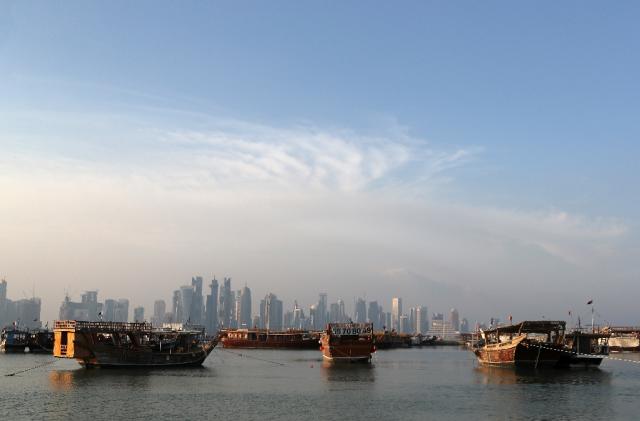
The Saudi plan, which would physically separate the Qatari peninsula from the Saudi mainland, is the latest stress point in a highly fractious 14-month long dispute between the two states (AFP Photo/KARIM JAAFAR) 


Riyadh (AFP) - A Saudi official hinted Friday the kingdom was moving forward with a plan to dig a canal that would turn the neighbouring Qatari peninsula into an island, amid a diplomatic feud between the Gulf nations.

"I am impatiently waiting for details on the implementation of the Salwa island project, a great, historic project that will change the geography of the region," Saud al-Qahtani, a senior adviser to Crown Prince Mohammed bin Salman, said on Twitter.

The plan, which would physically separate the Qatari peninsula from the Saudi mainland, is the latest stress point in a highly fractious 14-month long dispute between the two states.

Saudi Arabia, the United Arab Emirates, Bahrain and Egypt cut diplomatic and trade ties with Qatar in June 2017, accusing it of supporting terrorism and being too close to Riyadh's archrival, Iran -- charges Doha denies.

In April, the pro-government Sabq news website reported government plans to build a channel -– 60 kilometres (38 miles) long and 200 metres wide –- stretching across the kingdom's border with Qatar.
Part of the canal, which would cost up to 2.8 billion riyals ($750 million), would be reserved for a planned nuclear waste facility, it said.

Five unnamed companies that specialise in digging canals had been invited to bid for the project and the winner will be announced in September, Makkah newspaper reported in June.

Saudi authorities did not respond to requests for comment and there was no immediate reaction on the plan from Qatar.

After the dispute erupted last year, Qatar -- a small peninsula nation -- found its only land border closed, its state-owned airline barred from using its neighbours' airspace, and Qatari residents expelled from the boycotting countries.

Mediation efforts led by Kuwait and the US, which has its largest Middle East air base in Qatar, have so far failed to resolve the dispute.

Friday, August 31, 2018

OPEC August oil output hits 2018 high despite Iran losses: Reuters survey

A gas flare on an oil production platform is seen alongside an Iranian flag in the Gulf July 25, 2005.
A gas flare on an oil production platform is seen alongside an Iranian flag in the Gulf July 25, 2005. | Photo: Reuters


LONDON (Reuters) - OPEC oil output has risen this month to a 2018 high as Libyan production recovered and Iraq’s southern exports hit a record, a Reuters survey found, although a cut in Iranian shipments due to U.S. sanctions limited the increase.

The 15-member Organization of the Petroleum Exporting Countries has pumped 32.79 million barrels per day in August, the survey on Friday found, up 220,000 bpd from July’s revised level and the highest this year. 

OPEC and allies agreed in June to boost supply as U.S. President Donald Trump urged producers to offset losses caused by the renewed sanctions on Iran and to dampen prices, which this year hit $80 a barrel for the first time since 2014. 

In June, OPEC, Russia and other non-members agreed to return to 100 percent compliance with oil output cuts that began in January 2017, after months of underproduction in Venezuela and elsewhere pushed adherence above 160 percent. 

Top exporter Saudi Arabia, which promised a “measurable” boost in its own output, said the decision would translate into an output rise of about 1 million bpd. 

Even so, OPEC’s adherence with supply targets has actually risen to 120 percent in August from a revised 117 percent in July, the survey found, because extra barrels from Saudi and others did not fully offset losses in Iran and declining output in Venezuela and Angola.

LIBYA, IRAQ

The biggest increase in supplies this month has come from Libya, whose output remains volatile due to unrest. 

Production at the Sharara oilfield, the country’s largest, increased after the restart of a control station that had been closed due to the kidnapping of two workers, and other fields also pumped more. 

The second-largest increase came from Iraq, where southern exports reached a record high. Shipments also increased from the north, leaving Iraq as OPEC’s least compliant member in August according to the survey. 

Saudi Arabia, after a big increase in June output, apparently backtracked on plans for a further boost in July and cut supply last month to 10.40 million bpd. Supply has edged up to 10.48 million bpd in August, the survey found, still lower than June’s 10.60 million bpd. 

Supply in Nigeria, which like Libya is exempt from the OPEC supply cut pact because its output is often curbed by unplanned outages due to unrest and conflict, rose by 30,000 bpd.

Kuwait and the United Arab Emirates, after raising output in July following the OPEC deal, kept supply steady in August, the survey found. 

Among countries with lower output, the biggest drop of 150,000 bpd was in Iran. Exports fell as returning U.S. sanctions discouraged companies from buying the country’s oil. 

Production also slipped in Venezuela, where the oil industry is starved of funds because of economic crisis, and in Angola due to natural decline at oilfields. 

Despite these decreases, OPEC output in August has risen to the highest since September 2017 according to Reuters surveys. This partly reflects the addition of Congo Republic to OPEC in June, not just increases by existing members. 

Before Congo joined, OPEC had an implied production target for 2018 of 32.78 million bpd, based on cutbacks detailed in late 2016 and Nigeria and Libya’s expectations of 2018 output. 

According to the survey, OPEC excluding Congo pumped about 310,000 bpd below this implied target in August. 

The survey aims to track supply to market and is based on shipping data provided by external sources, Thomson Reuters flows data and information provided by sources at oil companies, OPEC and consulting firms. 

Additional reporting by Rania El Gamal; editing by David Evans and Jason Neely

Thursday, August 30, 2018

OPEC to discuss compensating for Iranian supply drop after U.S. sanctions: Iraqi official

The logo of the of the Organization of the Petroleum Exporting Countries (OPEC) is displayed.
Joe Klamar | AFP | Getty Images
The logo of the of the Organization of the Petroleum Exporting Countries (OPEC) is displayed.


BAGHDAD (Reuters) - OPEC will discuss in December whether producers can compensate for a sudden drop in Iranian oil supply after U.S sanctions against Tehran start in November, the head of Iraq’s state-oil marketer SOMO, Alaa al-Yasiri, told Reuters on Wednesday. 

Yasiri said a sudden drop in Iran oil exports will have a negative impact on prices and market fundamentals. 

“A sudden drop in Iranian crude shipments from the market will cause big shortages and a negative impact on oil prices,” he said, referring to a possible increase in prices. 

“It’s very difficult to predict what’s going to happen in next OPEC meeting but producers must find ways to make up for Iranian crude that the market will lose.” 

“The major issue during next OPEC meeting will be are producers really ready to pump more oil to compensate Iran’s share,” he added. 

Iraq has resumed crude shipments to Iran from its Kirkuk oil fields following a few days stoppage due to logistical issues, he said, adding that so far Iraq had only shipped 500,000 barrels and hopes to ship a total of 1 million before the November U.S. sanctions against Iran kick in. 

SOMO is studying a request from Jordan to resume crude supplies of 10,000 to 15,000 barrels per day via trucks, Yasiri said, and the Jordanian energy minister is expected to visit Baghdad to finalize the deal. 

Iraq’s August crude oil exports are nearing 3.595 million barrels per day, the SOMO chief said. 

Reporting by Ahmed Rasheed; Writing by Ahmed Aboulenein; Editing by Kirsten Donovan and Jane Merriman