Wednesday, April 3, 2024

Bitcoin Price Plummets As US Government Transfers $2B In Seized Silk Road BTC, Coincidence?

 Bitcoin price

https://www.newsbtc.com/bitcoin-news/bitcoin-price-plummets-as-us-government-transfers-2b-in-seized-silk-road-btc-coincidence/amp/ 

The crypto market is abuzz with speculation as the US government recently moved significantly regarding seized Bitcoin (BTC) linked to the infamous Silk Road dark web marketplace. This development comes at a critical time for the Bitcoin price, which has struggled to maintain its position above the $70,000 threshold after hitting its current all-time high (ATH) of $73,700 on March 14. 

As the largest cryptocurrency experiences yet another round of price correction, the movement of these seized funds has triggered intense speculation about a potential sell-off by the US government.

Seized Silk Road BTC On The Move

According to on-chain data, a wallet linked to the US government recently transferred 30,175 Bitcoin, seized from the Silk Road dark web marketplace. 

This transfer follows the earlier seizure of over 50,000 Bitcoin from James Zhong, who illegally obtained the cryptocurrency from the Silk Road in 2012. The US Department of Justice’s (DOJ) seizure of these funds marked the largest cryptocurrency seizure in its history.


The 1-D chart shows BTC’s price drop on Tuesday. Source: BTCUSD on TradingView.com

This is not the first instance of the US government moving Bitcoin obtained from criminal cases. In March 2022, the government sold 9,800 Bitcoin, with plans to sell an additional 41,500 BTC. However, the recent transfer of the 30,175 BTC from Silk Road-related addresses has raised questions about the fate of these funds and their potential impact on the Bitcoin price correction. 

Benjamin Skew, an on-chain data expert, took to social media to offer insights into the situation. Skew clarified that although there is chaos surrounding the Silk Road Bitcoin being sent to Coinbase for sale, a closer examination reveals that the main funds were transferred to a newly created wallet that remains inactive. 

However, Skew stated that 2,000 BTC of the total amount was transferred to the alleged Coinbase wallet for undisclosed purposes, while the rest was sent to a newly created wallet. 

200EMA Support Crucial For The Bitcoin Price

The Bitcoin price is currently witnessing a lack of bullish momentum as the cryptocurrency continues to face resistance in consolidating above the crucial $70,000 threshold. However, there is still hope on the horizon. 

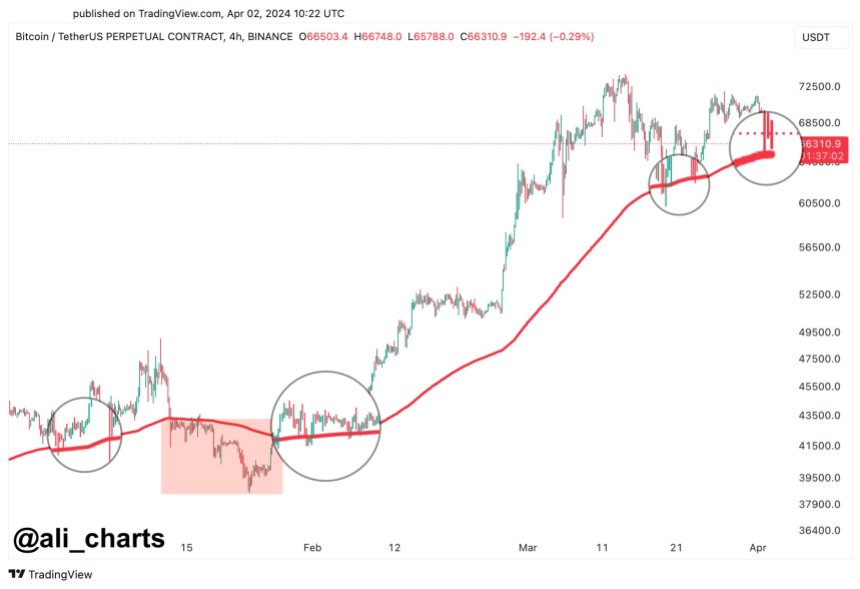
Crypto analyst Ali Martinez highlights the importance of the 200-epimetric moving average (EMA) on the 4-hour chart of BTC. According to Martinez, this indicator has acted as formidable support since early February and continues to play a crucial role in preventing further downward movement. 

The focus on the 200EMA stems from its potential to either catalyze a rebound or trigger more losses for Bitcoin. Martinez stated that if the 200EMA continues to hold as strong support, it signifies a significant probability of a price rebound. This scenario would provide renewed bullish momentum and potentially propel Bitcoin’s price above the $70,000 mark. 

However, if the 200EMA is broken, as it was in mid-January, as seen in the chart below, the analyst suggests that this could expose the Bitcoin price to further downward pressure and potentially lead to further losses.

BTC’s 200EMA support. Source: Ali Martinez on X

Bitcoin (BTC) is trading at $65,390, continuing its recent price correction. Over the past 24 hours, BTC has experienced a 5% decline; over the past seven days, it has seen a significant drop of over 6%. 

The market closely monitors whether the current key support level can sustain further price drops or if a potential bounce will occur before reaching that point. The outcome of these scenarios remains uncertain. 

Featured image from Shutterstock, chart from TradingView.com 

Tuesday, April 2, 2024

Timcast IRL First Podcast With FULLY AI Voice Guest ON SHOW, But The AI ...

It Begins… NYC Starts Busting Migrant Gangs

Candace Owens Asked LIVE On-TV if She'll Be Trump's Vice President, Answ...

Mexican mayor shot dead while at restaurant with his son

https://www.thestandard.com.hk/images/instant_news/20240331/20240331181915contentPhoto1.jpg?1711882873

https://www.newsbreak.com

A mayor was shot dead at a restaurant in Mexico on Saturday, the regional prosecutor's office said, the latest politically related killing in the country plagued by violence and organized crime.

Guillermo Torres, 39, and his 14-year-old son were attacked at a restaurant in Morelia, the capital of western Michoacan state, the prosecutor's office said in a statement . His son survived.

He was elected mayor of Michoacan's Churumuco municipality as a member of the Institutional Revolutionary Party in 2022, but recently quit the party and publically voiced sympathy for the ruling Morena, according to local media.

Torres is the latest politician to be murdered in Mexico in the run-up to the presidential elections on June 2, in which 20,000 local and federal positions and the entire Congress will be voted on.

Two mayoral candidates were murdered on February 26: Miguel Angel Zavala Reyes and Armando Perez Luna of the Morena and National Action Party, respectively.

Last month, prosecutors in southern Mexico said that mayoral candidate

Tomás Morales was killed in the Pacific coast state of Guerrero.

Between June 4, 2023, and March 26 this year, 50 people have been murdered in "episodes of electoral violence", 26 of them aiming for popular seats, according to a report by the Laboratorio Electoral think tank.

Mexico's drug cartels have often focused assassination attempts on mayors and mayoral candidates, in a bid to control local police or extort money from municipal governments.

Michoacan state, Mexico's main avocado-producing region, is the scene of constant fighting between organized crime groups, including the powerful Jalisco New Generation Cartel.

Last month, a state police officer was reportedly decapitated and her two bodyguards were killed in a highway attack in Michoacan.

Also in March, three farmers were killed by a bomb apparently planted in Michoacan. That came just days after President Andrés Manuel López Obrador acknowledged that an improvised explosive device killed at least four soldiers in what he called a "trap" likely set by a cartel in Michoacan.

Killings and abductions are daily occurrences in Mexico, where nearly 450,000 people have been murdered since 2006 in a spiral of drug-related violence, according to official data.

Monday, April 1, 2024

Why was an NYC sucker punch suspect released without bail?

https://www.yahoo.com/news/why-nyc-sucker-punch-suspect-152419122.html 

BROOKLYN - The suspect accused of randomly punching a woman in the face last week in Brooklyn pleaded not guilty to assault and harassment charges and was released without bail.

Franz Jeudy, 33, was quickly apprehended following the incident on Tuesday near Atlantic and Grand Avenues in Prospect Heights.

The attack left 57-year-old Dulce Pichardo with a broken jaw. So, why was Jeudy released? And why is this not bail-eligible?

Why was the suspect set free?

According to the New York Post, Jeudy was set free by a judge on supervised release after he was slapped with misdemeanor charges of third-degree assault, attempted assault and harassment — all non-bail-eligible offenses. He is set to face a judge again in May.

"He’s not supposed to be free," Pichardo told the Post. "They know that he’s dangerous. You cannot have these people outside that are that dangerous."

According to New York State law, "a person is guilty of Assault in the Third Degree when, with intent to cause physical injury to another person, he or she causes such injury to that person.

Second-degree assault counts are handed out when "that person intentionally causes stupor, unconsciousness, or other physical impairment or injury to another by administering to such other person, without his or her consent, a drug, substance, or preparation capable of producing the same," according to NY Courts.

Jeudy has prior arrests for two other random punch attacks, including one on a law enforcement officer and the other on a security guard, the Post reported.

Both of the misdemeanor assaults were later dismissed in August 2019 after Jeudy, who has an apparent history of schizophrenia, was found unfit to stand trial, the Post reported.

What happened to Pichardo?

Pichardo was left with a broken jaw after being punched in the face last Tuesday in Prospect Heights, the NYPD said.

According to police, the man walked up to Pichardo and punched her with a closed fist. Pichardo shared her story with FOX 5 NY, speaking through wires in her mouth. She said she was on her way home from work when it happened.

"As soon as I passed, he hit me very strongly … he didn’t say anything," she told FOX 5 NY's Stephanie Bertini.

Along with a broken jaw, Pichardo said she was also left with missing teeth with permanent nerve damage.

"That’s why I am here telling my story – I don’t want this to happen again." Dulce Pichardo

"I was bleeding a lot. It hurts, I knew something was broken because I feel it," she said.

Pichardo is currently recovering with a wire in her mouth and will likely need surgery.

It's still unclear at the time what led up to the attack.

"That’s why I am here telling my story – I don’t want this to happen again," Pichardo said.

Women being punched in NYC?

The attack comes as several women have shared stories of being randomly punched while walking last week in New York City.

It's unclear whether this incidents is related to the other women's claims.

Anyone with information in regard to this incident is asked to call the NYPD's Crime Stoppers Hotline at 1-800-577-TIPS (8477).

‘China Shock 2.0’ Is Coming for the US Economy, Trade Analyst Predicts

‘China Shock 2.0’ Is Coming for the US Economy, Trade Analyst Predicts

https://www.theepochtimes.com/business/china-shock-2-0-is-coming-for-the-us-economy-trade-analyst-predicts-5617661?src_src=uschinanoe&src_cmp=uschina-2024-03-31&est=AAAAAAAAAAAAAAAAbOgkZhYcwdLd%2FrYaqmB5DLl7wk9AJCYDuqakhKpFjY2fijshQalp4A%3D%3D

Michael Stumo, the CEO of the Coalition for a Prosperous America, is predicting U.S. markets could soon see a massive influx of cheap products produced by Chinese firms in an event similar to the “China Shock” era of the early 2000s.

“We had China shock 1.0 after China was let into the [World Trade Organization] in 2000. This is China Shock 2.0,” Mr. Stumo explained during an interview with NTD’s “Capitol Report” on Thursday.

The Coalition for a Prosperous America is a non-profit organization focused on domestic production and jobs that has emphasized “quality employment, national security, and domestic self-sufficiency over cheap consumption.” As the organization’s CEO, Mr. Stumo is watchful for trade trends that impact U.S. workers and firms, and he’s warning surging Chinese imports pose a challenge for the United States.

“We’re going to have an auto apocalypse for our companies here if we don’t do something, or a solar apocalypse. We’re building solar here—all the solar tariffs—they’re just climbing right over, they’re undercutting, and they’re taking out the U.S.-based solar companies,” he said. “So it’s a real bad situation, and it’s going to get worse, and President Biden has to pay attention.”

The Chinese regime has stated its goal of growing the Chinese economy by 5 percent this year. Mr. Stumo believes limited consumer demand in China, and slowing infrastructure projects, will put heightened pressure on the country to meet these economic growth targets by expanding exports.

“They’re going to displace a ton of Western production,” the trade analyst said of the Chinese export trends.

He predicted the United States will be a prime target for these Chinese exports.

“Europe doesn’t want it. Japan doesn’t want it. The U.S. is the only country big enough and dumb enough to take it so far, mostly,” Mr. Stumo said.

President Donald Trump raised tariffs on imports from China during his presidency and these tariffs have remained intact under President Joe Biden. Still, Mr. Stumo said Chinese firms are finding ways to get around these tariffs, including by shipping their exports through other countries or establishing affiliated factories in Mexico and even in the United States.

“You’re seeing Chinese solar companies built in Pataskala, Ohio, in Texas, in Florida, and trying to take advantage—and are, and will—of [U.S. Inflation Reduction Act] tax credits,” he said. “So we subsidize their plants here, even as they subsidize them from there. And they’re not profitable, they just get the money from the government.”

How ‘China Shock 1.0’ Impacted The US Economy

The term “China Shock” was popularized by a 2016 research paper by economists David H. Autor, David Dorn, and Gordon H. Hanson that analyzed how U.S. and European labor markets were impacted by China’s accession to the World Trade Organization. The authors concluded that a period about 2.4 million U.S. manufacturing jobs were lost between 1999 and 2011 as a consequence of China’s entry into the WTO.

Some economic analysts have offered differing views of the impact of the “China Shock” period of the 2000s, projecting U.S. job losses were fewer than the 2016 “China Shock” paper’s authors projected, and even offset by job growth on the U.S. side.

A 2017 research paper by economists Robert C. Feenstra and Akira Sasahara, for example, estimated about 2 million U.S. jobs were lost during the “China Shock” period, while about 6.6 million U.S. jobs were created from growth in U.S. exports during this same period.
Authors Scott Lincicome and Arjun Anand, of the libertarian-oriented CATO Institute policy think tank, concluded in a December 2023 report that while certain U.S. manufacturing jobs were lost and some communities may been disproportionately impacted, “the depth and breadth of these losses remains subject to intense scholarly debate—especially after considering preexisting economic trends, gains in American service jobs, benefits for consumers (families and companies), and increased US exports.”

The CATO Institute authors asserted that Trump-era trade tariffs against Chinese imports didn’t reverse losses in the U.S. manufacturing sector and instead contributed to net manufacturing job losses in the United States.

The Tax Foundation, another policy think tank, also opposes using tariffs as a means to protect the U.S. economy.

“Tariffs are ultimately paid for in large part by consumers and businesses in the domestic economy, can lead to stagnation as protected industries are shielded from competitive pressures, and invite retaliatory tariffs from other nations that come with additional costs,” the Tax Foundation author Erica York wrote in a December 2021 article criticizing both President Trump and President Biden for maintaining tariffs on Chinese goods.