Thursday, June 8, 2023

China Forcing US and Allies Out, Preparing for Blockade of Taiwan: Former Marine Colonel

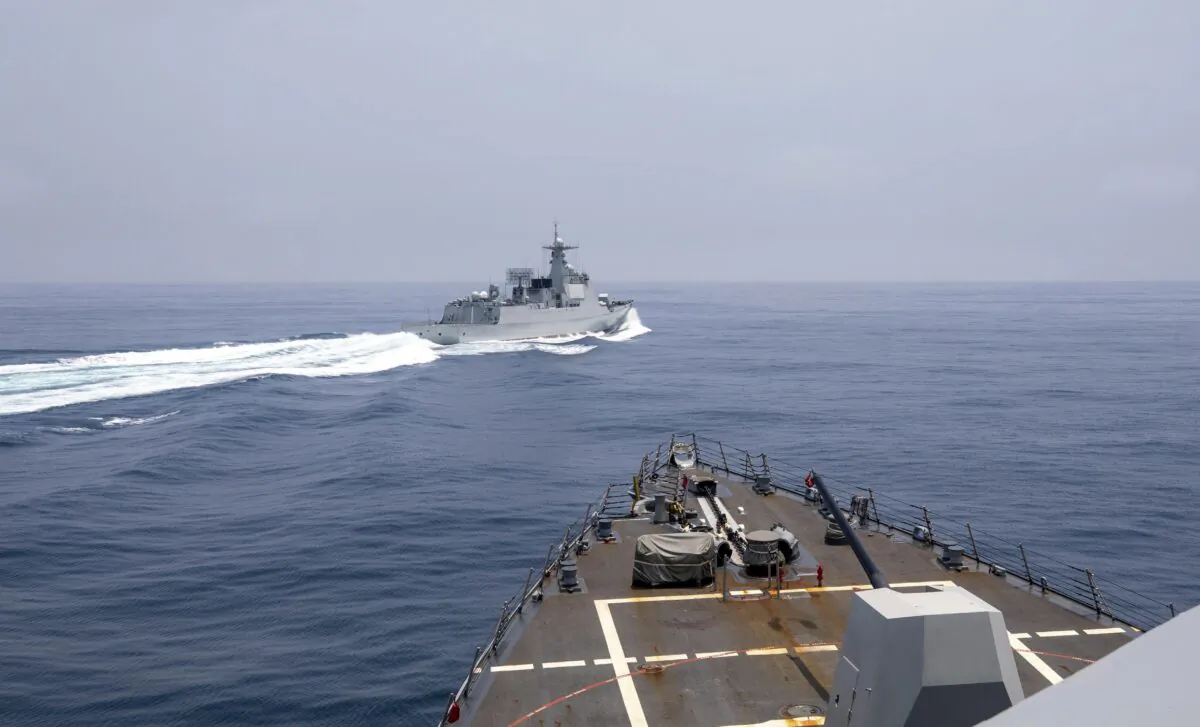
The USS Chung-Hoon observes a Chinese navy ship conduct what it called an "unsafe” Chinese maneuver in the Taiwan Strait, on June 3, 2023. (Mass Communication Specialist 1st Class Andre T. Richard/U.S. Navy via AP)

The USS Chung-Hoon observes a Chinese navy ship conduct what it called an "unsafe” Chinese maneuver in the Taiwan Strait, on June 3, 2023. (Mass Communication Specialist 1st Class Andre T. Richard/U.S. Navy via AP)

https://www.theepochtimes.com/china-forcing-us-and-allies-out-preparing-for-blockade-of-taiwan-former-marine-colonel_5318124.html?src_src=uschinanoe&src_cmp=uschina-2023-06-08&est=CEC%2BVidbKFNJj27RHQffjgyTY43a150lipJ9h0kRUCnfrsmqUU72nsHwVSVdBQk6%2FOn7jg%3D%3D 

The regime in China is seeking to force the United States and its allies out of the region and preparing for a blockade of Taiwan, according to Grant Newsham, a retired U.S. Marine colonel and the author of “When China Attacks.”

The U.S. Indo-Pacific Command recently accused the Chinese People’s Liberation Army Navy of engaging in dangerous naval maneuvers on June 3 during an intercept of the American destroyer USS Chung-Hoon in the Taiwan Strait.

According to the U.S. military, the Chung-Hoon was conducting “a routine south to north Taiwan Strait transit” alongside the Canadian frigate HMCS Montréal when the incident occurred.

It stated that a Chinese warship overtook the Chung-Hoon and crossed its bow at a distance of 150 yards, forcing the U.S. vessel to reduce its speed to avoid a collision.

“The [Chinese vessel] LY 132’s closest point of approach was 150 yards, and its actions violated the maritime ‘Rules of the Road’ of safe passage in international waters,” U.S. Indo-Pacific Command stated.

China was “sending a very clear message really for the umpteenth time that they consider the South China Sea, the Taiwan Strait, and surrounding waters to be Chinese territory,” Newsham told NTD’s “China in Focus.”

“And they are gradually locking down control of these waters and doing it bit by bit,” he said.

In another incident, a Chinese fighter jet aggressively intercepted a U.S. aircraft last month, risking the lives of its crew and escalating tensions between the two nations.

A J-16 fighter pilot “performed an unnecessarily aggressive maneuver” against a U.S. RC-135 reconnaissance plane on May 26, according to a statement released by U.S. military officials on May 30.

Indo-Pacific Command released a video of the incident, in which the Chinese pilot aggressively cuts across the nose of the U.S. aircraft, forcing it to fly through the smaller plane’s turbulence.

“It’s China pursuing its objectives, which is to assert absolute control over these waters that are sort of in China’s vicinity and to keep the Americans out and to keep everyone else out unless they enter at China’s sufferance,” said Newsham, who’s also an Epoch Times contributor.

“It’s China really setting the rules for this territory, and doing whatever they can to tighten control. And you will look at this over the years, and you’ll see the Chinese capabilities to enforce this have gradually strengthened. And one of these days, they are just going to say ‘Don’t come in.’

“But it’s a gradual process. It’s what China does, they lay claim to something they want. And then they sort of harden it, and then they absolutely take control of it. And we’re seeing this process played out.”

Point of No Return

As the United States is constantly seeking to reestablish normal communications with the Chinese Communist Party (CCP) in the aftermath of the Chinese spy balloon incident back in February, Newsham said the U.S. administration isn’t aware of the game that China is playing.

“The Americans don’t seem to recognize that that’s what the Chinese objectives are, they don’t want to believe it. And the idea seems to be, ‘Well, if we just keep going in, the Chinese will understand that we’re serious. And if we talk to them, even they will understand that what they’re doing is wrong. It’s not how the game is played. It’s not how civilized nations behave,’” he said.

“There seems to be a lack of understanding that the Chinese have a very different perspective of how international law, international custom and practice work. And they see it very differently than we do, and you’ve got to recognize that. So if you’re trying to think of some way to deal with it, it’s not going to be by trying to convince the Chinese that the way we and the West and the civilized nations do things is the right way. They don’t see it that way.”

Newsham singled out a recent remark by Chinese State Councilor and Defense Minister Gen. Li Shangfu.

Li said China’s military will attack “without any hesitation” any nation that dares to separate it from Taiwan. The comments were made in a speech on “China’s New Security Initiative” at the Shangri-La Dialogue in Singapore over the weekend.

“You’ve got to take the Chinese at their word, and listen to what the defense minister said, and he wasn’t winging it. This was a very clear, firm statement that China is willing to use force. And so you better take that seriously,” Newsham said.

“I think that China’s objectives are very clear, and if they are not challenged and if we don’t stop aiding and abetting what China is doing, then I think we will find that we are at a point of no return. It may be where we don’t have the wherewithal or the ability [physically] or psychologically to resist. I think we’re headed that way.”

Melanie Sun,  Andrew Thornebrooke, and  Katabella Roberts contributed to this report.

Copper price slump will give way to record buying spree, Citi says

 Copper price up

https://www.mining.com/web/copper-price-slump-will-give-way-to-record-buying-spree-citi-says/ 

Investors look set to pile into the copper market on an unprecedented scale in the next few years as usage surges in electric vehicles and renewable energy, according to Citigroup Inc.

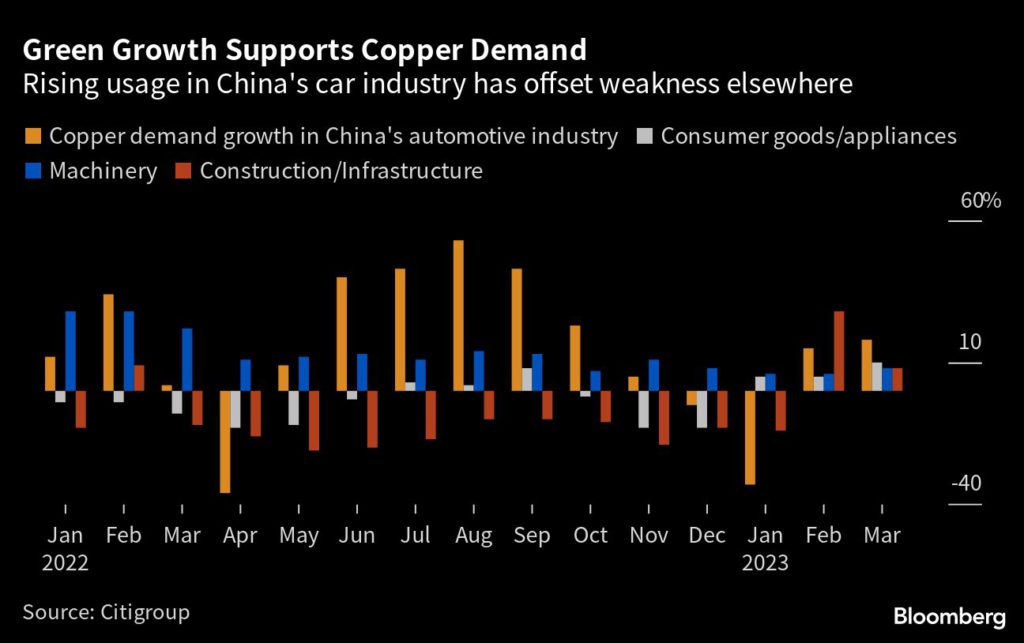
The key industrial metal is widely known as a proxy for global economic activity, and prices have slumped in recent months on weakening demand from traditional sectors like construction and consumer goods. Even staunch copper bulls like Goldman Sachs Group Inc. have been pulling in their horns, saying they were wrong in predicting sharp gains in prices this year.
But copper is fast emerging as the go-to commodity for investors looking for exposure to the energy transition, and they’re likely to pile in quickly as soon as the gloomy global growth outlook starts to improve, Max Layton, Citi’s managing director for commodities research, said in an interview.

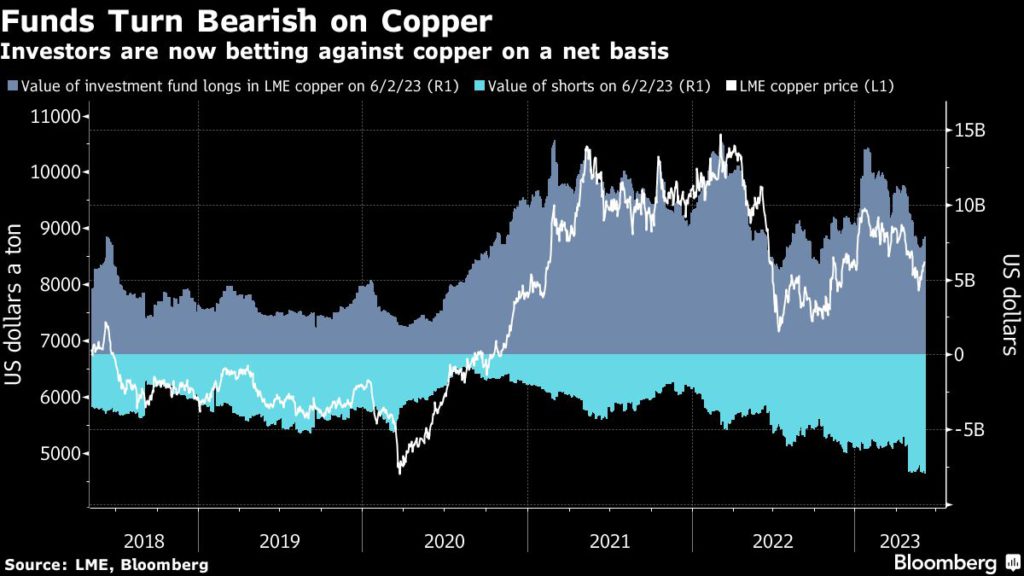
That will set the stage for a buying frenzy as orders from car-makers and grid operators flood in. The bank predicts that rising allocations from index-tracking investors and hedge funds could help boost net bullish positioning in the copper market to about 4 million tons by 2025, a sharp reversal of current bearish sentiment. That would be equal to about a fifth of global supply and double a prior peak seen in 2021.

As usage starts to soar, rising hedging activity from car-makers could add a further 1 million tons in long positions, bringing a wall of money into the futures markets just as demand starts to race ahead of supply in the physical industry. That will help push copper to a record high, Citi said.

“If you want to put on a decarbonization trade in commodities, the only truly liquid commodity is copper, and it’s the most liquid by a country mile,” Layton said by phone from London. “Copper’s unique characteristics mean that it could make oil’s 2008 bull run look like child’s play.”

The bank is advising investors and consumers to start purchasing soon while a weak macroeconomic backdrop keeps prices at around $8,300 a ton. Citi said copper may dip further in the short term, but should begin rallying within six to 12 months, topping out at about $15,000 in 2025 under the most bullish scenario.

Copper soared to a record of nearly $11,000 in early 2022, as a surge in demand during the pandemic left the industry critically low on stock and the war in Ukraine stoked fears over supplies from Russia. During the rally, Goldman Sachs Group Inc., BlackRock Inc. and Trafigura Group predicted the green energy revolution would drive prices much higher still, but so far that’s been more than offset by China’s tepid post-lockdown recovery, an industrial recession in Europe and a rising interest rates.

Sentiment has soured to the extent that on a net basis investors have turned bearish on copper for the first time in three years on the London Metal Exchange. Even so, the bellwether metal has held up far better than some other industrial commodities like zinc or oil this year, and Layton said investors would be betting against it much more heavily if it weren’t for the bright long-term outlook for demand.

Copper miners are already making strong margins at today’s spot prices, but there are widespread warnings that the industry will fall well short in delivering the additional supply needed as the energy transition gathers pace. As prices start to rise, Citi expects to see significant substitution away from copper in traditional sectors — such as consumer goods and air conditioning — and more economical use of copper in EVs and power generation. But the bank still expects an unprecedented gap to emerge between demand and mine supply over the next five to 10 years.

Rising prices for battery metals have pushed automakers to partially switch away from rare and volatile metals like cobalt in favor of iron and other more abundant materials over the past few years. But copper — which isn’t used in the battery itself but transmits power from the cells to an EV’s motor — isn’t as exposed to those kinds of shifts in battery chemistry. Copper’s deeper liquidity will also attract far more investment than other battery metals like lithium and nickel, Layton said.

The main long-term risk for copper is that its superior position as an electrical conductor is challenged by new cost-effective superconductors, Citigroup said in a report on Monday.

In the meantime, Citi thinks carmakers and other consumers will increasingly demand more than the market can supply, while the accelerating rollout of EVs and renewables will draw in a flood of investors.

“You don’t really know how high the price can go in that environment,” Layton said. “The whole market will be pushing back on it, but overall, looking at the historical context, you could easily see it in the $12,000-15,000 range.”

Copper prices were 0.2% lower at $8,280.50 a ton on the London Metal Exchange as of 9:55 a.m. Shanghai time on Thursday. Prices are virtually flat for the year, while aluminum has fallen 6.8%, zinc’s dropped 20%, and nickel’s lost about 30%.

(By Mark Burton)

It's Over! South Africa is F*&$d - Failed State

Aliens Are Real!?

Wednesday, June 7, 2023

US Knew Ukraine Planned To Blow Up Nord Stream Pipeline 3 Months Before It Happened: WaPo

https://nypost.com/wp-content/uploads/sites/2/2022/12/zelensky-biden-027.jpg

https://www.zerohedge.com/geopolitical/us-knew-ukraine-planned-blow-nord-stream-pipeline-3-months-it-happened-wapo 

The Washington Post is reporting that an unnamed European intelligence service told the CIA that Ukraine's military was planning an attack on the Nord Stream pipelines a full three months before the September 26, 2022 sabotage blasts which disabled them.

The revelation is based on Pentagon and classified intelligence documents leaked by Air National Guard member Jack Teixeira, or part of the so-called Discord leaks. The intelligence report in question was drafted in June 2022 and shared with the Biden administration, which means the White House has known all along that the "Putin did it" narrative which the West rallied around was false from the start. According to the new report published Tuesday

Details about the plan, which have not been previously reported, were collected by a European intelligence service and shared with the CIA in June 2022. They provide some of the most specific evidence to date linking the government of Ukraine to the eventual attack in the Baltic Sea, which U.S. and Western officials have called a brazen and dangerous act of sabotage on Europe’s energy infrastructure.

Image: AFP

Among the more interesting aspects to the intelligence leak is that it says the Ukrainians conducting the sabotage operation reported directly the country’s top military officerGen. Valerii Zaluzhnyi, in order to avoid sharing it with Ukrainian President Volodymyr Zelensky, likely for the sake of plausible deniability. 

The US government reportedly saw the information as of enough importance or authenticity to share it with Germany and other European intelligence services. It appears to be based on a single source or asset in Ukraine: "The intelligence report was based on information obtained from an individual in Ukraine" - as the Post report indicates.

The intelligence describes a plot which is very similar to a theory which recently came to prominence as German investigators spent months attempting to uncover a culprit, which claimed that six individuals under false identifies utilizing a small boat conducted a deep diving operation in the Baltic Sea to plant the explosives on the pipeline. 

The Washington Post writes in its Tuesday report, "The highly specific details, which include numbers of operatives and methods of attack, show that for nearly a year Western allies had a basis to suspect Kyiv in the sabotage."

"That assessment has only strengthened in recent months as German law enforcement investigators uncovered evidence about the bombing that bears striking similarities to what the European service said Ukraine was planning."

And WaPo offers the following verification that European intel services were briefed by the US on the information in its possession: "Officials in multiple countries confirmed that the intelligence summary posted on Discord accurately stated what the European service told the CIA."

The paper noted: "The Post agreed to withhold the name of the European country as well as some aspects of the suspected plan at the request of government officials, who said exposing the information would threaten sources and operations."

The timing of this revelation is interesting, as the WaPo report was published the same day as the Kakhovka hydroelectric power plant dam was blown up. In fact, Russians are already seizing on the parallels...

Many are now calling it the new Nord Stream sabotage mystery, as just like with the pipeline attack both the Russian and Ukrainian sides are quickly pointing the finger at the other.

One thing is clear in the wake of Tuesday's Washington Post Nord Stream reporting: the White House is lying about major, war-shaping events related to Ukraine. The US is lying about the conflict, and the US has been lying for a long time.

Journey Across Forgotten Cuba 🇨🇺

Tuesday, June 6, 2023

OPEC+ Cuts Fail to Boost Middle East Oil Prices

https://blogger.googleusercontent.com/img/b/R29vZ2xl/AVvXsEgr8ynwNTbu0ErBMOiVHQNbA9g7HNpWT8NZeSOVgC_S5b3AsRGbtBXeyTuTYBWE8eAutx1MSitdHIbBkmAAIwAVwWP5eUDmNgw_7ejqnD6WHMr6pvTafRG15uCnW0AuUakg7fKFyk6gqrxaNel0XqdLG2pQw3VK-4nclmsd4G8LDu6VvWouGxeE6YKv/w1200-h630-p-k-no-nu/Flag_of_OPEC.svg.png

https://tankterminals.com/news/opec-cuts-fail-to-boost-middle-east-oil-prices/?vgo_ee=KFz2wvGKQDYWuKiz4qBXLN5nEq%2Fs2caVIcp5dhc1Sc1TidoZ7tmAgQ%3D%3D%3Acr3RkzVQLMBxxVbXmAKyyvio8yWrkSmd 

The OPEC+ voluntary production cuts, on paper promising curtailments amounting to 1.66 million b/d, should have been the main story for May.

Regrettably for many in the Middle East, just as participating countries were preparing to curb output, the overall market sentiment worsened greatly. First it was refinery margins that forewarned of difficulties ahead, then data on Chinese manufacturing depressed markets even further and protracted negotiations on the US debt ceiling put the icing on the bearish cake. As Middle Eastern producers were thinking of formula prices for their cargoes loading in June, they did not necessarily see the scope of the headwinds that they were up against. There was still no mention of ouching, of punishing market short-sellers and there was hope that the negative trends in market positioning could be turned around once the reality of OPEC+ production cuts brakes through the clouds. Things have taken an awkward turn, however, and clouds have been the mainstay for the region’s main exporters.

Saudi Aramco’s Official Selling Prices for Asian Cargoes (vs Oman/Dubai average). Source: Saudi Aramco.

Saudi Arabia’s national oil company Saudi Aramco has cut all its Asian formula prices for June-loading cargoes going to Asia, simultaneously ramping up the OSPs for European destinations. For Asia, the month-on-month downward revision was expected. Despite the slight increase in the Dubai cash-to-futures spread, up $0.15 per barrel compared to March, refinery margins have been in freefall throughout April and that gloom has set the sentiment for prices. Surprisingly, the biggest month-on-month drop (down $0.90 per barrel compared to May OSPs) came for Arab Heavy, a grade that saw the biggest increases in the past months, whilst Arab Light was only cut by $0.25 per barrel to a $2.55 per barrel premium vs the Oman/Dubai average. Considering the substantial pricing decrease and Saudi Arabia’s pledge to cut 500,000 b/d from its production targets, it might come as surprise that Saudi Aramco vowed to allocate full requested volumes to Asian customers. Assuming Aramco will cut output, this can only mean that demand for Saudi barrels is getting weaker amidst recessionary pressures.

Formula prices of US-bound cargoes by selected grades (vs ASCI).Source: Saudi Aramco.

Saudi exports to the United States have halved year-on-year so far, averaging a meagre 230,000 b/d this year, according to Kpler tracking data. Not only that, the Gulf Coast is no longer the key region for whatever remaining volumes still are delivered to the US as crude-strapped refiners in PADD 5 have been ramping up their purchases recently. Saudi OSPs have been at their highest in years and remain well above any other Middle Eastern exporter for some time already. The difference between a Basrah Medium and an Arab Medium cargo into the US Gulf Coast stands at an unbelievable $8 per barrel, even though the latter’s quality is only marginally better than the former’s. Despite its pricing, Saudi Aramco profits fell 19% year-on-year to $31.9 billion, declining in unison with the average realized crude price that dropped to $81 per barrel in the January-March period.

ADNOC Official Selling Prices for 2017-2023 (set outright, here vs Oman/Dubai average). Source: ADNOC.

The headache of setting official selling prices in such a volatile market is no longer there for ADNOC as its formula prices are set by the Murban contract which came in at $84.11 per barrel, up almost $5 per barrel from May. Whilst the flat prices have moved up, the weakness of light grades globally has also seep into Middle Eastern pricing as the region’s main benchmark has been gradually getting closer to Murban, finishing the month at a meagre $0.71 per barrel discount to the UAE grade. This is a notable feat considering in early 2023 the same Murban-Dubai spread ticked in at around $5 per barrel. As Dubai was strengthening on the heels of the upcoming OPEC+ cuts, the UAE’s other key export grade Upper Zakum finally edged nearer to Murban with its differential hiked $0.40 per barrel to a $0.70 per barrel discount. Considering Dubai was trading almost neck-to-neck to Murban in the first half of May, Upper Zakum should see further increases when the time will come for July 2023 formula prices. The other light grades Umm Lulu and Das saw only marginal changes as their quality characteristics are very similar to Murban.

Iraqi Official Selling Prices for Asia-bound cargoes (vs Oman/Dubai). Source: SOMO.

For Iraq, the fact that Turkey seems to be stalling the resolution of the Kurdish issue (at least until the second round of presidential elections is over) has been an unnecessary hindrance to the state oil marketing company SOMO. Should President Erdogan get re-elected in the second round, the resumption of exports will most probably be a matter of several weeks if not days. After all, the debts that Turkey owes the Iraqi federal government were all incurred in the Erdogan era. For its Asian buyers, SOMO decided to roll over Basrah Medium prices (quite the contrast to Saudi Aramco which cut every single Asia-bound grade) and increase Basrah Heavy formula prices by $0.10 per barrel compared to May, placing it at a -$3.30 per barrel discount to Oman/Dubai.


Iraqi selling prices for Europe-bound cargoes (vs Dated Brent). Source: SOMO.


Mirroring Saudi Aramco, SOMO’s European formula prices are much more in line with the overall Middle Eastern trend. For Iraq, a downward pricing correction has been long overdue as the levelling out of Brent Dated and ICE Brent (the former is used by SOMO, the latter is used by Saudi Aramco) has rendered Iraqi barrels much cheaper than its peers. To take but one example, Basrah Medium is some $4 per barrel cheaper than Arab Heavy, despite being less sulphurous. Despite such discrepancies, Iraqi exports into Europe didn’t pick up and have been hovering around the same 600,000 b/d for most of this year and even the halting of Kurdish exports failed to boost Europe-bound outflows above this level.

Iranian Official Selling Prices for Asia-bound cargoes (vs Oman/Dubai average). Source: NIOC.

Iran has been enjoying a surprisingly undramatic 2023 so far, with a prospective Iran nuclear deal being completely scrapped from the geopolitical agenda of the day. Enjoying a period of strong exports with monthly outflows coming in above 1 million b/d every month of the year so far, Iran’s authorities also claim that production has surpassed the 3 million b/d mark for the first time since late 2018. The figures came from Javad Owji, Iran’s oil minister, and are more some 400,000 b/d above consensus figures provided by OPEC secondary sources. Perhaps reflecting this increasing confidence, Iran’s national oil company NIOC has the formula price of its Iran Light grade to Asia 5 cents per barrel above Arab Light, for the first time this has happened since November 2020. Overall, Iran has followed Saudi Aramco’s pricing strategy and cut its Asian OSPs by $0.20 per barrel and $0.80 per barrel, respectively for Iran Light and Iran Heavy.

Kuwait Export Crude official selling prices into Asia, compared with Arab Medium and Iranian Heavy (vs Oman/Dubai average). Source: KPC.

Kuwait has managed to bounce back from the series of hard knocks it has endured last month, restarting the second CDU of the al-Zour refinery after month-long repairs. Seeking to start up the third (and last) distillation unit of the 615,000 b/d refinery in June-July, Kuwait might finally be reaching that point when all its capacity is at last commissioned. As Kuwaiti exports continue to decline and currently are some 200,000 b/d below the 1.8 million b/d average of 2022, the ramp-up of al-Zour is set to shrink crude availability even further. As for formula prices of Kuwaiti crude in June, the state oil company KPC lowered its Kuwait Export Crude OSPs to Asian customers by $0.70 per barrel to a $1.70 per barrel premium vs the Oman/Dubai average. With this, Kuwait’s pricing changes were more modest than Saudi Aramco’s hikes for Arab Medium and Arab Heavy, a trend that was also reflected in KPC increasing Europe-bound cargoes by $0.50 per barrel, half the Saudi increases to European customers.