Tuesday, June 6, 2023

China’s state iron ore buyer gets down to business, yet to flex pricing power

China’s Reopening to Roil Energy Prices If Beijing Over-Delivers

https://www.mining.com/web/chinas-state-iron-ore-buyer-gets-down-to-business-yet-to-flex-pricing-power/ 

China’s Reopening to Roil Energy Prices If Beijing Over-Delivers
Financial street in Beijing (Stock Image)

China’s new state iron ore buyer is asserting itself in negotiating deals for the world’s biggest steel industry but has yet to help manufacturers struggling with weak demand to get lower prices, mills and miners said.

Around 30 Chinese steel mills have signed 2023 iron ore procurement contracts through China Mineral Resources Group (CMRG), which was set up last year to buy iron ore on behalf of the industry as well as oversee Chinese interests in mines abroad and at home.
Sign Up for the Iron Ore Digest

“We have not received any cheaper iron ore prices and to be honest I don’t expect they can get better deals any time soon,” a purchasing manager from a state-owned Chinese steel mill said on the sidelines of an industry event in Singapore this week.

“CMRG looks like an updated version of a previous collective buyer agency,” said the person, who like other mills and miners declined to be named given the sensitivity of the matter.

China, the world’s top steelmaker, buys about 70% of all iron ore shipped worldwide, mostly from Australia and Brazil.

A portion is bought at the start of the year under term contracts, with the rest bought later on the market.

CMRG is China’s latest attempt to enhance its iron ore pricing power. Previously, China’s steel industry association strived to win better prices for mills, negotiating fixed prices annually with miners until the industry moved to an index-based price system more than a decade ago.

Chinese steel mills are eager to reduce their iron ore procurement prices as profit margins take a hit from a slower than expected recovery as the country eased strict Covid-19 restrictions after three years.

“We are actively engaging with CMRG when it comes to negotiating contracts for steel mills,” an official at one of the world’s top miners told Reuters. “But after the negotiations are done, we have to sign individual contracts with mills.”
No ‘market-shaking’ change

Mills that have signed contracts through CMRG include 23 members of China’s steel association and several non-member companies, accounting for around 300 million tonnes of annual iron ore purchases, according to officials from two global miners and two Chinese steel mills.

China bought 1.1 billion tonnes of iron ore in 2022, worth $128 billion, according to customs data. It relies on imports for 80% of its consumption.

“Our cooperation with the CMRG is constructive … so far we have not seen a market-shaking change,” another official at a global mining company said.

“It’s hard to say if more Chinese firms will put their contract bargaining under CMRG in the future. That would mainly depend on what CMRG achieves,” the person said.

Several steel mill officials and iron ore traders said the prices that CMRG negotiated for the 2023 contracts are no different from what the mills achieved independently.

However, CMRG’s entry has added to the costs for the steel industry, which is obliged to pay a fixed commission to the agency, steelmakers said.

No contact details could be found for CMRG.

China’s State-owned Assets Supervision and Administration Commission (SASAC), which oversees almost 100 state companies and recently posted a recruitment notice on behalf of CMRG on its WeChat account, did not immediately respond to a fax seeking comment.

Lower iron ore prices are crucial for Chinese steel mills struggling amid high feedstock prices and sluggish demand from the country’s vast but ailing property sector.

Only a third of steel firms in China were operating at a profit last week, according to Mysteel data, capping operating rates at mills.

“We don’t know what CMRG will do for the upcoming 2024 contracts,” the official from the state-backed mill said. “But it’s hard to see much change (from 2023 deals), unless there are some adjustments on negotiation strategies.”

(By Muyu Xu, Naveen Thukral and Amy Lv; Editing by Tony Munroe)

"This is our Moment to Shine" Speech Scene | Chernobyl | S01E01

Dave

Friday, June 2, 2023

Elon Musk Rips Target After Its Stock Is Downgraded: ‘Won’t Be Long Before’ Shareholders Sue Target

https://www.kxl.com/wp-content/uploads/2020/03/Stocks-Plunge-Graphic.jpg

https://www.dailywire.com/news/elon-musk-rips-target-after-its-stock-is-downgraded-wont-be-long-before-shareholders-sue-target 

Twitter owner Elon Musk took a shot at Target on Friday morning after JP Morgan downgraded the retailer’s stock, saying that it was only a matter of time before the company faced lawsuits for its controversial actions that have led to the company losing billions of dollars in market value.

Target made “emergency” calls in mid-May to managers and senior directors after the company faced backlash for its Pride collection, which included “tuck-friendly” female swimwear.

“We were given 36 hours, told to take all of our Pride stuff, the entire section, and move it into a section that’s a third the size. From the front of the store to the back of the store, you can’t have anything on mannequins and no large signage,” a Target insider told Fox News.

The woke company has since faced boycotts, lost more than $12 billion in market value, and faced its longest losing streak in years.

JP Morgan said that it was downgrading Target’s stock because of the “recent company controversies.”

Musk responded to the news by tweeting: “Won’t be long before there are class-action lawsuits by shareholders against the company and board of directors for destruction of shareholder value.”

Daily Wire host Candance Owens responded in agreement with Musk’s disapproval of Target, praising the CEO for his commitment to free speech and the safety of children.

Target has been perceived as “woke” by many online since at least 2014 when the company announced it would no longer divide certain products by gender.

CLICK HERE TO GET THE DAILYWIRE+ APP

In 2016, Target introduced a gender-neutral line for children and also asserted they would allow transgender people to use whatever bathroom they preferred, prompting criticism. Target then spent $20 million to put private bathrooms in their stores.

The vice president for brand management at Target also serves as treasurer of an LGBT group that has received millions of dollars in donations from Target and urges schools to adopt policies to help trans and nonbinary school students hide their “gender identity” from their parents.

Senate Passes Debt Ceiling Deal, Sending Bill to Biden’s Desk

 The U.S. Capitol Building in Washington on June 1, 2023. (Anna Moneymaker/Getty Images)

The U.S. Capitol Building in Washington on June 1, 2023. (Anna Moneymaker/Getty Images)

https://www.theepochtimes.com/senate-passes-debt-ceiling-bill-ending-threat-of-default_5306894.html 

The Senate ended the threat of a U.S. default on its financial obligations by passing the Fiscal Responsibility Act of 2023 on June 1. The measure now moves to the desk of President Joe Biden, whose signature will lay the matter to rest for at least the next 19 months.

The bill passed in a bipartisan vote of 63 to 36.

Compromise Bill

The legislation resulted from a compromise forged by President Joe Biden and House Speaker Kevin McCarthy (R-Calif.) to suspend the debt limit through Jan. 1, 2025, while making slight reductions to non-defense discretionary spending and modest increases in defense spending in 2024. Discretionary spending growth is capped at 1 percent for 2025.

The bill also makes changes to work requirements for some social welfare programs, streamlines the permitting process to drill for oil and natural gas, and takes back $20 billion in IRS funding and $30 billion in unspent COVID relief funds, among other provisions.

With a possible default just four days away, the usually slow-moving Senate passed the bill in an evening session just 24 hours after it cleared the House of Representatives.

Chuck Schumer
Senate Majority Leader Sen. Chuck Schumer (D-N.Y.) speaks during a news conference at the U.S. Capitol on Feb. 7, 2023. (Alex Wong/Getty Images)

“It is so good for this country that both parties have come together at last to avoid default. I thank my colleagues on both sides of the aisle for their cooperation,” Senate Majority Leader Chuck Schumer (D-N.Y.) said shortly before the vote.

Sen. Minority Leader Mitch McConnell (R-Ky.) called it “an urgent and important step in the right direction for the health of our economy and the future of our country” during remarks on the Senate floor.

Defense Spending Concerns

The primary concern Republican senators voiced about the bill was what they saw as an inadequate amount of military spending.

Citing the growth in military spending and activity by China and other nations, senators including Tom Cotton (R-Ark.), Susan Collins (R-Maine), and Lindsey Graham (R-S.C.) criticized the bill for including a provision to cut defense spending automatically if a federal budget is not passed on time.

“The continuing resolution, if we don’t do our legislative business, increases non-defense spending, decreases defense spending,” Graham said while debating the bill on June 1. “If this budget is the end of the discussion and we don’t fix it, your sons and daughters are going to have more war, not less.”

“This bill would actually shrink the size of our navy,” Collins said. “Meanwhile, China has the largest navy in the world now.” Collins called for an emergency supplemental allocation to further increase defense spending in 2024.

Sen. James Lankford (R-Okla.) opposed the bill saying it would actually increase, not decrease, federal spending.

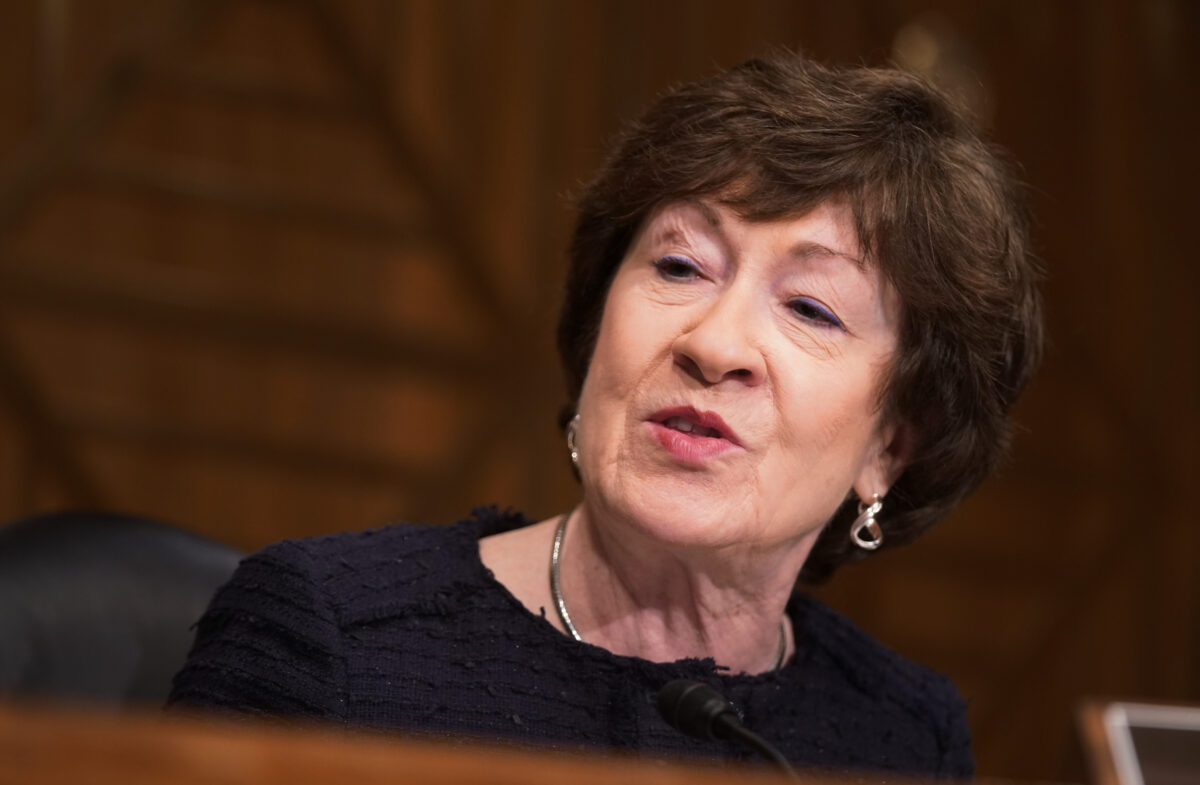
susan collins
Sen. Susan Collins (R-Maine) speaks during a hearing on Capitol Hill on Feb. 23, 2021. (Leigh Vogel/Pool/AFP via Getty Images)

“I get to the fine print and find out, actually, it increases spending 3.3 percent next year. And the year after that it increases spending 1 percent again. It actually doesn’t decrease spending at all,” Lankford said while debating the bill on June 1.

Some senators opposed the bill because of the additional work requirements it imposes on some recipients of social services while preserving tax cuts for the wealthiest Americans and large corporations.

“At a time of massive inequality and when the people on top have never had it so good, I cannot in good conscience vote for a bill that hurts working people,” Sen. Bernie Sanders (I-Vt.) said while debating the bill on June 1.

Former President Donald Trump voiced his opinion on the bill to a campaign audience in Iowa while the Senate deliberated on June 1. “We should have gone through a little more pain, perhaps, over the last few days to get maybe a deal done,” Trump said.

Amendments Defeated

To speed consideration of the bill, Republicans and Democrats agreed to permit only 11 amendments to be offered and limited debate to four to six minutes on each. All amendments failed.

As the evening wore on, Schumer urged senators to vote quickly. At one point he was overheard saying to Sen. John Cornyn (R-Texas), “Less talking, more voting.”

While many senators applauded the bill for avoiding a catastrophic financial default, none seemed particularly excited about its provisions.

“I think what we have is a compromise that doesn’t have what everybody wants,” Sen. Jeanne Shaheen (D-N.H.) told The Epoch Times on June 1. “But that’s what governing is about. It’s about making compromises.”

Jackson Richman contributed to this report.

Thursday, June 1, 2023

WTI Holds Gains After Biden Admin's 9th Straight Weekly SPR Drain

mobile-logo

https://www.zerohedge.com/energy/wti-holds-gains-after-biden-admins-9th-straight-weekly-spr-drain

Oil prices have been choppy overnight, since API reported a big surprise crude build, with WTI hovering around $68. China's factory activity and the OPEC+ meeting over the weekend in Vienna to discuss the group’s production policy are weighing on traders' minds, as US debt ceiling doubts fade.

“Today the market will look to US weekly inventory data and in particular the pace of Strategic Petroleum Reserve selling last week,” said Jens Pedersen, director of oil and commodities research at Danske Bank.

“Oil prices are stabilizing after better-than-expected Chinese PMIs and a halt in the recent dollar rally,” he added, referring to the purchasing managers’ index, a measure of economic activity.

The big question is whether the official data will confirm API's big build...

API

  • Crude +5.2mm (-5.1mm exp)

  • Cushing +1.777mm

  • Gasoline +1.89mm (-900k exp)

  • Distillates +1.849mm (+500k exp)

DOE

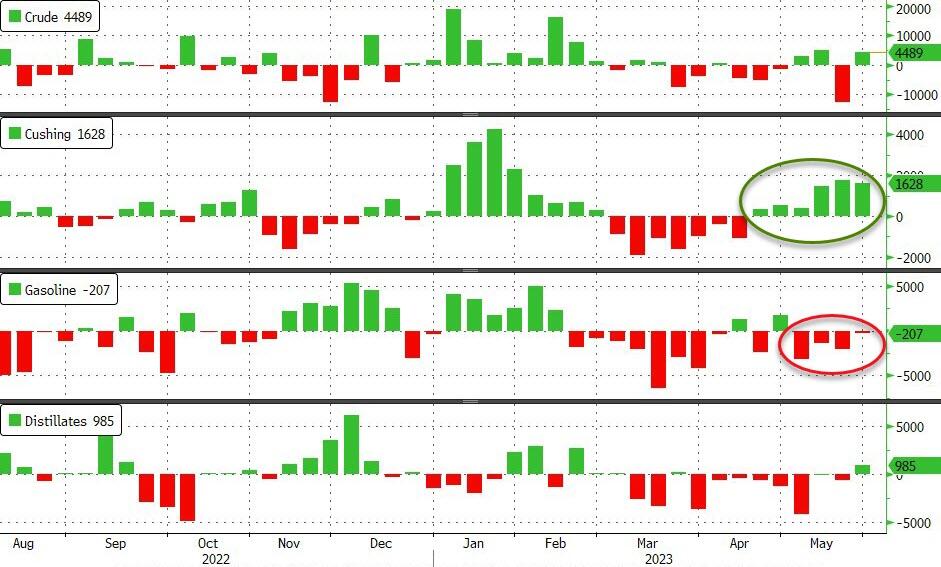
  • Crude +4.49mm (-5.1mm exp)

  • Cushing +1.63mm

  • Gasoline -207k (-900k exp)

  • Distillates +985k (+500k exp)

The official inventory data confirmed API's report that crude stocks rose significantly last week - after the massive draw the prior week. Cushing stocks rose for the 6th straight week. Gasoline stocks fell very modestly...

Source: Bloomberg

For the 9th straight week, the Biden admin drained the SPR last week...

Source: Bloomberg

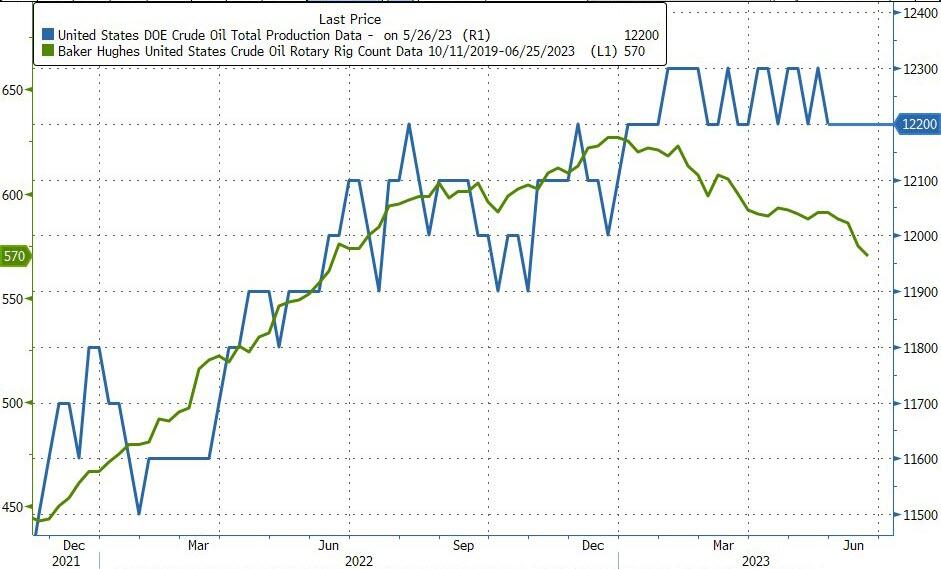
US crude production remains flat at cycle highs despite the ongoing slide in rig counts...

Source: Bloomberg

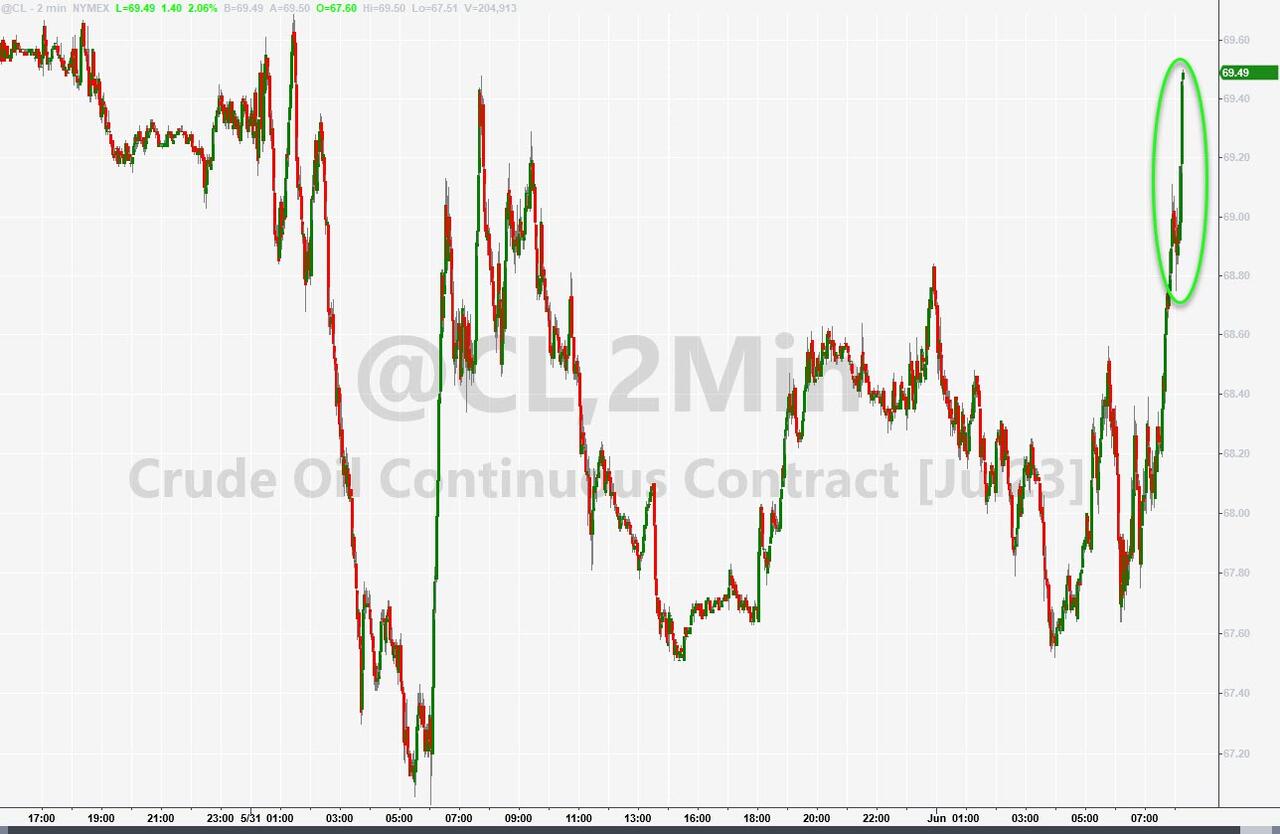
WTI rallied up to $69 ahead of the official inventory data and extended those gains...


Finally, we note that US demand for oil and diesel was more robust in March than previously thought, but remained below levels seen at the same time a year ago.