Wednesday, May 24, 2023

McCarthy Vents Frustration Over Biden’s Unwillingness to Cut Spending in Debt Ceiling Negotiations

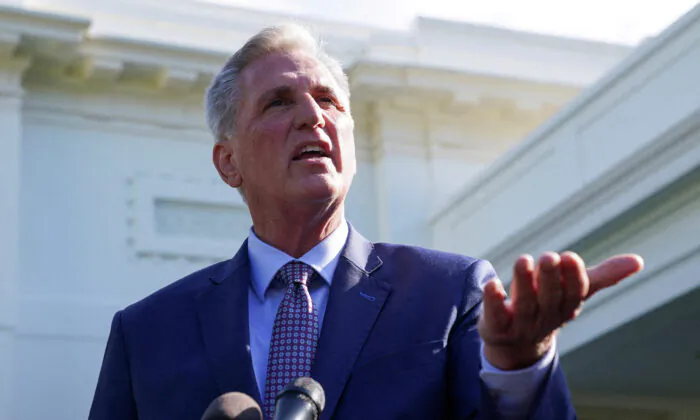
House Speaker Kevin McCarthy (R-Calif.) speaks to reporters outside the West Wing following debt limit talks with President Joe Biden at the White House on May 9, 2023. (Kevin Lamarque/Reuters)

House Speaker Kevin McCarthy (R-Calif.) speaks to reporters outside the West Wing following debt limit talks with President Joe Biden at the White House on May 9, 2023. (Kevin Lamarque/Reuters)

https://www.theepochtimes.com/mccarthy-vents-frustration-over-bidens-unwillingness-to-cut-spending-in-debt-ceiling-negotiations_5288383.html?utm_source=andshare 

House Speaker Kevin McCarthy (R-Calif.) vented frustration over President Joe Biden’s unwillingness to reduce federal discretionary spending in 2024 in exchange for lifting the debt ceiling.

“It didn’t seem like it’d be this hard,” McCarthy told reporters at midday on May 24.

The Speaker then listed a litany of complaints against Biden and the Democrat party.

McCarthy said that Democrats have overspent, driving the country into debt, causing inflation, increasing dependence on China, and causing four bank failures, all while the president refused to negotiate on raising the debt ceiling for more than three months.

Though he expressed hope that an agreement could still be reached in time to prevent a default on U.S. obligations, McCarthy often struck a defensive tone.

“I’m not a senator. I don’t control the Senate. Why didn’t they pass something? The president didn’t talk to us for 97 days. So don’t blame me for reaching out to the Democrats, for begging the president to meet with me, and trying to find [a solution],” McCarthy said.

The Limit, Save, Grow Act—a Republican plan to increase the debt ceiling while reducing federal spending—passed the House on April 26 by one vote.

The measure would reduce federal spending in 2024, cap spending growth for 10 years, increase work requirements for some recipients of social services, take back unspent COVID-19 funds, and loosen permitting requirements for oil and gas.

The Treasury could lack the funds to meet all financial obligations in full as soon as June 1 without additional borrowing, according to Treasury Secretary Janet Yellen.

“It’s not my fault that the Democrats today have become so extreme, so far toward the socialist wing that they are now opposed to work requirements, that they are now opposed to saving $1 less than you spent the year before. That, to me, really seems that the problem [is] the Democrats,” McCarthy said.

Republicans began by demanding that federal discretionary spending for 2024 be reduced to the 2023 level. That has emerged as a central sticking point in negotiations. However, McCarthy has lately used the phrase “spend less than we spent last year,” perhaps signaling a willingness to accept a smaller spending cut.

“When have I ever said, ‘You have to agree to 100 percent of what I want?’” McCarthy asked, indicating his willingness to make some concessions to Democrats. However, he reiterated his one non-negotiable: no increase in the debt limit without some agreement to reduce spending in 2024.

Asked whether the public would blame Republicans if a default resulted from the the fight over the debt ceiling, McCarthy first brushed off the suggestion that a default would occur. He then shifted any blame for the current impasse to Democrats.

“I don’t think I have to say who’s to blame. If the Republicans have passed a bill that raised the debt ceiling, did it in a responsible, sensible way, I think the American people understand that.” McCarthy added.

Democrats continue to portray the disagreement in opposite terms, accusing McCarthy and the GOP of using the debt limit to strong-arm their agenda into law rather than following the legislative process.

“I just heard Kevin McCarthy’s press conference. It sounds like he really is anxious to have a default on the debt, which I think would be damaging to our economy,” said Rep. Jim McGovern (D-Mass.).

“You know, he’s not negotiating. He’s giving us ransom notes,” McGovern added, evoking the metaphor often used by the president that Republicans are holding the U.S. economy hostage to their demands.

“This is about paying bills we’ve already accumulated,” McGovern said of the debt ceiling negotiation. “If you don’t want to accrue these bills, then don’t spend. But the place to do that is in the appropriations process.”

About 60 percent of Americans believe Congress should raise the debt ceiling only if spending cuts are also made, according to a poll by CNN and SSRS released May 24. About 24 percent of respondents said the limit should be raised no matter what.

Just 31 percent of respondents said the president has the right priorities, though the number for Republicans was 29 percent. Only 35 approved of the way Biden is handling the federal budget.

Despite the impasse in negotiations, McCarthy said he is determined to find a solution.

“I am not going to give up. We’re not going to default. We’re going to solve this problem. I will stay with it until we can get it done.”

Republican negotiators were headed back to the White House to continue talks on May 24, McCarthy said.

Apple closes in on a $3 trillion stock market valuation

https://finance.yahoo.com/news/apple-closes-in-on-a-3-trillion-stock-market-valuation-120118264.html 

A few more bites out of Apple's (AAPL) stock by investors, and we may find the tech giant's market cap beyond the $3 trillion level.

Shares of the iPhone maker have surged 35% year to date, out-performing the S&P 500 pedestrian's 9% gain. Apple is the fourth-best performing component of the closely tracked FAANG (Facebook, Apple, Amazon, Netflix, Google) complex, lagging the 105% gain in Meta (META), 41% increase in Alphabet (GOOG, GOOGL), and 39% appreciation in Amazon (AMZN).

In the process of its push higher, Apple has added about $690 billion in market cap. The company's stock market valuation now stands at $2.74 trillion, according to Yahoo Finance data, only 9% away from the $3 trillion mark.

Apple Inc. (AAPL)
NasdaqGS - Nasdaq Real Time Price (USD)
171.15
-0.41(-0.24%)
As of -.Market open.

Apple is the highest-valued company in the stock market, with Microsoft (MSFT) a close second, sporting a $2.38 trillion market cap.

Pros point to several reasons behind the impressive run in Apple's stock.

First, Apple continues to have a great story to tell investors on multiple fronts.

"For Apple there is massive installed base momentum going to the iPhone 15 anniversary cycle, and it has put a tailwind in the stock coupled by demand being solid in the field," Wedbush analyst Dan Ives tells Yahoo Finance.CANNES, FRANCE - MAY 20: Tim Cook attends the

That two could become a three soon. (Photo by Gareth Cattermole/Getty Images)

That installed base momentum could be stoked further at the company's 2023 Worldwide Developers Conference, which kicks off June 5.

Apple is widely anticipated to introduce the iOS 17 operating system. But some Apple watchers are holding out hope the company finally unveils its new AR/VR headset that has been in the works for years.

Meantime, Apple's latest quarterly results — while not perfect — have been viewed favorably by investors looking for relative safety amid the debt ceiling drama and sticky inflation.

"Overall, the results [from Apple] and guidance are exactly what investors were looking for from the company to feel reassured of its defensive positioning and at the same time the greater resilience of Big Tech in general in the current macro as well as on potential further macro deterioration, making it palpable to still keep paying 26x near-term earnings for Apple shares," said JP Morgan analyst Samik Chatterjee in a client note.

Chatterjee added: "While we can see some investors squirm about a 26x earnings multiple, we believe the resilience of the business proving out in the numbers currently as well as the early part of the pandemic (2020) will amply justify the reasons to pay a premium."

FILE - In this May 7, 2018, photo, Berkshire Hathaway Chairman and CEO Warren Buffett smiles during an interview in Omaha, Neb., with Liz Claman on Fox Business Network's
FILE - In this May 7, 2018, photo, Berkshire Hathaway Chairman and CEO Warren Buffett smiles during an interview in Omaha, Neb. (AP Photo/Nati Harnik, File)

Another vote of confidence from a special investor has helped sentiment on Apple, too.

Billionaire investor and Berkshire Hathaway CEO Warren Buffett said earlier this month he purchased more shares of Apple. Berkshire now owns a $151 billion stake in Apple, up from $1 billion in May 2016.

Berkshire is Apple's third-largest institutional shareholder, behind BlackRock (second) and Vanguard (one), according to Yahoo Finance data.

"Apple is different than the other businesses we own. It just happens to be a better business," Buffett said at the Berkshire Hathaway annual meeting earlier in May.

As for what could trip up Apple's stock, pros find it hard to come up with a major selling event. Many highlight China's economic recovery stalling as a key risk to Apple's stock price in 2023, however.

Said Ives: "Outside of the usual black swan events, the biggest risk to Apple’s stock is around the demand environment in China taking a step down. China is the hearts and lungs of the Apple growth story and so far so good, but that is the biggest risk for the stock."

Brian Sozzi is Yahoo Finance's Executive Editor. Follow Sozzi on Twitter @BrianSozzi and on LinkedIn. Tips on the banking crisis? Email brian.sozzi@yahoofinance.com

Tuesday, May 23, 2023

Chevron to Buy Shale Driller PDC in $6.3 Billion Stock Deal


https://finance.yahoo.com/news/chevron-buy-shale-driller-pdc-122546695.html?ref=biztoc.com&guccounter=1&guce_referrer=aHR0cHM6Ly9iaXp0b2MuY29tLw&guce_referrer_sig=AQAAAD6rugwSvkoiKQVmfXCwmJji-FV0bVWznrIy1JuhxZDKjhCzRMnNlYp-hJEJ2mnwId2cmzSfGCkvwYRX4u9uWF52m_pbsls5XW4O0w8wwQ4C_MSeJ8wMFyThQqrzmOZDCa6bwXghgM359m9lUZQxCEtqqYdrKO77RkwscEUQRc9o 

(Bloomberg) -- Chevron Corp. agreed to buy Denver-based oil and gas producer PDC Energy Inc. in a $6.3 billion all-stock deal as it seeks to expand amid what’s expected to be a busy year of mergers and acquisitions in US shale.

Chevron will pay $72 a share, a roughly 14% premium on a 10-day average based on May 19 closing prices, according to a statement Monday. The deal will increase Chevron’s production by just under 10% and expand the oil giant’s holdings in the Colorado and West Texas shale basins. Separately Monday, Exxon Mobil Corp. agreed to sell assets in the Williston Basin to Chord Energy for $375 million.

Though a small deal by Chevron’s standards — the price is less than the company’s first quarter cash flow from operations — PDC fits neatly into Chief Executive Officer Mike Wirth’s strategic plan to grow prudently in areas that fit with its existing assets rather take on large, transformative acquisitions. Chevron was widely praised for buying Noble Energy for $5 billion in a similar bolt-on deal in the midst of the pandemic in 2020 but has come under scrutiny recently about its lack of growth relative to Exxon Mobil Corp.

“PDC’s attractive and complementary assets strengthen Chevron’s position in key U.S. production basins,” Chevron CEO Mike Wirth said in the statement. “This transaction is accretive to all important financial measures and enhances Chevron’s objective to safely deliver higher returns and lower carbon.

Chevron will increase its capital expenditure budget by $1 billion per year, after realizing about $400 million in cost savings once the transaction closes by the end of the year, pending regulatory and PDC shareholder approval. Its new global spending range will be $14 billion to $16 billion a year through 2027.

Oil and gas producers are flush with cash after raking in record profits over the past year, leaving the US energy patch ripe for a takeover boom. Companies are looking to bulk up and consolidate, particularly in the Permian Basin of West Texas and New Mexico, the most prolific US shale play.

PDC shares climbed as much as 8.5% before the start of regular trading in New York. Chevron shares fell 0.7%.

The total enterprise value, which includes debt, of the deal is $7.6 billion. PDC shareholders will receive 0.4638 shares of Chevron for each PDC share.

Chevron said it expects the tie-up to add about $1 billion in annual free cash flow at $70 per barrel Brent oil and Henry Hub natural gas at $3.50 per thousand cubic feet. Morgan Stanley and Evercore advised Chevron, while JPMorgan advised PDC.

(Updates with details from third paragraph.)

Most Read from Bloomberg Businessweek

Monday, May 22, 2023

‘Stupid’: Climate ‘bedwetters’ turn Trevi Fountain black during protest

Depletion of US Munitions Stockpile Due to Ukraine War Will Benefit China: Former Military Officials

Military vehicles carrying DF-21D intermediate-range anti-ship ballistic missiles participate in a military parade at Tiananmen Square in Beijing on September 3, 2015, to mark the 70th anniversary of victory over Japan and the end of World War II. China kicked off a huge military ceremony marking the 70th anniversary of Japan's defeat in World War II on September 3, as major Western leaders stayed away. (GREG BAKER/AFP via Getty Images)

Military vehicles carrying DF-21D intermediate-range anti-ship ballistic missiles participate in a military parade at Tiananmen Square in Beijing on September 3, 2015, to mark the 70th anniversary of victory over Japan and the end of World War II. China kicked off a huge military ceremony marking the 70th anniversary of Japan's defeat in World War II on September 3, as major Western leaders stayed away. (GREG BAKER/AFP via Getty Images)

https://www.theepochtimes.com/depletion-of-us-munitions-stockpile-due-to-ukraine-war-will-benefit-china-former-military-officials_5281556.html?utm_source=uschinanoe&src_src=uschinanoe&utm_campaign=uschina-2023-05-22&src_cmp=uschina-2023-05-22&utm_medium=email&est=owrah1GaKQVO%2FzNYNgtcy8IE%2FpIlFPnEO06PnmMmnZLgrfBtd%2BL2PQ7fOSK5C1E58NBfkg%3D%3D 

Two former military officials are sounding the alarm that the depletion of U.S. munitions as a result of Washington’s support of Ukraine could end up benefitting China. This is occurring as the communist regime is modernizing its military posing a grave threat to the United States, they say.

Air Force Col. (ret.) Rob Maness, a former bomber squadron commander who served the U.S. military for over 30 years, told The Epoch Times that China is overtaking the U.S. military while the country is unnecessarily distracted with Ukraine, “wokeism,” and more. Force structure is one of his primary concerns, considering the naval fleet of the People’s Liberation Army Navy (PLAN) is larger than that of the U.S. Navy.

He contends that national security experts in the West underestimate the impact of the size of Beijing’s navy, deflecting to the superior quality and technology of the U.S. Navy. “While that’s not necessarily untrue, numbers matter and these [experts] know that numbers matter,” he said. “They matter in ground forces, they matter in air forces, and they certainly matter in naval forces.”

In Senate testimony in April, Secretary of the Navy Carlos Del Toro said the Chinese navy will have will increase the size of its navy by nearly 100 ships, “moving towards a fleet of 440 ships by 2030.” Previously, Del Toro also revealed that “by 2028, [the U.S.] will have approximately 291 ships or so.”

The Epoch Times also spoke to Brigadier General (ret.) Blaine “Blaino” Holt, a former deputy U.S. military representative to NATO and cofounder of the nonprofit Restore Liberty. He is considerably less concerned about the size and strength of the Chinese navy. For example, he said, reports of a new Chinese aircraft carrier, or supercarrier, have created quite a stir in the media.

“But these kinds of things are built for Chinese prestige,” he said. “Yes, they’ve got a big blue-water navy with more ships than we do, but how are their ships?” he said, adding “they’re not that great.” “They don’t have the same firepower we offer [with our naval vessels].”

Maness, however, contended that size still matters given that “the entire Indo-Pacific theater is navy-centric.” If communist China’s aggression leads to war, he said naval forces will be at the center of it. If this confrontation is imminent, he said, the United States should be focused on increasing the size and capability of its navy.

ukraine soldiers
Ukrainian service members fire a shell from a towed howitzer FH-70 at a front line, as Russia’s attack on Ukraine continues, in Donbas Region, Ukraine, on July 18, 2022. (Gleb Garanich/Reuters)

Rising Threat, Depleting Inventory

In addition to his concern about the U.S. Navy, Maness also expressed concern about the threat of intercontinental ballistic missiles (ICBMs) and nuclear arms. “The Chinese have redoubled their efforts to increase that force capacity to come to a more of parity with the United States in these areas,” he said.

Earlier this year, a congressional notification from U.S. Strategic Command (STRATCOM), which oversees the nuclear arsenal, revealed that China has more intercontinental ballistic missile launchers than the United States. “The U.S. must put more effort into increasing our production capability on these,” Maness said.

Holt agreed, saying, “The U.S. should not be focused on the Chinese military’s size and strength. He said, “We should be looking in the mirror.” In agreement with Maness, he said, “We’re overly engaged in Ukraine, giving up equipment and munitions.”

Maness said, “I only have access to what’s publicly available, but it certainly doesn’t look like the United States is doing the things it needs to do to deter China, which on the surface appears to be a near-peer competitor.” Even so, he said, “I still think they’re a second-grade power in that part of the world, but it is quite clear their goal is to become the great power across the globe—and we’re not doing what needs to be done to deter them.”

Maness criticized the billions in aid sent by the United States to Ukraine, arguing that “Ukraine has never been a vital national interest to the United States.” According to him, “western Europe under NATO is more than capable of defending itself.”

To date, the United States has provided $46 billion in military assistance to Ukraine, including drones, tanks, missiles, and artillery, as well as training, logistics, and intelligence support.

“We keep putting our [U.S.] resources in Ukraine, not just with dollars, but also with our war reserve materials and weapons,” Maness said. “After the 20-plus year wasted effort in Afghanistan, our war reserve stocks are low, and haven’t been replenished.”

According to Holt, “Whether someone agrees with our involvement in Ukraine or not, the mathematics is the same.” Agreeing with Maness, he said, “We’re giving up our stocks and ammunition for a war in Ukraine that comes off of 20 straight years of warfare in Afghanistan.” In the meantime, he said, “China has been happy to have the opportunity to build up its conventional forces while watching us weaken ourselves.”

Peace Through Strength 

Like Maness, Holt said “wokeism” has infiltrated the ranks of the military and the cultural shift is harming service members. “At a time when we should be strengthening our own military and guaranteeing victory against any of the nation’s enemies, we’re asking [service members] for their pronouns,” he said.

House Armed Services Committee members Mike Waltz (R-Fla.) and Jim Banks (R-Ind.) recently called attention to the U.S. Military Academy at West Point, inquiring about forced participation in sensitivity training that included “understanding and respecting” others’ preferred pronouns.

“Patriots are being called extremists and they’re rooting them out from the military’s ranks,” he added. “Loving your country is not extremism.” Instead of a “love for country” or the values of the Constitution being taught, he said, the military is pushing divisive race theory-based equity training and policies. “It’s a dangerous game for the U.S. to do what it’s doing to itself culturally.”

Holt said, “Patriotic service needs to be something that’s honorable again. It’s in our best interest to teach our military leadership about the concept of victory, not maintaining little wars all over the world.”

It’s not too late to achieve “peace through strength” throughout the world, Maness said. Not only must wokeism be brought to an end, he said, “we need to be stronger than [our adversaries], and we need to stay stronger than [our adversaries],” he explained. “We also have to have the political will to use force when it’s necessary, and that’s not something I’d expect to see from the Biden administration.

“What we are seeing while we focus on Ukraine is Russia push more towards China,” Maness said. “Combine their nuclear forces together, and they absolutely created a very large risk for the United States, NATO, and Indo-Pacific allies.”

Holt said, “If the U.S. is going to be any kind of deterrence, we need to sober up and show some strength.” According to him, the “State Department needs to start getting interested in diplomacy again.” Those are the things that will deter China, he added.

The Pentagon did not respond to requests by The Epoch Times for comment.

Congo President heads to China amid mining contract negotiations


Congo President Felix Tshisekedi. Credit: Wikimedia Commons

https://www.mining.com/web/congo-president-heads-to-china-amid-mining-contract-negotiations/?utm_source=Daily_Digest&utm_medium=email&utm_campaign=MNG-DIGESTS&utm_content=congo-president-heads-to-china-amid-mining-contract-negotiations 

Democratic Republic of Congo President Felix Tshisekedi will visit China next week as the two nations look to conclude the re-negotiation of a $6.2 billion mineral-for-infrastructure deal, people with direct knowledge of the trip said.

It’s the president’s first visit to the country, Congo’s biggest trading partner. The two nations did $21.7 billion of trade in 2022, according to data compiled by Bloomberg.

The trip comes as Tshisekedi prepares for elections scheduled for December. Spokespeople for the president and the government didn’t respond to text messages requesting comment. China’s Foreign Ministry announced on Friday that Congolese Foreign Minister Christophe Lutundula would visit China May 21-24.

Tshisekedi is scheduled to travel to Beijing, Shanghai and Shenzhen May 24 through May 29 with a contingent of government officials including his ministers of mines, hydropower and defense. Besides meeting with counterpart Xi Jinping, Tshisekedi is also scheduled to visit a number of battery, energy, mining and tech companies.

China is the primary destination for most of Congo’s copper and cobalt, a key ingredient in electric-vehicle batteries. The central African nation produces 70% of the world’s cobalt and was tied with Peru as the second-biggest source of copper last year.

In 2008, Congo signed a deal with Chinese state companies to finance $3 billion of infrastructure projects using the proceeds from a $3.2 billion copper and cobalt mine. The landmark agreement was signed at a time when Congo was struggling to secure financing after years of war.

‘Bad contract’

In January, Tshisekedi told Bloomberg the contract was “badly drawn up” and that Congo had “derived no benefit from it.” The president said the deal needed to be “rebalanced.”

While the mine is pumping out metal, the Chinese partners have only disbursed about $822 million of infrastructure funding over 14 years, the country’s inspector general said in a report in February.

The watchdog accused the Chinese companies of financial malfeasance, including transfer pricing and dumping, and called for them to be fined $100 million for breaching capital controls under the nation’s mining code by not repatriating more than $2 billion in export revenue.

The inspector general called on the Chinese partners to release $1 billion in infrastructure funding this year and amend the contract to ensure half of future infrastructure contracts go to Congolese companies.

China’s embassy dismissed the report’s conclusions at the time.

Royalty billions

Congo is also negotiating a final deal with China’s CMOC Group Ltd., which is in a dispute with its partner, state-owned Gecamines, over the Tenke Fungurume copper and cobalt mine. Gecamines says CMOC owes billions in royalties and a court-appointed administrator blocked Tenke’s exports last July.

While CMOC and Gecamines have agreed on the outlines of a resolution, they’ve yet to sign a final agreement, Gecamines Chairman Guy-Robert Lukama told Bloomberg Thursday in an interview in Kinshasa, Congo’s capital. In the interim, the joint venture has re-started exports of copper mined in 2022, but is still blocked by the finance ministry from exporting cobalt, he said.

CMOC didn’t respond to emailed questions on Friday. Officials from Gecamines, which is also a partner in the minerals-for-infrastructure contract, are also traveling to China.

(By Michael J. Kavanagh)

NY County’s Voters All Identified as Democrats on Voter IDs

A "Voter ID" sign at a polling site in a file photo. (Jeff Swensen/Getty Images)

A "Voter ID" sign at a polling site in a file photo. (Jeff Swensen/Getty Images)

https://www.theepochtimes.com/all-voters-of-new-york-county-falsely-identified-as-democrats-in-voter-ids_5280910.html?utm_source=andshare 

All voters in Nassau County, New York, were identified as Democrats on their voter ID cards irrespective of political affiliation because of an error by a printing company, triggering accusations about “sabotaging elections” ahead of the upcoming primaries.

The primaries are scheduled for June. Voters in the county, who number nearly a million, began to receive their voter ID cards last week, with voters supporting Republicans, independents, or another political party surprised to see themselves identified as Democrats on the cards, according to NBC.

“We’re already starting to get phone calls from people, saying ‘I’m a registered Republican, I’m a registered conservative—how come I’m being identified as a Democrat? Who changed my registration?’ And they’re quite upset about it,” Nassau County Executive Bruce Blakeman said.

“There’s a lot of confusion, there’s a lot of people emotionally upset about this,” he added. Blakeman, a Republican, is pinning the blame on Rochester-based Phoenix Graphics, the company hired by Nassau County’s Board of Elections to print the voter ID cards.

The printing company called it an “isolated event” that was the result of a human error.

“We apologize for our mistake, especially to Nassau County officials, who bear no responsibility for this problem,” he said.

However, this isn’t the first time that Phoenix Graphics has committed such a mistake. In 2020, Phoenix messed up absentee ballots for 99,000 voters in Brooklyn. The printing firm erroneously sent mailings to voters containing return envelopes bearing the names and addresses of other people.

Meanwhile, the campaign of Kari Lake, the 2022 Republican candidate for Arizona governor who has challenged the outcome of her race, slammed the incident.

“A ‘printing error’ in Nassau County, N.Y. led to every voter in that county being listed as a Democrat. There’s that word again. ‘Printer error.’ This is just their blanket excuse for sabotaging elections and hoping nobody calls them on it,” her campaign said in a May 21 tweet.

Since New York is a closed primary state, voters registered as belonging to a party aren’t allowed to vote for any other party. As such, if a GOP supporter is identified as Democrat in the voter registration system, that individual would be barred from casting votes in the Republican primary.

Trust in Elections

Out of the 972,000 voters in the county, Democrats account for around 40 percent. At a press conference, Blakeman ruled out partisanship as a cause for the mishap and said that the county is investigating the matter.

“I don’t think the Democratic Party is engaged in a conspiracy to create havoc in their own primaries. I don’t think the Democratic Party wants a bunch of Republicans showing up to vote in their primaries,” said Blakeman, according to the New York Post.

However, some voters are now questioning the election process due to the typo error.

“I have no faith in this country today, as far as what the politics are,” said George Klein, a voter from Nassau. “I’m going to vote Republican primary day, and Democrat on that is not going to affect it,” he said referring to the erroneous ID card he received.

During the 2022 midterms, only 56 percent of Republicans thought the elections would be administered “very” or “somewhat” well, according to Pew Research.

Accurate Voter ID Cards

According to Phoenix Graphics, they are correcting the error and will send out new and accurate voter ID cards soon at no additional cost to taxpayers.

Democratic County Election Commissioner Jim Scheuerman told the New York Post that Phoenix will be paying around $300,000 required to resend the correct cards to voters.

Phoenix was contracted more than 10 years ago via a sealed-bid process. Officials with Nassau County’s Board of Elections are reportedly not ruling out considering other vendors to ensure that the recent mistake doesn’t occur again, Fox reported.