Monday, April 3, 2023

Giant Chile mines are struggling just as world needs more copper


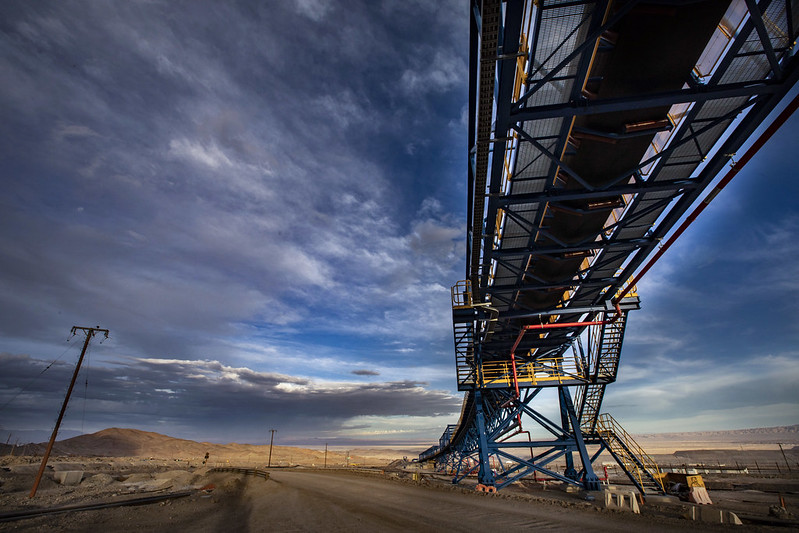
Chuquicamata mine. Credit: Codelco 

https://www.mining.com/web/giant-chile-mines-are-struggling-just-as-world-needs-more-copper/ 

Mines in the biggest copper-producing nation are struggling just as demand for the wiring metal is expected to accelerate in the shift away from fossil fuels.

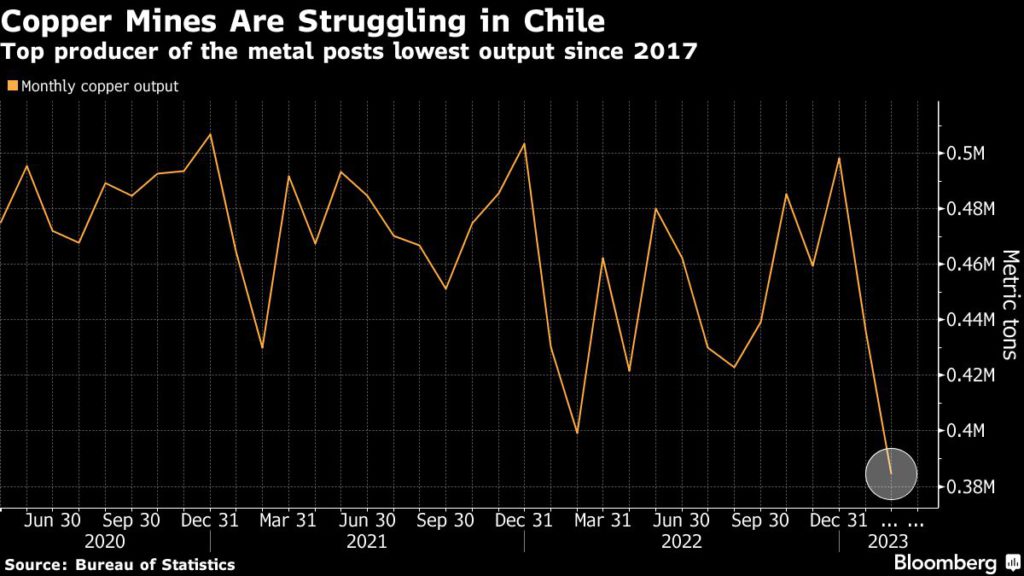
Chile, which accounts for a quarter of the world’s mined copper, posted its lowest monthly production in six years on Friday. Hours later, state-owned behemoth Codelco said its output woes of 2022 will only get worse this year as it strives to tap new areas of its aging deposits after decades of underinvestment.

Mines are being hampered by water restrictions in a prolonged drought as well as a string of operational setbacks and project delays as they battle deteriorating ore quality. That’s good news for copper bulls but it’s intensifying fears of a looming shortage given copper is a key material in the energy transition, used in everything from electric vehicles to wind turbines.
“It has been a complex year in terms of production, costs and surplus generation, which has challenged us to find ways to improve our future performance,” chief executive officer Andre Sougarret told reporters in Santiago Friday.

Copper futures reversed early declines Friday after the Chilean production release and were trading little changed at 12:30 pm in New York.

Heading lower

There’s no easy fix to the problem, with Codelco expecting production to fall as much as 7% this year after tumbling in 2022. The world’s biggest copper company sees output of between 1.35 million and 1.42 million metric tons at its wholly owned mines in 2023.

Sougarret spoke after the country’s statistics institute delivered data showing nation-wide production fell 12% in February from January, the weakest monthly result since early 2017.

For the global copper market, declining Chilean production signals further tightening of supplies at a time when Chinese demand has picked up after the easing of pandemic restrictions. Stockpiles on the London Metal Exchange are near the lowest levels in 18 years.

Still, Sougarret sees the market fairly balanced for now, predicting prices of between $3.50 and $4.40 per pound, compared with just above $4 at present.

The Chilean state-owned producer endured mishaps including a rockfall, equipment malfunctions and a dam freeze last year, pushing production down 11% to 1.45 million metric tons.

Codelco is developing several large-scale projects simultaneously in a bid to restore output by the end of the decade, Sougarret said. That’s a difficult task as the industry grapples with logistical challenges exposed by the pandemic and exacerbated by Russia’s invasion of Ukraine.

(By James Attwood)

House Passes Measure Blocking China From Buying US Farmland

A solar farm under construction in Punta Gorda, Fla., on April 22, 2016. (Kerry Sheridan/AFP via Getty Images)

A solar farm under construction in Punta Gorda, Fla., on April 22, 2016. (Kerry Sheridan/AFP via Getty Images)

https://www.theepochtimes.com/house-passes-measure-blocking-china-from-buying-us-farmland_5161734.html 

A bipartisan House majority has overwhelmingly passed a measure to keep Chinese investment out of U.S. land vital for producing renewable energy.

The measure, derived from the Defend America’s Rural Energy Act sponsored by Rep. Randy Feenstra (R-Iowa), passed with a vote of 407–26 on March 30 as an amendment to a bill earlier on Thursday that seeks to lower energy costs for Americans. It received support from 223 Republicans and 184 Democrats.

“Food security is national security,” Rep. Derrick Van Orden (R-Wis.), who signed on Feenstra’s amendment, told The Epoch Times, adding he was proud to cosponsor a measure that “keeps farmland in the hands of farmers and out of the hands of the Chinese Communist Party.”

Rep. Clay Higgins (R-La.) said he believes “American policy should deal with China quite decisively, and assert our massive economic leverage in every way possible.”

“Wars are averted through wise economic policy, and freedom has a chance to take root,” he told The Epoch Times after the measure’s passage. “My Democrat colleagues who understand these simple truths and voted with Republicans today should be recognized and commended. The entire world is imperiled because of CCP aggression, and America must lead the causes of peace through strength, and individual rights.”

Clay Higgins
Rep. Clay Higgins (R-La.) speaks during a House Committee on Oversight and Reform hearing on Capitol Hill in Washington on June 8, 2022. (Andrew Harnik-Pool/Getty Images)

Rep. Don Bacon, Republican from Nebraska, noted that his state is “one of the largest food-producing states in the nation and the world.”

“Agricultural security is national security,” he told The Epoch Times.

While Chinese investors own just shy of 1 percent of all foreign-held land in the United States as of 2021, land acquisition from China has taken on an accelerating pace. From 2010 to 2021, purchases from the country have leaped from 13,720 acres to 383,935 acres, a nearly 30-fold increase in just over a decade.

Such Chinese land ownership has drawn pushback recently in states such as North Dakota, where Chinese agribusiness Fufeng Group purchased 370 acres of farmland to build a corn mill near a sensitive air force base. In January, the U.S. Air Force warned that the project poses a “significant threat to national security.” The Grand Forks City Council in February unanimously voted to scrap the project.

Prior to that, China-based Guanghui Energy had acquired over 130,000 acres of ranch land in Texas to develop a wind farm near the Air Force’s largest pilot training facility. The founder of the Chinese firm is a former Chinese military officer.

Epoch Times Photo
Rep. Don Bacon (R-Neb.) speaks to reporters on Capitol Hill, in Washington, on Jan. 10, 2023. (Drew Angerer/Getty Images)

To Bacon, these Chinese investments near military facilities points to a worrying pattern.

“This is a grave concern, particularly since tensions with China are at an all-time high,” he said.

On March 28, Virginia signed into law a bill targeting China and other foreign adversaries in agricultural land acquisition. State lawmakers from Texas and Florida are also making a similar push.

Major Energy Companies Are Trading Tokenized Emissions Credits

article-image

https://blockworks.co/news/tokenized-emissions-credits-purewest-proman 

Natural gas producer PureWest is minting tokenized emissions credits in an effort to reduce the footprint of a methanol producer and other customers.

The Denver-based company’s certified environmental tokens (CETs) reflect aggregated data collected and verified by data company Project Canary. 

PureWest is now transacting the tokenized credits with Switzerland-based Proman, the world’s second largest methanol producer, the energy firm announced this week. PureWest itself is the most prolific natural gas producer in Wyoming, per its website.

The CETs are each matched to one million British thermal units (MMBtu) of gas produced and are sold on an MMBtu basis, Kelly Bott, PureWest’s senior vice president of ESG, land and regulatory told Blockworks. 

Using blockchain eliminates concerns about double selling and proves that each MMBtu of gas was produced with the Project Canary-verified attributes. PureWest describes CETs as “purchasable credits stored on the blockchain for third-party users to achieve their emission reduction goals.”

“With the purchase of these tokens, Proman can now purchase gas from anywhere while taking credit for our low-methane, freshwater friendly, safely and responsibly produced/certified gas when calculating their own environmental footprint,” Bott said.   

“These types of transactions serve to incentivize other producers to reduce their own environmental footprint and jump into this rapidly developing market.”

The tokens are transacted and stored on EarnDLT’s private blockchain, which was built using enterprise blockchain platform Quorum. 

JPMorgan forked Ethereum to create Quorum in 2016 before selling it to blockchain software firm ConsenSys four years later.

Tokenization is becoming en vogue

The PureWest-Proman linkup comes after Gold Standard chose climate tech company Flowcarbon to help it finalize guidelines around tokenizing voluntary emission reduction (VER) credits. 

Gold Standard CEO Margaret Kim said in a statement last September — when the company began exploring how it should go about creating digital tokens — that “blockchain could bring innovation, transparency and greater finance to the carbon market.”  

Tokenization has picked up steam in recent months, with Goldman Sachs, investment firm Hamilton Lane and Hong Kong’s government among those who have revealed such initiatives.  

BlackRock’s Larry Fink, CEO of the world’s largest asset managers, said in a letter earlier this month that the tokenization of assets is an attractive use case for his company. He had previously called the tokenization of securities “the next generation for markets.”

Most recently, Roofstock sold a Georgia home to ReaIT, a provider of fractional real estate investment in tokenized assets, in a transaction facilitated by an Ethereum-based NFT.

Japan buys Russian oil above $60-a-barrel cap, breaking with US allies: report

Japan has begun purchasing Russian crude oil above the $60-a-barrel cap, breaking with Western allies thanks to an exception authorized by the United States.

As many European nations weaned themselves off Russian oil in response to the invasion of Ukraine, Japan stepped up its purchase of Russian natural gas.

Russian oil

https://www.foxbusiness.com/markets/japan-buys-russian-oil-above-60-barrel-cap-breaking-us-allies-report 

Japan has begun purchasing Russian crude oil above the $60-a-barrel cap, breaking with Western allies thanks to an exception authorized by the United States. (Antonio Sempere / Europa Press via Getty Images / File / Getty Images)

Japan has almost none of its own fossil fuels, heavily relying on imports for much of its energy needs. Some analysts believe this dependency heavily influenced Japan’s hesitancy to fully back Ukraine against Russia. To date, Japan is the only Group of Seven members not to have supplied Ukraine with lethal weapons.

Despite the concession, Russian natural-gas imports to Japan are relatively small, accounting for around one-tenth of Japan’s supply and a fraction of Russia’s output, the Wall Journal reports. Most of what Russia exports to Japan comes from the Sakhalin-2 project in Russia’s Far East.

RUSSIAN OIL REROUTED TO ‘FRIENDLY’ COUNTRIES AT NO DECREASE IN SALES, OFFICIALS CLAIM

The G7 nations and Australia agreed to a $60 per barrel price cap on Russian seaborne crude oil to reduce Russia’s income from selling oil while preventing a spike in global oil prices.

Vladimir Arsenyev tanker in Russia

An aerial view shows the Vladimir Arsenyev tanker at the crude oil terminal Kozmino on the shore of Nakhodka Bay near the port city of Nakhodka, Russia, Aug. 12, 2022. (Reuters / Tatiana Meel / Reuters Photos)

The price cap allowed non-EU countries to continue importing Russian crude oil but prohibited shipping, insurance and re-insurance companies from handling cargoes of Russian crude around the globe, unless it is sold for less than the price cap.

CLICK HERE TO GET THE FOX BUSINESS APP

The nations granted an exception to the $60-a-barrel cap through September for oil purchased by Japan. And in the first two months of this year, Japan bought around 748,000 barrels of Russian oil for approximately $70 a barrel.

Reuters contributed to this report.

OPEC+ announces surprise oil cuts, while U.S. calls the move inadvisable

 Crude oil storage tanks at the Juaymah Tank Farm in Saudi Aramco's Ras Tanura oil refinery and oil terminal in 2018. Crude prices fluctuated in recent months, rising to more than $120 in early June amid growing fears about a global recession, subsequently falling to around $90 per barrel after OPEC+ slashed production.

Getty Images

https://www.cnbc.com/amp/2023/04/02/saudi-arabia-and-opec-producers-announce-voluntary-oil-output-cuts.html 

Saudi Arabia and other OPEC+ oil producers on Sunday announced further oil output cuts of around 1.16 million barrels per day, in a surprise move that analysts said would cause an immediate rise in prices and the United States called inadvisable.

The pledges bring the total volume of cuts by OPEC+, which groups the Organization of the Petroleum Exporting Countries with Russia and other allies, to 3.66 million bpd according to Reuters calculations, equal to 3.7% of global demand.

Sunday's development comes a day before a virtual meeting of an OPEC+ ministerial panel, which includes Saudi Arabia and Russia, and which had been expected to stick to 2 million bpd of cuts already in place until the end of 2023.

Oil prices last month fell towards $70 a barrel, the lowest in 15 months, on concern that a global banking crisis would hit demand. Still, further action by OPEC+ to support the market was not expected after sources downplayed this prospect and crude recovered towards $80.

The latest reductions could lift oil prices by $10 per barrel, the head of investment firm Pickering Energy Partners said on Sunday, while oil broker PVM said it expected an immediate jump once trading starts after the weekend.

"I expect the market to open several dollars higher ... possibly as much as $3," said PVM's Tamas Varga. "The step is unreservedly bullish."

Top OPEC producer Saudi Arabia said it would cut output by 500,000 bpd. The Saudi energy ministry said the kingdom's voluntary reduction was a precautionary measure aimed at supporting the stability of the oil market.

"OPEC is taking pre-emptive steps in case of any possible demand reduction," Amrita Sen, founder and director of Energy Aspects, said.

Last October, OPEC+ had agreed to an output cut of 2 million bpd from November until the end of the year, a move that angered Washington as tighter supply boosts oil prices.

The U.S. has argued that the world needs lower prices to support economic growth and prevent Russian President Vladimir Putin from earning more revenue to fund the Ukraine war.

The Biden administration said it sees the move announced by the producers on Sunday as unwise.

"We don't think cuts are advisable at this moment given market uncertainty - and we've made that clear," a spokesperson for the National Security Council said.

Cuts start in May

The voluntary cuts start in May and last until the end of the year. Iraq will reduce its production by 211,000 bpd, according to an official statement.

The UAE said it would cut production by 144,000 bpd, Kuwait announced a cut of 128,000 bpd while Oman announced a cut of 40,000 bpd and Algeria said it would cut its output by 48,000 bpd. Kazakhstan will also cut output by 78,000 bpd.

Russia's Deputy Prime Minister Alexander Novak also said on Sunday that Moscow would extend a voluntary cut of 500,000 bpd until the end of 2023. Moscow announced those cuts unilaterally in February following the introduction of Western price caps.

An OPEC+ source said Gabon would make a voluntary cut of 8,000 bpd and not all OPEC+ members were joining the move as some are already pumping well below agreed levels due to a lack of production capacity.

After Russia's unilateral reductions, U.S. officials said its alliance with other OPEC members was weakening, but Sunday's move shows the cooperation is still strong.

House Passes Sweeping Energy Bill; Schumer Says ‘Dead-on-Arrival’ in Senate

The U.S. Capitol building on Feb. 28, 2023. (Madalina Vasiliu/The Epoch Times)

The U.S. Capitol building on Feb. 28, 2023. (Madalina Vasiliu/The Epoch Times)

https://www.theepochtimes.com/house-passes-sweeping-energy-bill-schumer-says-dead-on-arrival-in-senate_5160295.html 

The House of Representatives passes a bill, 225–204, on March 30 that seeks to lower energy costs for Americans.

Four Democrats voted in favor of the measure.

The bill, introduced by House Majority Leader Steve Scalise (R-La.), would, among other things, increase U.S. energy production, reduce regulatory burdens, repeal the natural gas tax, increase the production and processing of critical minerals, streamline energy infrastructure and exports, and reform permitting. Senate Majority Leader Chuck Schumer (D-N.Y.) has said the measure is a “partisan, dead-on-arrival and unserious proposal for addressing America’s energy needs that they have laughingly labeled H.R. 1.”

In a statement, House Speaker Kevin McCarthy (R-Calif.) explained the necessity for the bill.

“The Biden administration has kneecapped American energy production, and endlessly delayed critical infrastructure projects. Democrats’ misguided policies increased costs for every American and jeopardized our national security—and they’ve made the rest of the world more reliant on dirtier energy from Russia and China,” he said.

“To lower costs for Americans and grow our economy, we need to get the federal government out of the way. The Lower Energy Costs Act will fast-track American energy production, and includes comprehensive permitting reforms that will speed construction for everything from pipelines to transmission to water infrastructure. And it ensures that the critical minerals needed for advanced technologies come from America—not China.”

Ahead of the vote, Scalise touted that the American energy industry has “the best standards in the world,” whereas Chinese energy is dirty. He also blasted Biden for canceling the Keystone XL Pipeline, which he did on his first day in office on Jan. 20, 2021, while waiving sanctions on NordStream 2, a pipeline that goes between Russia and Germany. Biden sanctioned the pipeline following Russia’s invasion of Ukraine. Scalise also slammed Biden for trying to get oil from authoritarian regimes, including Saudi Arabia and Venezuela, while hamstringing U.S. oil.

However, Democrats have blasted the bill, going as far as to call it the “Polluters Over People Act.”

“The ‘Polluters Over People Act’ would be disastrous for our national deficit, ballooning it by $2.4 billion over the next ten years, to pad the pockets of corporate polluters, who are, as you have heard, already enjoying record-breaking profits,” Rep. Jennifer McClellan (D-Va.) said on March 28.

“H.R. 1 is Republicans’ flagship legislation, and it blatantly disregards the financial interests, health, and well-being of American families while rewarding polluters with shameless giveaways.”

The bill comes amid high gas prices. Currently, gas prices nationwide on average are almost $3.49, according to AAA. In 2022, gas prices more than doubled from the previous year, when Biden took office.