Thursday, March 30, 2023

World's most important oil price is about to change for good

Photo: Bloomberg

https://www.tbsnews.net/bloomberg-special/worlds-most-important-oil-price-about-change-good-608174 

  • US oil to be added to Dated Brent benchmark from June cargoes
  • Dated Brent helps set price of around two-third of world's oil

After years of wrangling, the world's most important oil price is about to be transformed for good, allowing crude supplies from west Texas to help determine the price of millions of barrels a day of petroleum transactions.

The shift is because the existing benchmark, Dated Brent, is slowly running out of tradable oil for it to remain reliable. As such, its publisher S&P Global Commodity Insights — better known by traders as Platts — has been forced to make a dramatic overhaul.

Its switchover was fraught with controversy and caused a lot of stress among physical oil traders. But it was necessary. BP Plc at one stage said that Dated Brent was subject to "increasingly regular dislocations."

But the future of Dated is now set. From cargoes for June onward, West Texas Intermediate Midland, oil from the Permian will become one of a handful of grades that set the Dated benchmark.

Here's a look at what matters as the transition gets closer.

1. Why does it matter?

Dated, as it's commonly known by oil traders, helps to set the price of about two-thirds of the world's oil and even defines the price of some gas deals.

Oil producing states will often sell their barrels at small premiums or discounts to Dated, so the precise mechanics of how it is formed matter to them. In addition, the benchmark lies at the center of a complex web of derivatives, ultimately shaping Brent oil futures that get traded on exchanges.

Dated affects a host of oil prices, so even crude in Dubai could feel the effects, according to Adi Imsirovic, a veteran oil trader and senior research fellow at the Oxford Institute for Energy Studies.

2. Exactly what's happening?

Traders will be able to offer WTI Midland for sale from the US Gulf Coast. It will be delivered into Rotterdam and then price will be netted back using a freight adjustment factor as if it's shipped from the North Sea.

By following a careful process, Platts will evaluate if the oil is being offered at a higher or lower level than five existing grades that set Dated — Brent, Forties, Oseberg, Ekofisk or Troll.

If Platts judges that WTI Midland is the most competitive price on offer — or actually sold — then it could set Dated.

So WTI Midland might then influence the price a seller of an Atlantic Basin barrel charges a refinery in China.

3. How will price discovery work?

Imagine the existing Dated grades, which go under the acronym BFOET, are at $80 a barrel.

A trader might pick up a cargo of WTI Midland at $79 from a terminal the US Gulf with $2 added delivery cost to Rotterdam — more than 6,000 miles and around 17 days sailing away.

Platts would need to make that delivered cargo like-for-like against the existing BFOET grades, which are transacted on a so-called Free on Board, or FOB, basis in the North Sea.

To do that, it will use what it calls a freight adjustment factor, deducting the estimated cost of transportation across the North Sea to Rotterdam. If that were to be $1 a barrel, then the implied FOB price of WTI Midland in the North Sea would be about $80.

The process will place an emphasis on Platts's assessments of tanker costs. 

4. What's the timeline?

Some changes are already getting underway. In February, Platts began assessing forward prices based on the new assessment. Real cargoes of crude from the US will be allowed for inclusion from early May.

The expiry of the May Brent futures contract at end-March will rely on some trades of a June Brent exchange of futures for physical contract, which will take the changes into account.

Those key derivatives tools, along with the futures market, will determine the basis price of physical Dated Brent for June.

An important detail in the coming weeks is just how much trading of forward Dated Brent will pick up. So far, twelve entities have conducted transactions based on the new terms, according to Platts. 

Ultimately these deals will define something called the Brent Index, a once-a-month price published by ICE Futures Europe that's used for the cash settlement of futures.

"Without a forward market, there's no way to financially settle the ICE Brent contract," said Kurt Chapman, a veteran oil trader and ex-head of crude at Mercuria Energy Group, who retired in 2018 after almost three decades on the front lines of global oil trading. 

5. Will the Dated be better?

Assuming traders take to the adjustments, it will be transformative in terms of the underlying volume of oil that can be transacted.

In March alone, around 60 tankers hauling around 1.8 million barrels a day of oil were expected to arrive in Europe, the highest since 2016, according to data compiled by Bloomberg.

Something like 1 million barrels a day of WTI Midland will theoretically be eligible for inclusion in Dated, although the volumes may be marginal until the trading of new Dated picks up. 

6. What are the main concerns?

No two crudes are identical and eventually Platts will have to evaluate precisely how WTI Midland compares with other grades within BFOET.

Some say it is superior because of its density and sulfur levels.

However, some European traders have also expressed worries that the properties of WTI Midland cargoes may not match up to what was stipulated when it traded. That's because WTI is actually a blend of different crudes. 

It would be a problem if a cargo of oil — bought or sold with a view to setting a global benchmark underpinning prices globally — were found to have a flaw.

US terminal operators say there's not much to be concerned about. They say that the 11 terminals approved by Platts that will send crude are all able to assure consistently high quality to suit Dated.

Another issue is the cargo sizes that will be allowed to be included. At 700,000 barrels, they do not match up to the reality of current oil trading of US oil. 

There has been a flood of supertankers bringing 2-million-barrel cargoes across the Atlantic. Those wouldn't qualify for inclusion in setting the Dated.

Finally, the BFOET grades all come with their own loading programs with each consignment given its own unique identifier. That gives traders clear visibility on the supply of oil. That's not yet the case for WTI Midland and could cause some uncertainty about how many cargoes are being offered.

— With assistance by Sherry Su and Sheela Tobben

Disclaimer: This article first appeared on Bloomberg, and is published by special syndication arrangement.

Mexican president proposes tougher mining laws, shorter concessions

 Mexican Network of People Affected by Mining blasts mining law reform

Mexican President Andrés Manuel López Obrador. (Image by Gobierno Danilo Medina, Flickr).

https://www.mining.com/web/mexican-president-proposes-tougher-mining-laws-shorter-concessions/ 

The Mexican government’s proposed overhaul of mining laws, including shorter concessions and tighter rules for permits, drew a quick warning from industry leaders who fear it could undermine the sector’s growth prospects.

President Andres Manuel Lopez Obrador offered the draft reform on Tuesday to lawmakers in the lower house of Congress, which would sharply reduce the length of mining concessions to 15 from 50 years.

Mexico, a major mining country for decades, is the world’s top primary silver producer, as well as a top 10 gold and copper miner.

The initiative, which still must pass various legislative steps before it could be enacted, would also add new requirements to obtain mining and water permits, establish a new obligation to disclose mining impacts, and require miners to give back at least 10% of the profits to communities.

The country’s mining chamber Camimex warned that changes contemplated in the draft could provoke “strong repercussions” for the industry, stressing in a statement late on Tuesday that it continued to analyze the proposal.

Since he took office in late 2018, Lopez Obrador has refused to offer any new mining concessions, arguing that too many had been granted by previous governments.

Last year, the president championed the nationalization of the country’s nascent lithium industry, favoring a newly created state-run producer to mine the coveted battery metal, in another move mining sector analysts see dampening investor appetite.

Shares in precious metals miner Industrias Penoles fell more than 3% on Wednesday, after jumping more than 5% the day before, while Compania Minera Autlan dipped nearly 2%.

Leading copper producer Grupo Mexico advanced 0.73%, marking its third consecutive day of gains.

In its statement, Camimex expressed hope the upcoming debate over the proposal will incorporate industry concerns, adding it expects “a broad, inclusive and informed legislative discussion.”

(By David Alire Garcia, Valentine Hilaire and Noe Torres; Editing by Richard Chang)

Wednesday, March 29, 2023

$11 Trillion Investor Group Urges Members Not To Fund New Oil And Gas Projects

https://fsmedia.imgix.net/9f/14/0c/f7/81fb/4f2c/b371/1b9df2d22013/palpatine-teethpng.png?rect=0%2C82%2C2180%2C1091&auto=format%2Ccompress&dpr=2&w=650

https://oilprice.com/Latest-Energy-News/World-News/11-Trillion-Investor-Group-Urges-Members-Not-To-Fund-New-Oil-And-Gas-Projects.html 

The Net-Zero Asset Owner Alliance, a group made up of members from the banking, insurance, and investment sectors with $11 trillion of assets under management, called on its members on Wednesday to align their oil and gas policies to a 1.5-degree Celsius pathway, which cannot be achieved if there are new upstream infrastructure investments in new oil and gas fields.

“On private asset investment in new unabated oil and gas infrastructure, investors, including Alliance members, shall align with credible 1.5°C net zero scenarios. This cannot be achieved if there are new upstream infrastructure investments in new oil and gas fields,” the alliance said in a statement.

The alliance, in which 85 major banks and institutional investors are represented, issued a new position on the oil and gas sector today, expecting its member investors to adopt policies that align with these positions on infrastructure investments, or show how existing policies already align.

The investor group also called on oil and gas producers and their customers to set science-based, absolute- and intensity-oriented emissions targets covering Scope 1, 2, and 3 greenhouse emissions that are aligned with 1.5°C or limited overshoot scenarios.

“How energy is provided and consumed must therefore dramatically change. This includes the need to phase out non-renewable sources like oil and gas in many, if not most, of its current uses,” said Günther Thallinger, Allianz SE Board Member and Chair of the Net-Zero Asset Owner Alliance.

Under pressure from ESG trends and shareholders, some banks have announced in recent months tougher rules on the financing of fossil fuels.

ING, for example, is further restricting financing to the oil and gas industry, reducing the volume of traded oil and gas it finances and no longer financing midstream infrastructure for new oil and gas fields, the Netherlands-based bank said earlier this month. Last year, ING said it would aim to grow new financing of renewable energy by 50% by year-end 2025 and would no longer provide dedicated finance to new oil and gas fields.

Barclays has said it will no longer provide financing to oil sands companies or oil sands projects and tightened conditions for thermal coal lending in an updated policy, which fell short of announcing overall pledges or targets in funding oil and gas. 

ADVERTISEMENT

By Tsvetana Paraskova for Oilprice.com

U.S. gas producers skimped on price hedges and now face a reckoning

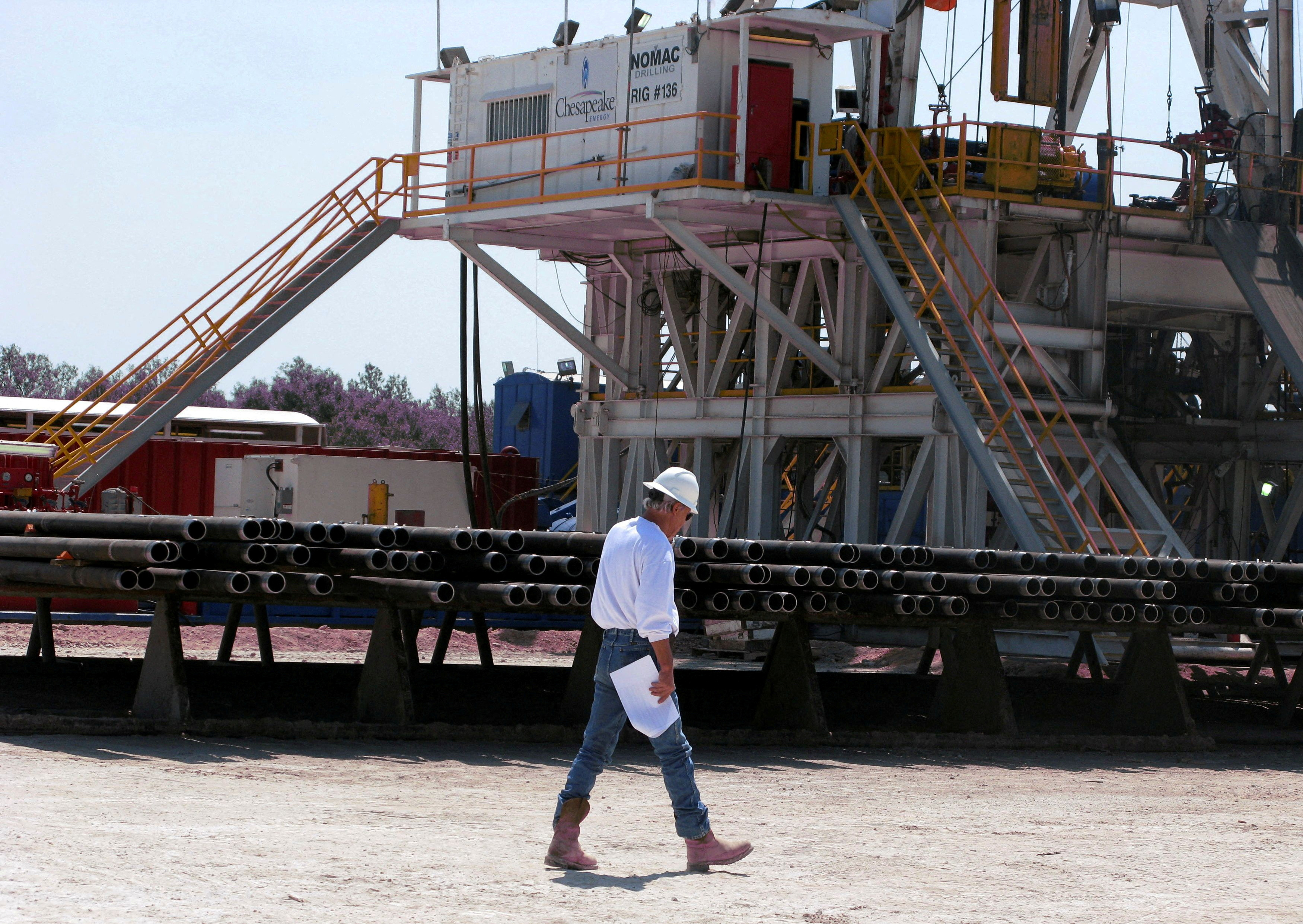
A Chesapeake Energy Corp worker at a drilling site on the Eagle Ford shale near Crystal City, Texas

A Chesapeake Energy Corp worker walks past stacks of drill pipe needed to tap oil and gas trapped deeply in rock like shale at a Chesapeake oil drilling site on the Eagle Ford shale near Crystal City, Texas, June 6, 2011. REUTERS/Anna Driver/File Photo

https://www.reuters.com/business/energy/us-gas-producers-skimped-price-hedges-now-face-reckoning-2023-02-14/ 

HOUSTON, Feb 14 (Reuters) - A rout in natural gas prices will hurt first-quarter earnings and cash flows at gas producers as hedges - the industry's version of price insurance - were inadequate to offset the expected losses, analysts and industry experts said.

Producers starting the year with fewer hedges than historically will have to sell more gas at the market rate of about $2.45 per million British thermal units (mmBtu), below the breakeven prices for producing gas in some regions, and that may force some companies to reduce drilling and put off completing wells.

Hedges, or contracts that lock in prices for future output, help producers protect cash flows against price swings, helping them drill and complete wells - crucial at a time when Europe has looked to the United States for gas.

U.S. prices for the heating fuel traded as low as $2.34 per mmBtu this month, down 76% from last year's August peak and the lowest level since April 2021, on mild winter weather in North America and on weaker exports.

The low levels of hedging would drain cash flow as market selling prices are low, said Matt Hagerty, senior energy strategist at FactSet's BTU Analytics.

About 36% of 2023 gas production was hedged at the end of September, according to consultancy Energy Aspects, which tracked 40 publicly traded gas producers. That percentage was down from 52% a year earlier.

Producers entered in to only two to three swap deals per month from April to October last year, said David Seduski, natural gas analyst at Energy Aspects, referring to a type of hedge. He called that amount "incredibly minimal" and said it compared with 30 to 50 such trades per month in 2021.

A rally in prices in 2022 after Russia's invasion of Ukraine forced a lot of producers already hedged at lower prices to take on hedging losses. That may have encouraged them to hedge less.

"Last year was pretty jarring for folks, who weren't ready for the uptick in price. A lot of folks probably sold off those hedges and wanted to be exposed to the upside and might see themselves in the predicament they're in now," said Trisha Curtis, chief executive of energy consultancy PetroNerds added.

EQT Corp (EQT.N), the top U.S. producer of natural gas, last month said it expects a $4.6 billion loss on derivatives for 2022, and net cash settlements of $5.9 billion. No. 2 producer Southwestern Energy Co (SWN.N) posted a $6.71 billion loss on derivatives for the first nine months of 2022.

RISKY STRATEGIES

Some companies have let their hedges expire, increasing exposure to current prices. Antero Resources Corp (AR.N) said in October that the vast majority of its hedges would roll off by Jan 1.

Another type of hedge, known as a three-way collar, could backfire because of the extent of the fall in prices, analysts said. These transactions have a producer buy an agreement to sell natural gas at one price, called a put, while also selling a put at a lower price in hopes of pocketing the premium from its buyer.

Effectively, this is a calculated bet that gas will fall to a certain level and no further. But when it falls below the predicted lower price, it takes away some of the benefits of the hedge.

Chesapeake Energy Corp (CHK.O), for example, bought puts for 900 million cubic feet at $3.40 per million cubic feet (mmcf), while also selling puts for $2.50 mmcf for the first quarter, according to a November presentation.

Were gas prices to average $2.36 per mmcf, the company would pay out 14 cents per mmcf, reducing the gains from the hedge.

Antero and Chesapeake did not respond to a request for a comment.

Denver-based Ovintiv Inc (OVV.N), previously Encana, also said it had sold puts for 400 mmcfpd at $2.75 per mmcf for the first quarter of 2023, according to a November press release. That would erode the gains from the hedges by about 39 cents per mmcf.

On the other hand, companies that locked in higher prices on average during the run-up in prices late last year could see gains, Rystad Energy senior analyst Matthew Bernstein said.

While overall hedging was lower, the average $3.16 per mmBtu was higher than a year earlier, he added. EQT, for example, has hedged about 58% of its total production at an average of about $3.40 per mmBtu, higher than current market prices.

Ovintiv and EQT did not immediately respond to a request for a comment.

Reporting by Arathy Somasekhar in Houston Editing by Matthew Lewis

Investments in renewable energies must quadruple to meet climate target -IRENA

https://images.fineartamerica.com/images-medium-large-5/one-trillion-dollar-bill-charles-robinson.jpg

https://www.reuters.com/article/renewables-investments-idAFL8N35Z4UK 

BERLIN, March 28 (Reuters) - Global investments in energy transition technologies must more than quadruple annually to stay in line with commitments made under the Paris climate accord, the International Renewable Energy Agency (IRENA) said on Tuesday.

Investments in renewable energy technologies reached a record of $1.3 trillion last year but that figure must rise to around $5 trillion annually to meet the key Paris accord target of limiting temperature increases to 1.5 degrees Celsius (2.7 Fahrenheit) above pre-industrial levels, IRENA said.

In total, the world needs around $35 trillion for transition technology by 2030, including improving efficiency, electrification, grid expansion and flexibility, IRENA said.

Renewable energy deployment must grow from around 3,000 gigawatts annually today to over 10,000 GW in 2030, IRENA said, adding that more equality is needed in renewable expansion between industrial and developing countries.

New renewable energy projects in China, the European Union and the United States accounted for two thirds of installed capacity last year, while Africa accounted for only 1% of renewable capacity installed.

“A fundamental shift in the support to developing nations must put more focus on energy access and climate adaptation,” IRENA’ Director General Francesco La Camera said, calling on financial institutions to direct more funds towards energy transition projects with better conditions.

IRENA called for directing planned fossil fuel investments -around $1 trillion of fossil fuel investments per year by 2030 - toward renewable energy technologies and infrastructure. (Reporting by Riham Alkousaa; Editing by Sharon Singleton)

[Full Ver.] North Korea stages massive military parade at midnight

Sir Christopher Chope