Thursday, October 6, 2022

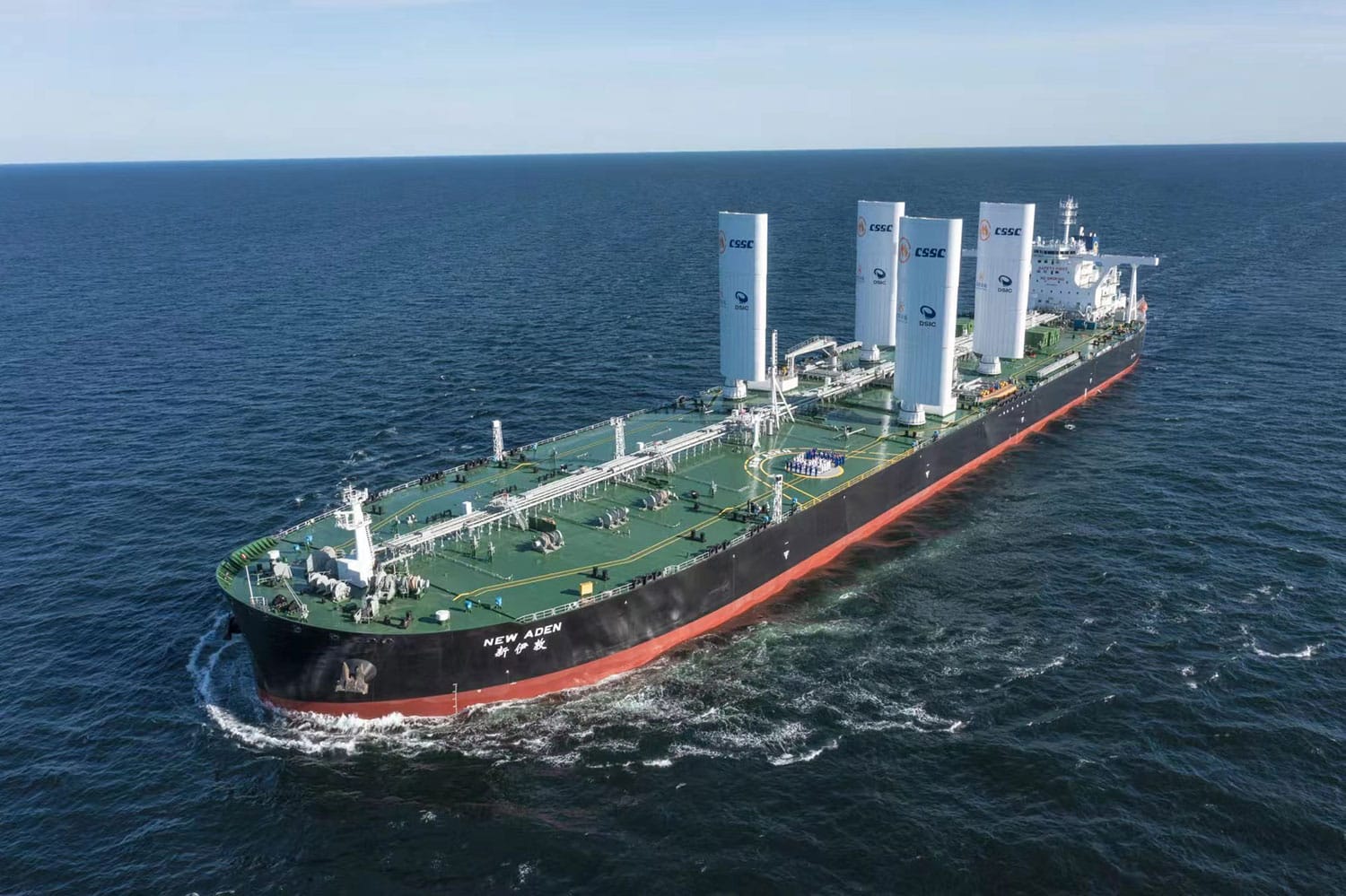
China launches new generation VLCC with rigid wing sails

 https://www.inceptivemind.com/wp-content/uploads/2022/10/New-Aden-VLCC.jpg

https://www.tankeroperator.com/ViewNews.aspx?NewsID=13302 

The sails are expected to slash average fuel consumption by nearly ten percent

China Classification Society (CCS) is hailing a major milestone after overseeing the delivery and naming ceremony of the first VLCC ever built in China deploying four 40metre rigid wing sails.

CCS attended the naming ceremony of the 307,000 DWT, 333 metre crude oil carrier M/V New Aden at Dalian Shipbuilding Industry Co (DSIC) together with the owner China Merchants Energy Shipping (CMES) and China Shipbuilding Trading Company. China Merchants Group chairman Mr Miu Jianmin meanwhile named the vessel.

CCS Vice President Mr Fan Qiang represented CCS at the ceremony saying the New Aden is ‘one of the most advanced VLCCs ever built in China’. He said the sails are expected to slash average fuel consumption by nearly 10pc on the Middle East to the Far East route cutting an estimated 2900 tons of CO2 emissions a year.

“The New Aden is an outstanding vessel which embraces the very latest design techniques as we work towards meeting the IMO GHG targets,” he said. “China Merchants, Dalian Shipbuilding’s R & D team and Guangwei Composite Materials have undertaken great work in developing the ship and this new generation of rigid wing sail (see notes to editors 1). The sails have a combined surface of around 1200 sq m and are a true innovation. They are made of a low weight carbon fibre composite supported by high strength corrosion resistance and a state-of-the-art autonomous control system. This system maximises efficiency in complex operating conditions. The technology monitors power supply and self-inspects to ensure the hydraulic lifting and electric rotation is optimised to ensure peak performance.”

Mr Fan said the New Aden sets new standards in VLCC performance.

“Together with China Merchants and Dailian Shipbuilding we have looked at every aspect of design to deliver the best possible result in fuel reduction, sailing performance in wind and waves through optimised hull design as well as safety and environmental protection,” he said. “The New Aden further meets the requirements of Harmonized Common Structural Rules (HCSR), the latest oxynitride and oxysulfide emission standards, the update phase requirements of the Energy Efficiency Design Index (EEDI) and the Energy Efficiency Existing Ship Index (EEXI). It further meets the EU Inventory of Hazardous Materials and ship recycling rules in line with the latest oil major requirements.”

So what happens now that OPEC+ has cut production by 2 million barrels a...

Tuesday, October 4, 2022

Saudi Arabia’s Oil Production Increased by 20% in 8 Months

 https://wstale.com/wp-content/uploads/2018/10/ccelebritiesfotoNINTCHDBPICT000440400814-e1539768207673.jpg

MBS

https://tankterminals.com/news/saudi-arabias-oil-production-increased-by-20-in-8-months/?vgo_ee=peYRwyI2Ab3FcNxZ0pnEDgA3SuMkJhmkGexv49sZvNU%3D 

The Kingdom’s production reached around 10.5mln barrels per day.

Saudi Arabia’s average oil production increased since the beginning of 2022 until the end of August by 20 percent, a government document seen by Saudi Gazette showed.

The Kingdom’s production reached around 10.5 million barrels per day, higher by 1.8 million barrels per day compared to the same period last year.

The increase is due to the efforts by the OPEC+ agreement to support market stability and the performance efficiency for the benefit of the participants in the market and the petroleum industry.

Saudi Arabia expects the real GDP growth to reach 8 percent in 2022, driven by real GDP growth in oil activities and the sustained levels of growth in the non-oil activities, which is expected to record growth of 5.9 percent in 2022.

According to the OPEC monthly report on oil markets in August of 2022, global demand for oil is expected to register a growth of 3.1 million barrels per day compared to last year, to reach 100.03 million barrels per day.

Global demand for oil in 2023 is expected to grow by around 2.7 million barrels per day, to reach 102.72 million barrels per day.

It is worth noting that the share of the non-OECD countries constitutes the largest percentage of the growth in 2023, which is around 2.1 million barrels per day.

The report attributes this increase to the economic recovery in these countries and the increase in demand for fuel in the transport, industry, and petrochemicals sectors.

The average price of Brent crude futures increased, since the beginning of 2022 until the end of August, by 55 percent to record around $104.04 per barrel, compared to $67.06 per barrel during the same period last year.

The average prices of Brent crude futures have recorded their highest levels since 2008, with the closing price reaching $127.98 per barrel on March.8, 2022.

Despite uncertainty in the global markets during this year in the midst of the geopolitical events, the severe economic concerns and the tightening of the monetary policies to curb inflation around the world, the oil market has been characterized with stability compared to other energy markets such as natural gas, coal, and electricity.

The OPEC+ agreement contributed to supporting stability of the oil market in particular, and balancing supply with the gradual recovery in global demand for oil after the Coronavirus pandemic has faded.

Oil Prices Rise on U.S. Production Outages

https://www.jwnenergy.com/media/filer_public_thumbnails/filer_public/4a/04/4a047471-d8d7-4102-84f2-f120910a7fba/oilgas_baton-rouge-refinery_source_exxonmobil.jpg__740x740_q85_subsampling-2.jpg

https://tankterminals.com/news/oil-prices-rise-on-u-s-production-outages/?vgo_ee=peYRwyI2Ab3FcNxZ0pnEDgA3SuMkJhmkGexv49sZvNU%3D 

Oil prices rose on Wednesday in U.S. trading hours as production cuts caused by Hurricane Ian outweighed downward pressure from a strengthening dollar and expected U.S. crude stockpile builds.

Brent crude futures were up 80 cents, or 0.9%, at $87.07 per barrel by 1229 GMT, while U.S. West Texas Intermediate (WTI) crude futures rose 97 cents, or 1.2%, to 79.47 per barrel. Both contracts erased earlier falls after rising over 2% in the previous session.

In the Gulf of Mexico, about 190,000 barrels per day of oil production, or 11% of the Gulf’s total, were shut-in due to Hurricane Ian, according to offshore regulator the Bureau of Safety and Environmental Enforcement (BSEE).

Global equities pulled off two-year lows on Wednesday, after the Bank of England said it would step into the bond market to stem a damaging rise in borrowing costs, thereby dampening investors fears of contagion across the financial system.

Latest Updates

EU vows to protect energy systems after ‘sabotage’ on Russian gas pipelines
Oil prices rise on U.S. production outages
Analysis: Russia’s Ukraine gas transit sanction threat a fresh blow for Europe
U.S. oil refinery run-rates could top 90% for 3rd quarter in a row

The dollar hit a fresh two-decade peak against a basket of currencies on Wednesday as rising global interest rates fed recession concerns. A strong dollar reduces demand for oil by making it more expensive for buyers using other currencies.

U.S. crude oil stocks rose about 4.2 million barrels for the week ended Sept. 23, while gasoline inventories fell about 1 million barrels, according to market sources on Tuesday, citing figures from industry group the American Petroleum Institute.

Distillate stocks rose by about 438,000 barrels, according to the sources. The report comes ahead of official Energy Information Administration data due 1430 GMT.

Goldman Sachs cut its 2023 oil price forecast on Tuesday, due to expectations of weaker demand and a stronger U.S. dollar, but said global supply disappointments only reinforced its long-term bullish outlook.

An upcoming price catalyst will be producer group OPEC+’s Oct. 5 meeting at which Russia is likely to propose an output cut of around 1 million barrels per day, a source familiar with the Russian viewpoint said on Tuesday.

Germany Inks LNG Deal As Chancellor Visits Gulf to Secure Energy


German Chancellor Olaf Scholz /UAE  

AP

https://tankterminals.com/news/germany-inks-lng-deal-as-chancellor-visits-gulf-to-secure-energy/?vgo_ee=peYRwyI2Ab3FcNxZ0pnEDgA3SuMkJhmkGexv49sZvNU%3D 

German utility RWE has signed a deal with Abu Dhabi National Oil Company (ADNOC) to deliver liquefied natural gas to Europe’s largest economy by the end of December, RWE announced on Sunday.

Though the initial amount to be delivered is relatively small, it’s a politically significant deal to shore up supplies of gas from outside of Russia as Chancellor Olaf Scholz seeks to deepen ties with the Gulf and find alternative energy sources.

The deal, which includes a memorandum of understanding for multi-year supplies of LNG, came on the second day of a two-day trip to the Gulf region by Scholz.

“We need to make sure that the production of LNG in the world is advanced to the point where the high demand that exists can be met without having to resort to the production capacity that exists in Russia,” Scholz told journalists before the deal was announced.

The cargo to be delivered this year by ADNOC will be for 137,000 cubic metres of LNG and will be the first LNG to be supplied to the German gas market via the floating LNG import terminal at Brunsbüttel near Hamburg, RWE said.

ADNOC further reserved an unspecified number of LNG cargoes for Germany in 2023.

Germany’s two new planned floating LNG terminals will eventually be able to receive up to 12.5 billion cubic meters of LNG a year, equivalent to about 13% of the country’s gas consumption in 2021, according to data from research firm Enerdata.

“This marks an important milestone in building up an LNG supply infrastructure in Germany and setting up a more diversified gas supply,” RWE said in a statement.

German officials hope an array of deals, like the one struck with Abu Dhabi for LNG, will help take the edge off skyrocketing energy prices.

Meanwhile, frustrated Germans protested on Sunday, calling to put into service the halted Nord Stream 2 pipeline project that was designed to transport fuel from Russia to Germany but was put on ice after the war in Ukraine broke out.

“Immediately open Nord Stream 2,” read one placard. “Opening Nord Stream 2 = Prevention”, read another. Organizers expected some 5,000 protestors in the city of Lubmin, where the pipeline lands in Germany.

In addition to supplying RWE, ADNOC has also agreed to sell ammonia to German companies, including Steag and Aurubis (NAFG.DE). It will also provide 250,000 tonnes of diesel a month to German firm Hoyer.

Earlier on Sunday, the president of the United Arab Emirates, Sheikh Mohammed bin Zayed al-Nahyan, signed an agreement with Scholz that covers accelerating energy security and industrial growth.

Separately, the UAE renewable energy company Masdar will explore wind energy development off the German coast.

Scholz travelled to Qatar after his meetings in Abu Dhabi. On Saturday, he held talks in Jeddah with Saudi Arabia’s Crown Prince Mohammed bin Salman.

Reporting by Andreas Rinke and Moataz Mohamed

Monday, October 3, 2022

Angel Oak proves “resilience once again” during Hurricane Ian

 https://www.southernspiritguide.org/wp-content/uploads/2011/12/078.jpg

https://www.newsbreak.com/news/2769975770287/angel-oak-proves-resilience-once-again-during-hurricane-ian?_f=app_share&s=a3&share_destination_id=MTM3MTE3MDI3LTE2NjQ4MDU4MDkwMDE=&pd=09HKOxl3&hl=en_US&send_time=1664805809&actBtn=floatShareButton&trans_data=%7B%22platform%22%3A1%2C%22cv%22%3A%2222.39.3%22%2C%22languages%22%3A%22en%22%7D 

JOHNS ISLAND, S.C. (WCBD) – An iconic oak tree – named the Angel Oak – has withstood yet another hurricane in its long history, according to the City of Charleston.

Hurricane Ian, a Category 1 storm, brought strong winds to the Charleston area on Friday. Forecasters say wind speeds of 92 miles per hour were reported at Shutes Folly, with nearly 70 miles per hour reported in Charleston.

And while the severe weather put the historic Angel Oak to the test, its survival is a true mark of resiliency.

Charleston city leaders call the Angel Oak a “Lowcountry treasure” with a history dating back 400-500 years.

Located on Johns Island, the tree measures 66.5 feet tall and 28 feet in circumference.

The City of Charleston says that city arborists surveyed the Angel Oak Tree for storm damage on Sunday. “The famous Angel Oak has proven her resilience once again,” city officials said.

The city reported no damage to the iconic tree.