Wednesday, April 20, 2022

Biden restores stricter environmental review of big projects

 https://assets-global.website-files.com/56e1b4d62ed664c311e125b3/5a0327c04d0ef80001546339_red-tape-1.jpg

https://www.newsbreak.com/news/2576936278871/biden-restores-stricter-environmental-review-of-big-projects?_f=app_share&s=a3&share_destination_id=MTM3MTE3MDI3LTE2NTAzOTA2NTQyMTg=&pd=09HKOxl3&hl=en_US 

WASHINGTON (AP) — The Biden administration is restoring federal regulations that require rigorous environmental review of major infrastructure projects such as highways, pipelines and oil wells — including likely impacts on climate change and nearby communities. The longstanding reviews were scaled back by the Trump administration in a bid to fast-track projects and create jobs.

A rule finalized Tuesday will restore key provisions of the National Environmental Policy Act, a bedrock environmental law designed to ensure community safeguards during reviews for a wide range of federal proposals, including roads, bridges and energy projects authorized in the $1 trillion infrastructure law Biden signed last fall, the White House said.

The White House Council on Environmental Quality said the new rule, which takes effect in late May, should resolve challenges created by the Trump-era policy and restore public confidence during environmental reviews.

“Restoring these basic community safeguards will provide regulatory certainty, reduce conflict and help ensure that projects get built right the first time,” said CEQ Chair Brenda Mallory. “Patching these holes in the environmental review process will help projects get built faster, be more resilient and provide greater benefits to people who live nearby.”

Former President Donald Trump overhauled the environmental reviews in 2020 in a bid to accelerate projects he said would boost the economy and provide jobs.

Trump made slashing government regulations a hallmark of his presidency. He and his administration frequently expressed frustration at rules they said unnecessarily slowed approval for interstate oil and gas pipelines and other big projects. The rule change imposed in 2020 restricted the timelines for environmental reviews and public comment and allowed federal officials to disregard a project’s role in cumulative effects, such as climate change.

The new rule comes as the Supreme Court reinstated a separate Trump-era rule that curtails the power of states and Native American tribes to block pipelines and other energy projects that can pollute rivers, streams and other waterways.

In a decision that split the court 5-4 earlier this month, the justices agreed to halt a lower court judge’s order throwing out the Trump rule. The decision does not interfere with the Biden administration’s plan to rewrite the Environmental Protection Agency rule. Work on a revision has begun, but the administration has said a final rule is not expected until next spring. The Trump-era rule will remain in effect in the meantime.

Contrary to frequent assertions by Trump and others in his administration, Mallory said a more rigorous environmental review will actually speed up completion of major projects, since they will be more likely to withstand a legal challenge by environmental groups or states. Many Trump-era environmental decisions were reversed or delayed by courts after findings they did not undergo sufficient analysis.

Environmental groups hailed the rule change, which they said restores bedrock environmental protections under NEPA, a 1970 law that requires the government to accept public comments and take environmental, economic and health impacts into consideration before approving any major project.

“NEPA plays a critical role in keeping our communities and our environment healthy and safe, and Donald Trump’s attempts to weaken NEPA were clearly nothing more than a handout to corporate polluters,″ said Leslie Fields, the Sierra Club’s national director of policy, advocacy and legal affairs.

Environmental groups and African American, Latino and tribal activists had protested the Trump-era rule change, saying it would worsen pollution in areas already reeling from oil refineries, chemical plants and other hazardous sites. The Biden administration has made addressing such environmental justice issues a key priority.

“Communities of color, especially, have relied on NEPA to make sure their voices are heard in decisions that have a profound impact on their health and their well-being,” said Rosalie Winn, a senior attorney for the Environmental Defense Fund, which challenged the Trump-era rule.

The White House action “reestablishes essential NEPA safeguards and ensures they will continue to protect people and communities today and in future generations,‴ she said.

Business groups and Republican lawmakers criticized the rule change, saying it would slow down major infrastructure developments.

“Important projects that address critical issues like improving access to public transit, adding more clean energy to the grid and expanding broadband access are languishing due to continued delays and that must change,″ said Chad Whiteman, vice president for environment and regulatory affairs for the U.S. Chamber of Commerce.

Arkansas Rep. Bruce Westerman, the top Republican on the House Natural Resources Committee, said the White House action would “weaponize NEPA” by making it harder to navigate and more bureaucratic.

“At a time when we should be coalescing around bipartisan ways to lower gas prices, tame skyrocketing inflation and fix the supply chain crisis, President Biden is unfortunately reinstating archaic NEPA regulations that will only result in delays and red tape and feed activist litigation,″ he said.

Tuesday, April 19, 2022

Top 50 mining companies power through covid adding $1 trillion in value

 https://www.miningmetalnews.com/sites/default/files/media-cover-images/Kittilla%2C_Finland%3B_Open_Pit_Mine_1.jpg

https://www.mining.com/top-50-mining-companies-power-through-covid-adding-1-trillion-in-value/

Extreme volatility on metal and mining markets continued into 2022 amid historically low stockpiles of metal on global exchanges, but for most sectors the risks remained on the upside.

Copper prices again entered record territory, iron ore prices climbed to $150 a tonne after dipping to double digits late last year, and industrial metals including nickel, tin and zinc shot up.

The Ukraine war lit a fire under an already hot potash market, coal and uranium benefitted from the ongoing worldwide energy crunch, lithium soared and cobalt bolted.   Gold pierced $2,000 but couldn’t hold it and palladium hit a record only to pull back sharply.

Rising tide 

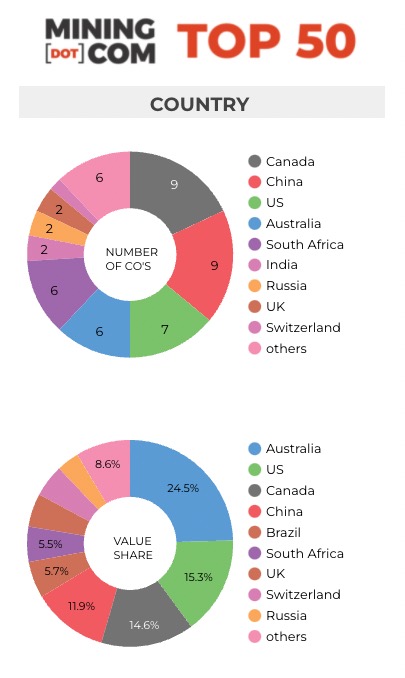
Investors made the most of the turmoil with the MINING.COM TOP 50* ranking of the world’s most valuable miners jumping by $335 billion in Q1, extending a trend that has seen valuations balloon nearly 150% since the lows of March-April 2020. 

From just over $700 billion at the depth of pandemic slump, the globe’s 50 most valuable mining companies now have a combined worth of $1.75 trillion, handily beating the previous record valuation set mid-2021.  

The index received a boost from the merger, closed in February, of constituents Agnico Eagle and Kirkland Lake Gold that created a $30 billion-plus company, but valuations moved sharply higher across the board. 

At the end of Q1 2020 a valuation of just over $3 billion secured a company a spot in the ranking while today, number 50 on the list, lithium and iron ore newcomer Mineral Resources, is valued at $8.5 billion. 

The mid-tier has also been swelling – a year ago 17 companies enjoyed a market valuation above $20 billion. Now investors have pushed 30 miners above that mark.  

Many of the counters – including big names such as Glencore, Anglo American and Newmont Goldcorp – are also trading close to 52-week highs. 

Rouble trouble 

The bottom did not fall out for Russia-based miners and, much like the rouble and the Moscow Stock Exchange, the country’s top companies have proved resilient. 

Were it not for the fact that Alrosa dropped out of the top 50 after its valuation slid to $8.2 billion, Russia’s combined representation in the ranking would’ve decreased by only 12%. 

Norilsk is placed outside the top 10 for the first time, but that is more of a function of soaring valuations among its peers – the nickel, palladium and copper producer only fell 16% in USD terms since the start of the year. 

The dollar market cap of Polyus has in fact climbed in 2022 – no doubt boosted by its significance as rouble hedge on the MCX.   

$100 billon club 

The Big 3 – BHP, Rio Tinto and Vale – dragged down the index last year, losing a combined $56 billion due to a pullback in iron ore prices and a cooling copper market in the latter part of 2021. 

But the first three months of 2022 saw combined gains just shy of $100 billion for the $100 billion market cap club. 

BHP peaked at a valuation of $206 billion mid-2021 and for a time was worth more than the oil major Shell, making it the most valuable stock on the LSE and marking a symbolic shift in the global resources sector.  On the ASX, the world’s number one miner is closing in on all-time highs after dropping its dual listing structure.

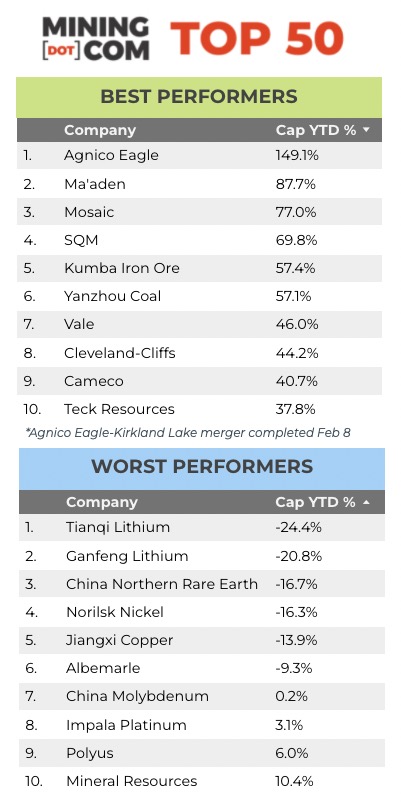
Rio Tinto’s USD market cap has grown 22% year to date, rebuilding after the reputational damage it suffered last year while Vale has come roaring back in 2022 topping $100 billion again after a 46% gain in US dollar terms on the Bovespa. 

After spending time outside the top 10 not that long ago, Glencore’s been thoroughly rerated and this week regained its 2011 IPO price in London for the first time. Unlike its peers, Glencore has not abandoned coal mining amid a spike in prices, and its trading arm is benefiting from sky high prices for energy

At the same time Anglo American, which six short years was in danger of suffocating under a pile of debt, is trading at all-time highs.  In January 2016 the market value of the company with a history going back more than a hundred years on the South African gold and diamond fields, fell to below $5 billion. Now it’s above $70 billion.  

Lively lithium

After quintupling in little over a year, some sanity may be returning to lithium prices and with it valuations of stocks in the sector. 

Ganfeng Lithium is included in the top 50 ranking for the first time as the Chinese battery manufacturer moves aggressively upstream making no less than nine investments in mines and projects over the past few years. Ganfeng’s long term goal is output of 600ktpa LCE or 20% of the market from spodumene, brine and clay sources. (See Notes below table for more on inclusion criteria.)

Nevertheless, the volatile stock has lost a fifth of its value so far this year, and has nearly halved from its peak in Hong Kong in August last year as early backers take profits.  

Albemarle has also been cut down from its high reached in November last year when the company was valued at $34 billion, but rival SQM has staged a massive comeback following a slump at the end of last year. 

Ever volatile Tianqi Lithium falls 13 places to no. 31 in the ranking after losing 24% year to date to a dollar value of $18.7 billion for the Shenzen-listed stock. Tianqi briefly fell out of the ranking altogether two years ago.  

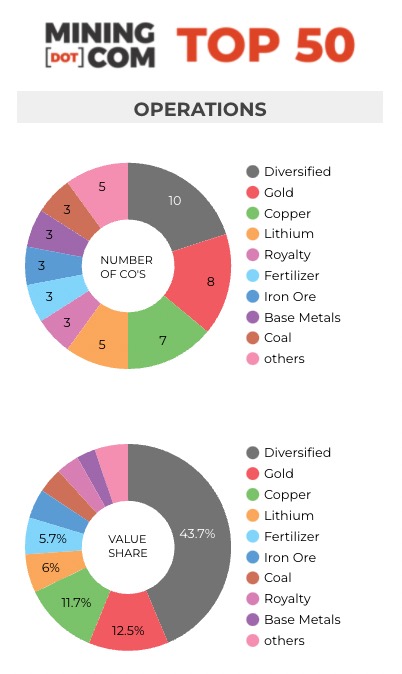
Mineral Resources sneaks in at no. 50, bringing the number of lithium focused stocks in the ranking to five with a combined value of more than $100 billion. 

Nuclear option

Thanks to a rally a decade in the making since the Fukushima disaster,  uranium stocks rejoined the top 50 ranking for the first time in many years in 2021. 

Mineral Resources just edged out Kazatomprom for the final spot in the Q1 snapshot although there is little to separate the companies’ valuation on any given trading day. 

The uranium producer, which has expanded its listings well beyond Almaty over the last couple of years, joins Fresnillo, Alrosa and KGHM among big names just outside the top 50. 

Canadian uranium producer Cameco rejoins the ranking at no. 43 from 51st at the end of last year as predicted. The Saskatoon-based company has poured cold water on punters talking up the uranium market, but it did not halt the counter’s nearly 100% surge over the past year.

Gold holds

Denver-based Royal Gold enters the top 50 for the first time, swelling the ranks of precious metals royalty and streaming companies to three. Royal Gold just pipped Perth-based gold producer Northern Star, which has been bubbling under the ranking for years, missing out on inclusion mostly due to timing.

Gold mining companies have been underperforming relative to the bullion price for more than a decade but precious metals share of value in the top 50 has been remarkably stable at just under a fifth of the index despite the gyrations of the gold price.  

The exception was March 2020, when the sector represented 26% of the overall value after a heavy sell-off of industrial metals and mineral producers at the beginning of the pandemic. 

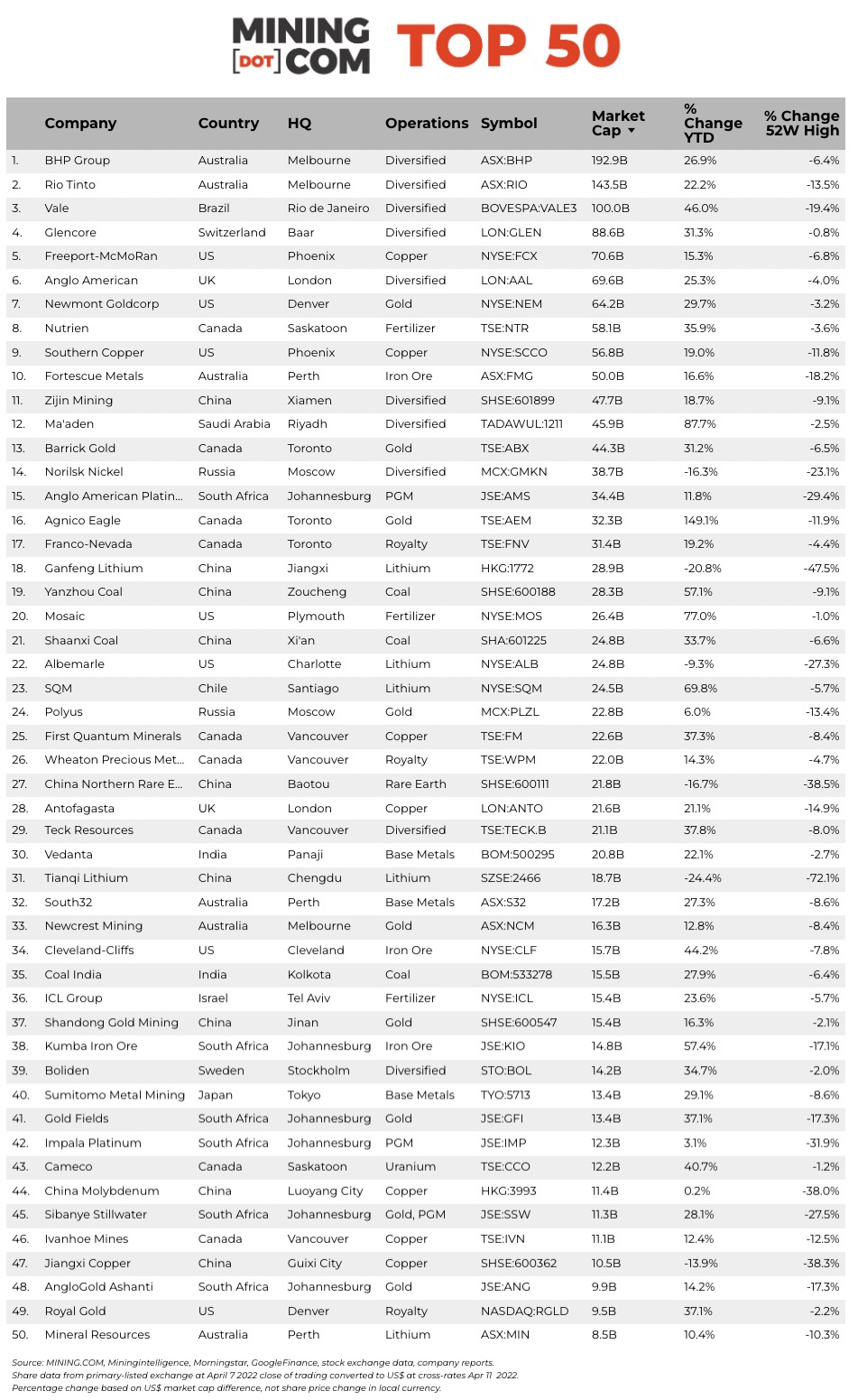
Click on table below for full-size image:


*NOTES:

Source: MINING.COM, Miningintelligence, Morningstar, GoogleFinance, company reports. Trading data from primary-listed exchange where applicable, currency cross-rates Apr 7, 2022. 

Percentage change based on US$ market cap difference, not share price change in local currency.

Market capitalization calculated at primary exchange, where applicable, from total shares outstanding, not only free-floating shares.

As with any ranking, criteria for inclusion are contentious issues. We decided to exclude unlisted and state-owned enterprises at the outset due to a lack of information. That, of course, excludes giants like Chile’s Codelco, Uzbekistan’s Navoi Mining, which owns the world’s largest gold mine, Eurochem, a major potash firm, Singapore-based trader Trafigura,  and a number of entities in China and developing countries around the world.

Another central criterion was the depth of involvement in the industry before an enterprise can rightfully be called a mining company.

For instance, should smelter companies or commodity traders that own minority stakes in mining assets be included, especially if these investments have no operational component or warrant a seat on the board?

This is a common structure in Asia and excluding these types of companies removed well-known names like Japan’s Marubeni and Mitsui, Korea Zinc and Chile’s Copec. 

Levels of operational or strategic involvement and size of shareholding was another central consideration. Do streaming and royalty companies that receive metals from mining operations without shareholding qualify or are they just specialised financing vehicles? We included Franco Nevada, Royal Gold and Wheaton Precious Metals.

Lithium and battery metals also pose a problem due to the booming market for electric vehicles and a trend towards vertical integration by battery manufacturers and mid-stream chemical companies.  Battery producer and refiner Ganfeng Lithium, for example, is included because it has moved aggressively downstream through acquisitions and joint ventures.   

Vertically integrated concerns like Alcoa and energy companies such as Shenhua Energy where power, ports and railways make up a large portion of revenues pose a problem as do diversified companies such as Anglo American with separately listed majority-owned subsidiaries. We’ve included Angloplat in the ranking as well as Kumba Iron Ore.

Many steelmakers own and often operate iron ore and other metal mines, but in the interest of balance and diversity we excluded the steel industry, and with that many companies that have substantial mining assets including giants like ArcelorMittal, Magnitogorsk, Ternium, Baosteel and many others.

Head office refers to operational headquarters wherever applicable, for example BHP and Rio Tinto are shown as Melbourne, Australia but Antofagasta is the exception that proves the rule. We consider the company’s HQ to be in London, where it has been listed since the late 1800s.

Please let us know of any errors, omissions, deletions or additions to the ranking or suggest a different methodology.

Gold price hits 5-week high as war, inflation continue to boost safe havens

https://cdn.shopify.com/s/files/1/0105/4844/5231/articles/Main-image-for-are-there-gold-bars-filled-with-tungsten-at-major-banks_2048x.progressive.jpg?v=1571413368

https://www.mining.com/gold-price-hits-5-week-high-as-war-inflation-continue-to-boost-safe-havens/ 

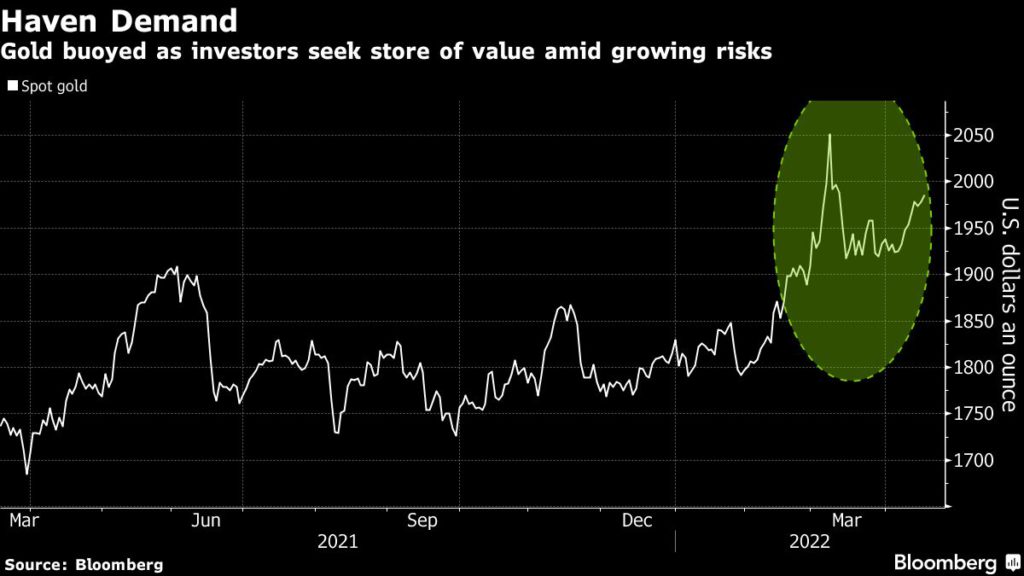
The gold price climbed to a five-week high on Monday as the war in Europe, elevated inflation and the risk of a US recession further bolstered demand for the safe haven asset.

Spot gold advanced 0.7% to $1,988.15 per ounce by noon ET, closing in on the $2,000 level last seen in early March. US gold futures rose 0.8% to trade at $1,991.00 per ounce in New York.

[Click here for an interactive chart of gold prices]

After capping a second weekly gain, bullion climbed as much as 1% earlier in the day following price increases in both oil and natural gas.

The possibility of a de facto European Union embargo on Russian gas and the threat of some curbs on crude in Europe’s next sanctions package have lifted both commodities, adding to the already elevated raw material prices around the globe. This in turn has driven up demand for gold as a hedge against accelerating inflation.

“The little step-up in tension due the Russia-Ukraine war with inflationary pressures across the board boosts safe-haven demand for gold,” David Meger, director of metals trading at High Ridge Futures, told Reuters.

Concerns over the economic hit from covid-led restrictions in China also supported gold prices, Meger added.

Gold’s advance came despite a jump in benchmark 10-year US Treasury yields to the highest since December 2018 and a stronger dollar, both of which usually dull the appetite for gold among overseas buyers.

“Gold is being reinforced by elevated inflation and heightened geopolitical risk,” said Kelvin Wong, an analyst at CMC Markets in Singapore, in a Bloomberg note.

Prices rising above the key medium-term technical resistance level of $1,975 is “likely to have attracted momentum-based traders back into the bullish camp,” Wong said.

(With files from Bloomberg and Reuters)

Natural gas pipeline future in doubt after SCOTUS rejection

 https://wlds.com/wp-content/uploads/2019/09/Spire-STL-Pipeline-201702091-300x400.png

https://www.newsbreak.com/news/2575949300646/natural-gas-pipeline-future-in-doubt-after-scotus-rejection?_f=app_share&s=a3&share_destination_id=MTM3MTE3MDI3LTE2NTAzMDY3Mzk4MTI=&pd=09HKOxl3&hl=en_US 

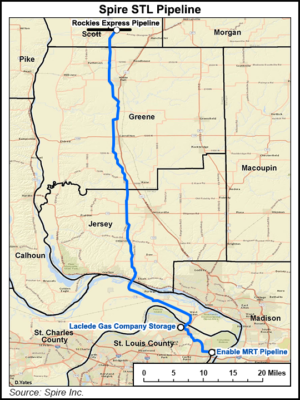
The U.S. Supreme Court on Monday declined to hear a St. Louis-based natural gas company's appeal of a lower court's decision that could close a pipeline that runs through parts of Illinois and Missouri.

The court rejected Spire Inc.'s appeal without comment. Spire President Scott Smith pledged to continue fighting to keep the 65-mile (105-kilometer) pipeline up and running.

The Federal Energy Regulatory Commission granted approval for the pipeline in 2018 and it became fully operational in 2019. The Spire STL Pipeline connects with another pipeline in western Illinois and carries natural gas to the St. Louis region, where Spire serves around 650,000 customers.

The Environmental Defense Fund sued in 2020, raising concerns that the pipeline was approved without adequate review. In June, a three-judge panel of the U.S. Court of Appeals for the District of Columbia ruled that FERC had not adequately demonstrated a need for the project, vacating approval of the pipeline.

EDF attorney Erin Murphy said in a statement Monday that the lower court ruling found “serious flaws” in FERC’s approval, “including failing to assess the harms to ratepayers and landowners.”

As the case played out in court, FERC last year issued a temporary certificate allowing the pipeline to remain operational. The temporary order continues to stand while the agency considers Spire's appeal to FERC seeking new approval of the pipeline.

“We are confident that when people have an opportunity to review the proven benefits of the STL Pipeline, they will agree that there is a critical need to keep this infrastructure fully operational to ensure continued access to reliable, affordable energy for families and businesses in the greater St. Louis region,” Smith said in a statement.

Monday, April 18, 2022

Japan to Release 6 Million Barrels of Oil from Private Reserves as Part of IEA-Led Action

 https://www.nationsonline.org/maps/japan-map.jpg

https://tankterminals.com/news/japan-to-release-6-million-barrels-of-oil-from-private-reserves-as-part-of-iea-led-action/?vgo_ee=peYRwyI2Ab3FcNxZ0pnEDgA3SuMkJhmkGexv49sZvNU%3D 

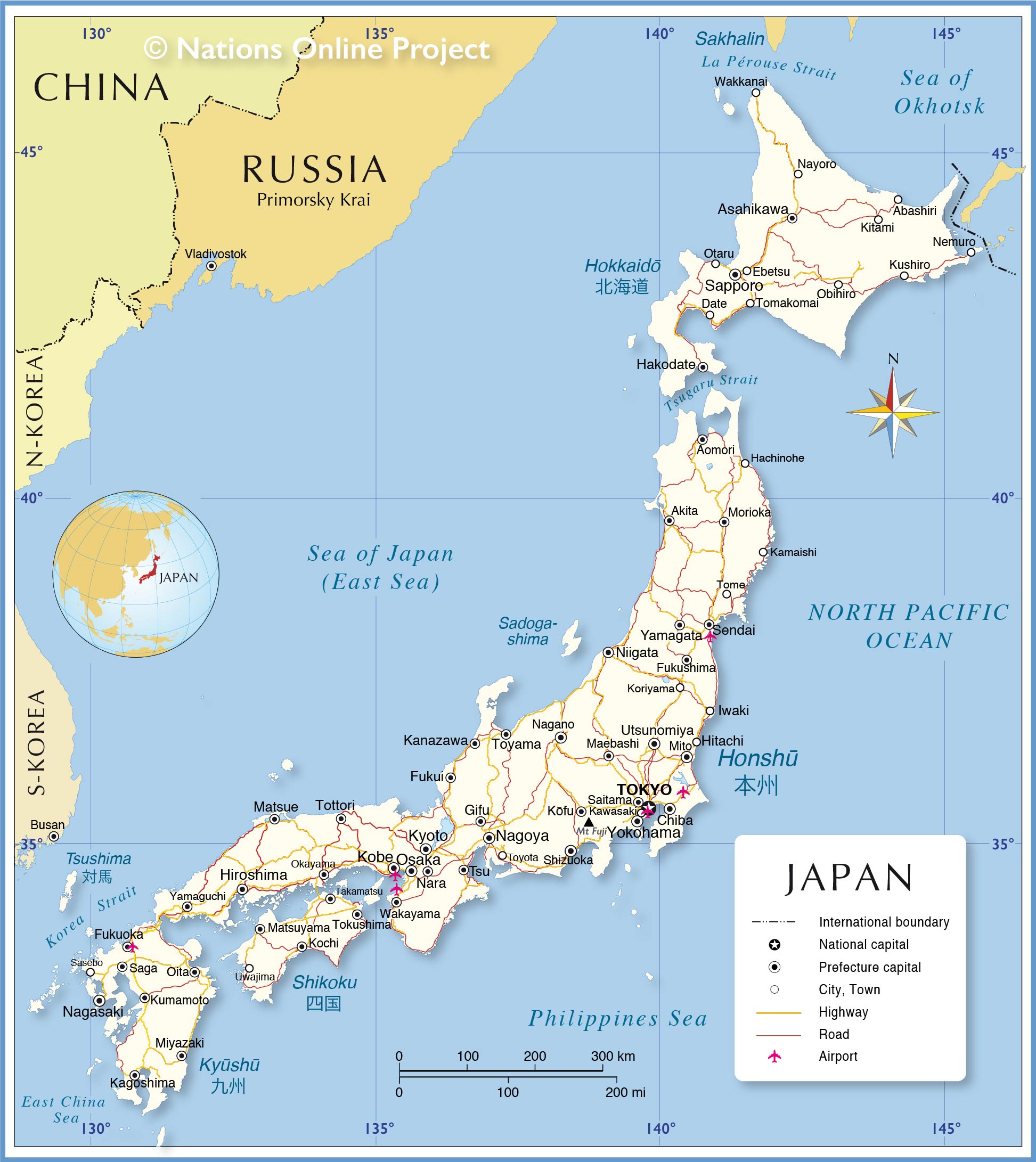
The industry ministry said on Friday it will release 6 million barrels of oil from privately held reserves as part of its contribution to a second round of the International Energy Agency’s (IEA) coordinated release to calm crude oil prices.

Japan will release the petroleum, equivalent to about three days of domestic consumption, by allowing local refiners to lower their mandatory stockpile level in private reserves by three days, to 63 days of domestic demand, from April 16 and Oct. 8.

Japan said earlier this month it would release a record 15 million barrels of oil from national reserves as part of a second round of the coordinated release led by the IEA.

The remaining 9 million barrels of oil will be released from state petroleum reserves, with details such as the method to be used and timing to be decided later, an official at the ministry said.

Japan held around 470 million barrels of petroleum reserves at the end of January, or 236 days of domestic consumption, comprising state reserves, private reserves held by local refiners’ tanks and a joint crude oil storage plan with producing countries.

Earlier this month, IEA states agreed to tap 60 million barrels of oil from storage, on top of a 180 million-barrel release announced by Washington in late March aimed at cooling prices after Russia’s invasion of Ukraine.

Wind passed coal, nuclear power in US for first time on record

https://www.mining.com/web/wind-passed-coal-nuclear-power-in-us-for-first-time-on-record/

Wind turbines in the U.S. produced more electricity than coal or nuclear plants on March 29 for the first time on record, the U.S. Energy Information Administration said Thursday. That made wind the second-biggest source of electricity that day, behind only natural gas and narrowly ahead of nuclear. 

Wind farm capacity has increased rapidly in the U.S. over the past 15 years and is widely seen as an important weapon in the push to decarbonize the power grid and the fight against climate change.
However, due to the natural variation in wind speeds leading to different amounts of power generation, the EIA doesn’t expect wind to surpass coal or nuclear for an entire month in 2022 or 2023.

The EIA data go back to 2018 and don’t include Alaska or Hawaii.

(By Josh Saul)

Chile heads towards two “lost decades” of copper output growth

 Chile heads towards two "lost decades" of copper output growth

https://www.mining.com/chile-heads-towards-two-lost-decades-of-copper-output-growth/ 

Chile’s crown as the world’s largest producer of copper is at risk as the country’s output continues to be lower than expected despite the billions of dollars invested in new projects in the past 18 years, BMO’s Colin Hamilton warned on Thursday.

The commodities analyst noted he had received several questions over the past week about the weakness in Chilean copper output year-to-date, as first quarter production reports from many of the companies with operations in the South American country have started coming out.

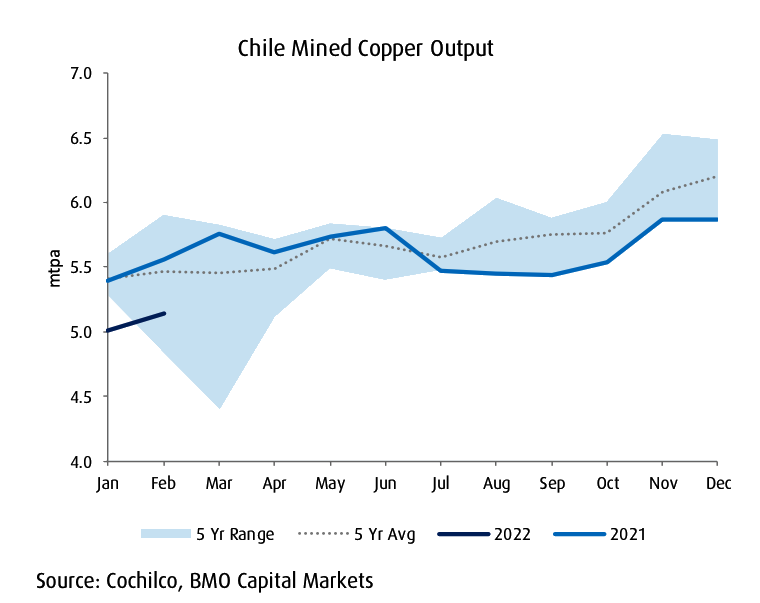
Chile’s January copper production spooked investors, as it fell 7.5% from the same month in 2021 to 425,700 tonnes — the lowest in 11 years.

Lower ore quality, water scarcity and other transitory near-term issues were the reasons given by state Chilean Copper Commission (Cochilco) for the sharp drop. For Hamilton, however, the production decline is far from being an unusual occurrence.

BMO estimates the country’s 2022 copper production is on track to being lower than in 2004, when the nation churned out slightly over 5.4 million tonnes of the metal, equivalent to 37% of the world’s production.

(Graphic courtesy of BMO Capital Markets.)

“Following the steady ramp-up in the 1990s and early 2000s, output levels have stagnated, with the projections of 6 million tonnes per year-plus of output never coming to pass,” Hamilton wrote.

Diego Hernández, president of Chile’s National Mining Society (Sonami), remains optimistic. The former chief executive of state-owned Codelco and Antofagasta Plc (LON:AAL) has said he expects the nation’s output to rise in 2023, as Teck Resources (TSX: TECK.A | TECK.B) (NYSE: TECK) brings the expansion of its Quebrtada Blanca mine on stream in the second half of this year.

There’s a dearth of other major developments in the pipeline, Hernández said in March, adding that once there is greater legal and regulatory certainty, investment should pick up.

Old mines

Chile’s output issues are not just a matter of investment in the new projects and expansion, but rather a consequence of aging existing assets, Hamilton said.

“Most notably, SX-EW [cathode copper] production in Chile continues to trend inexorably lower, and is now ~500kt below peak levels seen over a decade ago,” the analyst wrote.

“Rather than the short-term production issues, the potential for Chile’s output to keep undershooting expectations is more important from an investment thesis standpoint,” he added.

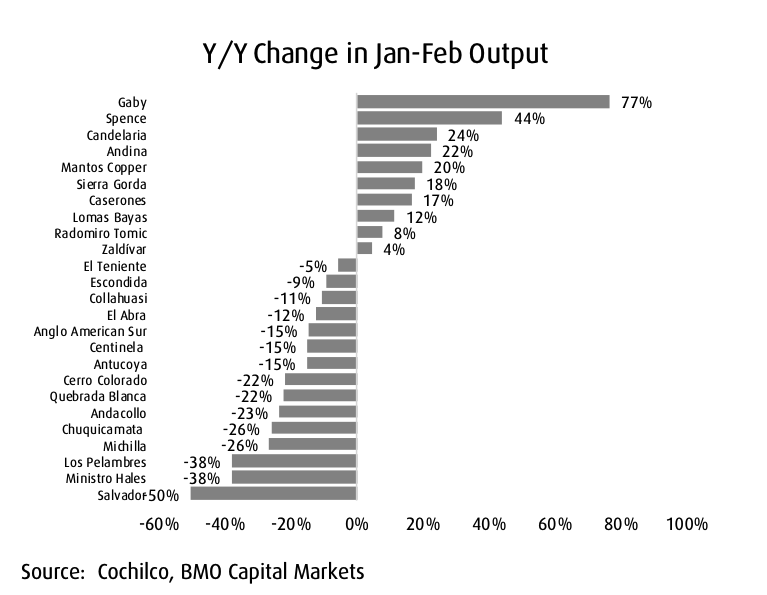
Copper futures on the Comex in New York have been trading at a premium to those on the London Metal Exchange in recent weeks, attracting more copper cathode, especially from South America.

(Graphic courtesy of BMO Capital Markets.)

US imports of cathode from Chile climbed 37% in the first three months of this year from the prior quarter, according to data from S&P Global.

Chile’s constituent assembly is proposing a series of changes to the Constitution to replace a market-centric one that dates to the military dictatorship of General Augusto Pinochet. 

Those modifications could affect miners as it may open the door to nationalizing some of the world’s biggest copper and lithium assets.

Politicians are also fine-tuning a new mining royalty bill, which will raise tariffs on firms based on gross sales and profitability.