Wednesday, March 2, 2022

Germany may extend coal use to replace Russian gas

 Germany may extend coal use to replace Russian gas

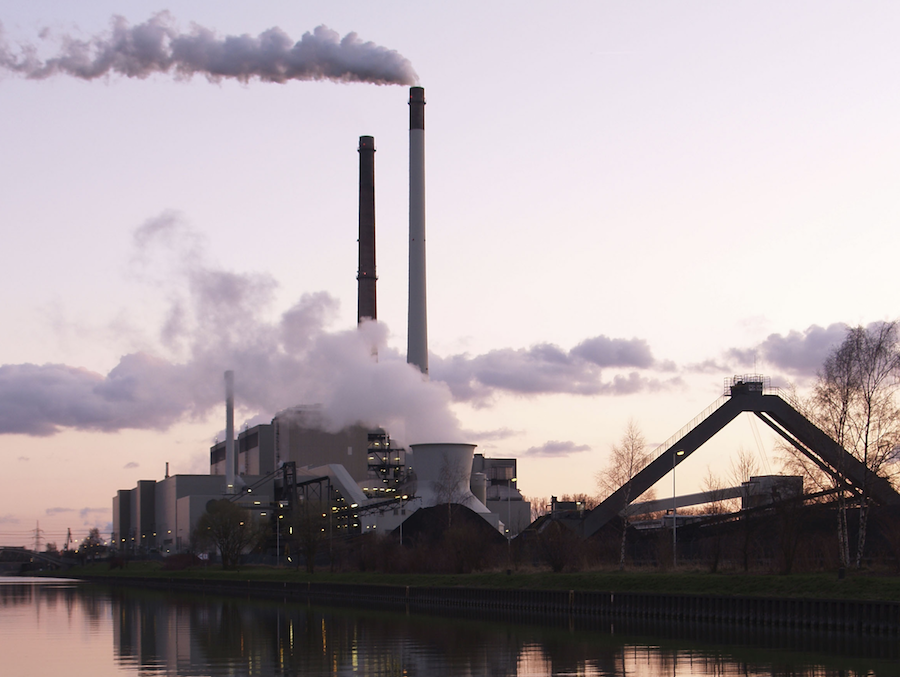
Coal power plant in Datteln, Germany, at the Dortmund-Ems-Kanal. (Image by Arnold Paul, Wikimedia Commons.). 

https://www.mining.com/web/germany-may-extend-coal-use-to-replace-russian-gas/?utm_source=Energy_Digest&utm_medium=email&utm_campaign=MNG-DIGESTS&utm_content=httpswwwminingcomwebgermanymayextendcoalusetoreplacerussiangas 

Germany is getting ready to prolong the use of coal as the country seeks to reduce its reliance on Russian energy in the aftermath of Moscow’s invasion of Ukraine.

Coal plants could run beyond 2030 — when Germany currently targets an end for the fuel — but the ultimate goal is greater energy independence through renewable power, said Robert Habeck, vice chancellor and minister for economy and energy.
“Energy policy is security policy,” Habeck said on Monday prior to talks with European Union counterparts. “Strengthening our energy sovereignty strengthens our security. Therefore, we must first overcome the high dependence on Russian imports of fossil fuels — a warmonger is not a reliable partner.”

Germany, which gets more than half of its gas from Russia, has undergone a rapid shift in policy in reaction to the assault on Ukraine. Alongside a massive boost in defense spending, Chancellor Olaf Scholz announced on Sunday plans to build two new liquefied natural gas terminals, signaling a longer term realignment of Germany’s energy sector.

Even before the invasion, Scholz halted the certification process for the Nord Stream 2 pipeline built to bring more Russian gas directly to Germany and bypass transit through Ukraine.
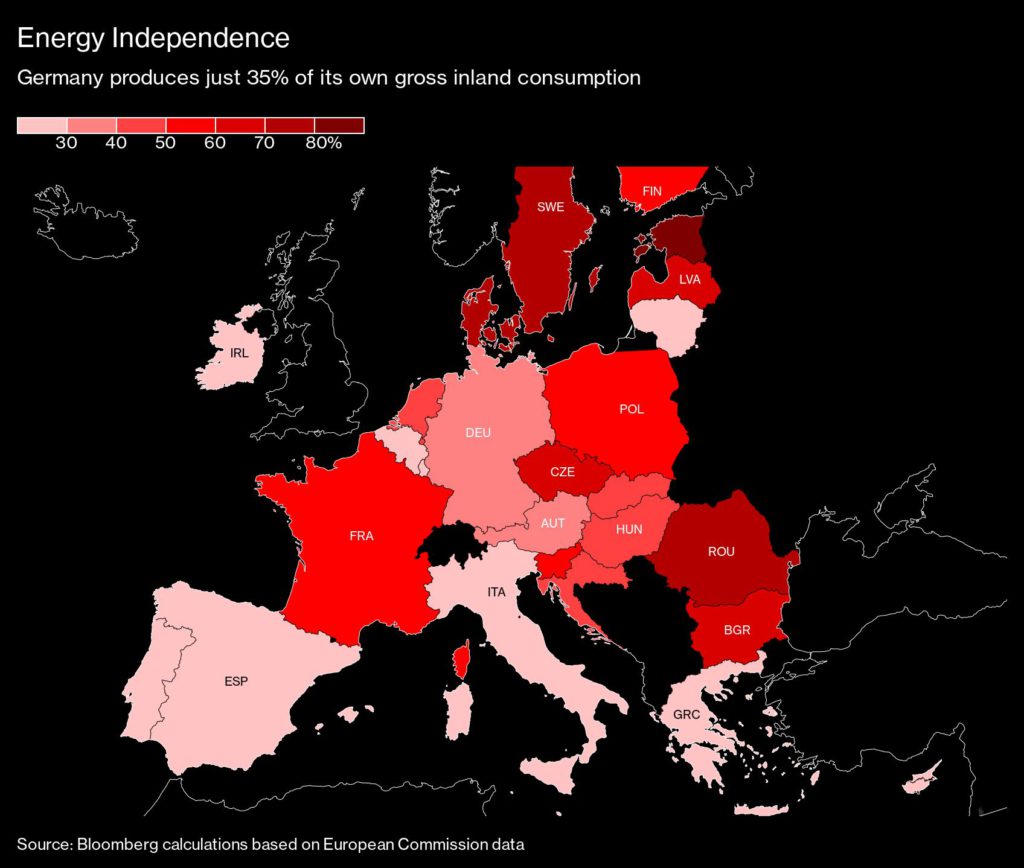
Germany is now looking at short- and long-term measures to safeguard its energy market from any possible abrupt cutoff of Russian gas. Habeck, the former co-leader of the anti-nuclear Green party, even said he wasn’t  “ideologically opposed” to extending the use of the country’s last reactors, but safety is a concern.

“There are no taboos,” Habeck said in an interview late Sunday with public broadcaster ARD. “The real path to independence in terms of energy policy is actually to phase out fossil fuels. The sun and the wind don’t belong to anyone.”

The Economy Ministry is proposing that Germany generate all of its electricity from renewable sources by 2035, 15 years earlier than originally planned, according to a tweet from a ministry official.

The energy rethink has broad backing in Germany’s ruling coalition. Finance Minister Christian Lindner — from the business-friendly Free Democrats — on Sunday called renewable power “freedom energy” as it would help reduce reliance on Russia and said he supports the efforts to push ahead with an expansion of hydrogen and synthetic fuels. 

“I strongly urge that we review our foreign energy policy,” he said in an ARD interview late Sunday. “This is now all the more pressing.”

‘Pick and choose’

Germany wants to reach a point where it can “pick and choose which countries we want to build energy partnerships with,” Habeck told ARD. “Being able to choose also means that you can become independent from Russian gas, coal or oil.”

While Germany can manage without Russian gas for the coming months, the country would have to expand its purchasing strategy significantly for next winter, he said.

Coal could help offset the use of Russian gas, but relying on the most polluting fossil fuel also has its own security risks, Habeck said.

“Running for longer means a longer dependence on coal, possibly also from Russia. Or we get it somewhere else,” he said. “But it’s another form of dependence.” 

Foreign Minister Annalena Baerbock — also a former co-leader of the Greens — said an extended use of coal is “the price that we all have to pay for this war.” 

Nuclear is unlikely to be a short-term fix, since the country’s last three reactors are already in the process of being wound down.

“The preparations for shutting down are at such an advanced stage that the atomic power plants could only be operated for longer under the highest security concerns and possibly with fuel supply that hasn’t yet been secured,” Habeck said. “That’s certainly not something we’d want.”

(By Angela Cullen and Birgit Jennen, with assistance from Iain Rogers)

Tuesday, March 1, 2022

Biden to release 30M more barrels from strategic oil reserves? Brent + $100 / barrel

https://www.gulftoday.ae/-/media/gulf-today/images/articles/business/2022/2/24/oil-barrel-11.ashx?h=450&la=en&w=750&hash=7799BB11E56C7FEEFBCC776D2BC661FD

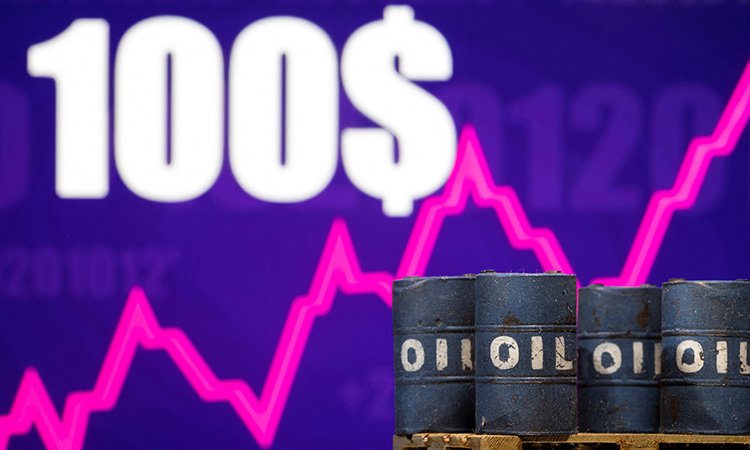
Models of oil barrel are seen in front of displayed rising stock graph and words "100 Dollars" in this illustration. File/Reuters

Horrible "presidential" decision. Political "kabuki" before the State of the Union tonight. US citizens have been forced garbage energy policies since January 20, 2021. 

The strategic oil reserves are for US energy emergency purposes only. They should always remain filled to the brim. 

Tapping the strategic oil reserves is not the solution for high gas prices. Energy costs have been intentionally inflated globally.

The US has one of the largest oil and gas reserves on the planet. We were the biggest producer of oil and gas products in the world. 

Pump more oil. Refine more crude. Utilize coal. Open the pipelines. Finish the Keystone pipeline. Sell US oil, gas and coal globally. 

+/-$50 / bbl target can be attained.

Stop buying foreign energy.

The US has to become the self sufficient, energy surplus powerhouse it once was 1 year ago under President Trump! 

God Bless America!

Watch live: Track the impact of global warming on the world: ?

Something REALLY Isn’t Right About the Russian Invasion of Ukraine | @Gl...

Iron ore price rises as Russia-Ukraine conflict stokes supply concerns

Iron ore price Russia Ukraine

https://www.mining.com/iron-ore-price-rises-as-russia-ukraine-conflict-stokes-supply-concerns/?utm_source=IronOre_Digest&utm_medium=email&utm_campaign=MNG-DIGESTS&utm_content=httpswwwminingcomironorepricerisesasrussiaukraineconflictstokessupplyconcerns 

Iron ore prices climbed on Monday over concerns that a prolonged armed conflict between Russia and Ukraine could curb global supply.

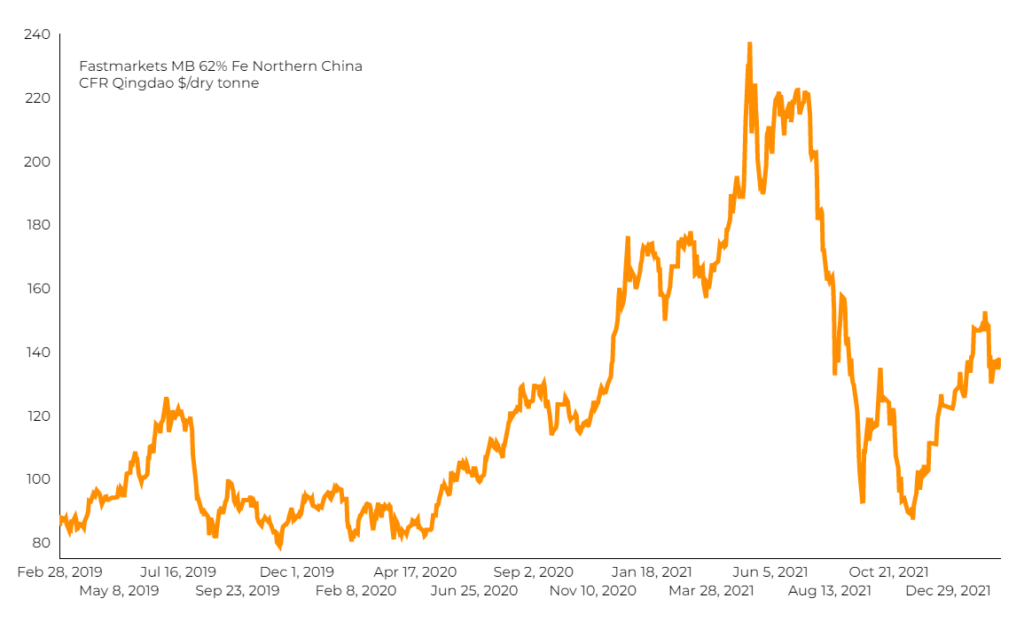
The most-traded May iron ore contract on China’s Dalian Commodity Exchange ended daytime trading 2.7% higher at 705.50 yuan ($111.82) a tonne.

On the Singapore Exchange, iron ore’s most-active April contract rose as much as 3.3% to $141.25 a tonne.

According to Fastmarkets MB, benchmark 62% Fe fines imported into Northern China were changing hands for $138.09 a tonne during morning trading, up 2.6% compared to Friday’s closing.

iron ore price

“Any prolonged military campaign will severely impact annual iron ore exports totaling almost 70 million tonnes from Russia and Ukraine, eventually tightening the global balance,” said Atilla Widnell, managing director at Navigate Commodities in Singapore.

While Russia and Ukraine are not major suppliers of iron ore to China, the two countries now at war usually export the steelmaking ingredient to other European countries.

Russia’s top steelmakers have seen exports drop since the incursion began, while nickel shipments have also been affected, people with knowledge of the matter told Bloomberg.

Russia’s metal shipments are falling and buyers are “hesitant in the context of sanction uncertainty and escalation,” Goldman Sachs analysts said in a note.

Ukrainian iron-ore miner Ferrexpo Plc said on Friday the availability of rail capacity to ship its pellets to customers in Europe was unclear. The London-listed company, which operates three mines in central Ukraine, said it’s delaying the publication of its full-year results.

As this month’s Beijing Winter Olympics has ended, rebounding Chinese blast furnace capacity utilization rates, which should result in the quicker drawdown of iron ore inventories at Chinese ports, are also expected to offer further price support, Widnell said.

Support for iron ore remained intact even as China’s state planner kept a close eye on market activities following the recent strong price rally.

The National Development and Reform Commission, which has warned against iron ore hoarding, market speculation and disinformation, on Monday reminded traders of regulators’ increased supervision of both spot and futures markets to ensure stable prices.

(With files from Reuters and Bloomberg)

Gold price edges higher on fears of economic slowdown following sanctions

Gold price edges higher on fears of economic slowdown following sanctions

https://www.mining.com/gold-price-edges-higher-on-fears-of-economic-slowdown-following-sanctions/?utm_source=Precous_Metals_Digest&utm_medium=email&utm_campaign=MNG-DIGESTS&utm_content=gold-price-edges-higher-on-fears-of-economic-slowdown-following-sanctions 

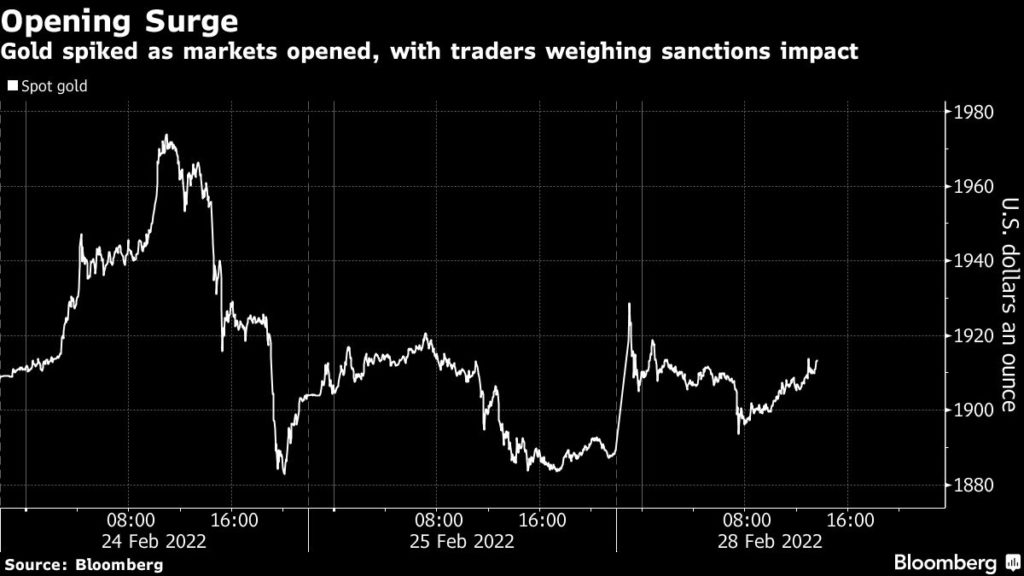
Gold prices climbed higher on Monday as Western nations escalated sanctions on Russia for the invasion of Ukraine, heightening fears of a hit to global economic growth.

Spot gold rose 0.6% to $1,901.64 per ounce by 11:20 a.m. ET, maintaining close distance to a 15-month high it reached last week. US gold futures were up 0.9% at $1,905.70 per ounce in New York.

[Click here for an interactive chart of gold prices]

Earlier, bullion surged as much as 2.2% after penalties were placed on the Bank of Russia to prevent it from using foreign reserves to blunt sanctions. Some Russian lenders were also excluded from the SWIFT messaging system that underpins trillions of dollars worth of transactions.

In response to these sanctions, the Russian central bank raised its key interest rate to the highest in almost two decades and imposed some controls on the flow of capital in a bid to shield the economy as its currency plummeted.

Concerns are now growing about whether the financial chaos may damage global economic growth or require action by the US Federal Reserve to supply dollars.

Meanwhile, Russia’s central bank said on Sunday it would resume its gold purchases on the domestic market after a two-year pause. It holds over 2,000 tonnes in bullion already, making it the fifth-biggest sovereign owner.

“The purpose of buying gold (in the domestic market), is to monetize it when required,” Nicky Shiels, head of metals strategy at MKS PAMP SA, wrote in a Bloomberg note. “It’s the fear over potential central bank sales that may overhang the market.”

Gold is now on course for its best month since May amid the fraught geopolitical tensions, having outperformed other haven assets. It will also be getting a boost from lower expectations of aggressive monetary tightening by the Fed to tame the highest inflation in decades.

(With files from Bloomberg)

Russian metal exports slide as sanctions hit commodity financing

 Russian Metal Exports Slide as Sanctions Hit Commodity Financing

Russia’s metal shipments are falling and buyers are “hesitant in the context of sanction uncertainty and escalation,” Goldman Sachs Group Inc. analysts said in a note. (Credit: Wikipedia)

https://www.mining.com/web/russian-metal-exports-slide-as-sanctions-hit-commodity-financing/?utm_source=Daily_Digest&utm_medium=email&utm_campaign=MNG-DIGESTS&utm_content=russian-metal-exports-slide-as-sanctions-hit-commodity-financing 

Russia’s industrial-metal exports are sinking as the country’s invasion of Ukraine prompts commodity buyers and financiers to pull back from its powerhouse producers, according to executives and analysts tracking trade flows.

The nation’s top steelmakers have seen exports drop since the incursion began, while nickel shipments have also been affected, people with knowledge of the matter said. While the response to Russia’s actions differs from country to country, Germany has halted almost all steel purchases, one of the people said, asking not to be named given the commercially sensitive nature of the transactions. 
With Russia among the top five global producers of steel, nickel and aluminum, reduced metal shipments threaten to further tighten a market that’s already short on supply. While metals haven’t been directly targeted by sanctions, prices are surging on concern that the latest measures could snarl payments to suppliers and spur banks to rein in financing for purchases of Russian goods. 

Russia’s metal shipments are falling and buyers are “hesitant in the context of sanction uncertainty and escalation,”  Goldman Sachs Group Inc. analysts said in a note. “With materially reduced export volume out of Russia, Kazakhstan and Uzbekistan, all the base-metal markets will face accelerated tightening in the near-term,” they said, without specifying how they’re tracking trade flows.

Some shippers are refusing to transport Russian commodities such as nickel, but the impact on volumes so far has been minor, another person familiar with the matter said. MMC Norilsk Nickel PJSC is Russia’s only producer of nickel.

“Our operations are proceeding as usual, we continue to meet all our contractual obligations and remain committed to our clients and partners,” a spokesperson for Nornickel said. 

Nickel futures on the London Metal Exchange surged as much as 3% on Monday before giving up gains later in the day to settle 0.3% lower, at $24.282 a metric ton. Aluminum also soared as much as 5% to a fresh record, before retreating to settle 0.3% higher, at $3,368.50 a ton. Other main LME metals were higher.

Banks were already limiting their exposure to Russian shipments before this weekend’s further round of sanctions, which exclude some Russian banks from the SWIFT messaging system and also penalize the country’s central bank. At least two of China’s largest state-owned lenders are restricting financing for purchases of Russian commodities, underscoring the limits of Beijing’s pledge to maintain economic ties with one of its most important strategic partners.

In Europe, Societe Generale SA and Credit Suisse Group AG stopped financing commodities trading from Russia, people familiar with the matter said. The two banks, key financiers to commodity trading houses, are no longer providing funds to move raw materials such as metals and oil from the country. 

Russia’s invasion has roiled markets worldwide from energy to grains, heaping more inflationary pressure on a global economy already grappling with soaring costs. U.S. officials are said to be weighing exemptions for transactions involving the energy sector in a bid to tame surging oil prices. But if similar dispensations were granted for metals, it’s unlikely that flows would return to normal quickly, given the turmoil in Black Sea freight markets, Goldman said.

Rusal halt

Russia’s United Co. Rusal International PJSC, the world’s top aluminum producer outside China, came under further strain on Monday as it halted shipments at an alumina refinery in Ukraine that feeds its smelters at home.

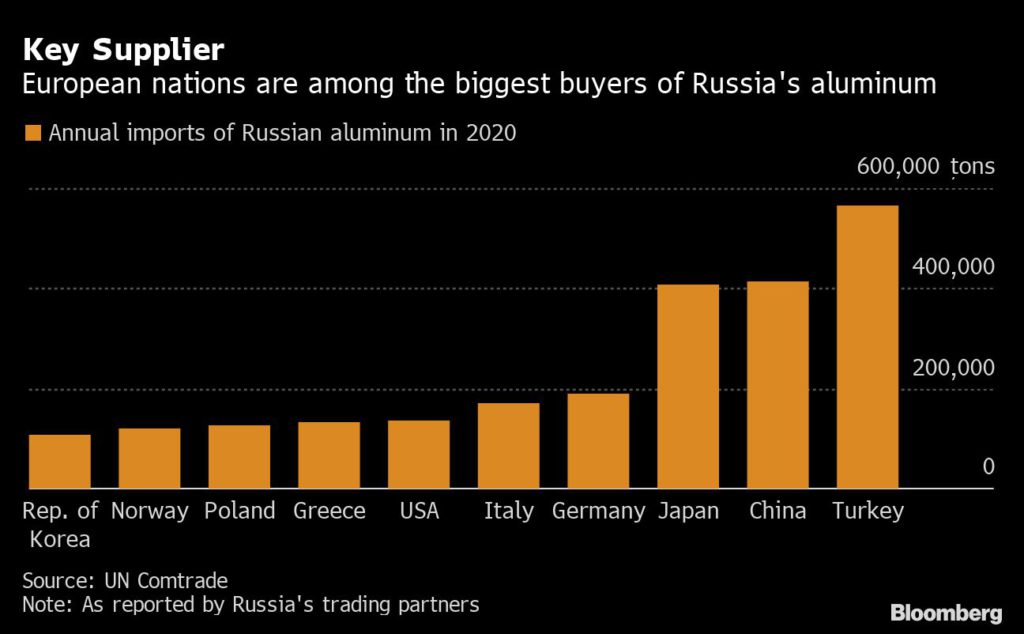
Turkey was the single largest buyer of Russian aluminum in 2020, ahead of China, Japan and Germany, according to UN Comtrade data. Italy and Greece are also major importers.

Annual imports of Russian aluminum.

“As a result of sanctions, should counterparties be unable to transact with UC Rusal as was the case in 2018, then there is a risk that all of UC Rusal’s overseas alumina assets could be impacted,” Ami Shivkar, principal analyst in Wood Mackenzie’s aluminum team, said in a note. “Any significant reduction in alumina production would impact primary metal output in short order leading to even greater primary aluminum market deficits.”

While Russia’s commodities trade is facing immediate threats, the country’s producers also fear longer-term risks arising from sanctions targeting its imports of high-tech products. Russia’s mining companies are reliant on equipment and software licenses from overseas vendors, executives at three of the firms said. 

(With assistance from Yvonne Yue Li)