Thursday, September 9, 2021

Guinea junta plans unity government, reassures mining firms


On national television, coup leader Mamady Doumbouya says the borders are closed and the constitution dissolved. Image: screenshot via Al Jazeera’s YouTube channel.

https://www.mining.com/web/guinea-junta-plans-unity-government-reassures-mining-firms/?utm_source=Daily_Digest&utm_medium=email&utm_campaign=MNG-DIGESTS&utm_content=guinea-junta-plans-unity-government-reassures-mining-firms 

A military junta that seized power in Guinea said it plans to establish a unity government pending a transition to civilian rule, urged mining companies to keep operating and reassured them that their existing agreements with the state will be honored.  

“A government of national unity will be set up to lead the transition,” coup leader Colonel Mamady Doumbouya said in an address to members of the toppled administration on Monday. “The curfew in mining zones has been lifted to ensure continuity of production, and ports remain open for exports,” he said. Air links have also been restored.
Special forces led by Doumbouya seized power on Sunday after detaining President Alpha Conde, who’d held power since late 2010. The 83-year-old leader has so far resisted pressure to resign, according to two people familiar with the matter who asked not to be identified because they aren’t authorized to speak to the media.

Doumbouya will present himself as the leader of the transition, the people said. 

The coup leader has ordered members of a presidential security unit to confine themselves to a barracks outside the capital city of Conakry, and banned former officials from leaving the country. He also instructed the secretaries-general of Guinea’s ministries to take over the role of ministers, and the governors of the regions to be replaced by military commanders. 

There were no signs of unrest in Conakry overnight in response to the military takeover by the junta.

Guinea is a key global supplier of bauxite, an ore that’s processed into alumina and then aluminum, which is used in cars and cans. The bulk of the West African nation’s bauxite exports are sent to smelters in China, the biggest producer of the metal. Guinea shipped 82.4 million tons of the mineral globally last year, according to government data. 

China and Russia on Monday joined the United Nations and the U.S. in condemning the coup. 

“China opposes coup attempts to seize power and calls for the immediate release of President Conde,” Chinese Foreign Ministry spokesman Wang Wenbin told reporters in Beijing on Monday. “We hope all parties can be cool headed and exercise restraint, keep in mind the fundamental interests of the nation and people, address the relevant issue through dialog and consultation and safeguard peace and stability in the country.”

Leaders of two African blocs have also pushed for Conde’s release. The Economic Community of West African States threatened sanctions against Guinea, while the African Union called for its Peace and Security Council to meet urgently over the matter.

Financial mismanagement

Conde’s overthrow was necessary to address financial mismanagement and corruption in Guinea, and the deposed leader is safe and has been in contact with his doctors, Doumbouya said on Sunday. 

The coup has upended a decade of stability in Guinea, and will be of concern to other African leaders, according to Eric Humphery-Smith, Africa analyst at risk intelligence company Verisk Maplecroft. 

“While the feeling among many Guineans is jubilation, make no mistake that this is two steps backwards for both the country’s democracy and economy,” he said in emailed comments. “Recovering what until now was a stable and predictable operating environment is anything but a given.”

(By Ougna Camara and Baudelaire Mieu, with assistance from Leanne de Bassompierre, Katarina Hoije, Yinka Ibukun and Colum Murphy)

Thursday, September 2, 2021

Iron ore price plunges on steel production curbs in China

Iron ore futures plunge over 8% on lacklustre demand outlook

https://www.mining.com/iron-ore-price-plunge-over-8-on-lacklustre-demand-outlook/?utm_source=IronOre_Digest&utm_medium=email&utm_campaign=MNG-DIGESTS&utm_content=httpswwwminingcomironorepriceplungeover8onlacklustredemandoutlook 

Iron ore prices fell sharply on Wednesday amid more expectations for crude steel production curbs in China for the remainder of the year.

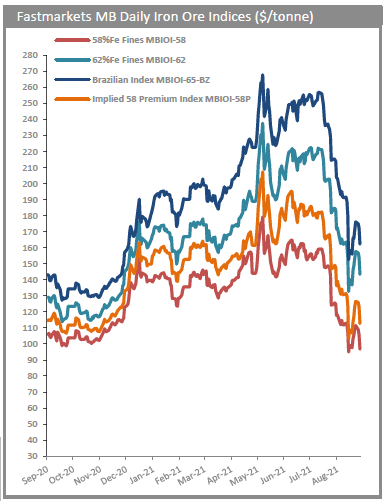
According to Fastmarkets MB, benchmark 62% Fe fines imported into Northern China were changing hands for $143.43 a tonne, down 6.5% from Tuesday’s closing.
Fastmarkets MB Iron Ore Indices

“The September delivery (of iron ore) remains wide contango,” analysts with SinoSteel Futures wrote in a report, noting that the price for the deliverable product Super Special Fine has been recently lowered to 723 yuan ($111.88) per tonne.

The September iron ore contract was traded around 880 yuan a tonne in the morning session.

While China has not relaxed steel production curbs as of yet, mills are not supported to increase inventories in the short term and that could affect price gain in a far-month contract, SinoSteel Futures added.

Benchmark iron ore futures on the Dalian Commodity Exchange for January delivery were down 8.1% at 763 yuan ($118.07) per tonne, as of 0255 GMT, the biggest percentage loss since July 30.

Steel prices on the Shanghai Futures Exchange were also undermined by a drop in raw materials and tepid economic data.

Earlier in the week, Baoshan Iron & Steel Co., the listed unit of China’s biggest producer, flagged the potential for renewed price declines in iron ore.

“We expect China’s steel curtailments to be targeted in 4Q when demand slows seasonally and air pollution is in focus (especially ahead of the Winter Olympics in Feb-22) and as a result we expect prices to stabilize in Sept/Oct before continuing to fall back below $100/tonne in 2022,” UBS analysts wrote in a recent note.

China’s factory activity slipped into contraction in August for the first time in nearly 1-1/2 years as covid-19 containment measures, supply bottlenecks and high raw material prices weighed on output in a blow to the economy.

Related read: Global iron ore production to accelerate until 2025 – report

(With files from Reuters and Bloomberg)

Wednesday, September 1, 2021

Copper royalty bill clears another hurdle in Chile


 Copper royalty bill clears another hurdle in Chile

 Chilean Senate / Wikpedia

https://www.mining.com/web/copper-royalty-bill-clears-another-hurdle-in-chile/?utm_source=Daily_Digest&utm_medium=email&utm_campaign=MNG-DIGESTS&utm_content=copper-royalty-bill-clears-another-hurdle-in-chile 

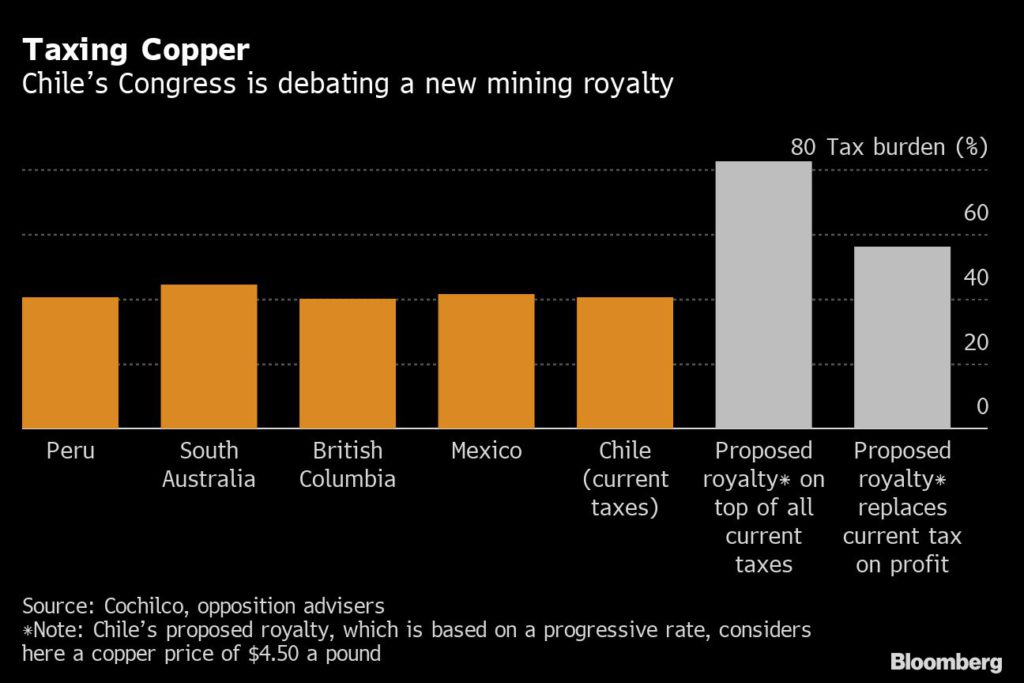
A bill that would create the heaviest tax burden among major copper-producing nations was approved by a Chilean senate mining committee on Tuesday. 

The royalty proposal passed by three votes to two and now goes to the senate floor for debate, with modifications likely to be presented in a bid to soften a version passed in the lower house in May.
Chile, like other host nations, is looking for a bigger share of mining profits to help resolve inequalities exacerbated by the pandemic. At the same time, the country is drafting a new constitution that may lead to tougher rules on water, mineral and community rights ahead of presidential elections in November.

The industry has warned that the bill as it stands — with sales tax brackets that increase as copper prices rise — would derail investments and undermine competitiveness in a nation that accounts for more than a quarter of global copper. In June, the center-right ruling coalition said it was confident of tempering the opposition-backed bill.

“As always, the right-wing voted against it, seeking to block a greater contribution from mining to a new model of society,” committee member and presidential candidate Yasna Provoste wrote on her Twitter account.

While proponents of the new royalty system say it would replace current taxes on profit, that isn’t written into the bill, leading government officials to suggest the two systems could run together. The bulk of large mining companies in Chile have tax stability agreements until 2023.

On the same day as the committee passed the bill, the government unveiled a road map for the sector over the next three decades. Goals include lifting copper output by 57% while maximizing social benefits through “fair and competitive” taxes.

(By James Attwood and Valentina Fuentes)