Monday, October 7, 2019

Oil slips as US-China trade talks loom


GP: Iran Salman Oil Field 190422
Workers cross walkways between zones aboard an offshore oil platform in the Persian Gulf’s Salman Oil Field, near Lavan island, Iran, on Jan. 5. 2017.
Ali Mohammadi | Bloomberg | Getty Images


Oil prices ended the day little changed on Monday as U.S.-China trade talks loomed.

Brent crude rose 13 cents or 0.2% to $58.50 a barrel, while U.S. West Texas Intermediate (WTI) crude settled down 0.1% at $52.75 per barrel.

Both futures contracts ended last week with a more than 5% decline after dismal manufacturing data from the United States and China, with the trade row between the world’s top economies undermining global economic prospects.

U.S. and Chinese officials meet in Washington on Oct. 10-11 in a fresh effort to work out a deal, which U.S. President Donald Trump said his administration had a “very good chance” of achieving.

On the supply side, deadly anti-government unrest has gripped Iraq, the second-largest producer among the Organization of the Petroleum Exporting Countries. The unrest helped buoy oil prices earlier in the day, with Brent and WTI gaining more than 1% each at one point.

Iraq’s oil exports of 3.43 million barrels per day (bpd) from Basra terminals could be disrupted if instability lasts for weeks, Ayham Kamel, Eurasia Group’s practice head for Middle East and North Africa, said in a note.

“Any oil production disruption would occur at a time when Saudi Arabia has lost a significant part of its energy system redundancies (spare capacity),” he said.

The major Buzzard oil field in the British North Sea was also shut for pipe repair work, China’s CNOOC said on Friday, while Shell maintains force majeure remains on exports of Bonny Light crude in Nigeria.

Still, Total’s giant Johan Sverdrup offshore oil field started up in the North Sea this month with a goal of achieving 440,000 bpd at peak production.

Libya’s National Oil Corporation (NOC) said on Sunday it would close the Faregh oil field at Zueitina port for scheduled maintenance from Monday until Oct. 14.

But analysts said the resumption in Saudi Arabian production after Sept. 14 attacks could undermine a price rally.

“The Saudi attacks have quickly been forgotten about and global growth is back to being the main driver of oil markets,” said Craig Erlam, senior market analyst at OANDA.

“Such complacency could come back to bite oil traders as another aggressive spike will likely accompany any further escalation in the region.”

Despite Monday’s gains, Brent is still down more than 20% from the 2019 peak of $75.60 a barrel recorded in April.

But OPEC Secretary-General Mohammed Barkindo said it was still too early for the group to discuss deeper oil output cuts to support prices, Russian news agency TASS reported on Monday.

Friday, October 4, 2019

Ecuador In State Of Emergency: End Of Fuel Subsidies Sparks Mass Protests


https://www.npr.org/2019/10/04/767164081/ecuador-in-state-of-emergency-end-of-fuel-subsidies-sparks-mass-protest

The news agency adds, "Diesel prices rose from $1.03 to $2.30 per gallon on Thursday, while gasoline rose from $1.85 to $2.39."

Some roads remain blocked on Friday, after indigenous rights groups, students and unions all worked to shut down traffic and disrupt commercial activities, aided by truck, bus and taxi drivers.

On Friday morning, Interior Minister María Paula Romo announced that the national police have arrested Jorge Calderón, president of the Federation of Taxi Drivers of Ecuador — a group closely tied to the mass protests.

In addition to the impact on their livelihoods and pocketbooks, critics of Moreno's fuel plan and other policies complain that austerity measures are being imposed on their country because of a multi-billion-dollar loan agreement with the International Monetary Fund.

In his response to the protests, Moreno accused the organizers of being in league with his political opponents and seeking to destabilize his government.

The US Oil Export Boom Is Only Just Getting Started

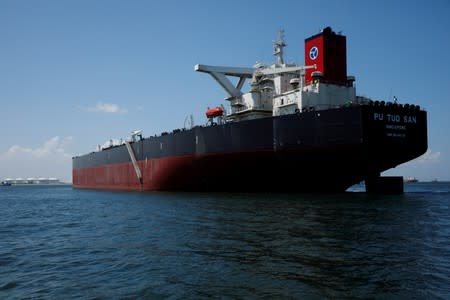
Oil tanker

https://oilprice.com/Energy/Crude-Oil/The-US-Oil-Export-Boom-Is-Only-Just-Getting-Started.html

U.S. crude oil exports jumped by nearly 1 million bpd in the first half of 2019 from the same period in 2018 to average 2.9 million bpd between January and June this year, the Energy Information Administration (EIA) said on Thursday.

Average U.S. exports of crude oil rose by 966,000 bpd in the first half of 2019, compared to the first half of 2018. In June this year, the U.S. set a monthly average record of 3.2 million bpd of crude oil exports, EIA data showed.
Canada stayed the top foreign destination of U.S. crude oil, with U.S. exports rising by 3 percent year on year in H1 2019.

U.S. exports to Asia and Oceania jumped by 58 percent, with exports to South Korea, India, and Taiwan more than doubling.

A notable exception from the rising trend of U.S. crude sales in Asia was China— U.S. crude oil exports to China averaged 248,000 bpd in the first half of 2019, down by 64 percent from the same period last year, as Chinese buyers have been reluctant to buy U.S. crude oil amid the U.S.-China trade war, fearing that tariffs may come any moment, disrupting their plans and making the imported oil more expensive.

U.S. crude oil exports to Western Europe surged by 66 percent to average 824,000 bpd in the first half of 2019, EIA data showed.
Despite soaring crude oil exports, the United States is still one of the world’s biggest crude oil importers, EIA noted. U.S. net crude oil imports—that is imports less exports—averaged 4.2 million bpd in the first half this year, down by 6.1 million bpd for the first half of 2018, thanks to rising U.S. domestic crude oil production. Related: Is Libya’s Oil Output Set For A Steep Drop?

The United States briefly overtook Saudi Arabia as the world’s number one gross oil exporter at one point in June this year, the International Energy Agency (IEA) said last month.  

“A reminder to the producers that competition for market share is getting tougher comes from preliminary data showing that in June the US momentarily overtook Saudi Arabia and Russia as the world’s number one gross oil exporter,” the IEA said.

Although U.S. shale growth has hit a wall in recent months, production from the United States continues to grow year on year, adding to the current surplus on the market.

Even at a lower production growth pace, U.S. oil exports are expected to increase in the near future, because of reduced takeaway constraints from the Permian to the U.S. Gulf Coast, EIA said in its Short-Term Energy Outlook (STEO) for September. The Cactus II crude oil pipeline added an estimated 670,000 bpd capacity and the EPIC Midstream contributed another 400,000 bpd to takeaway capacity out of the Permian.  

By Tsvetana Paraskova for Oilprice.com

Wednesday, October 2, 2019

Oil shipping rates from U.S. to Asia hit three-year high, quieting November trade - sources

FILE PHOTO: A view a VLCC supertanker in the waters off Jurong Island in Singapore


By Collin Eaton and Devika Krishna Kumar

HOUSTON/NEW YORK (Reuters) - Freight rates for U.S. crude tankers bound for Asia were bid up to a more than three-year peak this week as U.S. sanctions on a Chinese transport giant cut vessel availability, traders and shipbrokers said. 

The United States last week imposed sanctions on two units of China's COSCO for alleged involvement in ferrying crude out of Iran. That action prompted U.S. Gulf Coast exporters to hold back chartering COSCO-linked vessels, traders and shipbrokers said. 

One of the units - COSCO Shipping Tanker (Dalian) - owns and manages at least 36 tankers for crude and refined products, including 18 very large crude carriers (VLCCs), according to shipping sources and Refinitiv data. 

This week, suggested rates for VLCCs from the U.S. Gulf Coast to China vaulted to $9.8 million, up from $6.2 million in early September, according to ship broker McQuilling Services. VLCCs carry around 2 million barrels each. 

To attract a ship into the Atlantic market, it's going to cost about $10 million for U.S. Gulf Coast shipments bound for China or South Korea, said another U.S. shipbroker who brokers about 20 vessels per month. 

Friday's highest quote was at $9.5 million for charterer Atlantic Trading & Marketing, a unit of Total SA , to book a VLCC from the U.S. Gulf Coast to China, shipbrokers said. The deal did not go through, the brokers said, and Atlantic Trading declined to comment. 

No transactions for supertankers from the U.S. Gulf Coast to Asia have been executed this week, shipbrokers said.

Occidental Petroleum Corp last week replaced a COSCO-operated supertanker, Coswish Lake, following the U.S. sanctions, by chartering smaller vessels from Texas to destinations in Asia, shipbrokers said. 

The Coswish Lake had anchored off Corpus Christi, Texas, since Sept. 23 and departed on Sunday without loading crude, according to Refinitiv Eikon data. 

Occidental did not respond to requests for comment.

The surge in freight costs has narrowed the window to profitably export U.S. crude to Asia and left some U.S. crude exporters reluctant to book vessels at the higher rates. That could limit November loadings and exports unless more vessels become available in coming weeks, traders said. 

"People are nervous about locking freight in at these high levels, which is why the last week has been so quiet," one U.S. crude oil trader said.

Similarly, freight rates for supertankers loading West African crude in October for Asia have also risen more than 20% to nearly 90 Worldscale points. 

The rise in freight rates is driving up crude costs for Asian refiners and threatening to make shipping oil to Asia unviable, traders said. 

"Currently, West African and Latin American crude are too expensive," a source with a North Asian refiner said. Economics of U.S. crude are good, but freight has become an issue, the source said. 

Buyers may turn to more crude from the Asia Pacific and Middle East, which have shorter shipping distances, or spot premiums for long-distance cargoes will have to fall to displace the higher freight costs, a Singapore-based trader said. 

(Reporting by Collin Eaton in Houston and Devika Krishna Kumar in New York; Additional reporting by Florence Tan in Singapore and Noah Browning in London; Editing by Lisa Shumaker and Tom Hogue)

Tuesday, October 1, 2019

OPEC oil output sinks to lowest since 2011 after Saudi attacks: Reuters survey

Workers are seen at the damaged site of Saudi Aramco oil facility in Abqaiq, Saudi Arabia, September 20. — Reuters


OPEC oil output has fallen to an eight-year low in September after attacks on Saudi oil plants cut production, deepening the impact of a supply pact and U.S. sanctions on Iran and Venezuela, a Reuters survey found.

The 14-member Organization of the Petroleum Exporting Countries (OPEC) has pumped 28.9 million barrels per day (bpd) this month, the survey showed, down 750,000 bpd from August’s revised figure and the lowest monthly total since 2011. 

The Sept. 14 attacks on two Saudi oil plants shut down 5.7 million bpd of production and sent crude prices up 20% to $72 a barrel on Sept. 16. The price has since fallen to $61, near levels before the Saudi attack, pressured by a rapid production restart and concern about slowing demand. 

“Traders are clearly not particularly concerned about risk premiums in oil,” said Craig Erlam, analyst at online broker OANDA. “The focus again seems to be shifting back to the demand dynamics and the risk of further downgrades.” 

OPEC, Russia and other oil producer allies, known as OPEC+, agreed in December to reduce supply by 1.2 million bpd from the start of this year. OPEC’s share of the cut is 800,000 bpd, to be delivered by 11 members, with exemptions for Iran, Libya and Venezuela.

The 11 OPEC members bound by the agreement, which now runs until March 2020, have easily exceeded the pledged cuts. Compliance has been at 218% in September, up from 131% in August, the survey found. 

Two of the three exempt producers also pumped less oil than they did the previous month.
The biggest drop was in Saudi Arabia, which supplied 9.05 million bpd, or 700,0000 bpd less than in August.

RELEASED INVENTORIES

The drop would have been even larger but for state oil company Aramco releasing stored crude from its inventories to limit the decline. Sources in the survey put Saudi production at between 8.5 million bpd and 8.6 million bpd. 

Before this month’s attack, Saudi Arabia was already restraining output by more than called for by the OPEC-led supply deal to support the market. 

Output fell further in Venezuela, which is contending with U.S. sanctions on state oil company PDVSA - aimed at ousting socialist President Nicolas Maduro - as well as a long-term decline in output owing to a lack of investment and maintenance. 

PDVSA this month suspended some crude blending and cut production in response to a build in domestic inventories while the sanctions have proved a deterrent to customers and shippers. 

The survey found a mixed trend among Iraq and Nigeria, both of which have pledged to boost their compliance. 

Iraq trimmed exports from its southern and northern ports, the survey found, but Nigeria boosted supply slightly and continued to produce above its OPEC target by the largest margin. 

Among other countries raising output, Libya pumped more because of a higher contribution from the country’s largest oilfield, El Sharara, after outages that curbed output in August. 

 
There was little change to supply from the United Arab Emirates and a small increase in Kuwait, the survey found. 

September’s output was the lowest by OPEC since 2011, when the Libyan civil war caused a collapse in the country’s oil output, excluding membership changes that have taken place since then, according to Reuters surveys. 

The survey aims to track supply to the market and is based on shipping data provided by external sources, Refinitiv Eikon flows data and information provided by sources at oil companies, OPEC and consulting firms. 

Editing by David Goodman