Friday, April 5, 2019

Markets - recycling slowing down

foto


After a frantic period of activity throughout most of March, sales slowed last week.
Surprisingly, India lost several high profile HKC SoC vessels for green recycling to the only RINA approved yard in Bangladesh, GMS said in its weekly report.
 
However, given that this yard has taken in its quota, India returned to buying last week with a few interesting (market and private) green recycling sales reported.
 
At Gadani, since a majority of the local recycling yards have been empty for some time, we finally witnessed the Pakistani market waking up as appetite seemed to grow last week.
 
Even though the price gap remains significant at present, it may not be long before we see Gadani buyers competing against their Indian counterparts, on standard vessels once again, GMS said.
 
Bangladesh remained the point of reference for most of the market tonnage – with rates almost $20 per ldt above their nearest competitors.
 
However, as has been expected for some time, Bangladesh maybe due for a breather in the month(s) ahead and we may see the focus start to shift back to the Indian and Pakistani markets once again.
 
Meanwhile, the Indian market has been enjoying its share of cheaper priced units this year, with many offshore vessels and rigs heading its way, in addition to those units intended for strictly HKC SoC green recycling.
 
The only competitive RINA approved HKC yard in Bangladesh is now full, having secured two large ldt vessels, including a Vale capesize sold recently.
 
Turkish steel plate prices fell again last week, although prices managed to stay buoyant amidst strong local demand on the back of a dearth of tonnage, that has kept Aliaga buyers surprisingly aggressive in recent weeks.
 
With the first quarter of 2019 now concluded and charter rates, particularly in the dry sector, still in the doldrums, the supply of tonnage (older Capes in particular) is set to continue, as we head into the second quarter of the year, GMS concluded.
 
Brokers reported the sale of the 1999-built OBOs - ‘SKS Tanaro’ and ‘SKS Tiete’ - to Indian interests for just over $430 per ldt per vessel.

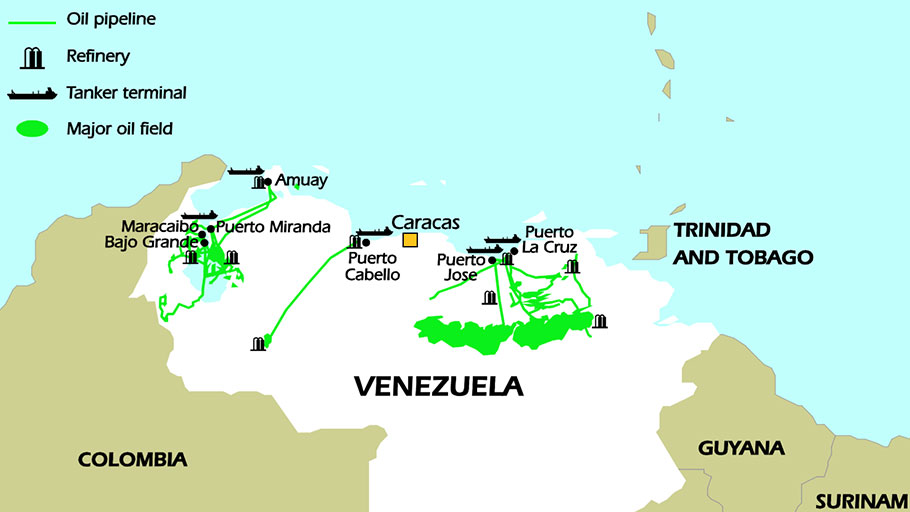
Second attack in Venezuelan waters in a week

Oil History in Venezuela

http://www.tankeroperator.com/ViewNews.aspx?NewsID=10661

Armed robbers boarded a tanker at Anchorage on 28th March, the IMB Piracy Reporting Centre reported.
 
Five persons armed with knives and a pipe wrench boarded the tanker and tied up the aft watch keeper.

They subsequently broke into the ship’s paint store, the IMB said.

Once the alarm was raised and crew mustered, the robbers escaped with some of the  ship’s stores.
This is the second robber attack on a tanker to take place at the same anchorage within seven days.

The first occured on 21st March when three robbers boarded a crude oil tanker.

They threatened a crew member with a knife and stole his radio before escaping.

Thursday, April 4, 2019

Key OPEC oil producer Libya is on the brink of war as general orders forces into Tripoli

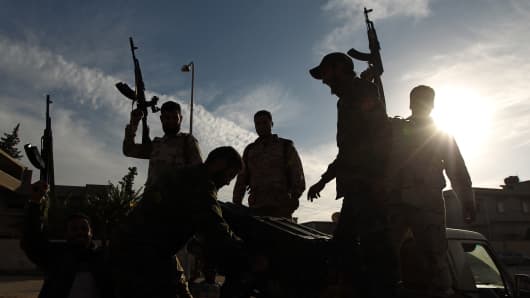
Members of a brigade headed by field commander Salah Bogheib and loyal to Khalifa Haftar -a retired general and former chief of staff for Moamer Kadhafi- hold up their guns as they fight alongside Libyan army troops against Islamist gunmen in the eastern Libyan city of Benghazi.
Abdullah Doma | AFP | Getty Images
  • Libya's eastern military leader orders his forces to march into Tripoli, the seat of a rival United Nations-recognized government.
  • "Those who lay down their weapons are safe, and those who raise the white banner are safe," Haftar says.
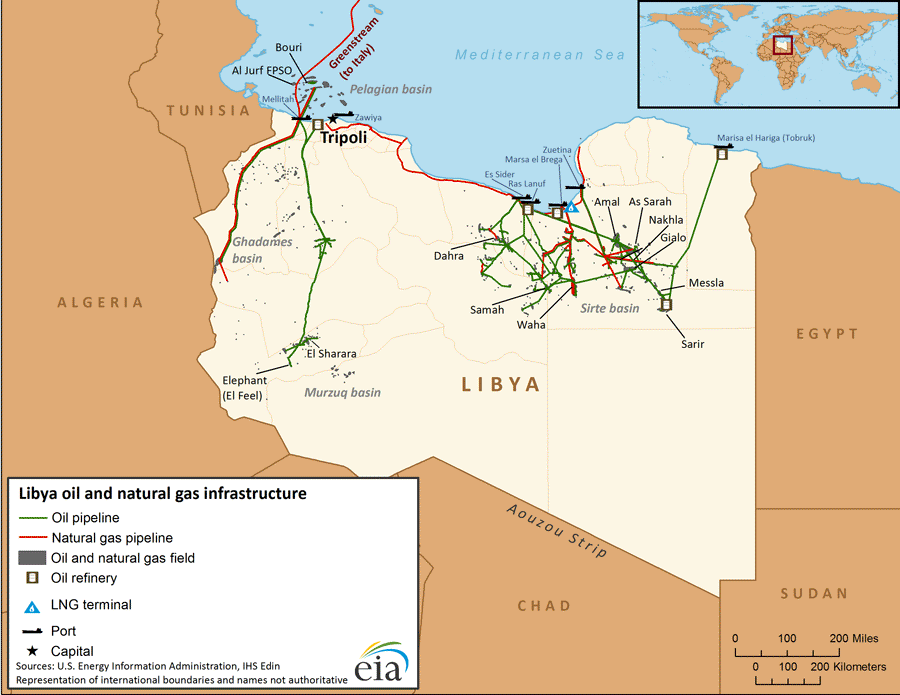
  • General Khalifa Haftar holds the nation's eastern oil terminals and his forces have moved south recently to secure Libya's oil fields.
https://www.cnbc.com/2019/04/04/libyan-forces-move-on-tripoli-threaten-to-tip-oil-producer-into-war.html

Members of a brigade headed by field commander Salah Bogheib and loyal to Khalifa Haftar -a retired general and former chief of staff for Moamer Kadhafi- hold up their guns as they fight alongside Libyan army troops against Islamist gunmen in the eastern Libyan city of Benghazi.
 
Libya's eastern military leader has ordered his forces to march on Tripoli, sparking concerns that open war could soon break out between the main political factions in a key oil-producing nation.

The OPEC member state has been riven by conflict since the fall of dictator Muammar Qaddafi in 2011. For much of that time, General Khalifa Haftar has held the country's east, drawing support from Egypt and the United Arab Emirates and serving as a foil to the United Nations-recognized government in the capital of Tripoli.

The two sides have been engaged in UN-sponsored power-sharing talks. But on Wednesday, Haftar's Libyan National Army unexpectedly advanced towards Tripoli. Skirmishes between the LNA and forces loyal to Prime Minister Fayez al-Serraj have since been reported.

Earlier, it remained unclear whether Haftar intended to bring the west under his grip or merely increase his leverage ahead of a national conference later this month. UN Secretary-General Antonio Guterres, who is in Libya to meet with leaders, called for calm and restraint.

But the order to enter Tripoli came in the early evening in Libya in a voice recording from Haftar posted online, the Associated Press reported. The general told his troops only to raise their weapons "in the face of those who seek injustice and prefer confrontation and fighting," according to AP.

"Those who lay down their weapons are safe, and those who raise the white banner are safe," he said.
This year, Haftar's LNA forces have already sought to bring order to the restive southern oil-producing region. But a campaign to take Tripoli could be even more grueling, says Hamish Kinnear, senior analyst for the Middle East and North Africa at Verisk Maplecroft.

"Our base case is that the LNA will soon find itself bogged down in heavy fighting near Tripoli," Kinnear said in an email briefing. "Unlike its recent advance in the south, the LNA will face more determined resistance from larger and better organised militias in the western region."

The LNA's strategy of bringing the south's small, opportunistic militias under its umbrella through negotiation and bribes would not be effective in the east, Kinnear says. Despite controlling oil terminals, Haftar's forces would also struggle to finance a prolonged conflict because his eastern faction does not hold sway over Libya's National Oil Corporation and the central bank, he added.


The advance of Haftar's LNA answers the "million dollar question" Libya watchers have been asking for years, says Helima Croft, global head of commodity strategy at RBC Capital Markets. Will Haftar finally seek to consolidate control over Libya's northern coast, leaving the nation's eastern oil terminals vulnerable to his rivals?

"Certainly, if he's going to take control of Tripoli by force, the question is what does that mean for these sizable energy assets that are under his control in the east?" Croft said.

The looming conflict comes at a time when global crude supplies are tightening and oil prices are steadily advancing towards $70 a barrel. On the demand side, global consumption is growing faster than many expected. On the supply side, OPEC and its allies led by Russia are cutting output while the U.S. is poised to tighten energy sanctions on Iran and Venezuela.

Analysts and traders keep a close eye on Libya because its oil production has been one of the biggest wild cards in the oil market in recent years. Its output has fluctuated wildly as the nation's southern oil fields have frequently gone offline amid fighting among Libya's patchwork of militias and tribal and ethnic groups. Haftar also briefly lost control of the Ras Lanuf and Sidra oil terminals last year.

If Haftar takes control of the west, it could be negative for oil prices because consolidated leadership could allow more crude to flow to the market from Libya, says Croft.

However, Croft cautions that it would be difficult for any leader to impose order across the fractious country, and a battle in Tripoli could be a prelude to prolonged fighting. Holding Tripoli, the east and the south could stretch the LNA's capacity to the breaking point.

"The problem with the south is it's like the Wild West down there," she said. "There are so many competing militias down there. You have a community that feels so marginalized, that is heavily armed."

"To me, that's a powder keg."

Pence calls on Venezuela to release US workers

Wednesday, April 3, 2019

The Biggest Saudi Oil Field Is Fading Faster Than Anyone Guessed

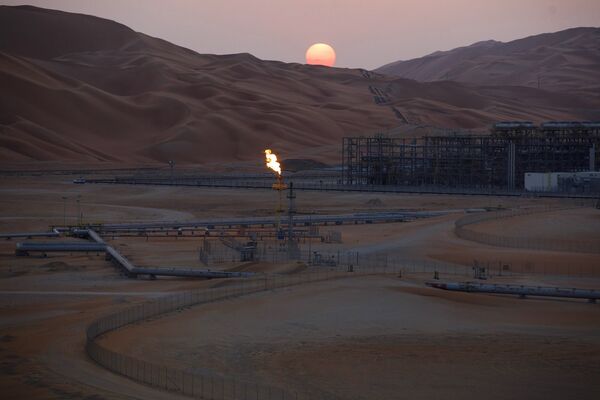
Saudi Aramco's Shaybah Oil Field 
 Flames burn off at an oil processing facility at Saudi Aramco’s Shaybah oil field.Photographer: Simon Dawson/Bloomberg

https://www.bloomberg.com/news/articles/2019-04-02/saudi-aramco-reveals-sharp-output-drop-at-super-giant-oil-field
  • Ghawar can pump 3.8 million barrels a day, less than expected
  • Bond prospectus give details of the kingdom’s largest fields
It was a state secret and the source of a kingdom’s riches. It was so important that U.S. military planners once debated how to seize it by force. For oil traders, it was a source of endless speculation.

Now the market finally knows: Ghawar in Saudi Arabia, the world’s largest conventional oil field, can produce a lot less than almost anyone believed.

When Saudi Aramco on Monday published its first ever profit figures since its nationalization nearly 40 years ago, it also lifted the veil of secrecy around its mega oil fields. The company’s bond prospectus revealed that Ghawar is able to pump a maximum of 3.8 million barrels a day -- well below the more than 5 million that had become conventional wisdom in the market.

“As Saudi’s largest field, a surprisingly low production capacity figure from Ghawar is the stand-out of the report,” said Virendra Chauhan, head of upstream at consultant Energy Aspects Ltd. in Singapore.

The Energy Information Administration, a U.S. government body that provides statistical information and often is used as a benchmark by the oil market, listed Ghawar’s production capacity at 5.8 million barrels a day in 2017. Aramco, in a presentation in Washington in 2004 when it tried to debunk the “peak oil” supply theories of the late U.S. oil banker Matt Simmons, also said the field was pumping more than 5 million barrels a day, and had been doing so since at least the previous decade.

In his book “Twilight in the Desert,” Simmons argued that Saudi Arabia would struggle to boost production due to the imminent depletion of Ghawar, among other factors. “Field-by-field production reports disappeared behind a wall of secrecy over two decades ago,” he wrote in his book in reference to Aramco’s nationalization.

The new details about Ghawar prove one of Simmons’s points but he missed other changes in technology that allowed Saudi Arabia -- and, more importantly, U.S. shale producers -- to boost output significantly, with global oil production yet to peak.

The prospectus offered no information about why Ghawar can produce today a quarter less than 15 years ago -- a significant reduction for any oil field. The report also didn’t say whether capacity would continue to decline at a similar rate in the future.

In response to a request for comment, Aramco referred back to the bond prospectus without elaborating.

Lost Crown

The new maximum production rate for Ghawar means that the Permian in the U.S., which pumped 4.1 million barrels a day last month according to government data, is already the largest oil production basin. The comparison isn’t exact -- the Saudi field is a conventional reservoir, while the Permian is an unconventional shale formation -- yet it shows the shifting balance of power in the market.

Ghawar, which is about 174 miles long -- or about the distance from New York to Baltimore -- is so important for Saudi Arabia because the field has “accounted for more than half of the total cumulative crude oil production in the kingdom,” according to the bond prospectus. The country has been pumping since the discovery of the Dammam No. 7 well in 1938.

On top of Ghawar, which was found in 1948 by an American geologist, Saudi Arabia relies heavily on two other mega-fields: Khurais, which was discovered in 1957, and can pump 1.45 million barrels a day, and Safaniyah, found in 1951 and still today the world’s largest offshore oil field with capacity of 1.3 million barrels a day. In total, Aramco operates 101 oil fields.

The 470-page bond prospectus confirms that Saudi Aramco is able to pump a maximum of 12 million barrels a day -- as Riyadh has said for several years. The kingdom has access to another 500,000 barrels a day of output capacity in the so-called neutral zone shared with Kuwait. That area isn’t producing anything now due a political dispute with its neighbor.

While the prospectus confirmed the overall maximum production capacity, the split among fields is different to what the market had assumed. As a policy, Saudi Arabia keeps about 1 million to 2 million barrels a day of its capacity in reserve, using it only during wars, disruptions elsewhere or unusually strong demand. Saudi Arabia briefly pumped a record of more than 11 million barrels a day in late 2018.

“The company also uses this spare capacity as an alternative supply option in case of unplanned production outages at any field and to maintain its production levels during routine field maintenance,” Aramco said in its prospectus.

Costly Strategy

For Aramco, that’s a significant cost, as it has invested billions of dollars into facilities that aren’t regularly used. However, the company said the ability to tap its spare capacity also allows it to profit handsomely at times of market tightness, providing an extra $35.5 billion in revenue from 2013 to 2018. Last year, Saudi Energy Minister Khalid Al-Falih said maintaining this supply buffer costs about $2 billion a year.

Aramco also disclosed reserves at its top-five fields, revealing that some of them have shorter lifespans than previously thought. Ghawar, for example, has 48.2 billion barrels of oil left, which would last another 34 years at the maximum rate of production. Nonetheless, companies are often able to boost the reserves over time by deploying new techniques or technology.

In total, the kingdom has 226 billion barrels of reserves, enough for another 52 years of production at the maximum capacity of 12 million barrels a day.

The Saudis also told the world that their fields are aging better than expected, with “low depletion rates of 1 percent to 2 percent per year,” slower than the 5 percent decline some analysts suspected.

Yet, it also said that some of its reserves -- about a fifth of the total -- had been drilled so systematically over nearly a century that more than 40 percent of their oil has been already extracted, a considerable figure for an industry that usually struggles to recover more than half the barrels in place underground.

Tuesday, April 2, 2019

Shell’s exit from US refining lobby a first --- and a sign of the times on climate


Royal Dutch Shell announced plans Tuesday to leave a U.S. refining lobby over climate-related policy positions. Although it’s a first for an oil and gas company, it’s also another sign of increasing climate accountability among companies and investors.

Shell released its Industry Associations Climate Review on Tuesday, announcing the company has “developed a new set of principles to govern the way we manage our relationships with industry associations on climate-related policy issues.” 

In reviewing its current association with 19 industry groups, Shell found “some misalignment” with nine of them. But most notably, the company found “material misalignment” with one particular industry group — refining and petrochemical trade association American Fuel & Petrochemical manufacturers (AFPm). Shell says it has “decided not to renew our membership of AFPm in 2020 as a result.”

Shell gives a number of reasons for leaving AFPm, including AFPm’s lack of stated support for the goal of the Paris Agreement. The review simply states, “Shell supports the goal of the Paris Agreement.” Shell said other factors leading to its decision included:
  • AFPm’s lack of support for carbon pricing.
  • AFPm’s opposition of government action to shape policy frameworks for low-carbon technologies.
  • AFPm’s support of the EPA’s proposed rollback of U.S. fuel economy standards.
  • AFPm’s lack of a position on the role of natural gas and the reduction of methane emissions.
Shell’s review includes a message from CEO Ben van Beurden, in which he writes:
“The need for urgent action in response to climate change has become ever more obvious since the signing of the Paris Agreement in 2015. As a result, society’s expectations in this area have changed, and Shell’s views have also evolved.
We must be prepared to openly voice our concerns where we find misalignment with an industry association on climate-related policy. In cases of material misalignment, we should also be prepared to walk away.”

Growing Trend

Though Shell is the first major oil and gas company to chart this path, investors have already started to move away from oil and gas.

Norway’s $1 trillion sovereign wealth fund made the recent decision to divest in some of its oil and gas holdings. Bloomberg notes that while the country’s Government Pension Fund is “keeping investments in the big, integrated oil companies, it said that’s because of their early commitment to renewable energy.”

Companies that “exist purely to find more oil” are not so lucky — that’s where much of Norway’s divestment is aimed.

A group of Dutch investors wasn’t as picky. The group of 22 wealthy individuals recently decided to take all of their money out of the fossil fuel industry, representing a divestment of about 200 million Euros ($224 million).

And Reuters reports that a group of sovereign wealth funds from oil-rich countries in the Middle East is looking to “diversify into renewable energy, pushed by regulators and pledges on climate change.” Those funds aren’t looking to divest in oil and gas — not a surprise — but even making a push into renewable energy at all is a sign of the times.

We’ve also seen pressure put on public utilities from powerful U.S. pension funds that seek a strong push toward decarbonization, and knowledge of those plans.

Companies are clearly taking note of the shift, as well. Corporations set a clean energy purchasing record last year, and hundreds of U.S. companies joined the recent launch of the Renewable Energy Buyers Alliance.

Electrek’s Take

While Royal Dutch Shell’s announcement is another indicator of a growing worldwide shift in climate awareness, even among oil corporations, Shell and its ilk can’t be given the benefit of the doubt. According to a recent report, Shell was one of a number of oil and gas giants that were found to spend a combined $1 billion on climate lobbying that was “overwhelmingly in conflict” with the Paris Agreement.

Will that change? And what will Shell actually do going forward? That’s the important part. The company recently moved 700,000 U.K. homes to renewable energy. We need more of that.

The bottom line matters, and the decreasing price of renewable energy is making its mark. When combined with widespread public support for green energy policies and growing climate change concerns, there are conditions for change. It may not quite be a perfect storm yet, but you can see the clouds.

We need solutions on multiple fronts, and from a variety of angles. If companies move in this direction, while governments enact policies that set concrete, quantifiable goals toward the reduction of carbon emissions and the further adoption of renewable energy and electric vehicles, we could see some real progress.

Monday, April 1, 2019

U.S. Oil Projects Begin to Falter as Producers Curb Spending

Cut Costs without Cutting Everything You Love

The number of pipeline and storage terminal projects proposed to move shale to the U.S. Gulf Coast has dwindled amid steps by oil producers to pare exploration spending. 

Last year, booming West Texas production overwhelmed existing pipelines out of the region, sinking local prices and helping launch nine projects proposing to add 5.4 million barrels per day (bpd) through the first half of 2021.

On Monday, Magellan Midstream Partners LP cut its capital spending outlook by $450 million over two years, saying the proposed Permian Gulf Coast pipeline was unlikely to proceed.

The project, proposed with partners including Delek US Holdings Inc, would have carried up to 1 million barrels per day (bpd) to the Gulf Coast. Its proposed mid-2020 start lagged behind other projects and as shale producers pare drilling outlays. Delek on Monday also shifted its stance on the joint venture, deleting a reference to the venture in an investor presentation.

A winnowing process of sorts has been occurring, with some projects advancing and others falling to the wayside,” said John Zanner, an analyst at consultancy RBN Energy, in a blog post this week.

The same day that Magellan ended its project, Schlumberger NV’s chief executive forecast North American onshore spending will decline more than 10 percent this year. Kinder Morgan Inc also this week exited an $800 million deepwater terminal project off Freeport, Texas, selling its stake to project leader Canada’s Enbridge Inc, which continues to pursue the terminal. Kinder said the project no longer fit its strategic priorities.

There are eight proposed oil-export terminals for the U.S. Gulf Coast. If all eight were built, they would have capacity to export a combined 12.5 million bpd, more oil per day than the United States produced in the week ended March 15, according to the U.S. Energy Information Administration.

The volume of projects is clearly too much for the short term,” said Sandy Fielden, analyst at equity researcher Morningstar Inc. Magellan said despite canceling its Permian to Gulf Coast pipeline, it hopes to develop a smaller pipeline that would carry 350,000 bpd from West Texas to a point outside Corpus Christi in South Texas.

The probability of its success is unknown at this time,” Magellan spokesman Bruce Heine said in an email.