Thursday, January 10, 2019

Increasingly isolated Venezuelan president begins new term


Caracas (AFP) - Venezuelan President Nicolas Maduro began a new term on Thursday with the economy in ruins and his regime more isolated than ever as regional leaders declared his re-election illegitimate and shunned his inauguration.

The 56-year-old socialist leader was sworn in by Supreme Court president Maikel Moreno as an audience of hundreds, including a handful of South American leftist leaders and Venezuela's military top brass, cheered and applauded.

"I swear on behalf of the people of Venezuela... I swear on my life," Maduro said solemnly as he took the oath of office for a second six-year term. 

After donning the presidential sash -- as well as a ceremonial gold chain bearing the key to the sarcophagus containing the remains of Venezuela's revolutionary leader Simon Bolivar -- an ebullient Maduro turned to salute the crowd with a V-sign. 

Maduro was re-elected last May in voting boycotted by the majority of the opposition and dismissed as a fraud by the United States, European Union and Organization of American States.

Even as he was sworn in, the United States said it would not recognize him, and vowed to increase the pressure on his regime.

"The US will not recognize the Maduro dictatorship's illegitimate inauguration," national security advisor John Bolton tweeted.

In a special session in Washington, the Organization of American States similarly backed a resolution declaring Maduro's government illegitimate.

"Venezuela is the center of a world war with US imperialism and its satellite governments," the socialist leader retorted in a rambling speech which lasted around two hours. 

He also demanded "respect" from the EU, accusing the bloc of "old colonialism" and "old racism" after it said Thursday that Maduro "lacked any credibility".

- Regional detractors -

A smiling Maduro arrived at the court building serenaded by a choir singing patriotic songs. He blew kisses at a welcoming party of children waving Venezuelan flags, and saluted supporters looking down from the building's multi-tiered galleries.

With the exception of Mexico, the Lima Group -- made up of 14 mostly Latin American countries -- has urged Maduro to renounce his second term and deliver power to parliament.

Maduro used his speech to call for a summit of Latin American leaders to discuss "with an open agenda all the issues that need to be discussed, face to face!"

Neither the EU nor the Lima Group sent a representative to the inauguration, with Lima Group member Paraguay announcing immediately after the ceremony that it was breaking off diplomatic relations with Venezuela. Peru branded it a "dictatorship."

Leftist presidents Miguel Diaz-Canel of Cuba, Evo Morales of Bolivia, El Salvador's Salvador Sanchez Ceren and Nicaragua's Daniel Ortega were present for the inauguration, as were representatives of Russia, China and Turkey. Mexico sent a low-level diplomat. 

-Former bus driver-

A former bus driver and union leader, Maduro is the handpicked successor of the late leftist firebrand Hugo Chavez.

Maduro has gained control of virtually all of Venezuela's political institutions and enjoys the support of the military. 

But his first term saw an exodus of millions of people escaping economic meltdown. The UN has said more than five million will have fled by the end of this year.

The International Monetary Fund predicts that Venezuela's economy will shrink by five percent next year, with inflation -- which reached 1.35 million percent in 2018 -- hitting a staggering 10 million percent.

He says he feels stronger and more legitimate than ever, but many blame him for Venezuela's economic woes, which have left much of the population living in poverty with shortages of basic foods and medicines.

"This is going to lengthen the agony we have lived through in recent years, everything has seriously deteriorated, basic goods and services are becoming more and more unattainable," Mabel Castillo, 38, told AFP.

Thursday's ceremony took place in the Supreme Court rather than the sidelined, opposition-controlled parliament, which has refused to recognize Maduro.

Instead, in a statement Thursday the parliament called on the army, Maduro's bedrock, to formally disavow the president.

-Opposition jailed or exiled-

While the opposition has tried to dislodge Maduro, it remains fractured, having launched a failed bid in March 2016 for a recall referendum aimed at removing Maduro from office before the end of his term.

Many prominent opposition figures are either in jail or exile and various factions continue to squabble over power while the National Assembly, the one institution they control, has been left impotent after Maduro created the rival Constituent Assembly and filled the Supreme Court with loyalists who annul every decision made by parliament.

Maduro claims US and EU sanctions cost the country $20 billion in 2018. The opposition says the government's control of foreign exchange, in place since 2003, has generated $300 billion in illicit gains.

Tuesday, January 8, 2019

Goldman Sachs slashes 2019 oil price forecast amid oversupply concerns

A worker walks through an oil production facility owned by Parsley Energy in the Permian Basin near Midland, Texas, August 23, 2018.  
 Nick Oxford | Reuters 
A worker walks through an oil production facility owned by Parsley Energy in the Permian Basin near Midland, Texas, August 23, 2018.
  • The investment bank now expects international benchmark Brent crude to average $62.50 a barrel this year, down from a previous forecast of $70.
  • Meanwhile, U.S. West Texas Intermediate (WTI) is expected to average $55.50 in 2019, down from a prior estimate of $64.50, the investment bank said in a research note published Sunday.
https://www.cnbc.com/2019/01/07/oil-prices-goldman-sachs-slashes-2019-forecast-amid-oversupply-fears.html

Goldman Sachs downgraded its oil price forecasts for 2019, citing a surge in global production and surprisingly resilient U.S. shale growth.

The investment bank now expects international benchmark Brent crude to average $62.50 a barrel this year, down from a previous forecast of $70.

Meanwhile, U.S. West Texas Intermediate (WTI) is expected to average $55.50 in 2019, down from a prior estimate of $64.50, the investment bank said in a research note published Sunday.

"We expect that the oil market will balance at a lower marginal cost in 2019 given: higher inventory levels to start the year, the persistent beat in 2018 shale production growth amidst little observed cost inflation, weaker than previously expected demand growth expectations (even at our above consensus forecasts) and increased low-cost production capacity," analysts including Damien Courvalin and Jeffrey Currie said.

'Excessively pessimistic' growth outlook

On Monday, oil prices continued to move away from December's 18-month lows, with OPEC and non-OPEC production cuts providing some support.

Last month, OPEC agreed to take 800,000 barrels per day (bpd) off the market from the start of 2019. Pledges from 10 other producers aligned to the influential oil cartel, including Russia, brought total output cuts to 1.2 million bpd.

The aim of the energy alliance's production cut is to rein in global oversupply, fueled mostly by the U.S., where production reportedly grew by almost 20 percent to nearly 12 million bpd by the end of 2018. That would make the U.S. the world's biggest oil producer — ahead of OPEC kingpin Saudi Arabia and non-OPEC heavyweight Russia.

Brent crude traded at around $58.28 on Monday, up around 2 percent, while WTI stood at around $49.07, more than 2.3 percent higher. Oil has gained more than 10 percent since last Monday, notching five consecutive days of price gains in the process.

Meanwhile, financial markets also offered some support for crude futures at the start of the trading week, with investors monitoring a fresh round of trade talks between the U.S. and China.

An ongoing trade war between Washington and Beijing has exacerbated concerns of an economic downturn over the coming months, which would likely hurt demand for oil.

"The oil market has priced in an excessively pessimistic growth outlook," analysts at Goldman Sachs said, before adding: "This sets the stage for prices to recover as long as global growth does not slowdown below 2.5 percent."

Monday, January 7, 2019

Saudis Plan New Export Cuts in Hopes of Lifting Oil to $80 a Barrel

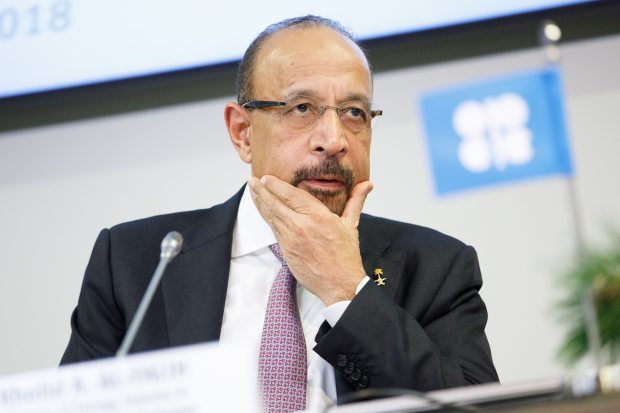
Saudi Arabian energy minister Khalid al-Falih 
 Saudi Arabian energy minister Khalid al-Falih Photo: florian wieser/Shutterstock

Saudi Arabia to reduce crude exports by up to 800,000 barrels a day from November levels

By: Benoit Faucon and Summer Said

Saudi Arabia is planning to cut crude exports to around 7.1 million barrels a day by the end of January in hopes of lifting oil prices above $80 a barrel, according to OPEC officials.

The new strategy comes as the kingdom seeks to cover a large government spending boost. It said last month that it planned to increase its expenditures by 7% in 2019—the equivalent of about $20 billion—as the country struggles to fund ambitious plans to diversify its economy beyond petroleum products.

Crown Prince Mohammed bin Salman, the de facto Saudi ruler, has faced a sharp decrease in oil prices since October amid a supply glut. The brutal killing of journalist Jamal Khashoggi by Saudi operatives in October has also deterred foreign companies from working in the kingdom and investing in its economic development plans.

The new Saudi budget requires oil prices to rise to as much as $95 a barrel, according to an official with the Organization of the Petroleum Exporting Countries. But the kingdom would be satisfied with prices at $80 to $85 a barrel, a range that would limit its need to dip it into its financial reserves, according to people familiar with its thinking.

To cover proposed expenditures, Riyadh is set to reduce crude exports by up to 800,000 barrels a day from November levels.

Saudi Arabia exported about 7.3 million barrels a day of crude last month. That was already down from around 7.9 million barrels a day in November and 7.7 million barrels a day in October.

The U.S. market will see the largest reduction in Saudi oil exports, according to an OPEC official. Overall, the export cuts would go beyond the six-month commitment it made in early December to OPEC.

At an OPEC meeting last month, Saudi Arabia agreed to reduce its production by 2.5% from October levels starting in January. Later it upgraded its target to 3%. But the planned reduction in shipments—the most vital component of its supply because it affects global oil markets—would bring the export cut to 7.8%.

Oil prices fell below $80 a barrel in October after Saudi Arabia turned up the spigots in response to U.S. pressure to replace sanctioned Iranian oil. The increase turned out to be more than the market needed.

OPEC officials said the new effort is unlikely to lift prices to a level the Saudis require in the short term. They said $80-a-barrel oil, however, could become possible in the second half of the year when analysts anticipate an increase in oil demand.

Brent crude, the global benchmark, rose 1.2% to just under $59 a barrel and WTI jumped 3.5% to just under $50 a barrel Monday after The Wall Street Journal reported Saudi Arabia planned to deepen export cuts.

Friday, January 4, 2019

PSCs warn of 2020 sulfur cap compliance

IMO sets 0.5% sulfur cap


The Paris and the Tokyo Memoranda of Understanding (MoU) on Port State Control (PSC) have issued warning letters on the sulfur content of marine fuels ahead of 2020.
 
Issued during inspections, the letters are expected to increase awareness of and encourage timely compliance with the new IMO requirements, the PSC administrations said.

The implementation of the global sulfur cap will have considerable implications on ship operators, the fuel oil supply chain and the industry as a whole.

To facilitate a smooth and consistent implementation of the global 2020 sulfur cap, the Paris and the Tokyo MOUs will carry out a joint information campaign by issuing a letter of warning to ships during inspections this year.

A letter of warning will be issued to ships found not yet ready for compliance with the relevant requirements that will enter into force at the beginning of 2020, the PSCs said.

Thursday, January 3, 2019

Shutdown delays release of Trump's offshore oil, gas plan: sources


Washington — The ongoing partial shutdown of the federal government has indefinitely delayed the Trump administration's release of a proposed plan for offshore oil and natural gas leasing sales from 2019 through 2024, industry sources familiar with the plans said Wednesday.
The plan, which was expected to call for sales in US Atlantic, Arctic and Gulf of Mexico waters, was initially proposed in draft form by the Interior Department nearly a year ago. It initially included 47 proposed lease sales in nearly all federal waters.

Sources said that the release of the formal proposed plan, expected to be unveiled in mid-January, has been pushed back. The length of the delay depends on the length of the shutdown, which entered its 12th day on Wednesday. Nine federal departments, including Interior, are affected by the shutdown.
Sources said the announcement of the plan could be further complicated by the resignation of Interior Secretary Ryan Zinke, who officially left the position Wednesday. David Bernhardt, a deputy secretary at Interior, will be acting secretary. President Donald Trump has yet to name Zinke's replacement.

An offshore oil and gas lease sale planned for March, which is scheduled to offer 78 million acres in the Gulf of Mexico, is unlikely to be affected by the shutdown, sources said.
That March sale is part of the 2017-2022 offshore leasing plan, finalized during the Obama administration. That plan includes 11 lease sales, including 10 in the Gulf and one in Cook Inlet offshore Alaska.

The Bureau of Ocean Energy Management, the agency within Interior developing the offshore plan, has 84 of its 558 employees available during the shutdown to assist with permitting operations, administrative services or emergency response, according to a contingency plan posted on Interior's website. Of these 84 employees, 76 will be available in an "on-call basis" to help with permitting, the agency said.

BOEM "will not process or review new exploration and development plans, but will process and review certain revised plans if it is related to the ongoing permitting work performed by the Bureau of Safety and Environmental Enforcement," the plan said.

Roughly half of BSEE's 804 employees remain on the job during the shutdown to oversee offshore permitting and safety, with their salaries paid through "non-lapsing funds," Interior said in its plan.

"Should an extended shutdown occur, exhausting current funding sources, all of the exempt personnel would be designated as excepted as they are essential for life and safety," Interior said.

Sources said that an Interior rule to revise offshore safety rules developed during the Obama administration in response to the Deepwater Horizon disaster in 2010 is unlikely to be impacted by the shutdown since it is already under review at the White House. That rule, known formally as Revisions to the Blowout Preventer Systems and Well Control Rule, was sent to the White House's Office of Management and Budget on December 13. OMB is not directly affected by the partial shutdown, which began on December 21.

-- Brian Scheid, brian.scheid@spglobal.com
-- Edited by Annie Siebert, newsdesk@spglobal.com