Tuesday, December 4, 2018

Iran's Rouhani threatens to cut off Gulf oil


https://s1.yimg.com/lo/api/res/1.2/opLige8A06NJkHkKv9bg6Q--/YXBwaWQ9eW15O3E9NzU7dz02NDA7c209MTtpbD1wbGFuZQ--/http://media.zenfs.com/en_us/News/afp.com/231f256b943fb0b843b641077cf564124caef66d.jpg 
 
 
Iran's President Hassan Rouhani struck a defiant stance against US sanctions on Tuesday, renewing his threat to cut off international oil sales from the Gulf. 
 "America should know... it is not capable of preventing the export of Iran's oil," Rouhani said at a televised rally in Semnan province.

"If it ever tries to do so... no oil will be exported from the Persian Gulf," he added.

since the 1980s, Iran has said repeatedly it would blockade the Gulf in response to international pressure but has never carried out the threat.

Washington has reimposed sanctions, including an oil embargo, since withdrawing from a landmark 2015 nuclear deal between Tehran and major powers in May.

It has vowed to reduce Iran's oil sales to zero, but has granted temporary waivers to eight countries.

Rouhani last threatened to close the Gulf in July when he warned the US "should not play with the lion's tail."

The president downplayed the economic impact of sanctions, accusing the media of exaggerating the country's problems.

"No hyperinflation, no massive unemployment will threaten us. People should stop saying such things in the papers," he told the crowd.

The latest inflation report from Iran's central bank says food prices rose 56 percent year-on-year in October.

Rouhani acknowledged there were "some problems", but said these would be addressed in the new budget plan to be presented on December 16. 

He said the government would maintain subsidies on essential goods and increase public sector wages and pensions by 20 percent.
 

Monday, December 3, 2018

China-Linked VLCCs Storing Iran Crude; Loading from Kharg Island: Sources


[S&P Global Platts] - In spite of the US sanctions on Iran, some Iranian crude exports are coming into the international market through non-Iranian companies that are offering their VLCCs for transporting as well as storing Tehran's oil, several oil shipping industry sources in Malaysia, Singapore, the UK and China said this week.

Coming soon after National Iranian Tanker Company-owned VLCC Dover transferring its condensate cargo into the CCPC Vanguard, a floating storage vessel in Malaysia's Batu Pahat, another Iranian VLCC, the Hedy, has just completed the transfer of heavy grade crude into the Alter Ego I, owned by Kunlun Holding, in the same region of Malaysia, sources tracking the developments said.

Kunlun, which bought the Alter Ego I earlier this year, has changed the name of the VLCC to Tian Ying Zuo and received Iranian crude, the sources said.

According to one of the sources, another VLCC, the Ataka, whose name is now changed to Tian Ma Zuo, was scheduled to load heavy Iranian crude from Kharg Island.

An NITC official declined to comment. A Kunlun Holding executive also declined to comment.

"I am not sure and I have not heard about this," a second Kunlun Holding official said when asked about Iranian crude being transferred into the Tian Ying Zuo, and the Tian Ma Zuo loading from Kharg Island.

The second Kunlun Holding official said the company did have 49% ownership of the CCPC Vanguard, but that stake had been sold two months ago. He declined to divulge the name of the buyer and claimed the company did not own VLCCs any more.

However, several owners, brokers and charterers told S&P Global Platts that it is possible for a company to control and still claim a lack of direct ownership of ships that are registered in the name of separate entities for corporate reasons, which can include efforts to reduce taxes.

A reply to an email sent to Kunlun Holding had not been received at the time of publishing this article.

Data from the UK-based global maritime consultancy, VesselsValue, confirmed that the names of both the Ataka and the Alter Ego I have been changed and they are now owned by Kunlun Holding.

Another shipping source separately confirmed that the Alter Ego I was purchased recently by a company that is part of the overall Kunlun Holding Group.

Data from cFlow, S&P Global Platts trade flow software, also showed the former Ataka at the Fujairah/Khor Fakken area when its signal was last received on November 19, while the former Alter Ego I was at Batu Pahat.

Ship-to-Ship Transfers
 
A Malaysian company, Petrotech Marine, was involved in the ship-to-ship transfer from the Hedy to the former Alter Ego I, a source tracking the movement of crude cargoes in the region said. A Petrotech Marine official declined to comment. A reply to an email sent to Petrotech had not been received at the time of publishing this article.

Iranian VLCCs occasionally do ship-to-ship transfers of crude and condensate in Malaysian ports such as Linggi and Batu Pahat, but a large volume of floating storage involves cargoes from other countries as well, said a shipping agent in Malaysia.

Since the US granted exemptions to importers from eight countries from the sanctions for six months under specific terms and conditions, there should not be any fuss over such trade with Iran, said a shipping consultant in Singapore.

However, sources tracking the Kunlun deal point out that the cargoes recently transferred in Malaysia left Iranian waters before the exemptions were announced.

Kunlun Holding Company Ltd (Kunlun Holding) markets itself as a one-stop solution provider for the oil and gas industry, and undertakes activities from the upstream to the downstream in the oil and gas value chain, an S&P Global Platts Ocean Intelligence, or OI report, said.

The Chinese company owns 50% of Kunlun Trading Co Ltd, which is involved in oil and LPG trading, 80% of Kunlun Shipping Co Ltd, and 100% of China Concord Petroleum Co Ltd, or CCPC, according to OI. Another entity, China Concord Investment Co Ltd, was wholly-owned by Kunlun Holding until May 2018, when its shares were transferred to the ownership of one of the group's directors, Xu Bin, according to OI.

When a group company has several subsidiaries, ships may be owned by one or many among them and tracing actual control is complicated, sources said.

Chinese companies continue to import Iranian crude and shipments are mostly delivered in ships owned by local entities to avoid sanctions-related complications, a shipping broker in Beijing said.

Cargo transfer in ship-to-ship areas of Malaysia ensures that Iranian ships do not always have to directly call Chinese ports and local buyers there can lift parcels in sizes and at times of their liking, sources said.

Friday, November 30, 2018

Trump just sealed the landmark trade deal with Mexico and Canada, but there's still a long road toward victory

neito trump trudeau nafta usmca
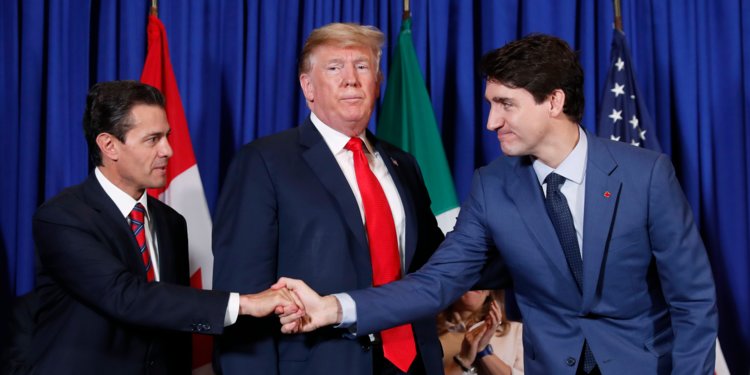
President Donald Trump, Canadian Prime Minister Justin Trudeau, right, and Mexican President Enrique Peña Nieto at the USMCA signing ceremony on Friday.
Pablo Martinez Monsivais/AP Images

  • US President Donald Trump, Canadian Prime Minister Justin Trudeau, and Mexican President Enrique Peña Nieto signed the US-Mexico-Canada Agreement on Friday.
  • The deal is an update to the two-decade-old North American Free Trade Agreement.
  • The USMCA is the culmination of nearly two years of negotiating among the three countries.
  • The deal mostly keeps NAFTA intact but contains key tweaks to the treatment of cars, crops, and labor regulations.
  • The USMCA must still pass through Congress, which is far from a done deal as both Democrats and Republicans have expressed some reservations about it.
The leaders of Mexico, Canada, and the US came together Friday in Buenos Aires, Argentina, to officially sign their updated free-trade agreement, known as the US-Mexico-Canada Agreement. 

US President Donald Trump, Canadian Prime Minister Justin Trudeau, and Mexican President Enrique Peña Nieto officially signed the USMCA as part the G20 summit. 

The signing comes just days before Peña Nieto is set to leave office, handing off the presidency to Andrés Manuel López Obrador. It also caps nearly two years of uncertainty over the update to the North American Free Trade Agreement. 

"We worked hard on this agreement," Trump said. "It's been long and hard. We've taken a lot of barbs and a little abuse and we got there. It's great for all of our countries." 

But while the ceremonial pomp and circumstance is out of the way, the agreement still has a long way to go before it takes full effect. The deal still has to be approved by each country's legislature — and in the US, there are still questions about whether the USMCA can pass Congress.

A long road for some NAFTA tweaks

The USMCA process kicked off just a few days after Trump took office in 2017, when he signed an executive order. Formal negotiations took months to begin, finally starting this year after Trump was able to get key trade negotiators confirmed. 

The negotiations were at times tense, with disagreements over various aspects of the deal and personality clashes among the countries' top negotiators.
trump trudeau
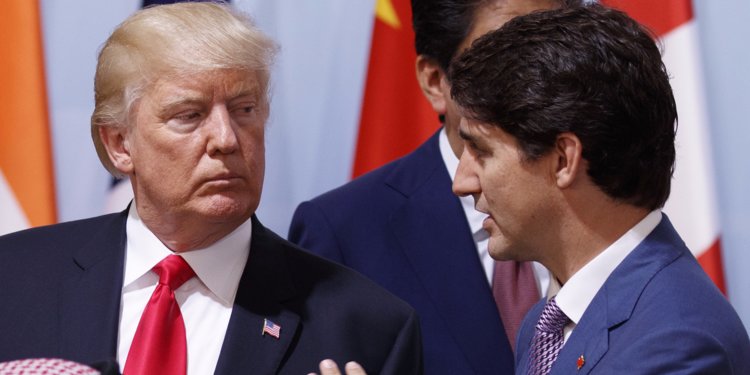
Trump and Trudeau in Hamburg, Germany, at last year’s G20 summit.
Evan Vucci/AP
The pressure of Peña Nieto's departure from office pushed the US and Mexico to agree to a bilateral deal in August to ensure the signing happened before Obrador took office. A deal between the US and Canada followed at the tail end of September, but not before a series of threats from Trump and tense moments when it seemed the trilateral deal might fall through. 


Ultimately, the USMCA retained a substantial amount of NAFTA's framework, with notable tweaks on the treatment of automobiles, agricultural products, and labor protections.

Still a long way to go

In the US, the USMCA must be reviewed and approved by Congress before taking effect. 

Since Trump negotiated the deal under Trade Promotion Authority, the agreement needs only a majority vote in each chamber of Congress and can't be filibustered in the Senate. 

But passage could be complicated by a few factors, notably including Democrats' pending majority in the House. Congress must write legislation to pass any trade deal, and there is wide latitude for the Democrats to try to adjust the USMCA to enforce their goals, such as labor regulations and environmental protections.
Trump Nieto Mexico
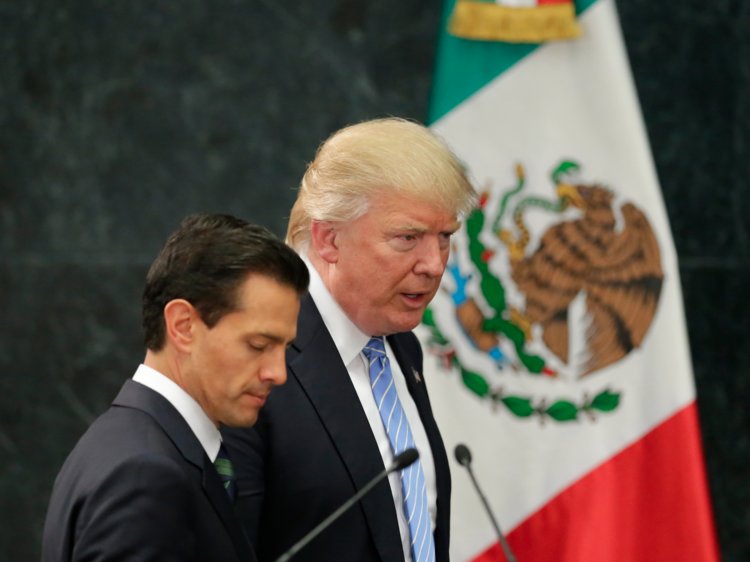
Trump and Peña Nieto at the Los Pinos residence in Mexico City.
Reuters/Henry Romero
"Thankfully, the Congress has a role in crafting 'implementing legislation' to make sure the deal benefits and protects middle-class families and working people and isn't simply a rebranding of the same old policies that hurt our economy and workers for years," Senate Minority Leader Chuck Schumer said. 


Republicans, generally supportive of free trade, have not been particularly enthusiastic about the deal.
The outgoing House Ways and Means Committee chairman, Kevin Brady, released a statement following the signing that hedged his support for the deal, saying there needed to be careful examination of the deal to ensure that US goods still kept access to the North American markets. 

Additionally, a group of 40 Republican House members raised concerns about the new deal's language protecting LGBTQ workers. The group argues that the trade deal will ultimately force the US to adapt workplace protections for transgender people. 

"A trade agreement is no place for the adoption of social policy," the group said in a letter to Trump sent November 18. 

But Trump seemed confident at the ceremony in Argentina and predicted an easy road through Congress. 

"It's been so well reviewed I don't expect to have very much of a problem," he said.

Thursday, November 29, 2018

Blockchain platform goes live for North Sea crude oil trading


Oil majors and trading firms can start finalizing crude oil deals on a live blockchain-based platform for the first time, in a move that could revolutionize the market. 

Commodities trading firms have piloted similar schemes in recent years as blockchain technology has the potential to drastically cut costs in an environment of razor-thin profit margins. 

London-based platform Vakt is the first of these to go live, with shareholder Gunvor Group saying it was rolled out on Wednesday, although no trades took place that day. 

Blockchain, the platform behind cryptocurrency Bitcoin, is viewed by many as a solution to trade and settlement inefficiencies, as well as a way to improve transparency and reduce the risk of fraud. 

Vakt was created in 2017 by a consortium that includes oil majors BP (BP.L) and Royal Dutch Shell (RDSa.AS), Norway’s Equinor, global energy trading firms Mercuria Energy Group and Koch Supply and Trading, as well as Gunvor. 

These firms will initially be the only users of Vakt but access will be opened up in January next year.
Banks ABN Amro, ING and Societe Generale are other shareholders. 

Vakt digitizes and centralizes what was previously a mountain of a paperwork shared between all the parties involved in each deal. It will be linked to another platform launched earlier this year, Geneva-based komgo, which will provide financing including digital letters of credit. 

“Vakt is the logistical arm...Once a deal is executed through our book of records, it gets pushed through Vakt. The next leg is the financing and the link-up with komgo gives access to several banks,” said Eren Zekioglu, Chief Operations and IT Officer at Gunvor Group. 

komgo, which is due to go live before the year end, is backed by a consortium including 10 global banks and most of the Vakt shareholders. 

The financing platform will target the full spectrum of commodities trading, from oil to wheat. 

Use of Vakt will at first be limited to contracts for the five North Sea crude grades that are used to set dated Brent, a benchmark used to price most of the world’s crude oil. 

In early 2019, the platform plans to include U.S. crude pipelines and barges of refined products like gasoline in northern Europe. 

Deutsche Bank raided in money laundering probe
 
“It’s an exciting time,” Andrew Smith, Shell’s head of trading, said. 

“Collaboration with our peers and some of the industry’s key players is the best way to combine market expertise and achieve the scale necessary to launch a digital transaction platform that could transform the way we all do business.” 

Reporting By Julia Payne; Editing by Kirsten Donovan

Tuesday, November 27, 2018

Saudi Arabia pumps record amount of oil as Trump piles on pressure

Trump/MbS
© Reuters/Kevin Lamarque
Crown Prince Mohammed bin Salman • President Donald Trump
 

DHAHRAN, Saudi Arabia (Reuters) - Saudi Arabia raised oil production to an all-time high in November, an industry source said on Monday, as U.S. President Donald Trump piled pressure on the kingdom to refrain from production cuts at an OPEC meeting next week.

The meeting, at which OPEC members will consider how to arrest a decline in oil prices, comes days after leaders of top global oil producers - Russian President Vladimir Putin, Saudi Crown Prince Mohammed bin Salman and Trump - travel to Argentina for a G20 summit this week. 

Saudi Arabia agreed to raise supply steeply in June, in response to calls from consumers, including the United States and India, to help cool oil prices and address a supply shortage after Washington imposed sanctions on Iran. 

But the move backfired on Riyadh after Washington imposed softer than expected sanctions on Tehran. That triggered worries of a supply glut and prices collapsed to below $60 per barrel on Friday from as high as $85 per barrel in October. 

The industry source, who is familiar with the matter, said Saudi crude oil production hit 11.1-11.3 million barrels per day (bpd) in November, although it will not be clear what the exact average November output is until the month is over. 

Those levels are up around 0.5 million bpd - equal to 0.5 percent of global demand - from October and more than 1 million bpd higher than in early 2018, when Riyadh was curtailing production together with other OPEC members. 

Non-OPEC Russia, which teamed up with Saudi Arabia in the first OPEC joint production cuts since 2016, has also raised production steeply in recent months to a post-Soviet high of 11.4 million bpd. 

Analysts at Goldman Sachs, one of the most active banks in commodities, said the G20 meeting could be a catalyst for prices to rebound. 

“We expect an OPEC cut and its announcement to lead to a recovery in (Brent) prices,” the bank said in a note.

KHASHOGGI FACTOR

Saudi oil industry sources have signaled they wanted prices to stay above $70 per barrel and Saudi energy minister Khalid al Falih said this month global oil supply could exceed demand by over 1 million bpd next year, requiring OPEC to take action. 

Falih said earlier this month that state oil giant Saudi Aramco would ship 0.5 million bpd less crude in December than in November as demand from customers was lower. 

Possibly complicating Saudi decisions on oil output is the crisis around the killing of journalist Jamal Khashoggi at Riyadh’s consulate in Istanbul last month. 

Trump stood behind Saudi Crown Prince Mohammed bin Salman despite calls from many U.S. politicians to impose stiff sanctions on Riyadh. Prince Mohammed is the ultimate Saudi oil policy maker and Saudi watchers have said the Prince will try to avoid confrontation with Washington, including on oil prices. 

The United States is not a member of OPEC and is not participating in the output reduction. Trump has repeatedly called on OPEC to refrain from cuts and has raised pressure on the group in the last few days. 

On Sunday, Trump thanked himself for lower oil prices and compared it to a big tax cut for the U.S. economy. 

Shares dip as Trump dampens hopes of trade breakthrough
 
“So great that oil prices are falling (thank you President T),” Trump tweeted, referring to himself. 

Last week, Trump tweeted: “Oil prices are getting lower... Thank you Saudi Arabia but let’s go lower”. 

Reporting by Rania El Gamal; Writing by Dmitry Zhdannikov; Editing by Dale Hudson and Kirsten Donovan