Wednesday, January 17, 2018

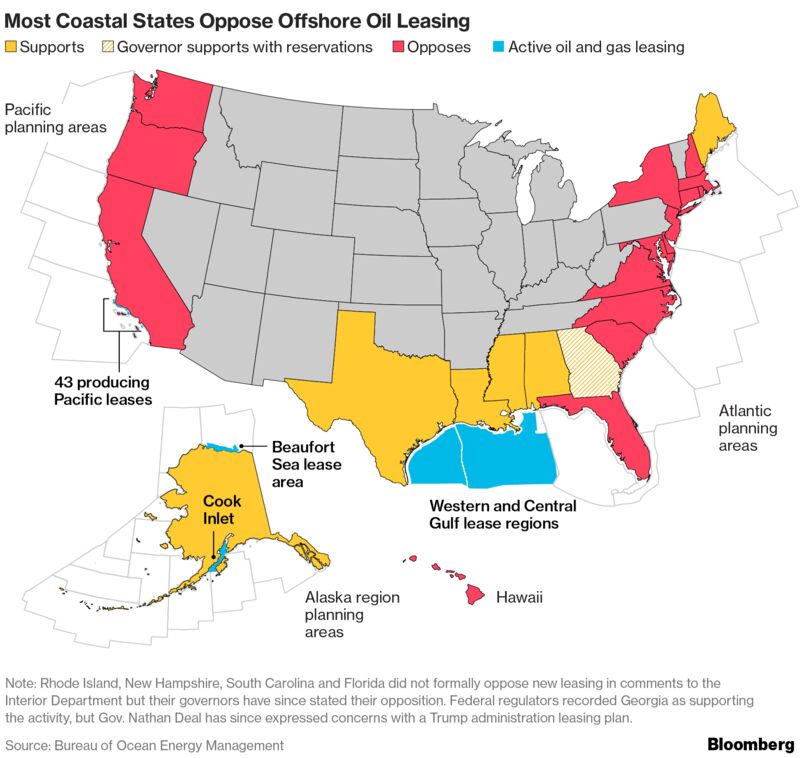
Trump's Offshore Oil Plan Faces Opposition on All Coasts: Map


The Trump administration is hoping to lure investment to the U.S. with a proposal to sell leases in almost every inch of the nation’s outer continental shelf -- including waters hugging the U.S. East Coast that share characteristics with Brazil, Guyana, Ghana and other countries attracting hundreds of millions of dollars in oil companies’ quest for crude. Geologists speculate that the U.S. waters could hold an equally tantalizing amount of crude and natural gas. But oil companies may be unwilling to endure the high production costs and public opposition to find out. A gusher of litigation is more likely than a gusher of oil.

By
Jennifer A Dlouhy
and Dave Merrill

Tuesday, January 16, 2018

Burning oil tanker sinks in the East China Sea

Digging data not ditches

http://www.phillips66partners.com/operations-site/PublishingImages/Pages/default/psxp-operations.jpg 
Phillips 66 Assets

https://fluidhandlingmag.com/display_news/13325/digging_data_not_ditches/

A OneBridge-Phillips 66 joint development project is set to advance digital management and machine learning for pipelines into the cloud.

The US Pipeline and Hazardous Materials Administration reports that since 1997, in Natural Gas pipelines alone incidents have resulted in 322 deaths and damages totalling to over $7 billion. Ageing infrastructure and increased public scrutiny on how energy companies conduct their business means that being able to know what a pipeline looks like and where the problems are is only becoming more important.

In September 2017 OneBridge, a software company out of Alberta, Canada, supplied the Houston-based diversified company, Phillips 66 with something to address this issue: a machine learning and data science system called the cognitive integrity management (CIM) solution. Now both companies are looking to build on the system by moving the software into an online app, dubbing it the ‘integrity management solution’ (IMP). The IMP is now in development, and is aimed at catering to the needs of major pipeline operators.

The previous pipeline management solution was a combination of the CIM and Phillips 66’s pipeline data management system (PT-DMS). Phillips 66’s system was developed to be a comprehensive solution to manage its pipelines, combining functions including assessment team scheduling, analyses of data integrity and anomaly worklist tracking.

The CIM built on this by providing data normalisation and alignment, and applying machine learning technology to identify threats to the pipeline. In a statement, the software company said that they reduced the time it took to analyse the data from ten weeks, to two hours. CIM also allowed all of the data to be assessed whereas in the previous manual process could only process 5% of data collected.
OneBridge has patented this machine learning technique.

The resulting boost in awareness of pipeline condition allows companies to streamline their maintenance programme and allow engineers to spend more time on more substantial tasks like risk analysis and corrosion modelling. OneBidge is also preparing to use Microsoft’s HoloLens to enhance pipeline assessment.

In a press release, OneBridge President Tim Edward said: “This development project with Phillips 66 represents an important milestone for OneBridge… Our vision at the outset was to develop a cloud application that enables pipeline operators to manage their pipeline assets as smart infrastructure.”

CTO Brandon Taylor added: “PT-DMS is one of the most comprehensive and sophisticated pipeline management solutions within the industry today, which will ease migration to the cloud and reduce time-to-market for IMP.”

The company expects IMP to launch market-wide in Q4 of 2018.

Monday, January 15, 2018

DOE Interest 'Extremely Important' to Making Underground NGL Storage a Reality, Researcher Says


http://media-cdn.timesfreepress.com/img/photos/2017/09/08/1504908046_appalachia_t1070_h9937c181b431acbf0e0c4b036e673976badc085c.jpg

tankterminals.com

It could be anywhere from six months to two years before the U.S. Department of Energy decides whether it will guarantee a $1.9 billion loan for an underground storage hub in Appalachia.

Appalachian Development Group is trying to secure the loan guarantee to help build the hub somewhere in the quad-state region — Kentucky, Ohio, Pennsylvania or West Virginia. ADG recently was invited to continue to Part II of DOE’s vetting process for the loan guarantee, which would facilitate construction of secure storage for high-value natural gas liquids.

ADG CEO Steve Hedrick had said the initial cost for a storage hub would be “north of $3 billion,” but West Virginia University Energy Institute Director Brian Anderson had said costs for a full build-out could eventually reach as high as $10 billion. A federal loan guarantee would help erase some of the uncertainty surrounding financing for the hub, the American Chemistry Council said in a 2016 study.

That study suggested keeping the NGLs in the Appalachian region rather than shipping them to the Gulf Coast could spark as much as $36 billion in investments by chemical and plastics companies and create more than 100,000 jobs in the quad-state area.

Hedrick said ADG has already completed its pre-engineering work needed to satisfy Part I of DOE’s application process. The focus now is on developing the framework for requesting information and proposals for the permitting, detailed design, engineering and construction of the hub.

ADG will work closely with the DOE on Part II of the application process while simultaneously working to avail the market with the opportunity to secure an equity position in this development,” said Hedrick, who also is president and CEO of Mid-Atlantic Technology, Research & Innovation Center in Charleston. “We all have to be patient as we move forward.

With the invitation for ADG to now complete Part II of the application process and seek the issuance of the loan guarantees, we are excited to take next steps.

Hedrick said they still haven’t selected a site for the hub, saying their plan is to use the “best available and most technically sound geologic formations, in the most viable geographic locations.

This may include hard rock limestone formations, sandstone formations or salt strata,” he said. “All of these geologic formations exist in Appalachia, as was outlined in the geologic study led by WVU and brought forward from Ohio, Pennsylvania and West Virginia. While plans are in fact made, it is premature to publicly discuss specific prospective sites until further permitting and engineering has been completed.

Anderson, who headed that research team, said the announcement that China Energy Corporation had signed a memorandum of understanding to invest up to $84.7 billion in energy projects in the Mountain State hasn’t changed the timeline, but it does bring a sense of urgency to the project.

China Energy’s interest “serves as a significant indicator that the (storage hub) is a critical component of the infrastructure needed for substantial growth in the petrochemical industry in Appalachia,” he said, pointing out it’s a vertically-integrated company that “believes in investing in the supply chain to their proposed petrochemical investments.”

Anderson said the hub would integrate the NGL storage network with surface infrastructure, including pipelines that provide the inter-connectivity between petrochemical sites, fractionation and storage.

As such, the flexibility in locations provided by the geology of the region identified in the geologic report last summer is extremely valuable to minimize the disturbance caused by the pipeline network,” he said.

“The maximization of the potential growth of the petrochemical industry is less reliant on the location of the storage as it is on the development of available industrial sites and the coordination of the inter-connectivity of these sites through the surface infrastructure associated with the ASTH.

Anderson said DOE’s announcement was an extremely important step to bringing the project to fruition, saying it indicates that the project meets eligibility requirements associated with the Advanced Fossil Loan Program.

The two primary requirements are that the project will deploy advanced and innovative technologies and that the project will reduce emissions of CO2 and other gases as compared to existing technology,” he said. “The (storage hub) will be incorporating cutting edge technologies that serve to protect the environment and minimize the environmental impact.

Friday, January 12, 2018

Number of piracy incidents drop

http://images.all-free-download.com/images/graphiclarge/pirate_flag_312488.jpg

http://www.tankeroperator.com/ViewNews.aspx?NewsID=9312

Around 180 incidents of piracy and armed robbery against ships were reported to the International Chamber of Commerce’s (ICC) International Maritime Bureau (IMB) last year, according to its report.
 
This is the lowest annual number of incidents since 1995, when 188 reports were received.
 
In 2017, 136 vessels were boarded, while there were 22 attempted attacks, 16 vessels fired upon and six vessels hijacked. In 15 separate incidents, 91 seafarers were taken hostage and 75 were kidnapped from their vessels in 13 other incidents. Three crew members were killed last year and six injured.
 
In the previous year, 191 incidents were reported, with 150 vessels boarded and 151 crew members taken hostage.
 
The report also underlined several highlights from the past year.
 
For example, in the Guff of Guinea (GoG), there were 36 reported incidents but no vessels were hijacked and 10 incidents of kidnapping, involving 65 crew members in or around Nigerian waters. Globally, 16 vessels reported being fired upon—including seven in the GoG.
 
“Although the number of attacks is down this year in comparison with last year, the Gulf of Guinea and the waters around Nigeria remain a threat to seafarers. The Nigerian authorities have intervened in a number of incidents helping to prevent incidents from escalating,” said Pottengal Mukundan, IMB director.
 
Nine incidents were recorded off Somalia last year, up from two in 2016. 
 
Following an attack on a containership, six Somali pirates were detained by EU NAVFOR, transferred to the Seychelles and charged with ‘committing an act of piracy’ where they face up to 30 years’ imprisonment if convicted.
 
“This dramatic incident, alongside our 2017 figures, demonstrates that Somali pirates retain the capability and intent to launch attacks against merchant vessels hundreds of miles from their coastline,” Mukundan warned.
 
Elsewhere, Indonesia recorded 43 incidents last year, down from 49 in 2016. The IMB report said that Indonesian Marine Police patrols continued to be effective in the country’s 10 designated safe anchorages.
 
In the Philippines, however, the number of reported incidents more than doubled, from 10 in 2016 to 22 in 2017. According to the report, the majority of these incidents were low-level attacks on anchored vessels, mainly at the ports of Manila and Batangas.
 
Vessels underway off the Southern Philippines were boarded and crew kidnapped in the first quarter of 2017.  However, alerts broadcast by the IMB’s Piracy Reporting Centre (PRC), on behalf of the Philippine authorities, have since helped to avoid further successful attacks.

Thursday, January 11, 2018

Analysis: China's slow strategic petroleum reserves build signals reduced dependency for energy security

http://www.eurad.net/filestore/Ingress_bilder/china.png?size=520x1200&quality=75

https://www.platts.com/latest-news/oil/singapore/analysis-chinas-slow-strategic-petroleum-reserves-27904696

China's pace of strategic petroleum reserves growth slowed over mid-2016 to mid-2017, compared to the previous two years, in a sign that Beijing was comfortable in lowering its dependency on those reserves for energy security.

The country did not bring any new SPR storage site on stream in that period.

But the country's implied crude stocks growth over the same period hit a record high, suggesting more crude barrels went into commercial storage.

Some analysts expected China to need more crude to build its SPR in H2 2017, and also in 2018, because of more SPR storage sites coming online.

 PIRA Energy Group, a unit of S&P Global Platts, expects China to build 100,000 b/d of crude stocks for its SPR in 2018.

The National Bureau of Statistics at the end of December said the country's SPR had reached 37.73 million mt of crude as of mid-2017, or 276.56 million barrels, up 4.48 million mt, or 89,968 b/d from 33.25 million mt recorded in mid-2016.

The SPR stocks build pace was 37% slower than the 143,195 b/d over mid-2015 to mid-2016, and was at only one-third the pace of 274,524 b/d over mid-2014 to mid-2015, S&P Global Platts' calculations based on NBS data showed.

"No new SPR storage site was launched over the period [mid-2016 to mid-2017], preventing the government from bringing in more crude to build the reserves," Wang Zhuwei, senior analyst with S&P Global Platts' China Oil Analytics said.

The nine SPR storage sites, which were in use as of mid-2017, were the same as of mid-2016 -- having a total capacity of 198.83 million barrels, according to NBS announcements. In contrast, the Zhoushan II site in Zhejiang province, with a capacity of 18.87 million barrels, was put into use over mid-2015 to mid-2016.

From mid-2014 to mid-2015, the capacity of SPR storage sites had surged by 76.8 million barrels to 179.93 million barrels due to the launch of four sites -- Dushanzi, Lanzhou, Tianjin and Huangdao II.

Analysts estimate that Beijing would need more crude barrels from the previous period over mid-2016 to mid-2017 to build its SPR, amid expectations that PetroChina's Jinzhou (18.87 million barrels capacity) SPR storage site would have been put to use in H2 2017, while CNOOC's 31.45 million barrels capacity Huizhou site would be functional in 2018.


USING COMMMERCIAL TANKS


Due to limited availability at the SPR storage sites, the government has been gradually injecting crudes meant for its SPR into rented commercial tanks, Wang added.

Assuming the nine SPR storage sites were fully filled as of mid-2017, about 77.73 million barrels would have made its way into commercial storage, compared to nil in mid-2014.

"It is unlikely for owners of the commercial tanks to offer more space to store SPR barrels due to its lower lease rate, competing with commercial crudes," a Beijing-based analyst said. "This could be also have an impact on the SPR stock build rate."

Market sources said the annual lease rate at commercial storage tanks for SPR crude was around $1.2/b lower than that for commercial barrels, while the lease business for commercial crudes was thriving last year.


LOWER DEPENDENCY


A policy paper dated May 2016 by the National Administration of Energy said that all the crude barrels stored in country could be used for state energy security if needed.

That was to say, for energy security purposes, the government is allowed to take barrels not only from SPR tanks, but also any other tank in country. With that policy, Beijing was not in a hurry to build up SPR stocks on the back of the 351.11 million barrels absolute volume increase from mid-2016 to mid-2017 in China's total implied crude stocks, Platts calculations showed.

The volume was more than 10 times the SPR stocks change over mid-2016 to mid-2017, which was only up 32.84 million barrels. Beijing does not release official data on its absolute oil stock levels.

The volume change figure of implied crude stocks during the mid-2016 to mid-2017 period was equivalent to 43 days of the country's net import cover, considering the country's net crude inflow of 8.08 million b/d between mid-2016 and mid-2017. As of mid-2017, China's SPR stocks were at the level to cover 34 days net crude imports.

The State Council in 2007 approved a long-term plan that envisioned the national petroleum reserves base reaching some 500 million barrels by 2020, or the equivalent of 90 days of net import cover.

-- Oceana Zhou, oceana.zhou@spglobal.com

-- Edited by Geetha Narayanasamy, geetha.narayanasamy@spglobal.com

Wednesday, January 10, 2018

Trump administration says no oil drilling off Florida coast

https://image.slidesharecdn.com/offshoreoilgasfloridastateownedwatersbriefingv17-091007075844-phpapp01/95/offshore-oil-gas-florida-state-owned-waters-briefing-v17-6-728.jpg?cb=1254902404

https://www.yahoo.com/finance/news/trump-administration-says-no-oil-drilling-off-florida-234507328--finance.html

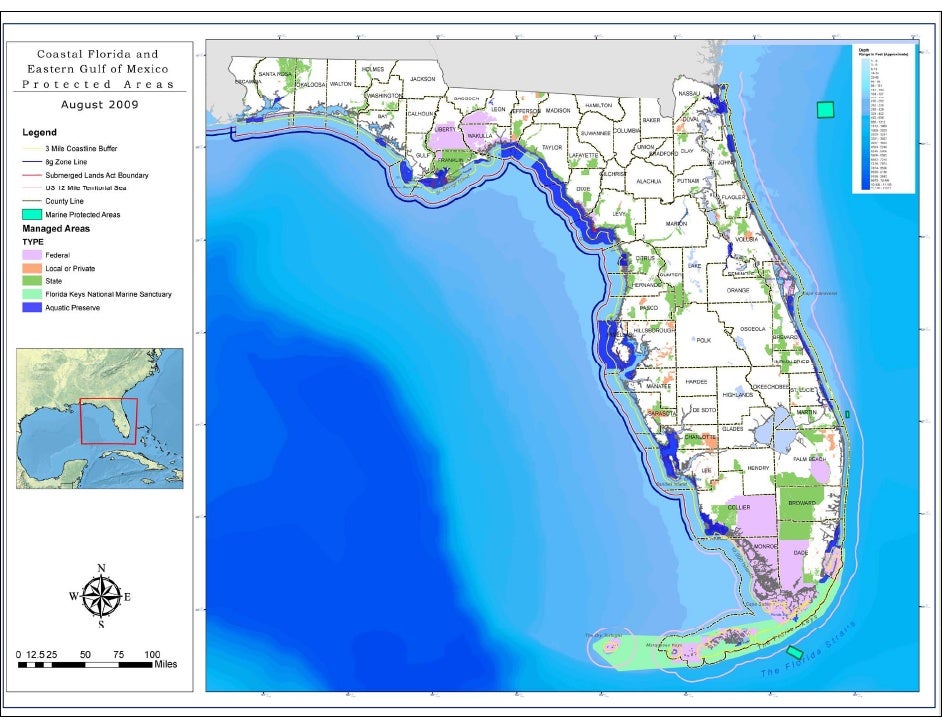
The Trump administration said Tuesday it would not allow oil drilling off the coast of Florida, abruptly reversing course under pressure from Republican Gov. Rick Scott.

Interior Secretary Ryan Zinke said after a brief meeting with Scott at the Tallahassee airport that drilling would be "off the table" when it comes to waters in the eastern Gulf of Mexico and the Atlantic Ocean off Florida.

The change of course — just five days after Zinke announced the offshore drilling plan — highlights the political importance of Florida, where President Donald Trump narrowly won the state's 29 electoral votes in the 2016 election and has encouraged Scott to run for Senate.

The state is also important economically, with a multibillion-dollar tourism business built on sunshine and miles and miles of white sandy beaches.

Zinke said Tuesday that "Florida is obviously unique" and that the decision to remove the state came after meetings and discussion with Scott.

Zinke announced plans last week to greatly expand offshore oil drilling from the Atlantic to the Arctic and Pacific oceans, including several possible drilling operations off Florida, where drilling is now blocked. The plan was immediately met with bipartisan opposition on both the Atlantic and Pacific coasts.

Scott, who is expected to run for Senate later this year, came out against the Trump administration plan when it was first announced, saying his top priority is to ensure that Florida's natural resources are protected.

Other Republican governors also oppose the plan, including Maryland Gov. Larry Hogan, South Carolina Gov. Henry McMaster and Massachusetts Gov. Charles Baker.

"For Floridians we are not drilling off the coast of Florida, which clearly the governor has expressed that's important," Zinke said, adding that he knew when he announced the drilling plan last week that it would spark discussion across the country.

"Our tactic was open everything up, then meet with the governors, meet with the stakeholders so that when we shaped it, it was right," he told reporters at a news conference Tuesday night. "The president made it very clear that local voices count."

When asked what caused the administration to change its position on Florida drilling, Zinke said bluntly, "The governor."

Scott said he was pleased at the administration's change of heart.

"It's a good day for Florida," he said, adding, "I think it's very important to continue our efforts to take care of our environment."

Democratic Sen. Bill Nelson said the meeting with Zinke was "a political stunt orchestrated by the Trump administration to help Rick Scott," who Nelson said has long wanted to drill off Florida's coast.

"I have spent my entire life fighting to keep oil rigs away from our coasts. But now, suddenly, Secretary Zinke announces plans to drill off Florida's coast and (five) days later agrees to 'take Florida off the table'? I don't believe it," Nelson said in a statement. "We shouldn't be playing politics with the future of Florida."

Zinke said last week that the drilling plan called for responsible development that would boost jobs and economic security while providing billions of dollars to fund conservation along U.S. coastlines.

The five-year plan would open 90 percent of the nation's offshore reserves to development by private companies, Zinke said, with 47 leases proposed off the nation's coastlines from 2019 to 2024. Nineteen sales would be off Alaska, 12 in the Gulf of Mexico, nine in the Atlantic and seven in the Pacific, including six off California.

Industry groups praised the announcement, the most expansive offshore drilling proposal in decades. The plan follows Trump's executive order in April encouraging more drilling rights in federal waters, part of the administration's strategy to help the U.S. achieve "energy dominance" in the global market.

A coalition of more than 60 environmental groups denounced the plan, saying it would impose "severe and unacceptable harm" to America's oceans, coastal economies, public health and marine life.