Friday, May 13, 2016

Few tanker orders good for the market

  Oil tanker


New tanker orders have seen a sharp fall, but this slowing trend needs to be sustained for the longer-term health of the market, according to the latest edition of ‘Tanker Forecaster’, published by shipping consultancy Drewry.
 
After numerous orders in recent years, newbuilding activity in the tanker market declined sharply in the first quarter of 2016, as only 34 vessels (2.6 mill dwt) were ordered during the period.

Challenging conditions in capital markets and tight credit availability from banks have subdued new ordering. Although this will not arrest the strong fleet growth and corresponding decline in freight rates over the next two years, as many vessels are scheduled to be delivered in 2016-17, it bodes well for the future, especially if this is a reflection of cautious ordering by owners.

However, if the current decline is just a breather after the spate of orders seen in 2015, when owners increased contracting to avoid stringent Tier III regulations for the vessels ordered from 1st January, 2016, any increase in ordering in the coming months will hurt the longer-term outlook for the tanker market.

Despite the slowdown in ordering in the first quarter of the year, the total orderbook remains high at 63.7 mill dwt, 18.6% of the crude tanker fleet. About 80% of the vessels in the orderbook are scheduled to be delivered in the next two years, and Drewry expected more than 200 crude tankers to be delivered by the end of 2017.

“Newbulding prices declined during the quarter on account of the slowdown in tanker ordering, which coincided with weakness in newbuilding activity in other sectors as well, keeping prices under pressure. If ordering remains weak in the coming quarters, newbuilding prices could soften further,” said Rajesh Verma, Drewry’s lead analyst for tanker shipping. 

“The tanker market is expected to be oversupplied in the next two years, due to hefty deliveries and relatively slow growth in the crude oil trade. If the slowdown in ordering continues further, it will keep fleet growth in check in the later years, which in turn will support tonnage utilisation in the tanker market,”he added.

Turning to the chemical tanker sector, rates are expected to remain firm over the medium term, thanks to rising production capacity in key exporting countries, according to Drewry’s ‘Chemical Forecaster’. 

Since 2015, the US has started to export more and import less liquid chemical products. US methanol capacity surged 77% in 2015 with the addition of around 3.5 mill tonnes per year of new capacity. As a result, US methanol exports are starting to change the pattern of the long-haul chemical shipping trade.

US exports volume to Northeast Asian and Europe rose 12% and 20%, respectively, last year. As a result, Drewry said that eastbound transatlantic freight rates in particular will rise over the medium term.

Since sanctions on Iran have been lifted, many new projects in the Middle East are expected to come on stream from this year. For instance, the country’s 2.3 mill tonnes per year Kaveh Methanol plant is scheduled to start operations in the second half of 2016.

Exports from the region to Northwest Asia and Europe rose 5% and 23%, respectively, in 2015 and Drewry forecast the pace of growth to continue over the next three years, boosting freight rates.

However, on the westbound transpacific route, many large vessels have joined the trade. For instance, in the second half of 2015, 38 more vessels plied this route, of which 15 were of in 30,000-40,000 dwt bracket.

“We expect more large vessels to join the eastbound transpacific trade during 2016 and as a result we expect freight rates to weaken in the short term but to remain stable over the medium term,”said Hu Qing, Drewry’s lead analyst for Chemical Shipping. 

Thursday, May 12, 2016

Pipeline Outage Adds to Nigerian Oil Disruptions

LONDON— Royal Dutch Shell PLC on Wednesday said its exports of Nigerian crude oil had been significantly disrupted, adding to a slew of stoppages that have knocked out around 500,000 barrels a day of oil output in the West African country.

It is the latest hit to oil exports across the world, leading to mounting concerns about the global crude supply. A series of output interruptions from Canada to Libya have illustrated how quickly the global glut of oil could be cleared out after nearly two years of weighing on prices.

Canadian outages caused by rampant wildfires, supply disruptions caused by political disagreements in Libya and the Nigerian stoppages now add up to 3.5 million barrels of offline oil a day, said Seth Kleinman, a Citigroup analyst.

“The growing level of supply disruptions should tighten near-term balances,” Mr. Kleinman wrote in a note.

Global oil production still outpaces demand by more than 1 million barrels on any given day, weighing down crude prices that fell to their lowest levels in 13 years in 2016. Oil-market experts, including Saudi Arabia, believe supply and demand won’t balance more permanently until the end of 2016.

Oil prices were up on Wednesday as new data showed U.S. oil stock inventories had been drawn down.

Nigeria’s oil production looks particularly vulnerable amid an alarming increase in militant attacks on infrastructure in the country’s oil-rich south. Though it remains unclear what caused the latest outage, it follows a series of attacks that knocked out a significant volume of production since the start of the year.

In an emailed statement, Shell’s Nigerian subsidiary said it had declared force majeure as of Tuesday, a move that gives it legal indemnity for being unable to fulfill its export obligations. The company said a leak had closed the Nembe Creek Trunk line which pipes crude through the Niger Delta to Shell’s export terminal. The disruption will affect about 200,000 barrels a day of crude exports this month, according to a trader familiar with Nigeria’s export program.

Shell didn’t comment on the cause of the leak or the size of any associated spill. The Anglo-Dutch oil major sold the pipeline to Nigerian energy company Aiteo last year as part of a series of divestments from the restive Niger Delta, and referred further questions on the incident to the African company. Aiteo didn’t respond to a request for comment.

The incident comes a week after an attack shut down Chevron Corp. ’s Okan platform off the Nigerian coast, knocking out 35,000 barrels a day of the company’s crude output. Another of Shell’s export terminals has been out of action since February, cutting off a further 250,000 barrels a day of the country’s oil output.

Both attacks were claimed by a group calling itself the Niger Delta Avengers, which says it wants locals to have more control over the region’s oil resources and revenues.

Nigeria’s rich oil fields have a long history of militancy and criminality that frequently force oil companies to shut down production. In the 1990s, protests over oil spills forced Shell out of one part of the Niger Delta, and militant attacks last decade frequently shut down big chunks of the country’s output.

But large and sophisticated attacks on Nigeria’s oil fields seemed to die down in the wake of a 2009 government amnesty for militants. That truce may be coming to an end, with severe implications for Nigeria’s oil output.

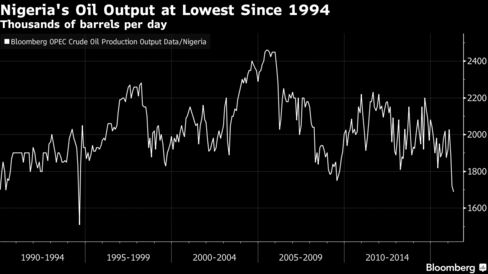
Last month, the International Energy Agency said supply from Nigeria fell to 1.7 million barrels a day in March—its lowest level since the middle of 2009. That was before the latest set of disruptions hit.

The Niger Delta Avengers has threatened fresh attacks and said it would target international oil companies. Earlier this week, Shell evacuated nonessential personnel from one of its oil fields off the coast of Nigeria, though it said operations were continuing.

Write to Sarah Kent at sarah.kent@wsj.com and Miriam Malek at Miriam.Malek@wsj.com

Tuesday, May 10, 2016

Canadian Wildfire Takes 1 Million Barrels Off Market

Wildfires in Canada force thousands to evacuate homes


An estimated one million bpd of crude oil has been taken off the market due to the wildfire that has been raging in Alberta, Canada. According to reports, daily production is down by an estimated 800,000 to 1 million bpd.

While no facilities or pipelines have been damaged due to the wildfire, staff from the facilities have been forced to evacuate. The evacuation has resulted in a lack of manpower to keep facilities up and running.

Paul Newmarch, a spokesman for Suncor Energy Inc., one of the operators in the region, said that prior to the wildfire, the company was producing about 300,000 bpd; now it is producing none, due to it shutting down operations at three facilities north of Fort McMurray.

Monday, May 9, 2016

Why This Saudi Prince Is Known as 'Mr. Everything'

Here’s what the departure of Saudi Arabia’s al-Naimi means for oil prices

Oil prices could rise in the near term on volatility

AFP/Getty Images
Saudi Arabia’s Ali al-Naimi, right, at a May 4 meeting
http://www.marketwatch.com/story/heres-what-the-departure-of-saudis-al-naimi-means-for-oil-prices-2016-05-07

He was known to some as the Alan Greenspan of the oil world.

That is Ali al-Naimi, Saudi Arabia’s powerful oil minister, who was fired from his post on Saturday. He will be replaced by Khalid-al Falih, the chairman of the country’s state oil company, Saudi Aramco.

“This is a historic one. [Al-Naimi] is the guy who for all intents and purposes has been the global oil market for the last 30 years,” said Phil Flynn, senior market analyst at Price Futures Group.
Al-Naimi gained global respect for turning the biggest oil cartel in the world, otherwise known as the Organization of the Petroleum Exporting Countries (OPEC), into a respectable organization, Flynn said in a telephone interview. And just as former Fed Chairman Greenspan would lower or raise interest rates when he thought the market needed it, al-Naimi would add or hold back on oil depending on the energy market’s needs, he added.

The move has reminded some who is ultimately in charge. While al-Falih, the new oil minister, now has one of the most powerful posts in the world, Flynn said there is no doubt that 36-year old Deputy Crown Prince Mohammed bin Salman is running the show in Saudi Arabia. “This guy is the new power broker in that country,” he said.

The dismissal of al-Naimi comes weeks after the Saudi government unveiled a plan to wean the country off its dependence on oil revenue, given the hit the country has taken from lower oil prices.
Read: Meet the 30-year old prince leading the charge to wean Saudis off oil
 
Some saw the writing on the wall for al-Naimi after major oil producers failed to reach a deal to freeze production in Doha, Qatar last month. While al-Naimi had previously said a deal was possible even if Iran didn’t take part, Prince Mohammed by all accounts put his foot down and no deal was done.
AFP/Getty Images
Khalid al-Falih, pictured in January.
Worry about al-Falih? Flynn said al-Naimi survived as many of his buddies were fired under Prince Mohammed’s father, King Salman bin Abdulaziz Al Saud. He said King Salman stopped short of axing al-Naimi because of the respect he commanded both in the country and abroad. It was clear, he said, that al-Naimi didn’t have the power to get a deal done at Doha. 

But what some may not realize is that al-Falih also commands much respect in the oil world, said Jason Bordoff, a professor at Columbia University and founding director of the Center on Global Energy Policy in New York. “Everyone who pays attention to Saudi Arabia and oil prices knows Khalid al-Falih is very widely regarded and respected as a capable leader of Saudi Aramco,” he said in a telephone interview.

Al-Falih has been working closely with the Prince Mohammed and seems to have the “confidence and trust of him,” said Bordoff, who served as White House energy adviser to President Barack Obama from 2009 to 2013. 

“Saudi Aramco is widely regarded as one of the most technically sophisticated oil companies in the world, and I’ve had some personal dealings with Khalid and many other people who have view him as an incredibly impressive and smart and capable person,” he said. 

Before Saturday’s announcement, Al-Falih had been the country’s health minister, tackling a problematic area of the country’s economy, he said.

As for al-Naimi, no one should be that surprised at an 81-year old, who had spoken for years of retiring, is finally leaving that powerful oil post, he said.

Where now for oil prices? If there’s one thing that rattles the oil market, that’s any sort of surprise, and it’s fair to say the market may get the jitters over the news out of Saudi Arabia. 

The Doha meeting created uncertainty for the oil market as well as questions over Saudi Arabia’s futures policies and whether it will rise to the occasion such as in the past, raising and lowering global oil production when it was needed for the rest of the world, said Flynn.

Now uncertainty in the wake of Saturday’s news could give oil prices a push in the near term, he said.
“My assumption is that we’re in a globally oversupplied market. The market might look at it two ways: more uncertainty is bullish overall, though in the short term there is this perception that Saudi Arabia may flood the market with oil,” said Flynn.

Just ahead of the failed Doha meeting, Prince Mohammed told Bloomberg in an interview that his country could boost its daily production number by as much as 20 million barrels if it invested in production capacity and by up to 11.5 million barrels a day right away. But Flynn said that given the country is seeing a strain on its finances because of weak oil prices, it can’t really afford to start ramping up production by more than a small amount.

He said it would be worth watching China closely as for how well the oil market deals with news of a new oil minister in Saudi Arabia. The Shanghai Composite SHCOMP, -2.79%  fell nearly 3% on Friday on worries about looming bond defaults.

China crude imports in March were the second-highest on record, and any signs that the economy or stocks are stressed will lead the oil market to believe the country could curb that demand, said Flynn. But he’s ultimately optimistic about prices, provided the Chinese economy doesn’t fall apart. 

If the Chinese economy does melt down again, he said the market will be talking about a glut, and if things stabilize in China, the conversations will be quite different, more along the balance side.
Bordoff said he doesn’t see much reaction coming from the oil market, though he agrees the changing of the guard could drive prices up in the short term. 

“We’ll be watching the next 24 to 48 hours to see if any other news comes out. I don’t think that this was that unexpected. I don’t think people will view it as any indication that large-scale changes are imminent in Saudi oil policy,” he said.

West Texas Intermediate futures CLM6, -1.79%  finished last week down 2.7%, while Brent crude LCON6, -2.53% the global oil benchmark, slid 4.2%. Oil gained on Friday, though as news of wildfires in an oil-rich region of Canada and disruptions to an offshore oil facility in Nigeria outweighed a disappointing U.S. jobs report.

Friday, May 6, 2016

Nigerian Oil Output Plunges to 20-Year Low as Attacks Mount

  • Strike on Chevron platform cuts output by about 90,000 b/d
  • Crude output fell in April to lowest in more than two decades

Nigeria is suffering a worsening bout of oil disruption that has pushed production to the lowest in 20 years, as attacks against facilities in the energy-rich but impoverished nation increase in number and audacity.

Chevron Corp. shut down about 90,000 barrels a day of output following an attack on a joint-venture offshore platform that serves as a gathering point for production from several fields. Even before that strike on Wednesday night, Nigerian oil production had fallen below 1.7 million barrels a day for the first time since 1994, according to data compiled by Bloomberg.
“This is some very, very sophisticated brazen attack,” said Dolapo Oni, the Lagos-based head of energy research at Ecobank Transnational Inc. “It is a resurgence of militancy. These guys don’t seem to be after money. They just want to frustrate the government.”

The fresh round of attacks come after President Muhammadu Buhari vowed to stamp out corruption and oil theft. They echo a campaign waged by the self-proclaimed Movement for the Emancipation of the Niger Delta between 2006 and 2009, which cost the Nigerian government billions of dollars of lost oil revenue. That violence abated after thousands of fighters accepted an amnesty from late-President Umaru Musa Yar’Adua and disarmed, in exchange for monthly payments from the government in some cases.

Facility Breached

Chevron said it shut down its Okan offshore facility after it was “breached by unknown persons” and had sent “resources to respond to a resulting spill.” The U.S company on Friday said that 35,000 barrels a day of its own net production was affected. Okan, which feeds crude and gas into Escravos, one of the country’s largest export facilities, is jointly owned by Chevron, with a 40 percent stake, and state-owned Nigeria National Petroleum Corp., which has the rest, according to NNPC’s website.
A group calling itself the Niger Delta Avengers said on its website that it was responsible for the attack. The authenticity of the claim could not be verified by Bloomberg News.

The Nigerian government is struggling to contain the economic damage of the slump in energy prices and separate attacks in the north of the country by the Boko Haram Islamist insurgency. The country’s foreign reserves have fallen to less than $27 billion, the lowest since 2005. The International Monetary Fund expects the economy to expand 2.3 percent this year, the weakest growth since 1999.

"Lower oil prices have meant that the poorer oil-producing countries don’t have enough money to pay for social services,” said Ehsan Ul-Haq, senior oil analyst at KBC Process Technology Ltd. “Protests are increasing as a result."

Force Majeure

In February, Royal Dutch Shell Plc declared force majeure -- a legal clause that allows it to stop shipments without breaching contracts -- after an attack on a pipeline feeding the Forcados terminal, which typically exports about 200,000 barrels a day.

The International Energy Agency estimated last month that Nigeria could lose an estimated $1 billion in revenue by May, when it expects repairs on Forcados to be completed. The terminal may not restart until June, Nigerian Oil Minister Emmanuel Kachikwu said April 20.

Major oil companies like Shell, Chevron, Total SA, Eni SpA and ConocoPhillips, which for five decades dominated the Nigerian oil industry, have been selling onshore and shallow water oil fields in the Niger delta to local companies, concentrating their investments in deep-water fields outside the reach of militants.

"If prices remain low, we will see more and more problems including these kind of sabotage attacks," said Ul-Haq.